Government Shutdown Fears Trigger 2% Crypto Dip, But Bitcoin Hyper Remains Unshaken

bitcoinistОпубліковано о 2026-02-10Востаннє оновлено о 2026-02-10

Анотація

Fears of a U.S. government shutdown triggered a 2% decline in the broader cryptocurrency market, causing a liquidity crunch and risk-off sentiment. Major assets like Bitcoin and Ethereum saw sell-offs as investors de-risked amid regulatory delays and economic uncertainty. However, the Fear and Greed Index moved into Neutral, indicating underlying market equilibrium. Despite the downturn, on-chain data reveals capital rotation into infrastructure projects with fundamental utility, particularly Bitcoin Layer 2 solutions. Bitcoin Hyper ($HYPER) emerged as a standout, raising over $31 million in its presale. The project integrates the Solana Virtual Machine (SVM) with Bitcoin’s base layer, enabling high-speed smart contracts and sub-second transactions while leveraging Bitcoin’s security. This addresses Bitcoin’s scalability limitations and attracts developer interest with Rust-based dApp deployment. Whale accumulation has been significant, with several wallets purchasing over $1 million worth of $HYPER during the dip, signaling strong institutional confidence. The token’s staking mechanism and short vesting period aim to reduce post-launch sell pressure. Priced at $0.0136754, $HYPER represents a utility-focused investment narrative decoupled from short-term macro volatility.

Trusted Editorial content, reviewed by leading industry experts and seasoned editors. Ad Disclosure

Quick Facts:

  • ➡️ The crypto market is down roughly 2% due to fears of a U.S. government shutdown, causing a short-term liquidity crunch and risk-off behavior in major assets like BTC and ETH.
  • ➡️ Despite the downturn, smart money is rotating out of correlated assets and into infrastructure plays that offer fundamental utility, specifically in the Layer 2 sector.
  • ➡️ Bitcoin Hyper leverages the Solana Virtual Machine to bring high-speed smart contracts to Bitcoin, securing over $31M in funding by solving the network’s scalability bottleneck.
  • ➡️ Large-scale wallet accumulation during a market dip signals strong institutional conviction in the Bitcoin L2 narrative over short-term macro noise.

Global crypto markets have retracted by roughly 2% in the last 24 hours, largely due to escalating fears of a U.S. government shutdown.

It’s a classic setup: when Capitol Hill gridlock threatens federal operations, risk assets usually face immediate sell-pressure. Crypto is no exception. Bitcoin ($BTC) has slipped below key support, and Ethereum ($ETH) is mirroring the downturn as institutional desks de-risk before the legislative deadline.

Good news, though, the Fear and Greed Index is now pushing into Neutral.
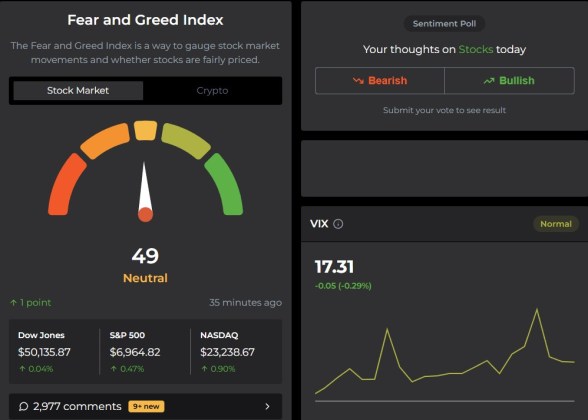
That matters. The correlation between traditional finance (TradFi) macros and crypto price action is sitting at a local peak right now. Investors aren’t necessarily bearish on the tech; they’re terrified of liquidity crunches.

When government operations stall, economic data releases get delayed and regulatory clarity vanishes. The result? A ‘wait and see’ paralysis that drains volume from order books. Just look at the sea of red across the top 100 tokens, it’s a clear flight to safety.

Dig a bit deeper into the on-chain data, though, and you’ll spot a divergence. While the macro-correlated majors stumble, capital isn’t actually leaving the building. Instead, it’s rotating into infrastructure plays that operate independently of immediate regulatory noise.

Smart money is seeking a ‘flight to utility’, assets solving fundamental scalability issues regardless of the macro environment. Bitcoin Hyper ($HYPER) is leading this counter-trend charge, attracting serious inflows while the broader market hesitates.

Learn more about Bitcoin Hyper here.

Bitcoin Hyper Brings High-Speed SVM Tech To The Old Guard

While Bitcoin remains the pristine collateral of the crypto world, its utility as a transactional layer is severely limited by 10-minute block times.

Frankly, the lack of native smart contract capability is a headache developers have dealt with for a decade. That’s the specific bottleneck Bitcoin Hyper addresses (and it explains why the project is decoupling from general market sentiment).

By integrating the Solana Virtual Machine (SVM) as a Layer 2 solution on top of Bitcoin, the protocol offers a combo investors find hard to ignore: Bitcoin’s ironclad security with Solana’s blistering speed.

The interest here is driven by the ‘execution layer’ thesis. Developers have been itching to build high-speed DeFi and gaming platforms secured by Bitcoin for years, but the base layer’s rigid scripting language made it nearly impossible. Bitcoin Hyper fixes this with a modular architecture. It uses Bitcoin L1 for final settlement while employing a real-time SVM L2 for execution.
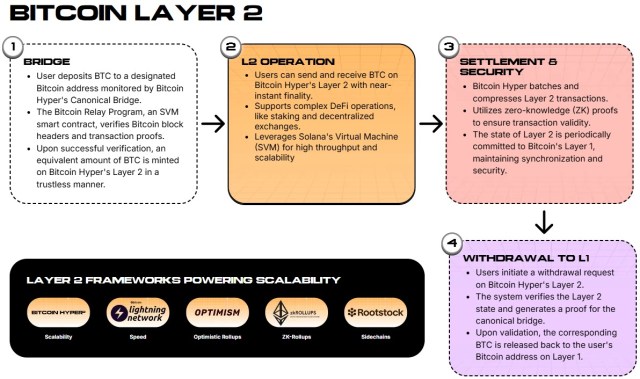
This allows for sub-second finality and negligible transaction costs, effectively solving the ‘Blockchain Trilemma’ for the crypto king.

For devs, it’s a zero-friction environment. They can use Rust, the industry standard for high-performance dApps, to deploy applications tapping into Bitcoin’s trillion-dollar liquidity.

Plus, a Decentralized Canonical Bridge ensures trustless transfers between layers, removing the centralization risks we often see in wrapped token bridges. This utility-first approach acts as a hedge; even when prices dip, the demand for faster, cheaper transactions doesn’t disappear.

Buy $HYPER here.

Whales Accumulate $HYPER As Presale Crosses Major Milestone

This split between the market’s 2% dip and Bitcoin Hyper’s ($HYPER) trajectory shows up clearly in the funding numbers. While retail traders panic-sell majors, sophisticated investors are quietly accumulating positions in this pre-market infrastructure.

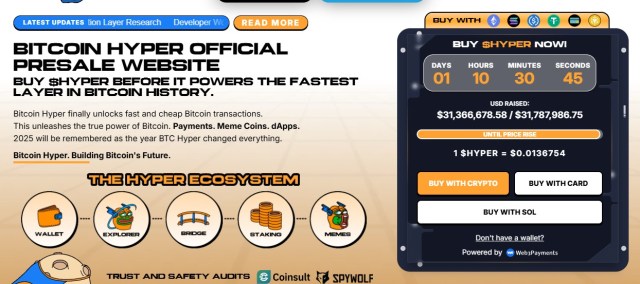
According to the official presale page, Bitcoin Hyper has already raised $31.3M a number that suggests high conviction from early backers despite the external gloom.
Smart money behavior is often the canary in the coal mine. Etherscan records show that 3 whale wallets have accumulated over $1M in recent transactions. The largest buy, a chunky $500K, happened on Jan 15, 2026.

This accumulation during a ‘risk-off’ period highlights a specific appetite for Bitcoin Layer 2 protocols. Whales appear to be positioning themselves for the Token Generation Event (TGE), betting that the SVM-on-Bitcoin narrative will outperform legacy altcoins once market sentiment stabilizes.

With tokens priced at $0.0136754, the entry point looks primed for those hunting asymmetry. The protocol also pushes for long-term holding via a staking model offering immediate APY after TGE, paired with a short 7-day vesting period for presale stakers.

This structure is designed to reduce post-launch sell pressure (a common pitfall). In a market paralyzed by government shutdown fears, $HYPER offers a narrative that doesn’t depend on congressional budgets.

Buy $HYPER here.

The information provided in this article is for educational purposes only and does not constitute financial advice. Cryptocurrency investments are volatile and carry a high risk of loss. Always conduct your own research before investing.

Editorial Process for bitcoinist is centered on delivering thoroughly researched, accurate, and unbiased content. We uphold strict sourcing standards, and each page undergoes diligent review by our team of top technology experts and seasoned editors. This process ensures the integrity, relevance, and value of our content for our readers.

patrubogdan

Follow

Full Profile

Related Posts

Dogecoin Tries to Hold $0.09370 – Is 2026 the Doge Year or Will $MAXI Take Over?

US Debt Spiral Eyes $39T: Why Bitcoin Hyper ($HYPER) Is The Hedge to Watch

Crypto Exchange Backpack Targets Token Launch Soon, as BMIC Fires Up Quantum Defense

Ethereum Foundation Backs SEAL Initiative as LiquidChain L3 Protocol Gains Traction

Vitalik Buterin Outlines Ethereum’s AI Future, While SUBBD Token Targets the Creator Economy

Binance Dominates Trump’s USD1 Supply as Bitcoin Hyper Breaks Records

Пов'язані питання

QWhat is the main reason for the 2% dip in the crypto market mentioned in the article?

AThe main reason for the 2% dip is escalating fears of a U.S. government shutdown, which caused a short-term liquidity crunch and risk-off behavior among investors.

QDespite the market downturn, which sector is attracting smart money investments according to the article?

ASmart money is rotating into infrastructure plays, specifically the Layer 2 sector, which offers fundamental utility and operates independently of immediate regulatory noise.

QWhat specific technology does Bitcoin Hyper use to address Bitcoin's limitations?

ABitcoin Hyper uses the Solana Virtual Machine (SVM) as a Layer 2 solution to bring high-speed smart contracts and sub-second finality to the Bitcoin network.

QHow much funding has Bitcoin Hyper's presale raised, and what does this indicate?

ABitcoin Hyper's presale has raised $31.3 million, indicating strong conviction from early backers and institutional investors despite the broader market downturn.

QWhat on-chain behavior suggests strong institutional interest in Bitcoin Hyper during the market dip?

AOn-chain data shows that large-scale whale wallets have accumulated over $1 million in $HYPER, with the largest single buy being $500,000, signaling strong institutional conviction.

Пов'язані матеріали

As Consensus Accelerates, What Are Young Investors Betting On?

Title: As Consensus Forms Faster, What Are Young Investors Betting On? In the rapid evolution of tech investment, a new generation of young investors is navigating a landscape where AI, robotics, commercial aerospace, and quantum computing are advancing simultaneously. Traditional investment logic based on financial models is giving way to a need for deep technical understanding and the ability to act before industry consensus forms. An analysis of trends from the "WAIC FUTURE TECH" list of young investment leaders reveals key shifts in focus. The first major trend is the movement of AI from the digital screen into the physical world. Investment is shifting from large language models and chatbots towards embodied AI, robotics, AI hardware, and edge computing. While demonstrations generate excitement, the real challenge lies in achieving scalable, reliable, and cost-effective delivery in complex real-world environments like factories and logistics. Success depends not just on algorithms but on the integration of sensors, actuators, and control systems. Second, the competitive focus for large models is moving beyond raw capability toward building an "intelligence flywheel." The goal is to create self-reinforcing systems where user interaction generates data, improving the model, which in turn enhances the user experience and attracts more engagement. Companies that successfully embed AI into workflows to create these closed-loop systems can build lasting value that isn't easily erased by the next model upgrade. Third, facing a potential bottleneck in high-quality human-generated data, investors are looking at new underlying technologies. Reinforcement learning and self-play, as demonstrated by AlphaGo Zero, offer paths for AI to generate its own experience. Scientific foundation models, which aim to build general AI capabilities for fields like life sciences and materials discovery, represent a non-consensus direction that could unlock new frontiers of knowledge and data. Finally, in deep-tech areas like quantum computing, commercial aerospace, and space-based infrastructure, patient capital is essential. These fields have long, uncertain development and validation cycles involving complex engineering, supply chains, and regulations. Investment here requires a long-term view, focusing on foundational team capabilities and the eventual emergence of market demand, even if commercial returns are distant. Collectively, these trends illustrate how young investors are adapting to a new era. They are learning to make earlier, technically-informed judgments, balance hype with real-world viability, and provide the patient capital needed to build the deep-tech foundations of the future.

marsbit12 хв тому

As Consensus Accelerates, What Are Young Investors Betting On?

marsbit12 хв тому

Can Japan Buy Growth with AI? Will the Bond Market Believe It?

Japan's cabinet has introduced the 2026 Basic Policy on Economic and Fiscal Management and Reform, shifting its primary fiscal target. The new framework moves away from the traditional annual primary balance goal and instead prioritizes a stable reduction of the debt-to-GDP ratio. This change is tied to a strategy of increased "responsible proactive fiscal" spending, aiming to boost long-term growth through investments in strategic sectors like AI, semiconductors, energy, and robotics. The government estimates total public and private investment in 62 key technologies could exceed 370 trillion yen by 2040. The market reaction has been mixed and cautious. While equity markets may respond to policy signals, bond markets are focused on fiscal credibility. Concerns center on whether the weakening of the clear primary balance anchor could lead to looser fiscal discipline. If investors doubt that these strategic investments will generate sufficient productivity gains, tax revenue, and nominal growth to outpace rising interest costs, they may demand higher yields on Japanese Government Bonds (JGBs). Recent volatility in the yen and JGB yields, with the 10-year yield briefly reaching 2.9%, reflects this skepticism. The success of this new framework hinges on two factors: whether Japan can achieve a nominal growth rate consistently higher than its long-term interest rates, and whether future budgets demonstrate disciplined control over bond issuance. The government's narrative is that strategic investment is essential to break Japan's cycle of low growth, aging, and labor shortages. However, the bond market will continuously assess the credibility of this plan, pricing the risk that it may represent fiscal expansion rather than a viable growth strategy.

marsbit49 хв тому

Can Japan Buy Growth with AI? Will the Bond Market Believe It?

marsbit49 хв тому

Misjudged A-Shares: Resilience, Expectations, and Confidence

China's A-share market recently faced selling pressure, especially in tech sectors, initially triggered by a global tech sell-off that began in South Korea. However, the article argues this is a case of "mistaken injury" and highlights the market's underlying resilience. This resilience stems from three main pillars: **1) Tech Sector Fundamentals:** Unlike Korea's market dominated by a few memory chip stocks, China's tech sector is diversified across computing, communications, electronics, and semiconductors, supported by dual narratives of global AI supply chains and domestic substitution. Core areas like optical modules and fiber optics continue to show strong earnings growth. **2) "National Team" Support:** State-backed institutions and large corporations have made significant market purchases and announced buybacks, providing liquidity and signaling confidence. This is seen as a stabilizing policy signal, often associated with market bottoms. **3) Broader Market Pillars:** Other major sectors are showing endogenous recovery momentum. Consumer stocks benefit from stabilizing CPI and signs of sector recovery (e.g., liquor price hikes). Cyclical sectors like aluminum have high earnings, potential price increases due to tight supply, and low valuations. The financial sector offers stable dividends and low valuations. The conclusion is that the sell-off was driven by external contagion, not a collapse in fundamentals. With strong policy support and recovering momentum across key sectors, the A-share market possesses the toughness to regain stability.

marsbit1 год тому

Misjudged A-Shares: Resilience, Expectations, and Confidence

marsbit1 год тому

Торгівля

Спот
活动图片





