Original | Odaily Planet Daily(@OdailyChina)
Author | Azuma(@azuma_eth)
At 00:00 Beijing time on August 27, NVIDIA announced its Q2 fiscal 2027 financial results for the quarter ended July 26, 2026. The financial data showed that NVIDIA (NVDA)'s Q2 revenue and profits comprehensively exceeded expectations, with the data center business continuing to accelerate, and guidance for the next quarter reaching a new high.
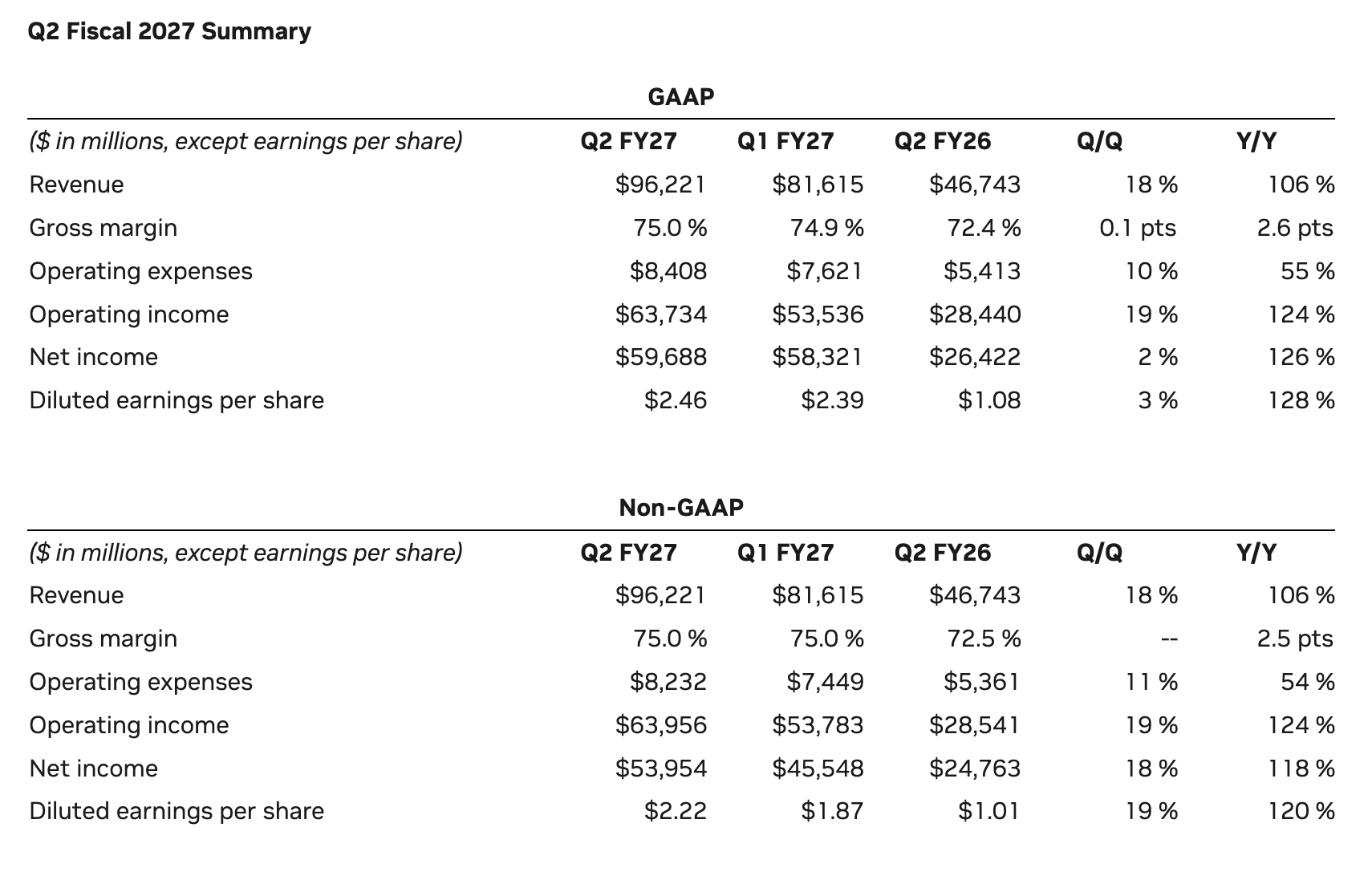
Specifically, NVIDIA's Q2 revenue reached $96.221 billion, a year-over-year increase of 106%, a quarter-over-quarter increase of 18%, exceeding analyst expectations by 4%; Non-GAAP net profit was $53.954 billion, a year-over-year increase of 118%, adjusted EPS was $2.22, exceeding market expectations by nearly 6%; Additionally, NVIDIA provided Q3 revenue guidance of $108 billion, indicating the company is about to formally enter the era of "quarterly revenue exceeding one hundred billion dollars."
The above data is impressive enough, but it's still not the most astonishing number in this earnings report. In the investor conference call after the earnings release, NVIDIA CFO Colette Kress gave a signal that the market hadn't fully anticipated ) —— the company expects its fiscal 2028 revenue to still grow approximately 70% (without including any data center revenue from China), significantly higher than Wall Street's previous expectation of 45%.
More importantly, NVIDIA emphasized that this 70% growth expectation is given even under supply constraints. In other words, the main issue the company now faces seems no longer to be "how long can AI demand last," but rather "how much demand can the supply chain still meet for NVIDIA."
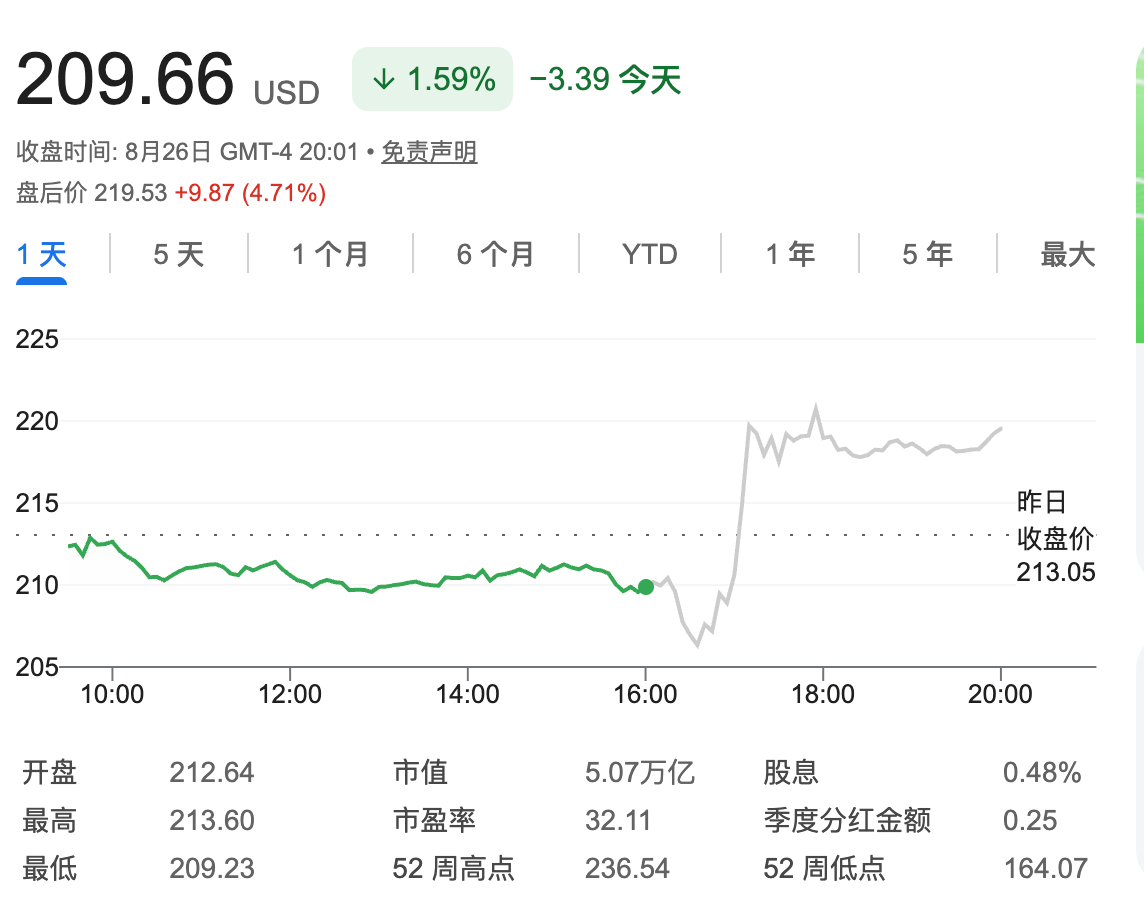
Affected by the earnings report and the conference call, NVIDIA's stock rose over 4% in after-hours trading, temporarily quoted at $219.53.
Revenue Structure: AI Demand Still Led by Hyperscale Customers
Looking closely at the structure of NVIDIA's $96.2 billion revenue, one finds that "the Data Center business remains the absolute core revenue source."
In Q2, NVIDIA's Data Center business revenue reached $89 billion, a year-over-year increase of 117%, a quarter-over-quarter increase of 18%, accounting for over ninety percent of the company's total revenue. The more important point is that the revenue growth rate of the Data Center business is still faster than the company's overall revenue growth —— In Q1, NVIDIA's total revenue grew 85% YoY, while Data Center revenue grew 92% YoY; by Q2, both growth rates further increased to 106% and 117% respectively —— With quarterly revenue approaching $100 billion, NVIDIA's core business not only hasn't shown significant deceleration, but is instead continuing to accelerate.
Looking internally at the Data Center business, Q2 growth was still primarily driven by "Hyperscale Cloud Providers." NVIDIA disclosed that Q2 revenue related to hyperscale customers was approximately $48.7 billion. Meanwhile, major tech companies like Amazon, Microsoft, Google, and Meta continue to expand their AI infrastructure investments. Just before the earnings release, AWS also announced plans to deploy an additional 2 million NVIDIA GPUs.
This means that, at least from the current revenue structure, the primary driver of AI computing demand is still the capital expenditures of large cloud providers. This is also the most critical variable for observing NVIDIA's future growth trajectory and the continuation of the AI cycle. If capital expenditures from companies like Microsoft, Amazon, Google, and Meta continue to grow, NVIDIA's high growth will still have the most direct order support; conversely, if these companies' AI investments begin to enter a digestion period, NVIDIA will also be the first to feel the pressure.
On the other hand, NVIDIA's Edge Computing business recorded $7.2 billion in revenue, a year-over-year increase of 27%, a quarter-over-quarter increase of 13%. While there's a clear gap in scale compared to the Data Center business, as a representative of the company's long-term strategy in "Physical AI," this is also part of NVIDIA's efforts to reduce dependence on a single business.
Vera Rubin: The New Product Cycle Has Already Begun
The most important product-level signal in this earnings report and subsequent conference call lies in the landing of Vera Rubin —— NVIDIA confirmed on the call that Vera Rubin has entered full-scale mass production, and shipments began earlier this month......Every 1 GW of computing power deployed for Vera Rubin corresponds to roughly $40 billion in revenue opportunity, and it is expected to contribute about 20% of Data Center business revenue in Q3.
This announcement marks NVIDIA's gradual transition from the Blackwell cycle to the Rubin cycle.
For a company like NVIDIA with an extremely fast product iteration pace, this handover between old and new platforms is crucial. In the past, a major market concern about the AI chip cycle was whether each generation of products could successfully pass the baton. If there was a significant gap between two generations, revenue growth would naturally decline rapidly. This time, however, Rubin's commercialization pace is evidently fast enough.
As NVIDIA's rack-scale supercomputing platform designed specifically for AI, Vera Rubin integrates seven self-developed chips including the Rubin GPU, Vera CPU, NVLink6, and ConnectX-9, achieving a leap in performance. The product evolution will ultimately be reflected in value capture. The data anchor point "Every 1 GW of computing power ➡️ $40 billion revenue" implies that after Vera Rubin's deployment, as data center scales continue to expand, the value NVIDIA can capture from each newly built AI data center will also continuously increase.
Furthermore, Jensen Huang himself emphasized on the call that the ramp-up speed of Vera Rubin will set a company record......This perhaps is the confidence behind NVIDIA's bold guidance of "fiscal 2028 revenue still expected to grow about 70%."
AI Demand Remains, but Supply Has Become the Bottleneck
Regarding the question of "Has AI demand peaked?", NVIDIA management conveyed a stronger signal than ever during the investor conference call after the earnings release: demand is not only not slowing down, but is instead still accelerating.
Jensen Huang stated plainly on the call that AI has entered a new phase. Over the past year, AI computing demand was primarily driven by a few leading model companies, whereas now, demand is diffusing into more frontier models, open-source models, enterprise AI, Agents, and robotics.
The most significant sign of change among these is the accelerated growth in inference demand. As large models move from training to practical application, AI computing power consumption is no longer just a one-time investment during model training, but will continuously increase with user usage and token generation. Jensen Huang even directly used the phrase "Tokens are becoming productive and profitable" to describe this shift.
Additionally, NVIDIA stated on the call that based on the current capital expenditure plans of major tech companies, there are no clear signs of demand slowing down either. The capital expenditures of the top five global cloud service providers this year are estimated to be close to $800 billion, and could further reach about $1.3 trillion next year.
These observations collectively form the foundational support for NVIDIA's assessment of future "AI demand." However, with demand so strong on that end, supply has now become a constraint limiting NVIDIA's further growth. In other words, the main bottleneck the company currently faces is not insufficient orders, but whether components, capacity, and delivery capabilities can keep pace with the order flow.
NVIDIA management explicitly stated on the call that, at least through fiscal 2028, supply will remain the primary bottleneck restricting the company's growth. Jensen Huang even emphasized that without supply constraints, the company's fiscal 2028 performance outlook would be "much higher."
The "supply" here isn't limited to GPUs themselves. As the scale of AI chips rapidly expands, HBM, advanced packaging, wafers, networking equipment, and data center power could all become important factors constraining the speed of computing power deployment. Especially HBM – NVIDIA directly addressed the significant rise in memory prices on this call and expects Q3 non-GAAP gross margin to be approximately 74%, lower than Q2's 75%. The continuous increase in memory costs is now putting pressure on future profit margins.
To break through this bottleneck, NVIDIA is extending its role towards becoming a "capital organizer" for AI infrastructure. The earnings report disclosed that NVIDIA has established strategic collaborations with Apollo, BlackRock, Blackstone, Brookfield, Goldman Sachs, and KKR, intending to mobilize over $500 billion in third-party capital for AI infrastructure construction in the future. Concurrently, NVIDIA is partnering with SB Energy at the PORTS-Pike Technology Campus in Ohio, pre-securing land, power, and building shell capacity to accommodate its computing resource deployments.
The $100 Billion Threshold and the Next Starting Point
NVIDIA's earnings report, along with management's statements during the conference call, have once again provided a provisional answer to one of the market's most pressing current questions —— Has AI demand peaked, and has the cycle ended?
Judging from the 70% revenue growth guidance for fiscal 2028, the answer NVIDIA is currently giving is still "the cycle is far from over" —— the ceiling is still distant, and the current growth rate isn't even a true reflection of demand, merely the limit of what the supply chain can support. When a company with quarterly revenue approaching $100 billion still dares to give a growth target far exceeding market expectations under supply constraints, it can only mean that the order book NVIDIA sees is even thicker than the number it dared to put in its guidance.
And NVIDIA itself is adapting to the market's development needs by continuously expanding its commercial role. Today's NVIDIA is no longer just a semiconductor company designing GPUs, but is evolving towards the general contractor of "AI factories," providing chips, networking, CPUs, software, deployment solutions, and is even already participating in infrastructure financing and land/power locking.
Of course, high expectations inherently carry high pressure. The gentle downward shift in gross margin guidance and the policy uncertainties in global markets are inevitable frictions in the expansion at a $100 billion scale...... But at least for now, the core logic for which the market is willing to grant NVIDIA a premium has not wavered —— in the AI infrastructure race, NVIDIA remains the player setting the rules, and for now, no serious challengers are in sight.
When Q3 revenue officially crosses the $100 billion threshold, NVIDIA will step into a new magnitude. And the 70% growth guidance for next year hints that this threshold might just be the starting point for the next leg of the journey.