Glassnode On-Chain Data Reveals: True Mean Lost, Bitcoin Enters 'Bear Time'

marsbitОпубліковано о 2026-02-05Востаннє оновлено о 2026-02-05

Анотація

Bitcoin has broken below its "Realized Price" (the average on-chain acquisition cost of active supply), signaling a shift to a bearish market structure. On-chain data reveals initial accumulation between $70K-$80K and a dense cost basis cluster at $66.9K-$70.6K, which may provide short-term support. However, investor capitulation is intensifying, with realized losses exceeding $1.26B daily. Spot trading volume remains weak despite the price decline from $98K to $72K, indicating a lack of buying interest and poor sell-side absorption. Derivatives markets show forced deleveraging, with record long liquidations adding downward pressure. Institutional inflows have weakened significantly, with ETF flows diminishing. Options markets reflect heightened downside risk expectations, as put option demand rises and implied volatility remains elevated. The volatility risk premium turned negative, suggesting increased hedging activity may exacerbate near-term volatility. While the liquidation of leveraged positions removes excess speculation, a sustainable recovery requires renewed spot demand and fundamental improvement. Without substantial buying pressure, any price bounce is likely technical and temporary, with risks skewed to the downside.

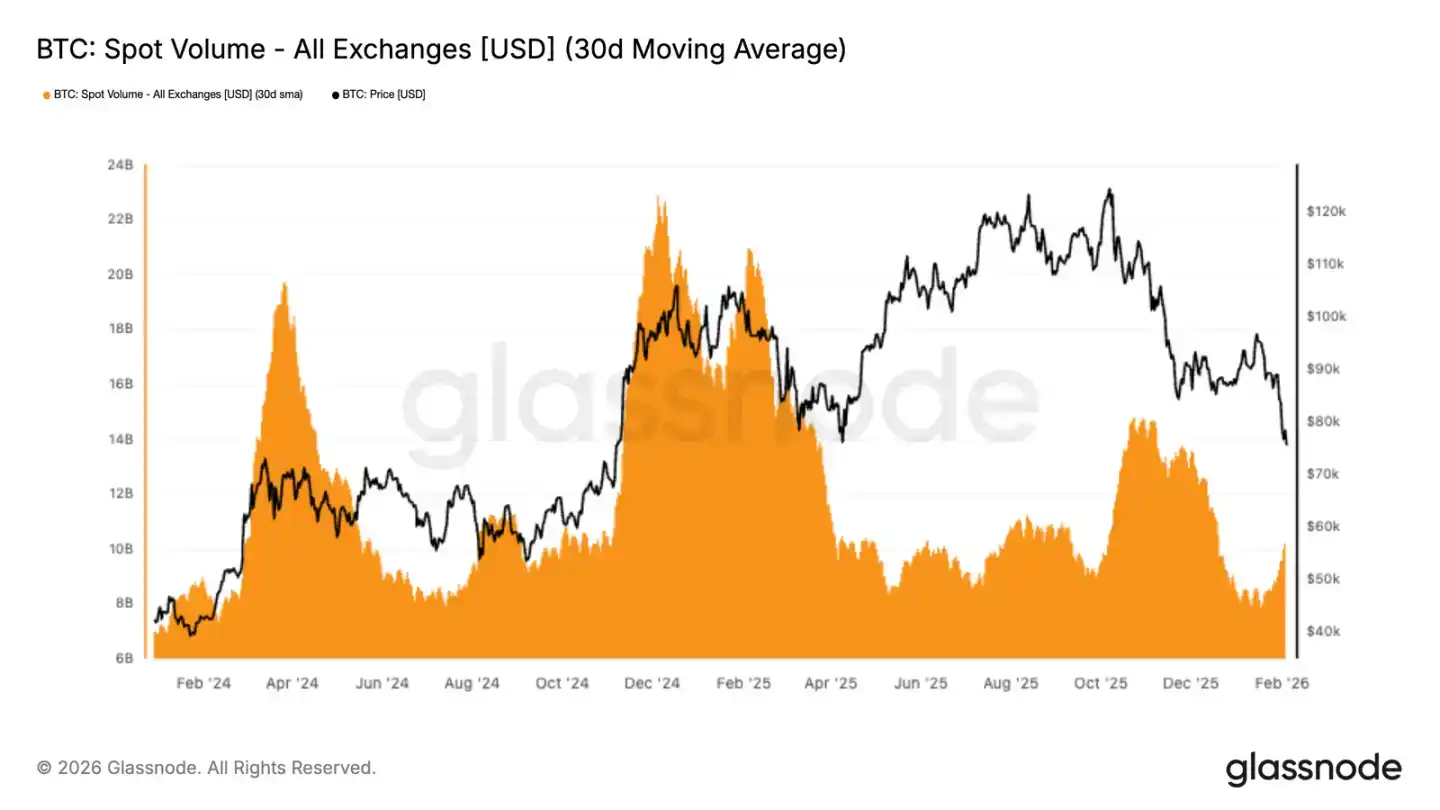
Bitcoin spot trading volume remains sluggish. Despite the price dropping from $98,000 to $72,000, the 30-day average trading volume is still weak. This reflects insufficient market demand and a failure to effectively absorb selling pressure.

Core Views

· Bitcoin has confirmed a breakdown, with the price falling below the true market mean, shifting market sentiment to cautious defense.

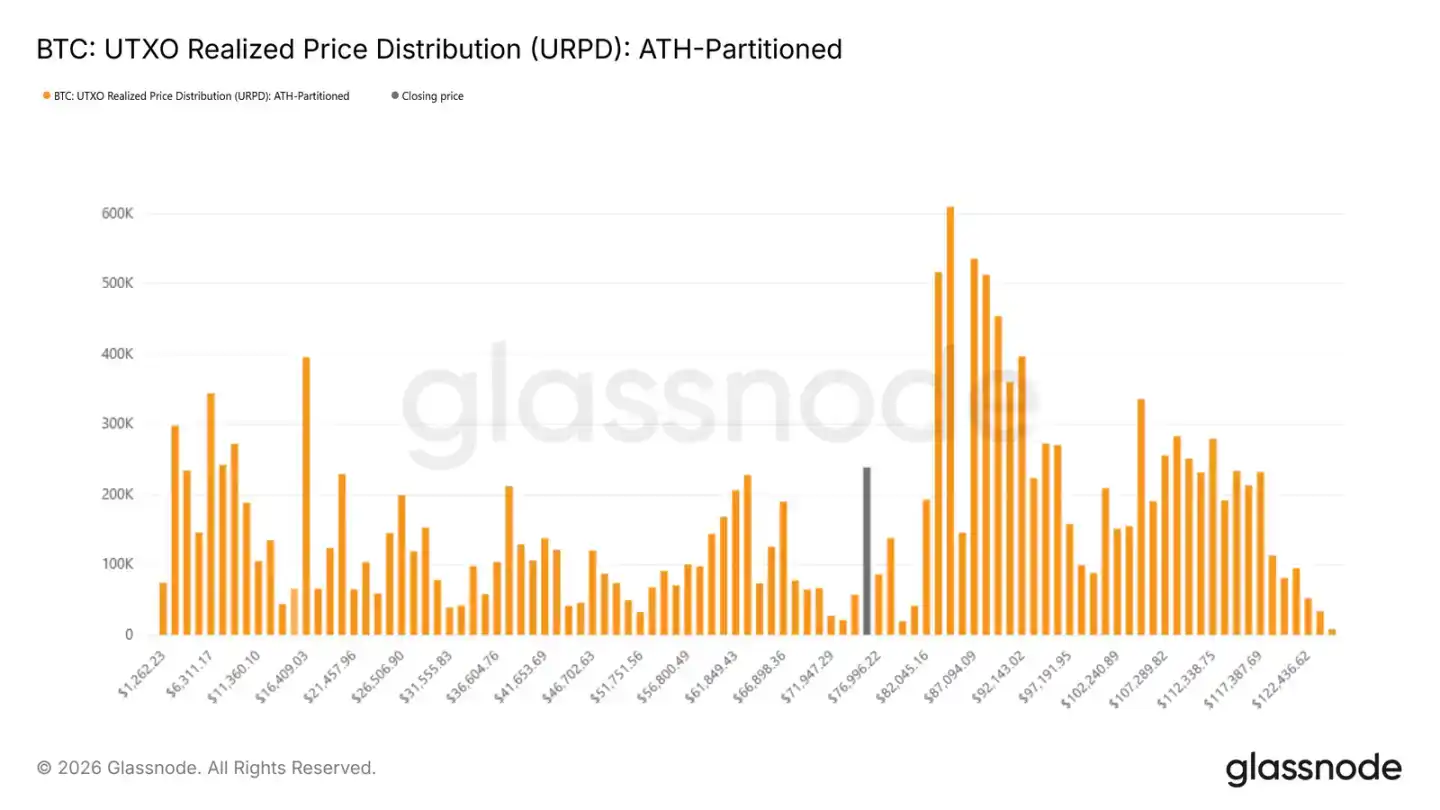
· On-chain data shows initial accumulation signs in the $70,000 to $80,000 range, while a dense cost-basis concentration zone has formed between $66,900 and $70,600, which could act as a short-term buffer against selling pressure.

· Investor loss-selling has intensified. As the price continues to decline, more holders are being forced to liquidate their positions to stop losses.

· Spot trading volume remains persistently weak, further indicating insufficient market absorption and a lack of effective digestion of sell orders.

· The futures market has entered a forced deleveraging phase, with large-scale long liquidations exacerbating market volatility and downward pressure.

· Institutional capital inflows have significantly weakened. Net inflows into ETFs and related funds have shrunk, unable to provide sustained buying support as they did in the previous rally phase.

· The options market continues to reflect high expectations of downside risk. Implied volatility remains elevated, and rising demand for put options indicates strong risk-aversion sentiment.

· With market leverage being cleared and spot demand still weak, prices remain fragile. Any rebound is likely to be a technical correction rather than a trend reversal.

On-Chain Data Observations

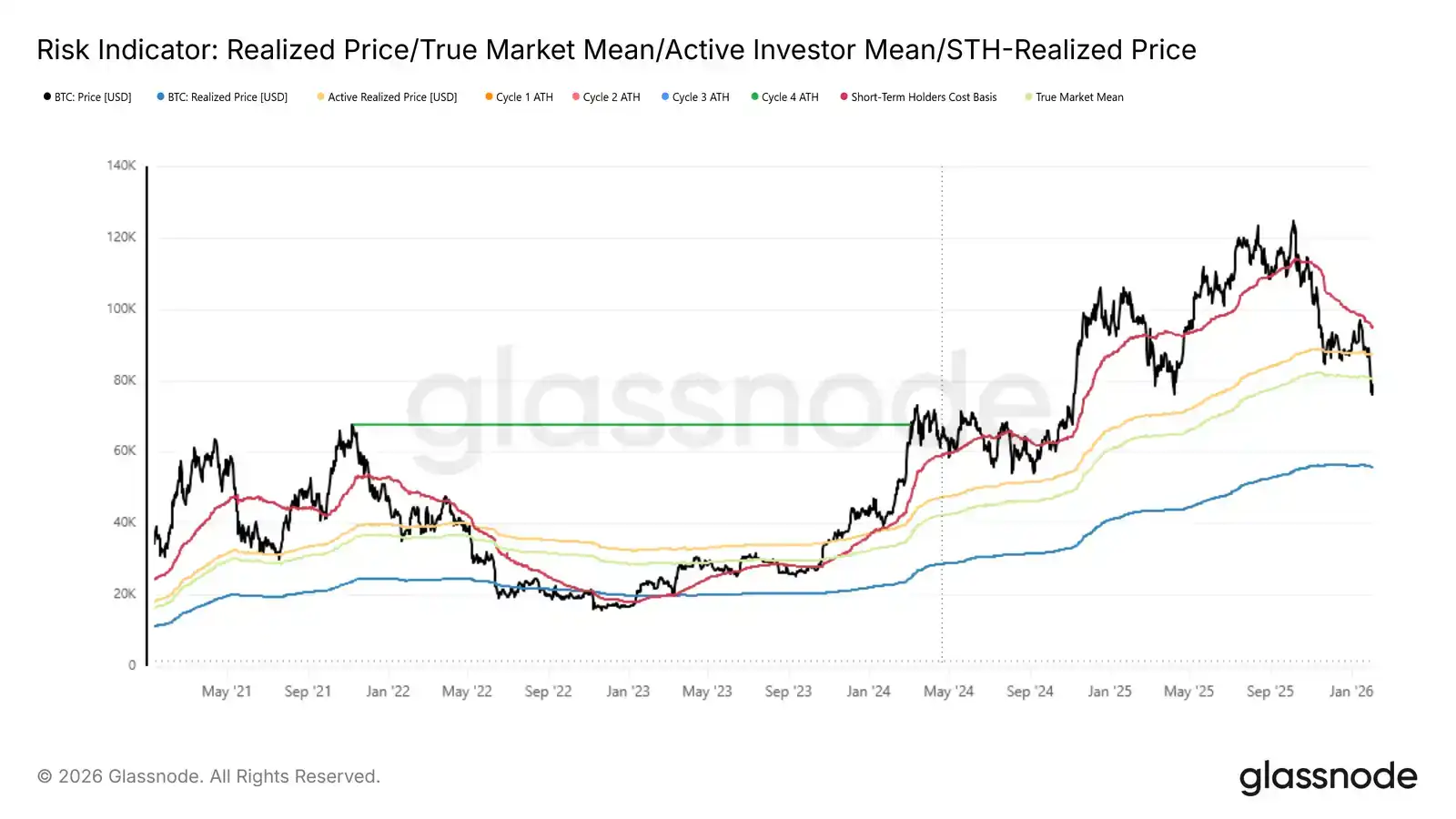
Following last week's analysis, which pointed out the downside risk after the market failed to reclaim the $94,500 short-term holder cost basis, the price has now clearly broken below the true market mean.

Breaking Key Support

The True Market Mean (the average cost basis of active circulating supply, excluding long-dormant tokens) has acted as a key support line during this correction.

The loss of this support confirms the deterioration of market structure since late November. The current setup resembles the phase in early 2022 when the market transitioned from consolidation to a deep correction. Weak demand coupled with persistent selling pressure indicates the market is in a fragile equilibrium.

From a medium-term perspective, the price range is gradually narrowing. Resistance above lies near the True Market Mean around $80,200, while support below is around the Realized Price near $55,800, a level that has historically attracted long-term capital.
Potential Demand Zone Analysis

As the market structure resets, the focus shifts to potential levels for a downside stabilization. The following on-chain metrics help identify zones where a阶段性 bottom might form:

The UTXO Realized Price Distribution shows significant accumulation by new investors in the $70,000 to $80,000 range, indicating a willingness to buy the dip in this zone. Below it, a dense concentration of holdings exists between $66,900 and $70,600. Historically, such cost-basis concentration zones often act as short-term support bands.
Market Stress Indicators

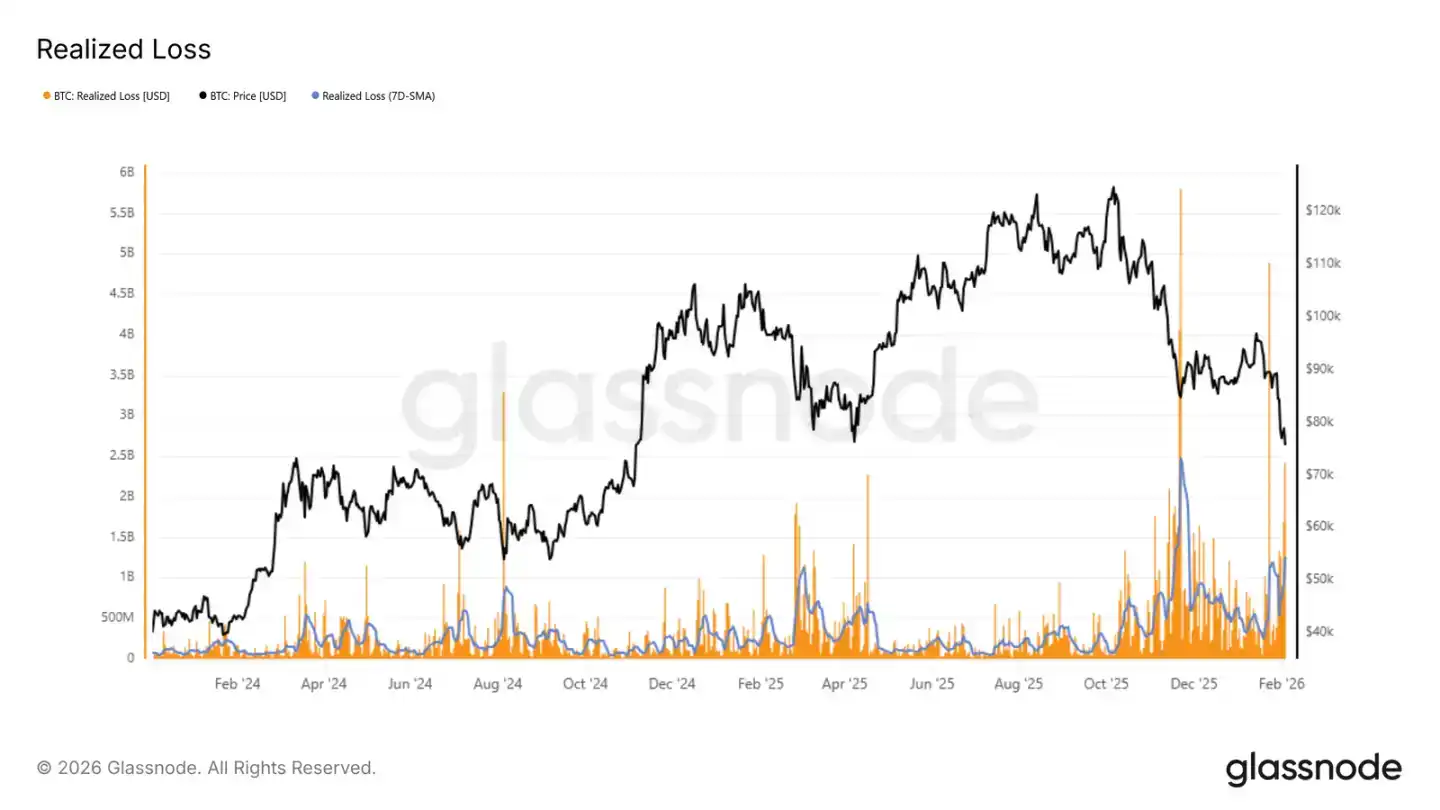
The Realized Loss metric directly reflects the stress level among investors. The current 7-day average Realized Loss has exceeded $1.26 billion daily, showing that panic selling has increased after the market broke below key support.

Historical experience suggests that peaks in Realized Loss often coincide with exhaustion in selling. For example, during the recent bounce from $72,000, daily losses briefly surpassed $2.4 billion. Such extreme values often correspond to short-term inflection points.
Comparison with Historical Cycles

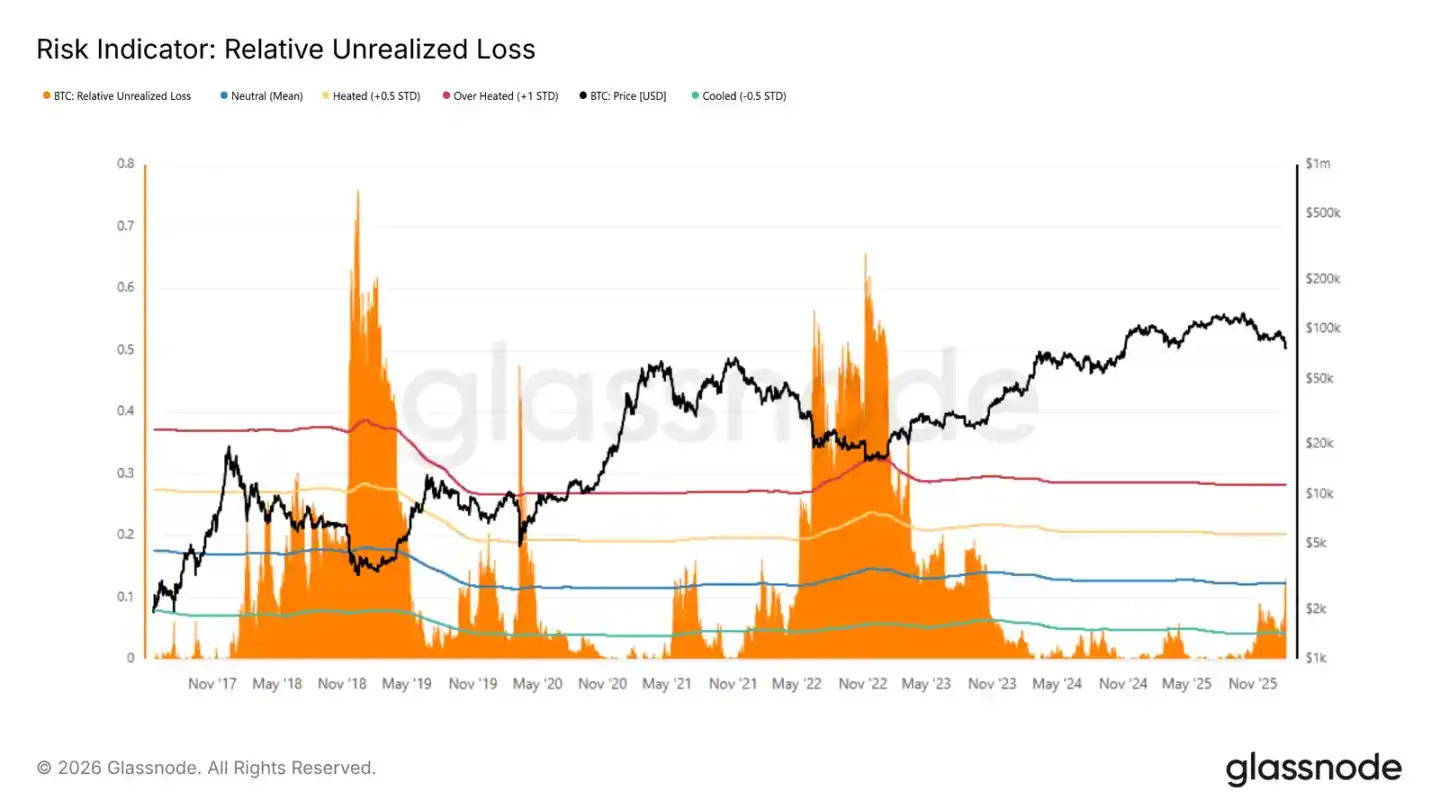
The Relative Unrealized Loss metric (the proportion of unrealized loss to total market cap) helps compare market stress across different cycles. Historical bear market extremes usually exceed 30%, with cycle bottoms in 2018 and 2022 even reaching 65%-75%.

This metric has now risen above its long-term average (approx. 12%), indicating pressure on investors holding coins above the current price. However, reaching historical extreme levels typically requires a systemic risk event on the scale of the LUNA or FTX collapse.
Market Dynamics

Spot and futures trading volumes remain low, while the options market continues to focus on downside protection.

Institutional Flows Turn Net Negative

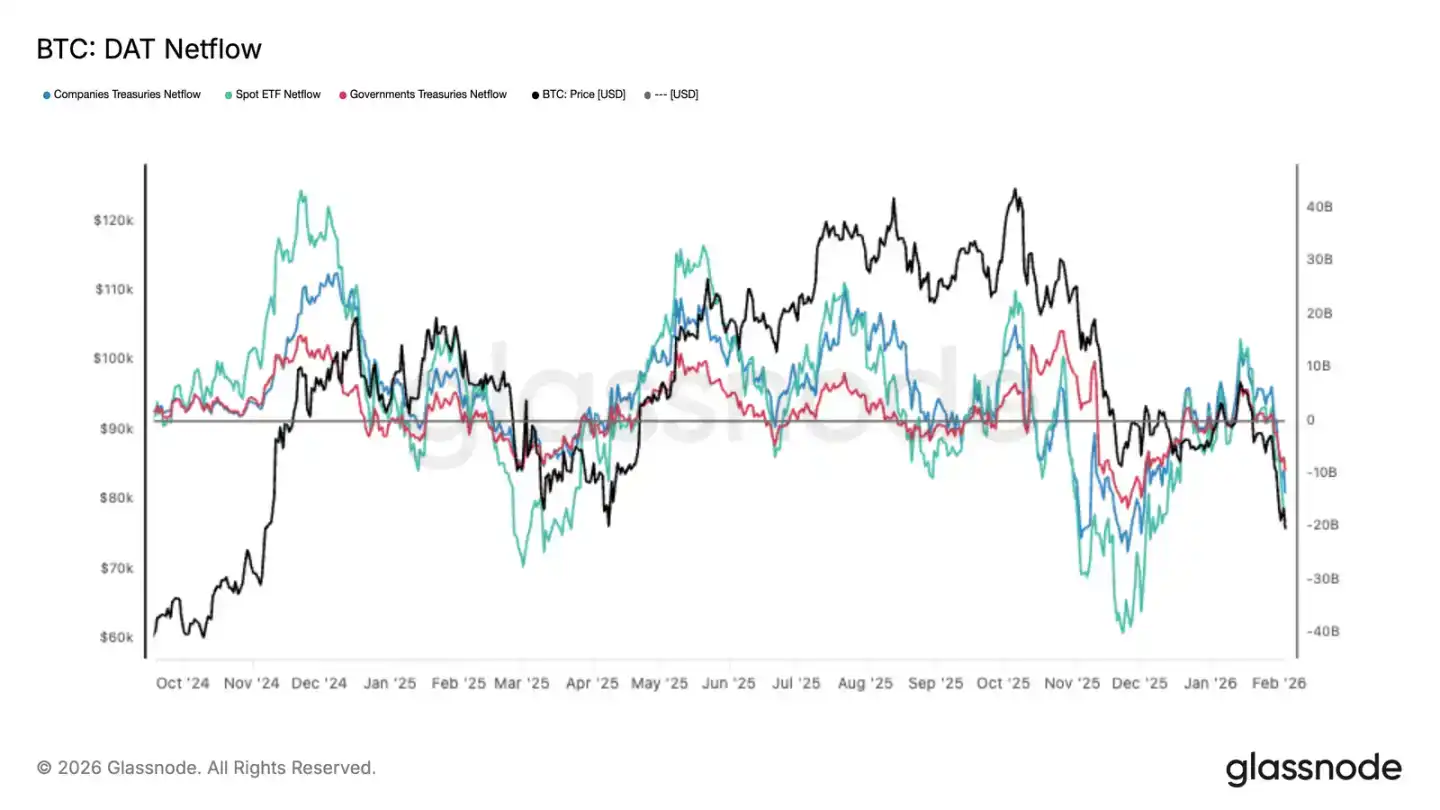
As prices fell, demand from major institutional investors noticeably weakened. Spot ETF inflows slowed, and corporate and government-related capital also decreased, showing reduced willingness for incremental capital to enter the market.

This contrasts sharply with the previous rally phase, where sustained inflows provided support for price appreciation. The shift in capital flow further confirms the lack of new capital entering the market at current price levels.
Spot Volume Remains Lackluster

Despite the price drop from $98,000 to $72,000, the 30-day average trading volume has not expanded significantly. This indicates a lack of sufficient buying interest to absorb the selling during the decline.

Historically, genuine trend reversals are often accompanied by a significant expansion in spot trading volume. The current volume has only slightly recovered, suggesting market activity is still dominated by position reduction and risk aversion, rather than active accumulation.

Low liquidity makes the market more sensitive to selling pressure, meaning even medium-sized sell orders can trigger relatively large price drops.
Futures Market Forced Liquidations

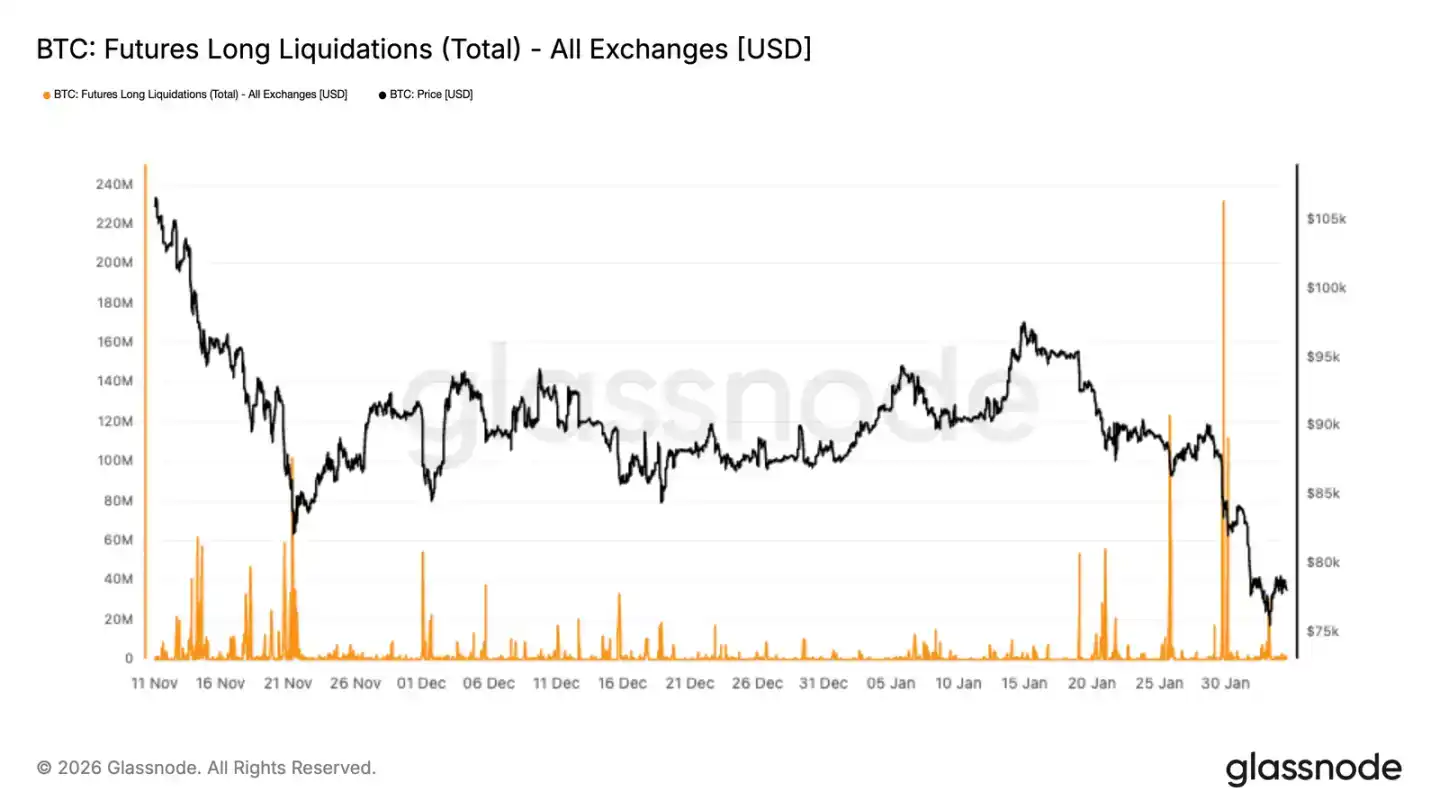
The derivatives market saw large-scale long liquidations, hitting the highest level since this decline began. This indicates that as prices fell, leveraged long positions were forcibly closed, adding to the downward momentum.

It is worth noting that liquidation activity was relatively moderate during November-December, showing leverage was gradually rebuilding. The recent surge marks the market's entry into a forced deleveraging phase, where forced liquidations become a primary factor influencing price.

Whether prices can stabilize going forward depends on the sufficiency of this deleveraging process. A genuine recovery requires the介入 of spot buying; mere position clearing is unlikely to form a sustained rebound.
Short-Term Volatility Remains Elevated

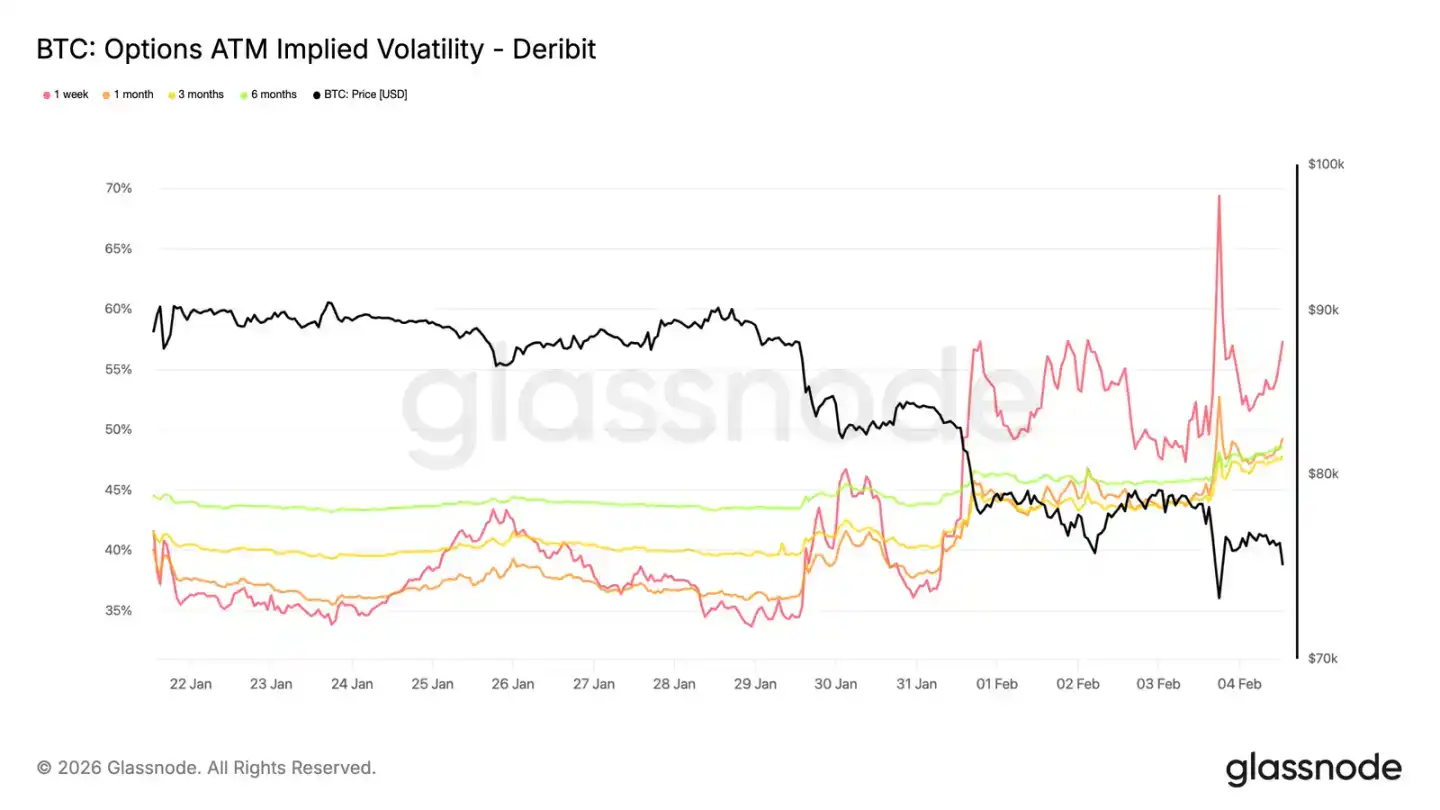
When the price tested the previous high of $73,000 (now turned support), short-term implied volatility rose to near 70%. Volatility levels have increased by about 20 volatility points compared to two weeks ago, with the entire volatility curve shifting upward.

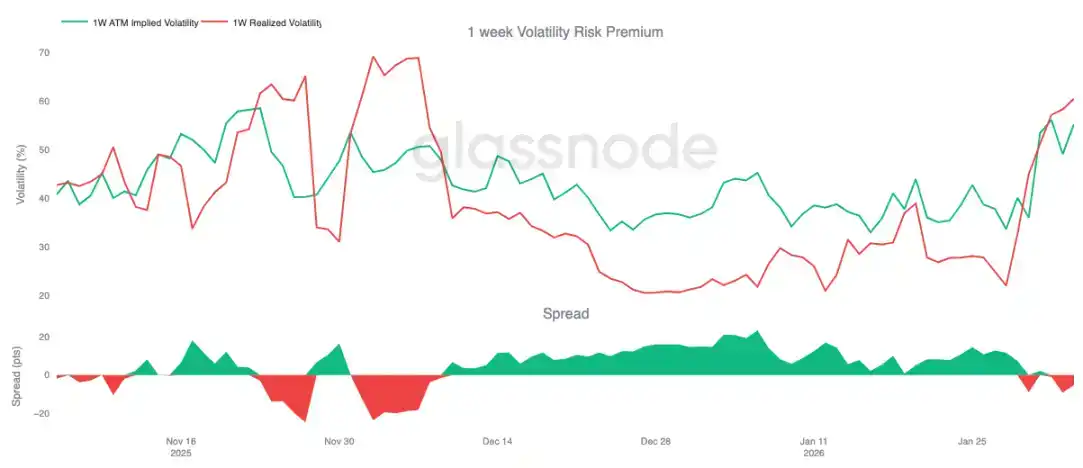
Short-term implied volatility consistently exceeding recent realized volatility indicates investors are willing to pay a premium for short-term protection. This repricing is particularly evident in near-term contracts, showing risk is concentrated here.

This reflects more a demand for protection against sudden drops rather than a clear directional view. Traders' reluctance to sell short-term options in size keeps the cost of downside protection elevated.
Sustained Increase in Put Option Demand

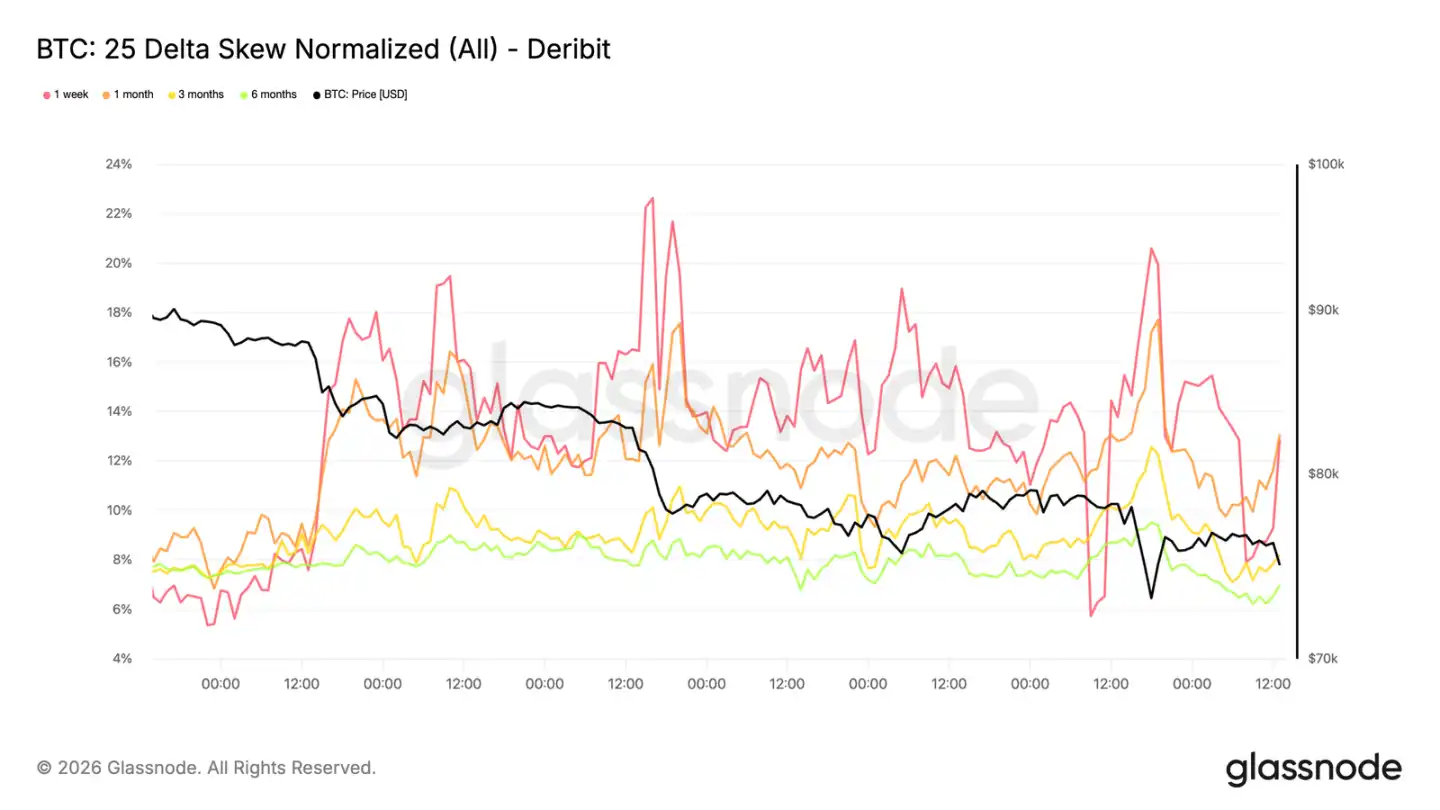
The volatility repricing shows a clear directional bias. The skew of put options relative to call options has widened again, showing the market is more concerned about downside risk than rebound opportunities.

Even with prices holding above $73,000, option flow remains concentrated in protective positions. This biases the implied volatility distribution negatively, reinforcing the market's defensive tone.
Volatility Risk Premium Turns Negative

The 1-week Volatility Risk Premium turned negative for the first time since early December, currently around -5, compared to +23 just a month ago.

A negative risk premium means implied volatility is below realized volatility. For option sellers, this turns the收益 from time decay into a loss, forcing them to hedge more frequently, which in turn increases short-term market pressure.

In this environment, option trading no longer plays a stabilizing role for the market and may instead exacerbate price volatility.
Change in $75,000 Put Option Premium

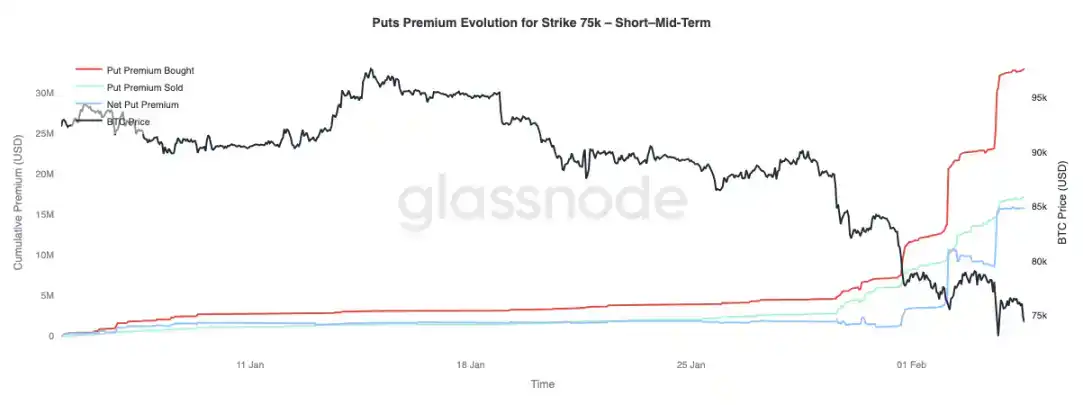
The $75,000 strike put option has become a focal point for the market, as this level has been tested repeatedly. The net buying premium for these puts has increased significantly, a process advancing in three stages, each synchronized with price declines lacking effective rebound.

The situation is different for longer-dated options (over 3 months): selling premiums have begun to exceed buying premiums, indicating traders are willing to sell high volatility in forward contracts while continuing to pay a premium for short-term protection.
Summary

After failing to reclaim the key level of $94,500, Bitcoin broke below the True Market Mean of $80,200, entering a defensive state. As the price fell into the $70,000 range, unrealized profits contracted and realized losses increased. Although initial accumulation signs appeared in the $70,000-$80,000 range, and a dense holding zone formed between $66,900 and $70,600, persistent loss-selling indicates market sentiment remains cautious.

In the derivatives market, selling pressure showed disorderly characteristics. Large-scale long liquidations confirmed the leverage reset process. While this helps clear speculative froth, it is not sufficient on its own to form a solid bottom. The options market reflects increased uncertainty; rising put demand and high volatility indicate investors are preparing for continued turbulence.

The key to future price action still lies in spot demand. Without seeing an improvement in spot participation and sustained capital inflows, the market will continue to face downward pressure, and any rebounds may lack sustainability. Until fundamentals improve, risks remain skewed to the downside. A genuine recovery requires time, sufficient筹码 turnover, and a substantial restoration of buyer confidence.


Трендові криптовалюти

Пов'язані питання

QWhat key support level did Bitcoin break, confirming a deterioration in market structure since late November?

ABitcoin broke below the Realized Price Mean (the average cost basis of actively circulating coins excluding long-dormant tokens), which confirmed the deterioration in market structure since late November.

QAccording to the UTXO Realized Price Distribution, where is there a significant accumulation of new investor positions that might act as a short-term support zone?

AThe UTXO Realized Price Distribution shows significant accumulation of new investor positions in the $70,000 to $80,000 range, with a particularly dense cost concentration zone between $66,900 and $70,600 that could act as a short-term support band.

QWhat does the surge in 7-day average realized losses to over $1.26 billion indicate about investor behavior?

AThe surge in the 7-day average realized losses to over $1.26 billion indicates that panic selling and forced liquidations have increased as the market broke below key support levels, reflecting heightened investor stress.

QHow has the institutional capital flow, particularly through ETFs, changed compared to the earlier rally phase?

AInstitutional capital flow has weakened significantly, with spot ETF inflows slowing down and capital from corporations and governments decreasing. This is a stark contrast to the earlier rally phase, which was characterized by consistent inflows that provided sustained buying support.

QWhat is the significance of the 1-week volatility risk premium turning negative, and what impact does it have on the market?

AThe 1-week volatility risk premium turning negative (to around -5) means that implied volatility is lower than realized volatility. This forces option sellers to hedge more frequently, which can add to short-term market pressure and exacerbate price volatility instead of stabilizing it.

Пов'язані матеріали

Podcast Notes | Conversation with GSR Asset Management Head: To Determine if This Crypto Rally is Real, Just Watch the Lending Rates on Aave

Podcast Summary: Dialogue with GSR's Head of Asset Management: To Determine if This Crypto Rally is Real, Just Check Lending Rates on Aave Andy Baehr, Managing Director of Asset Management at GSR, discusses the current crypto market, characterizing it as stuck in a state of "ambivalence" with short-lived, unsustainable rallies. He outlines a simple framework: the market moves between "ambivalence" and "conviction" (sustained upward momentum). Currently, every rally resembles a single-stage rocket booster that quickly fizzles out. Baehr identifies three key signals to watch: 1) DeFi lending rates, 2) the potential passage of the CLARITY Act, and 3) the market forming a consensus on the "Fed hawkish peak." He emphasizes that the most immediate indicator for the sustainability of the recent CPI-triggered rally is the USDC borrowing rate on Aave, currently around 3.75%—close to U.S. Treasury yields. The absence of a credit spread indicates low leverage demand and a lack of market energy. He explains that a healthy, sustained rally requires layered buying pressure. Last year's rally progressed from an ETH short squeeze to crypto-native trader influx and finally to ETF inflows. Currently, this structure is missing. Other potential structural buyers like Digital Asset Treasury (DAT) companies are absent, and ETF flows have proven transient. Baehr notes that while small-cap crypto tokens outperformed large caps in Q2—a potential sign of capitation in major assets—capital is also flowing to more exciting opportunities like AI stocks and tech IPOs, leaving crypto sidelined. Regarding DeFi, he highlights that platforms like Aave provide a clear, real-time signal of leverage demand through their supply/demand-driven interest rates. A significant, sustained rate increase would signal genuine market conviction. He also observes the quiet emergence of fixed-income-like products and vaults in DeFi. On regulation, the probability of the CLARITY Act passing before the August 7th deadline has dropped linearly from 75% to below 40% on Polymarket. Baehr suggests its passage would be treated as a bullish surprise, a potent driver for price movement. However, political hurdles, including ethical clause debates and disclosures about the First Family's crypto profits, remain significant obstacles. Ultimately, the market awaits clarity on the Fed's terminal rate under Chair Warsh. Until the "Fed Solstice"—the point where the market collectively understands the peak of hawkish policy—sustained conviction will be difficult to achieve.

marsbit3 хв тому

Podcast Notes | Conversation with GSR Asset Management Head: To Determine if This Crypto Rally is Real, Just Watch the Lending Rates on Aave

marsbit3 хв тому

7 Months After the Collapse of Huiwang, Southeast Asia's Escrow Platforms Undergo a Major Reshuffle

Following the collapse of Huione Pay—dubbed the "Alipay of Southeast Asia"—seven months ago, the region's underground financial guarantee platform sector is undergoing a significant reshuffle. This power vacuum has been swiftly filled by emerging platforms such as XinBi, Tiger/Navigator, JinBei (renamed JinBo), Dali/Tiancheng, and FullyLight. These platforms, operating largely via Telegram and offering services like escrow for illicit transactions, have absorbed the vast user base and markets left behind by Huione. While positioning themselves as "trust intermediaries," their primary clientele consists of networks involved in online scams, money laundering, illegal gambling, and even human trafficking. For instance, the Tiger/Navigator platform explicitly provides "escrow" services for kidnapping-for-ransom operations ("强押车交易"). Data underscores the immense scale: Huione alone processed over $103 billion in cryptocurrency payments and facilitated over $31 billion through its escrow market before its downfall, linking it to Cambodia's notorious Prince Group. Since its collapse, competitors have seen explosive growth. For example, the XinBi platform has accumulated over $1.6 billion in total USDT revenue, while platforms like NewPay, OkPay (under Dali), and FullyLight Wallet collectively processed over $4.8 billion in USDT in a single year. This ecosystem thrives in regions like Cambodia and Myanmar, where regulatory gaps allow these platforms to act as critical financial infrastructure for sprawling cybercrime industries, from scam compounds to online casinos. The article concludes that the moniker "Southeast Asian Alipay" is a misnomer, obscuring the platforms' fundamental role in enabling serious criminal enterprises rather than representing legitimate financial innovation.

Odaily星球日报1 год тому

7 Months After the Collapse of Huiwang, Southeast Asia's Escrow Platforms Undergo a Major Reshuffle

Odaily星球日报1 год тому

The Changing Landscape: What Are Crypto VCs Experiencing?

Title: The Shifting Landscape of Crypto Venture Capital The era of dedicated crypto venture capital funds is undergoing a significant transformation. Once essential for navigating the sector's complexity and high risk, these specialized funds are now facing an identity crisis as the market matures. This shift mirrors historical patterns in other specialized investment classes like cleantech and SPACs, where initial information advantages dissipate as technologies become mainstream and integrated into existing industry frameworks. The article argues that crypto is reaching a critical inflection point, transitioning from a "building phase" to an "integration phase." Major players like Stripe, BlackRock, and Visa now engage with crypto not for its novel mechanics but as a foundational financial infrastructure. Their needs—regulatory compliance, banking partnerships, distribution channels—align with traditional fintech, a domain easily understood by large, generalist funds like Sequoia and Founders Fund. This evolution creates a "barbell effect" within the VC landscape. On one end are massive, diversified platforms that can incorporate crypto as one vertical among many. On the other are small, nimble funds focused on niche, experimental projects. The middle ground—medium-sized dedicated crypto funds—is being squeezed out. Their typical fund size makes it impossible to generate sufficient returns solely from early-stage crypto bets, yet they cannot compete with giants for later-stage deals. Consequently, leading crypto-native firms like Paradigm and Framework Ventures are expanding into AI, robotics, and other sectors, driven partly by LP pressure for better returns amid a broader VC DPI crisis. Others, like Dragonfly and a16z, have narrowed their crypto focus predominantly to financial infrastructure like stablecoins, reframing the sector's core narrative. For crypto entrepreneurs, this consolidation presents challenges. While generalist funds offer larger checks and broader resources, crypto projects now compete fiercely with AI for attention and capital within these firms. Furthermore, the long-term, non-commercial foundational work that built the ecosystem—funded by dedicated crypto VCs—is less likely to attract generalist capital focused on direct returns. The conclusion is that "crypto investor" as a standalone category is becoming obsolete, akin to "internet investor." Crypto is becoming a baseline infrastructure layer. The future will see a barbell structure: large-scale growth financing handled by generalist funds, while pioneering, speculative projects are funded by small, specialized vehicles. The dedicated crypto funds of the 2017-2021 boom, which incubated core infrastructure, are giving way to this new, bifurcated reality.

Foresight News1 год тому

The Changing Landscape: What Are Crypto VCs Experiencing?

Foresight News1 год тому

Торгівля

Спот

Популярні статті

Що таке BITCOIN

Розуміння HarryPotterObamaSonic10Inu (ERC-20) та його позиції у крипто-просторі Останніми роками ринок криптовалют спостерігав за зростанням популярності мем-коінів, які привертають інтерес не тільки трейдерів, але й тих, хто шукає спілкування та розважальну цінність. Серед цих унікальних токенів є HarryPotterObamaSonic10Inu (ERC-20), інтригуючий проект, що поєднує культурні посилання з тканинами криптовалюти. Ця стаття досліджує ключові аспекти HarryPotterObamaSonic10Inu, вивчаючи його механізми, спільноту та його взаємодію з ширшим крипто-ландшафтом. Що таке HarryPotterObamaSonic10Inu (ERC-20)? Як випливає з його назви, HarryPotterObamaSonic10Inu є мем-коіном, побудованим на блокчейні Ethereum, класифікованим за стандартом ERC-20. На відміну від традиційних криптовалют, які можуть підкреслювати практичну корисність або інвестиційний потенціал, цей токен процвітає завдяки розважальній цінності та силі своєї спільноти. Проект спрямований на створення середовища, де зацікавлені користувачі можуть об'єднуватися, ділитися ідеями та брати участь у заходах, натхненних різноманітними культурними явищами. Однією з примітних особливостей HarryPotterObamaSonic10Inu є нульовий податок на транзакції. Цей привабливий елемент має на меті заохочувати торгівлю та участь у спільноті, позбавлену додаткових витрат, які можуть відлякувати дрібних трейдерів. Загальна пропозиція монет становить один мільярд токенів, що позначає намір підтримувати суттєву циркуляцію в межах спільноти. Творець HarryPotterObamaSonic10Inu (ERC-20) Походження HarryPotterObamaSonic10Inu дещо окутане таємницею; деталі про творця залишаються невідомими. Розвиток цього токена позбавлений впізнаваної команди або чіткої стратегії, що не є рідкістю в секторі мем-коінів. Натомість проект виник органічно, а його розвиток значною мірою залежить від ентузіазму та участі його спільноти. Інвестори HarryPotterObamaSonic10Inu (ERC-20) Щодо зовнішніх інвестицій та підтримки, HarryPotterObamaSonic10Inu також залишається невизначеним. Токен не зазначає жодних відомих інвестиційних фондів або значної організаційної підтримки. Натомість життєва сила проекту полягає в його базовій спільноті, яка інформує про його зростання та стійкість через колективні дії та залученість у крипто-просторі. Як працює HarryPotterObamaSonic10Inu (ERC-20)? Як мем-коін, HarryPotterObamaSonic10Inu функціонує передусім поза традиційними рамками, що часто регулюють вартість активів. Є кілька відмінних аспектів, що визначають, як працює проект: Транзакції без податку: Завдяки відсутності податкових зборів на транзакції, користувачі можуть вільно купувати та продавати токен, не турбуючись про приховані витрати. Залучення спільноти: Проект процвітає завдяки взаємодії спільноти, використовуючи соціальні медіа для створення шуму та сприяння залученню. Обговорення, обмін контентом та залученість є ключовими елементами, що допомагають розширити його охоплення та зміцнити лояльність серед прихильників. Відсутність практичної корисності: Слід зазначити, що HarryPotterObamaSonic10Inu не пропонує конкретної корисності в рамках фінансової екосистеми. Натомість він класифікується як токен, що призначений в основному для розваги та спільнотних активностей. Культурне посилання: Токен кмітливо вплітає елементи популярної культури, щоб привернути інтерес, зв'язуючи з ентузіастами мемів та крипто-стежками. HarryPotterObamaSonic10Inu ілюструє, як мем-коіни функціонують інакше, ніж традиційні криптовалютні проекти, увійшовши на ринок як інноваційні соціальні конструкти, а не утилітарні активи. Хронологія HarryPotterObamaSonic10Inu (ERC-20) Історія HarryPotterObamaSonic10Inu відзначена кількома значними етапами: Створення: Токен виник з вірусного мему, захопивши уяву багатьох крипто-ентузіастів. Конкретні дати створення недоступні, що підкреслює його органічний розвиток. Лістинг на біржах: HarryPotterObamaSonic10Inu з'явився на різних біржах, дозволяючи зручніший доступ і торгівлю спільноти. Ініціативи залучення спільноти: Ведення діяльності, спрямованої на покращення взаємодії спільноти, включаючи конкурси, кампанії в соціальних мережах та створення контенту від фанатів та прихильників. Плани на майбутнє: Дорожня карта проекту включає запуск колекції NFT, мерчандайзинг та електронну комерцію, пов'язану з його культурними темами, що далі залучає спільноту та намагається додати більше вимірів до його екосистеми. Ключові моменти про HarryPotterObamaSonic10Inu (ERC-20) Спільнотний підхід: Проект надає пріоритет колективному внеску та креативності, забезпечуючи, щоб участь користувачів була в центрі його розвитку. Класифікація як мем-коін: Це є його епігенез розважальної криптовалюти, що відрізняється від традиційних інвестиційних інструментів. Жодного прямого відношення до Bitcoin: Незважаючи на схожість у назві, HarryPotterObamaSonic10Inu є відмінним і не має жодного зв’язку з Bitcoin або іншими усталеними криптовалютами. Зосередженість на співпраці: HarryPotterObamaSonic10Inu створено для того, щоб надати простір для співпраці та обміну історіями серед його власників, забезпечуючи шлях для творчості та спільного зв'язку. Перспективи на майбутнє: Амбіція розширитися за межі початкової концепції в NFT та мерчандайз відкриває шлях для проекту потенційно потрапити в більш мейнстрімні сфери цифрової культури. Оскільки мем-коіни продовжують захоплювати уяву спільноти криптовалют, HarryPotterObamaSonic10Inu (ERC-20) вирізняється своїми культурними зв'язками та орієнтованим на спільноту підходом. Хоча він може не відповідати типовій моделі утилітарного токена, його суть полягає в радощах і товариськості, що підтримуються серед його прихильників, підкреслюючи еволюційну природу криптовалют в усе більш цифрову епоху. Оскільки проект продовжує розвиватися, важливо спостерігати за тим, як динаміка спільноти вплине на його траєкторію в постійно змінюваному ландшафті технології блокчейн.

2.2k переглядів усьогоОпубліковано 2024.04.01Оновлено 2024.12.03

Що таке BITCOIN

Як купити BTC

Ласкаво просимо до HTX.com! Ми зробили покупку Bitcoin (BTC) простою та зручною. Дотримуйтесь нашої покрокової інструкції, щоб розпочати свою криптовалютну подорож.Крок 1: Створіть обліковий запис на HTXВикористовуйте свою електронну пошту або номер телефону, щоб зареєструвати обліковий запис на HTX безплатно. Пройдіть безпроблемну реєстрацію й отримайте доступ до всіх функцій.ЗареєструватисьКрок 2: Перейдіть до розділу Купити крипту і виберіть спосіб оплатиКредитна/дебетова картка: використовуйте вашу картку Visa або Mastercard, щоб миттєво купити Bitcoin (BTC).Баланс: використовуйте кошти з балансу вашого рахунку HTX для безперешкодної торгівлі.Треті особи: ми додали популярні способи оплати, такі як Google Pay та Apple Pay, щоб підвищити зручність.P2P: Торгуйте безпосередньо з іншими користувачами на HTX.Позабіржова торгівля (OTC): ми пропонуємо індивідуальні послуги та конкурентні обмінні курси для трейдерів.Крок 3: Зберігайте свої Bitcoin (BTC)Після придбання Bitcoin (BTC) збережіть його у своєму обліковому записі на HTX. Крім того, ви можете відправити його в інше місце за допомогою блокчейн-переказу або використовувати його для торгівлі іншими криптовалютами.Крок 4: Торгівля Bitcoin (BTC)Легко торгуйте Bitcoin (BTC) на спотовому ринку HTX. Просто увійдіть до свого облікового запису, виберіть торгову пару, укладайте угоди та спостерігайте за ними в режимі реального часу. Ми пропонуємо зручний досвід як для початківців, так і для досвідчених трейдерів.

5.0k переглядів усьогоОпубліковано 2024.12.12Оновлено 2026.06.02

Як купити BTC

Що таке $BITCOIN

ЦИФРОВЕ ЗОЛОТО ($BITCOIN): Комплексний аналіз Вступ до ЦИФРОВОГО ЗОЛОТА ($BITCOIN) ЦИФРОВЕ ЗОЛОТО ($BITCOIN) — це проект на основі блокчейну, що працює в мережі Solana, який має на меті поєднати характеристики традиційних дорогоцінних металів з інноваціями децентралізованих технологій. Хоча він має таку ж назву, як і Bitcoin, який часто називають “цифровим золотом” через його сприйняття як засобу збереження вартості, ЦИФРОВЕ ЗОЛОТО є окремим токеном, розробленим для створення унікальної екосистеми в ландшафті Web3. Його мета — позиціонувати себе як життєздатний альтернативний цифровий актив, хоча деталі щодо його застосувань і функціональностей все ще розробляються. Що таке ЦИФРОВЕ ЗОЛОТО ($BITCOIN)? ЦИФРОВЕ ЗОЛОТО ($BITCOIN) — це токен криптовалюти, спеціально розроблений для використання в блокчейні Solana. На відміну від Bitcoin, який виконує широко визнану роль зберігання вартості, цей токен, здається, зосереджується на більш широких застосуваннях і характеристиках. Помітні аспекти включають: Інфраструктура блокчейну: Токен побудований на блокчейні Solana, відомому своєю здатністю обробляти швидкі та низьковартісні транзакції. Динаміка постачання: ЦИФРОВЕ ЗОЛОТО має максимальне постачання, обмежене 100 квадрильйонами токенів (100P $BITCOIN), хоча деталі щодо його обігового постачання наразі не розголошуються. Утиліта: Хоча точні функціональності не викладені, є вказівки на те, що токен може бути використаний для різних застосувань, потенційно пов'язаних з децентралізованими додатками (dApps) або стратегіями токенізації активів. Хто є творцем ЦИФРОВОГО ЗОЛОТА ($BITCOIN)? На даний момент особа творців і команди розробників, що стоять за ЦИФРОВИМ ЗОЛОТОМ ($BITCOIN), залишається невідомою. Ця ситуація є типовою для багатьох інноваційних проектів у сфері блокчейну, особливо тих, що пов'язані з децентралізованими фінансами та феноменом мем-коінів. Хоча така анонімність може сприяти культурі, орієнтованій на спільноту, вона посилює занепокоєння щодо управління та підзвітності. Хто є інвесторами ЦИФРОВОГО ЗОЛОТА ($BITCOIN)? Доступна інформація вказує на те, що ЦИФРОВЕ ЗОЛОТО ($BITCOIN) не має жодних відомих інституційних спонсорів або помітних венчурних капіталовкладень. Проект, здається, працює за моделлю “рівний до рівного”, зосереджуючись на підтримці та прийнятті спільноти, а не на традиційних шляхах фінансування. Його активність і ліквідність переважно розташовані на децентралізованих біржах (DEX), таких як PumpSwap, а не на встановлених централізованих торгових платформах, що ще більше підкреслює його підхід знизу вгору. Як працює ЦИФРОВЕ ЗОЛОТО ($BITCOIN) Операційні механізми ЦИФРОВОГО ЗОЛОТА ($BITCOIN) можна детальніше розглянути на основі його дизайну блокчейну та характеристик мережі: Механізм консенсусу: Використовуючи унікальний proof-of-history (PoH) Solana в поєднанні з моделлю proof-of-stake (PoS), проект забезпечує ефективну валідацію транзакцій, що сприяє високій продуктивності мережі. Токеноміка: Хоча конкретні дефляційні механізми не були детально описані, велике максимальне постачання токенів вказує на те, що воно може задовольняти мікротранзакції або нішеві випадки використання, які ще потрібно визначити. Інтероперабельність: Існує потенціал для інтеграції з більш широкою екосистемою Solana, включаючи різні платформи децентралізованих фінансів (DeFi). Однак деталі щодо конкретних інтеграцій залишаються невизначеними. Хронологія ключових подій Ось хронологія, яка підкреслює значні віхи, пов'язані з ЦИФРОВИМ ЗОЛОТОМ ($BITCOIN): 2023: Початкове розгортання токена відбувається на блокчейні Solana, позначене його адресою контракту. 2024: ЦИФРОВЕ ЗОЛОТО набуває видимості, оскільки стає доступним для торгівлі на децентралізованих біржах, таких як PumpSwap, що дозволяє користувачам торгувати ним проти SOL. 2025: Проект спостерігає спорадичну торгову активність і потенційний інтерес до ініціатив, очолюваних спільнотою, хоча на даний момент не зафіксовано жодних значних партнерств або технічних досягнень. Критичний аналіз Сильні сторони Масштабованість: Основна інфраструктура Solana підтримує високі обсяги транзакцій, що може підвищити утиліту $BITCOIN у різних сценаріях транзакцій. Доступність: Потенційно низька торгова ціна за токен може привабити роздрібних інвесторів, сприяючи більш широкій участі завдяки можливостям дробового володіння. Ризики Відсутність прозорості: Відсутність публічно відомих спонсорів, розробників або процесу аудиту може викликати скептицизм щодо стійкості та надійності проекту. Волатильність ринку: Торгова активність сильно залежить від спекулятивної поведінки, що може призвести до значної волатильності цін і невизначеності для інвесторів. Висновок ЦИФРОВЕ ЗОЛОТО ($BITCOIN) постає як цікавій, але неоднозначний проект у швидко розвиваючійся екосистемі Solana. Хоча він намагається використати наратив “цифрового золота”, його відхід від встановленої ролі Bitcoin як засобу збереження вартості підкреслює необхідність чіткішого розмежування його передбачуваної утиліти та структури управління. Майбутнє прийняття та адаптація, ймовірно, залежатиме від вирішення поточної непрозорості та більш чіткого визначення його операційних та економічних стратегій. Примітка: Цей звіт охоплює синтезовану інформацію, доступну станом на жовтень 2023 року, і можуть відбутися події, що виходять за межі дослідницького періоду.

160 переглядів усьогоОпубліковано 2025.05.13Оновлено 2025.05.13

Що таке $BITCOIN

Обговорення

Ласкаво просимо до спільноти HTX. Тут ви можете бути в курсі останніх подій розвитку платформи та отримати доступ до професійної ринкової інформації. Нижче представлені думки користувачів щодо ціни BTC (BTC).

活动图片













