On July 17, 2026, the World Artificial Intelligence Conference (WAIC) opened in Shanghai. Over 1,100 exhibitors, 100,000 square meters of exhibition space, more than 300,000 professional visitors — this is the "face" of the conference.
But what is truly worth a deep read is the "substance": the financing performance of these exhibiting companies over the past 18 months is becoming a capital barometer for the direction of China's AI industry.
We systematically analyzed the investment and financing dynamics of the core exhibiting companies at this WAIC from 2025 to July 2026 through the ITJuzi data platform.
The three major tracks of large models, embodied AI, and AI chips are experiencing an unprecedented period of concentrated capital inflow—
Just among the key exhibiting companies covered in this article, the cumulative financing amount over the past 18 months has exceeded the hundred-billion RMB level.
Large Models: IPO Window Opens, Capital Concentrates Towards Leaders
Large models are the most capital-attracting track at this WAIC and also the area where capital logic is changing most dramatically.
Zhipu and MiniMax have successively completed IPOs on the Hong Kong Stock Exchange, setting exit benchmarks for the large model industry. Zhipu completed a placement for additional financing on July 9, raising 31.41 billion HKD; MiniMax (Xiyu Technology) followed the next day, raising approximately 16 billion HKD through a share placement + convertible bond.
Unlisted companies are also attracting significant capital.
StepFun completed its Pre-IPO round of financing in May 2026, raising $2.5 billion, with ZTE, Huaqin Technology, Tencent Investment, OmniVision, and Longcheer Technology jointly investing;
Shengshu Technology just completed a $500 million Series B+ round in July;
Mianbi Intelligence completed a several hundred million RMB E+ round the same month;
Wuwen Xinqiong completed a 700 million RMB Series B round in May.
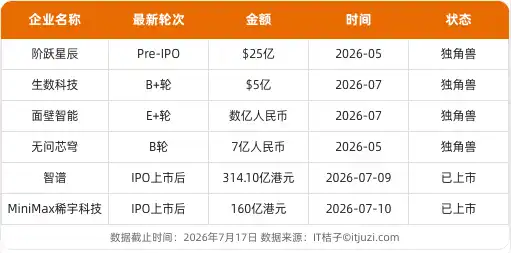
StepFun is the most representative case in this wave of large model financing.
This Tsinghua-affiliated large model company, founded in April 2023 in Xuhui, Shanghai, has an estimated market valuation of $12 billion.
Its financing speed is remarkable:
In November 2023, it completed a Series A round raising tens of millions of USD, with investors including 5Y Capital, Qiming Venture Partners, and Sequoia Capital China; in December 2024, the Series B round escalated to hundreds of millions of USD, with Shanghai Guosheng Group joining; in January 2026, the Series B+ round jumped to 5 billion RMB, with Shanghai Guosheng, 5Y Capital, Qiming Venture Partners, Tencent Investment, etc., continuing to increase their stakes; only four months later, the Pre-IPO round reached $2.5 billion, with ZTE, Huaqin Technology, Tencent Investment, OmniVision, and Longcheer Technology jointly investing; in the same month, Lotus Holdings led a follow-on investment of 300 million RMB.
The change in investor structure is noteworthy.
Early rounds were dominated by pure financial investors like 5Y Capital, Qiming Venture Partners, and Sequoia Capital China; starting from the B+ round, Tencent consecutively invested in three rounds; by the Pre-IPO round, hardware ecosystem partners like ZTE and Huaqin Technology entered — this marks industrial capital no longer being content with financial returns but attempting to bind edge-side large model deployment capabilities through investment.
From an industry-wide perspective, the financing logic of the large model track is undergoing three shifts:
First, the IPO channel is opening. The listings of Zhipu and MiniMax provide exit expectations for subsequent companies.
Second, industrial capital is entering. Physical giants like ZTE, CATL, and SAIC are shifting from financial investment to strategic layout.
Third, the financing pace is shifting from "small steps, quick runs" to "large amounts, concentrated." The average single financing amount in the first half of 2026 increased about threefold compared to 2025.
Capital is shifting from "looking at PPTs" to "looking at implementation," with leading players possessing commercialization capabilities gaining超额溢价.
Embodied AI: The Extremely Fast "Compressed Financing"
If 2024 was the conceptual元年 of embodied AI, then 2025 to 2026 is the period of capital爆发期.
Leading humanoid robot companies like Unitree Robotics, Galaxy General Robots (Galbot), LimX Dynamics, Star AGI, and Zhiyuan Robot have collectively attracted over 30 billion RMB in the past 18 months, with several already in the Pre-IPO stage.
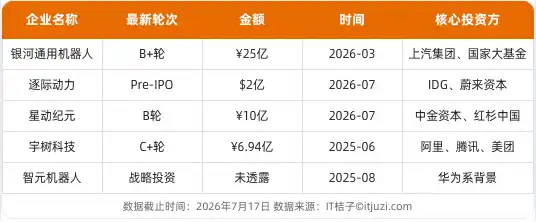
The financing rhythm of Galaxy General Robots (Galbot) is the most extreme case in this wave of embodied AI capital狂热.
This company, founded in May 2023 in Haidian, Beijing, focusing on general-purpose humanoid robots, completed 5 rounds of financing from its angel round in June 2024 to its Series B+ round in March 2026, raising a cumulative amount exceeding 7 billion RMB in less than two years.
Specifically:
Angel round of 700 million RMB in June 2024, invested by IDG Capital and Qiming Venture Partners; 5 months later, a strategic investment round of 500 million RMB with Meituan joining; Series B round of 1.1 billion RMB in June 2025, with CATL and GGV Capital entering; another Series B+ round of $300 million in December 2025, followed by China Mobile and CICC Capital; in March 2026, another Series B+ round of 2.5 billion RMB, jointly invested by SAIC Group, the National AI Industry Investment Fund, and the National Integrated Circuit Industry Investment Fund.
The evolution of Galbot's investor trajectory clearly demonstrates the capital upgrade path of the embodied AI track:
Early stages were led by top VCs like IDG and Qiming, then industrial capital like Meituan and CATL intervened, and finally "国家队" like the National IC Fund and National AI Fund entered.
This triple-endorsement structure of "national team + industrial leaders + top VCs" indicates that embodied AI is regarded as a national strategic emerging industry.
The节奏 of LimX Dynamics is even more紧凑—
In July 2026, it completed a $200 million Pre-IPO round, only 5 months after its previous Series B round.
This kind of "compressed financing" only appears during超级风口期, signifying a high consensus among capital on the track's prospects and hinting at intensified talent and technological competition among companies.
AI Chips:国产替代 Enters the Deep Water Zone
The Zhangjiang Science Hall, serving as the "Chip-Compute Integration Pavilion" at this WAIC, gathered over 60 AI chip companies including Huawei, MetaX, Enflame, Moore Threads, and Tianshu Zhixin.
The financing logic of this track is distinctly different from that of large models and embodied AI—longer R&D cycles, higher capital thresholds, and stronger policy dependence.
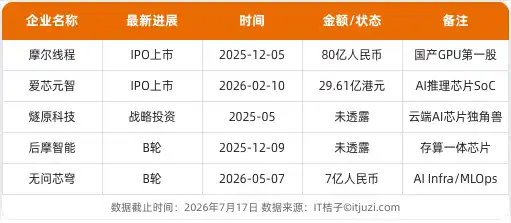
Moore Threads is the most emblematic case in the AI chip track.
Founded in June 2020 in Haidian, Beijing, by former NVIDIA global vice president Zhang Jianzhong, the company completed its IPO on December 5, 2025, raising 8 billion RMB, becoming the "first国产GPU stock." Its shareholder lineup includes top institutions like ByteDance, Tencent, Sequoia Capital China, and 5Y Capital, spanning the entire process from early stages to listing.
Moore Threads' listing holds多重意义 for the AI chip track:
It validates the feasibility of domestic GPU companies successfully navigating the capital market path and also provides valuation references for subsequent companies. In February 2026, Axera Technology followed closely, completing an IPO on the Hong Kong Stock Exchange, raising 2.961 billion HKD, further confirming that the listing通道 for AI chip companies is widening.
However, compared to the large model and embodied AI tracks, financing in the AI chip field exhibits different characteristics:
For some companies (Enflame, Haimo AI), the latest round financing amounts were undisclosed, reflecting higher information barriers and longer commercialization cycles in this track;
State-owned capital and operators account for a relatively high proportion among investors, while participation from market-oriented VCs is relatively lower.
This is directly related to the industry characteristics of AI chips: long R&D cycles, massive投入, and slow回报.
Panorama of Capital Flow: Where is the Money Going?
Placing the three major tracks side by side for comparison allows for a clearer view of the logic behind capital distribution.
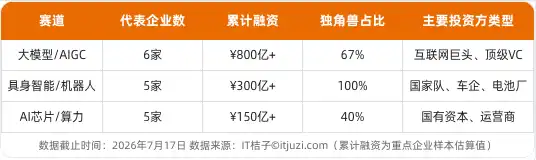
From the above comparison, five noteworthy trends can be提炼:
First, the winner-takes-all effect is显著.
StepFun's single Pre-IPO round raised $2.5 billion, Shengshu's Series B+ raised $500 million; capital is高度集中 towards the Top 5.
The cumulative financing in the large model track exceeds 80 billion RMB, but the vast majority flows to a few leading companies.
This trend means the "Matthew Effect" in the large model field is accelerating — leading companies leverage financial advantages to expand compute and talent barriers, potentially narrowing the生存窗口 for mid-to-tail-end companies.
Second, embodied AI has become a new增长极.
Galbot's 5 rounds in 9 months, LimX Dynamics' $200 million Pre-IPO completed in 5 months — this kind of "compressed financing" only appears during超级风口期.
All five representative companies are unicorns, with cumulative financing exceeding 30 billion RMB.
Even more值得注意的是 is the investor structure: industry giants like SAIC Group, CATL, and NIO directly入场, indicating embodied AI is seen as the next汽车级 industry.
Third, industrial capital is replacing pure financial investors.
ZTE investing in StepFun, SAIC Group funding Galbot, CATL betting on embodied AI, Alibaba, Tencent, and Meituan jointly investing in Unitree —
These cases show that industrial capital is切入 different segments of the AI industry chain through investment. Unlike pure financial investment, industrial capital places more emphasis on technological synergy and supply chain卡位; their entry often意味着 deeper business绑定.
Fourth, the "national team" is moving from behind the scenes to the台前.
The National Integrated Circuit Industry Investment Fund and the National Artificial Intelligence Industry Investment Fund frequently appear, co-investing with market capital in projects like Galbot.
This indicates AI has been纳入国家战略版图, with government-guided capital正在与 market capital forming合力.
Fifth, exit通道 are becoming多元化.
Besides IPOs, methods like M&A integration and strategic investment are increasing.
The successive listings of Zhipu, MiniMax, Moore Threads, and Axera provide valuation references and exit expectations for后续企业; some companies choose to introduce industrial partners for deep synergy rather than单纯追求上市.
Capital is Not Omnipotent
WAIC 2026 is not just a technology盛宴, but also a集中检阅 of industrial strength.
The financing data tells us:
China's AI industry is undergoing a critical转折期 from concept validation to规模化落地.
Large models need to find sustainable commercial closed loops, embodied AI needs to跨越 the鸿沟 from lab to factory, AI chips need to achieve自主可控 under external封锁.
The influx of hundred-billion capital说明 the market has cast a信任票 on the prospects of China's AI industry.
But the prosperity催生 by capital also comes with risks:
Financing高度集中 in leading companies may抑制生态多样性; deep介入 by industrial capital may影响企业独立决策空间; under the节奏 of "compressed financing," the risk of valuation泡沫 cannot be忽视.
When you walk through the exhibition booths at WAIC 2026, it's worth thinking about one more question—
What are this company's investors thinking?
The answer often holds more信息量 than the technical parameters on the display boards.
This article is from the WeChat public account: ITJuzi , Author: Judy