From 'Scientist' to 'Prophet': How Did OpenClaw Help Him Earn $100,000 in 10 Days?

比推Опубліковано о 2026-03-16Востаннє оновлено о 2026-03-16

Анотація

This article features an interview with Kevin, a trader who used OpenClaw to turn $30,000 into over $100,000 in just 10 days on the prediction market platform Polymarket. Originally an ERP architect and later a developer of sports betting systems, Kevin entered the crypto space in 2018. He made his first significant profit during the 2023 "inscription summer" with ORDI. In summer 2025, he shifted to Polymarket, attracted by its improved liquidity and user experience. Initially, he used automated arbitrage strategies between betting odds, doubling his initial $100,000 investment. Since late February, he integrated OpenClaw into his strategy. While 60% of his funds still run automated arbitrage, 40% are now managed with OpenClaw-assisted subjective betting. OpenClaw helps by gathering and weighting factors like smart money movements, public sentiment, and team lineups—even uncovering new influencing factors. It also automates backtesting and execution. Kevin highlights Polymarket’s AI-friendly API as a key advantage. Currently, OpenClaw is experimenting mainly in sports betting with small automated bets (~$1,000). Kevin plans to develop and sell packaged OpenClaw "Skills" based on his strategy in the future.

Author: Golem

Original Title: Earning $100,000 in 10 Days: An Interview with OpenClaw's Practical Experience in Prediction Markets


Currently, "raising lobsters" is no longer difficult, but how to master OpenClaw and actually use it to make money still troubles many lobster farmers.

Last week, I spoke with some deep users of OpenClaw in the crypto circle. Some mentioned that OpenClaw's heartbeat mechanism and scheduled tasks can improve the efficiency of news trading, but more interviewees believe that using OpenClaw to trade cryptocurrencies for profit is challenging. (Related reading: Odaily Editorial Team Tea Party)

However, where there's a will, there's a way. A trader named Kevin, with the assistance of OpenClaw, turned a $30,000 principal into a fourfold increase in 10 days, with a net profit of $100,000 (currently slightly retraced to $82,000). Kevin himself stated that this was initially just an experiment, but he didn't expect to actually make money.
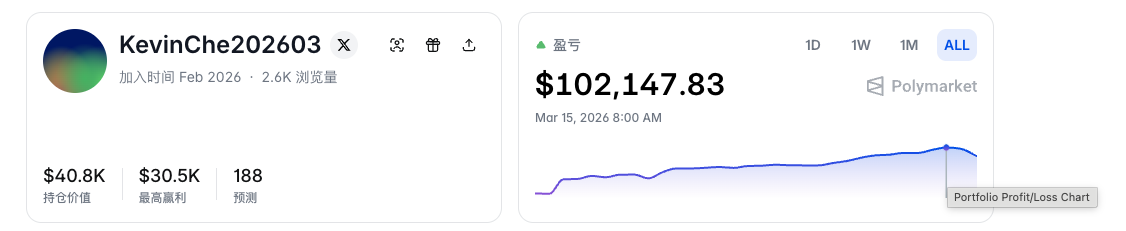
So how did Kevin transform OpenClaw from a toy that only burns tokens into a money-making machine? Odaily Planet Daily spoke with Kevin, who shared his personal crypto journey and how he leveraged OpenClaw in prediction markets, hoping readers can gain some inspiration.

The Transition from 'Scientist' to 'Prophet'

Kevin's early career primarily involved designing ERP architectures for enterprises. Later, he joined a Top 3 domestic internet company to build a sports betting software system from scratch. This professional experience laid the foundation for Kevin's current achievements in prediction markets. After 2018, Kevin entered the Web3 investment sector, mainly incubating and accelerating startups.

However, Kevin's first real bucket of gold was earned five years after entering the circle. In 2023, ordi emerged, ushering in the "Inscription Summer" for the crypto market. With a background in computers and code, Kevin became one of the highly sought-after "scientists" at the time (Odaily Note: Scientists refer to those who can write programs and code to quickly participate in new asset deployments during inscription launches).

"The period when ordi was listed on Binance was when my account assets were at their highest. I eventually cashed out about over 2 million RMB," Kevin said, noting that he was also among the first batch of people to participate in the ordi launch, with a cost of less than 1 RMB per coin, later enjoying a thousand-fold increase.

After inscriptions completely cooled down, Kevin began searching for other opportunities and finally started seriously researching and participating in the prediction market Polymarket in the summer of 2025. "I had played Polymarket before, but the liquidity was poor, so I ignored it," said Kevin, who had previously worked in traditional sports betting. For him, the early Polymarket's trading depth fell far short of requirements.

However, after Polymarket successfully predicted Trump becoming the 47th President of the United States in 2025, Kevin's attention returned to Polymarket. "After 2025, Polymarket's reputation grew, its liquidity could handle large orders, and more importantly, deposits and withdrawals became very convenient," so Kevin began experimenting with algorithms on Polymarket, becoming a "prophet."

Kevin's journey in prediction markets is divided into two stages: before using OpenClaw assistance and after using OpenClaw assistance. For clarity, Odaily Planet Daily has condensed Kevin's sharing as follows, enjoy~

How to Play Prediction Markets Before Using OpenClaw

Odaily Planet Daily: In the summer of 2025 when you started playing Polymarket, how much money did you invest, and what was the final profit?

Kevin: I invested about $100,000 at that time, and the total profit by this year was roughly double the principal.

Odaily Planet Daily: What strategy did you mainly adopt?

Kevin: I don't bet directly; I made profits through automated arbitrage using programs. When I worked on the sports betting system at the Web3 internet company, I was also involved in the design of order matching. This experience was very helpful for understanding Polymarket's order book. So I used programs to capture spreads between order books, especially in sports events, where a lot of emotional arbitrage can be done.

Odaily Planet Daily: Do you have a dedicated team, and is someone providing you with funds?

Kevin: I'm doing this alone; AI assistance is enough. Initially, I was afraid Polymarket might have withdrawal issues, so I ran dozens of accounts. But later, I found the deposit and withdrawal process very smooth, so I reduced the number of accounts. I mainly use my own money to run strategies, but indeed, some people provide funds for me to run strategies for them. However, this is just one way of making money.

How to Play Prediction Markets After Using OpenClaw

Odaily Planet Daily: When did you start using OpenClaw to play prediction markets?

Kevin: At the end of February. This was itself an experiment to see how much money OpenClaw could make at the trading level, but I didn't expect to actually make money. For example, the account KevinChe202603, I used $30,000 in cost and made up to $100,000 at its peak, in just 10 days.

Odaily Planet Daily: So what is your specific strategy?

Kevin: Frankly, this account's strategy is mixed. Currently, 60% is still running the previous automated arbitrage algorithm, and 40% is using the "lobster" for subjective betting. Compared to market making arbitrage, betting is a complex decision that requires considering factors such as smart money in prediction markets, public sentiment, lineups, player form, etc. OpenClaw's role here is to actively collect various factors that determine the outcome of events and turn them into an indicator. After training several times, it can also find other influencing factors that I might overlook, saving me a lot of time and mental effort.

Odaily Planet Daily: But isn't this just AI predicting events? Conversational AI can do that too, and some developers have even specifically created AI prediction tools for events. What's special about OpenClaw?

Kevin: Having an information advantage is just one of OpenClaw's strengths. It can also dig up new strategies by itself, conduct backtests on its own, and place automated bets during events. If the strategy is good, we just need to give the money to OpenClaw; everything else is automated, which AI prediction tools cannot do. For example, it can actively discover some smart money addresses and foolish addresses, either following the smart money's bets or using the foolish addresses as contrarian indicators.

Additionally, this is why Polymarket, among all prediction markets, integrates particularly well with OpenClaw—because Polymarket's API is the most AI-friendly, making data access very convenient for AI.

Odaily Planet Daily: In which areas is OpenClaw currently placing bets, and is it fully automated already?

Kevin: Based on my areas of expertise, OpenClaw is currently mainly experimenting in the field of sports competitions. But once mature, I will consider expanding OpenClaw to other areas. Right now, I give OpenClaw small amounts of funds for automated betting, around $1000. I still don't dare to put too much money into fully automated accounts.

Odaily Planet Daily: Is your strategy replicable, or will you write a Skills for the market in the future?

Kevin: I'm also trying because there is indeed user demand for this, to see if my methodology can be combined to allow everyone to build a money-making lobster. Later, I also plan to package some Skills for the market to use, which will definitely be paid, of course.



Original link:https://www.bitpush.news/articles/7620106

Пов'язані питання

QWhat was Kevin's initial investment and profit using OpenClaw in the prediction market?

AKevin started with a $30,000 investment and achieved a peak profit of $100,000 within 10 days, though it later retraced to $82,000.

QHow did Kevin's background contribute to his success in prediction markets?

AKevin's experience in ERP architecture design and building sports betting systems for a top internet company provided the foundation for his understanding of prediction markets and automated arbitrage strategies.

QWhat specific role does OpenClaw play in Kevin's prediction market strategy?

AOpenClaw collects factors influencing event outcomes, transforms them into indicators, discovers new strategies, performs backtesting, and automates betting, including identifying smart money and foolish addresses for informed decisions.

QWhy does Kevin prefer Polymarket for using OpenClaw?

APolymarket offers improved liquidity since 2025, facilitates large orders, has convenient deposit and withdrawal processes, and provides an AI-friendly API for easy data access and integration with OpenClaw.

QWhat are Kevin's future plans regarding his OpenClaw strategy?

AKevin plans to expand OpenClaw's automation to other domains beyond sports, develop and sell paid Skills based on his methodology, and allow users to build their own profitable setups using OpenClaw.

Пов'язані матеріали

In Conversation with Ray Dalio: We Are Currently in an AI Bubble, with 1% of My Portfolio in Bitcoin

Ray Dalio, founder of Bridgewater Associates, warns in an interview that the current AI boom shows classic bubble characteristics, which could lead to significant economic downturns as seen in past cycles like 1929 or 2000. He explains that speculative enthusiasm, fueled by debt and overvaluation, often precedes a crash when rising rates or taxation force asset sales, causing widespread losses and recession. Dalio also outlines his "Big Cycle" theory, describing an approximate 80-year pattern where widening wealth gaps, massive government deficits, and shifting geopolitical power (like China's rise) create internal conflict and global instability. He emphasizes that we are in a late-cycle, transitional phase where traditional powers like the US and UK face decline. For personal wealth protection, Dalio advises diversification beyond cash into assets like stocks, bonds, real estate, and particularly gold, which he prefers over Bitcoin. While he holds about 1% of his portfolio in Bitcoin as a non-printable hard asset, he views gold as more secure from technological or governmental threats. Regarding AI's impact, Dalio believes it will disproportionately benefit capital owners, worsening inequality by replacing both physical and cognitive labor. He suggests that human intuition and emotional intelligence, combined with AI, will be key for future workers. On taxation, Dalio argues that wealth taxes are impractical and risk triggering asset sell-offs, reducing productive investment. He points to the UK as a cautionary example of debt, low productivity, and political strife. Geopolitically, Dalio foresees a more regionalized world, with the US showing weakness in prolonged conflicts like with Iran, akin to past imperial declines. The ideal outcome, he suggests, is coexisting powerful blocs (e.g., Americas, China-Asia Pacific) without major war.

marsbit3 год тому

In Conversation with Ray Dalio: We Are Currently in an AI Bubble, with 1% of My Portfolio in Bitcoin

marsbit3 год тому

Daily 7.2 Trillion KRW: Foreign Capital's Record Net Buying on Friday! Wall Street Says Headwinds for Korean Stock Fund Flows Have Subsided

South Korean stock market sees a dramatic shift in fund flows. On July 31, foreign investors made a record net purchase of approximately KRW 7.2 trillion in KOSPI stocks, marking a fundamental reversal from the persistent large-scale net outflows seen in previous months. This contributed to a significant narrowing of foreign net selling in July to KRW 9.8 trillion, down sharply from KRW 48.4 trillion in June and KRW 44.5 trillion in May. Simultaneously, domestic institutional pressure eased. South Korean pension funds and asset managers turned to a net buying position in July, purchasing KRW 1.0 trillion worth of KOSPI shares, contrasting with net sales in May and June. Market volatility is expected to be dampened by new financial regulations. Effective July 31, the Financial Services Commission tightened access for retail investors to single-stock leveraged ETFs by raising the minimum cash deposit requirement. Trading volumes for these products subsequently dropped to about 50% of their monthly average. Citigroup Research maintains its year-end KOSPI target of 10,000 points. The firm cites several supportive factors: the substantial easing of headwinds from capital outflows, a robust fundamental outlook for the semiconductor sector, historically low market valuations, strong economic fundamentals, and the potential for policy support from financial authorities if needed.

marsbit3 год тому

Daily 7.2 Trillion KRW: Foreign Capital's Record Net Buying on Friday! Wall Street Says Headwinds for Korean Stock Fund Flows Have Subsided

marsbit3 год тому

Thanks to Dice Rolls, Bitcoin Keys Are Stored Offline, But Not Everyone Will Do It

The article discusses using dice rolls to generate secure Bitcoin wallet seeds, providing entropy independent of potentially flawed hardware random number generators. It explains that each fair dice roll offers about 2.585 bits of entropy, with around 50 rolls needed for a standard 12-word seed phrase and 99+ recommended for higher security. This method gained attention after a vulnerability was revealed in some Coldcard hardware wallets, where a faulty firmware RNG (dating back to 2021) compromised generated keys. The analysis notes that while a dice-generated main seed was safe from this specific flaw, other Coldcard functions (like creating paper wallets, backup keys, or passwords) could still be vulnerable if they used the defective RNG. The piece argues that while dice-based entropy is technically robust, the manual process is error-prone, tedious, and unrealistic for most new users, who might make mistakes in recording or inputting rolls. It concludes that while manual entropy generation should remain an option for advanced users, the long-term goal is to develop reliable, user-friendly hardware and software that securely generates randomness without requiring specialized knowledge. Coldcard users are advised to check their firmware version and replace any secondary secrets (like paper wallet keys) created with vulnerable devices, while also considering multi-signature setups with devices from different manufacturers for added security.

cryptonews.ru8 год тому

Thanks to Dice Rolls, Bitcoin Keys Are Stored Offline, But Not Everyone Will Do It

cryptonews.ru8 год тому

Торгівля

Спот
活动图片



