From Precious Metals to U.S. Stocks: Crypto Platforms Are Reshaping Global Asset Pricing Power

marsbitОпубліковано о 2026-03-17Востаннє оновлено о 2026-03-17

Анотація

Amidst geopolitical tensions and attacks on Middle Eastern facilities, cryptocurrency platforms are rapidly gaining influence in global asset pricing, particularly for commodities like oil. While traditional markets were closed over a weekend, platforms such as MEXC saw surging activity in WTI oil perpetual futures, with prices to spike ahead of formal market reopenings. These crypto-based perpetual contracts—leveraged, speculative, and operating 24/7—allow instant reactions to breaking news, attracting a new generation of traders unwilling to wait for conventional exchanges. The trend extends beyond oil. Tokenized stocks and perpetual contracts for assets like gold, silver, and U.S. equities (e.g., AMD) are increasingly available on crypto exchanges, appealing to investors seeking real-time responsiveness. This shift highlights a broader movement toward digitized, continuous trading, challenging traditional market hours and structures. However, this high-leverage, always-on model carries significant risks, including extreme volatility and forced liquidations. Despite these challenges, the integration of crypto mechanisms into traditional finance appears inevitable, positioning crypto platforms at the forefront of a new, borderless financial paradigm.

When geopolitical black swans take flight on weekends, traditional financial market investors often find themselves helpless. Recently, attacks on facilities in the UAE and other regions have intensified oil price volatility. Since the U.S. and Israel launched airstrikes against Iran, numerous traders have flocked to crypto platforms to trade oil perpetual contracts. While traditional energy investors were counting down the hours last weekend, waiting for the futures market to reopen on Sunday, overseas cryptocurrency traders had already begun betting on oil price trends.
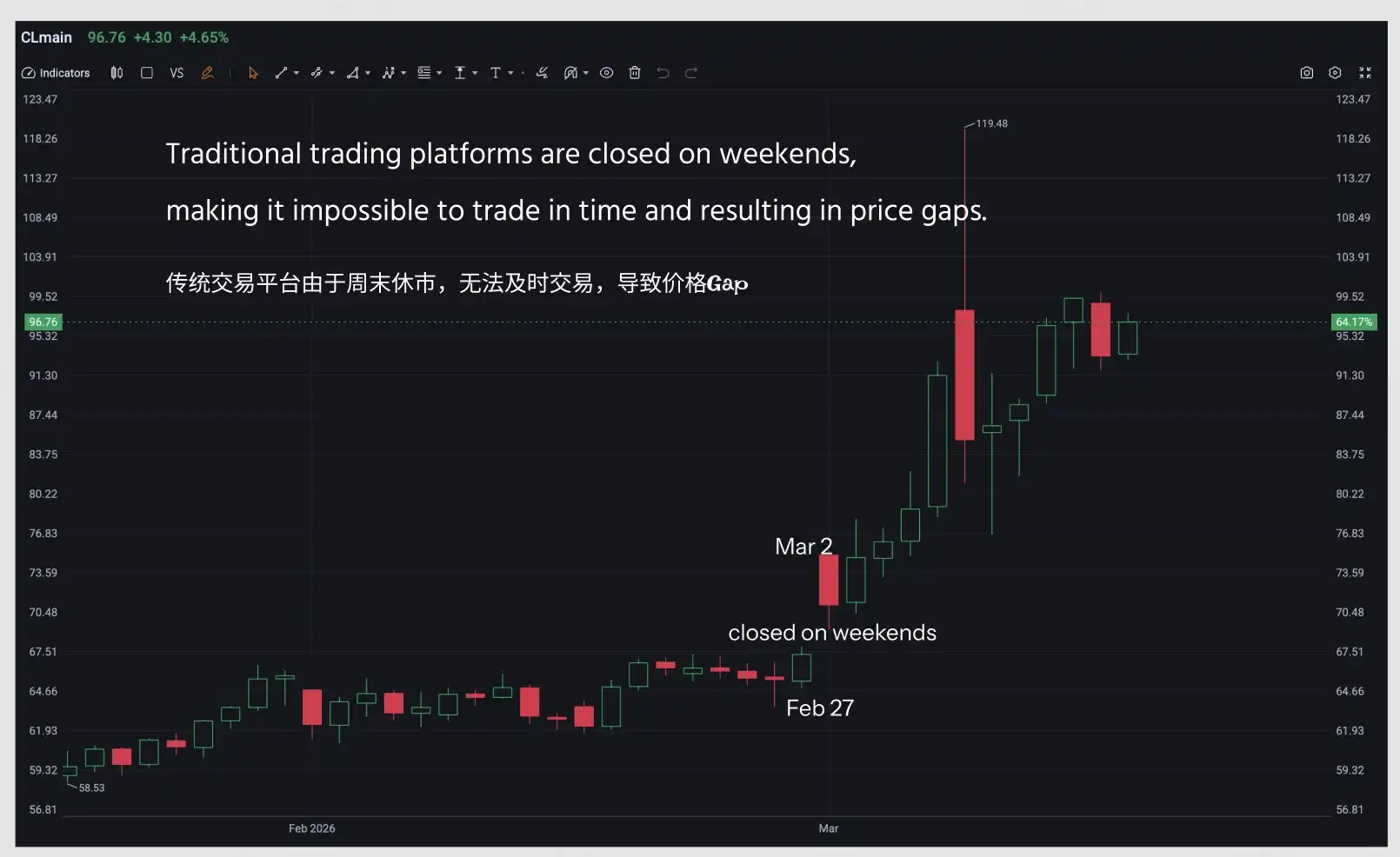
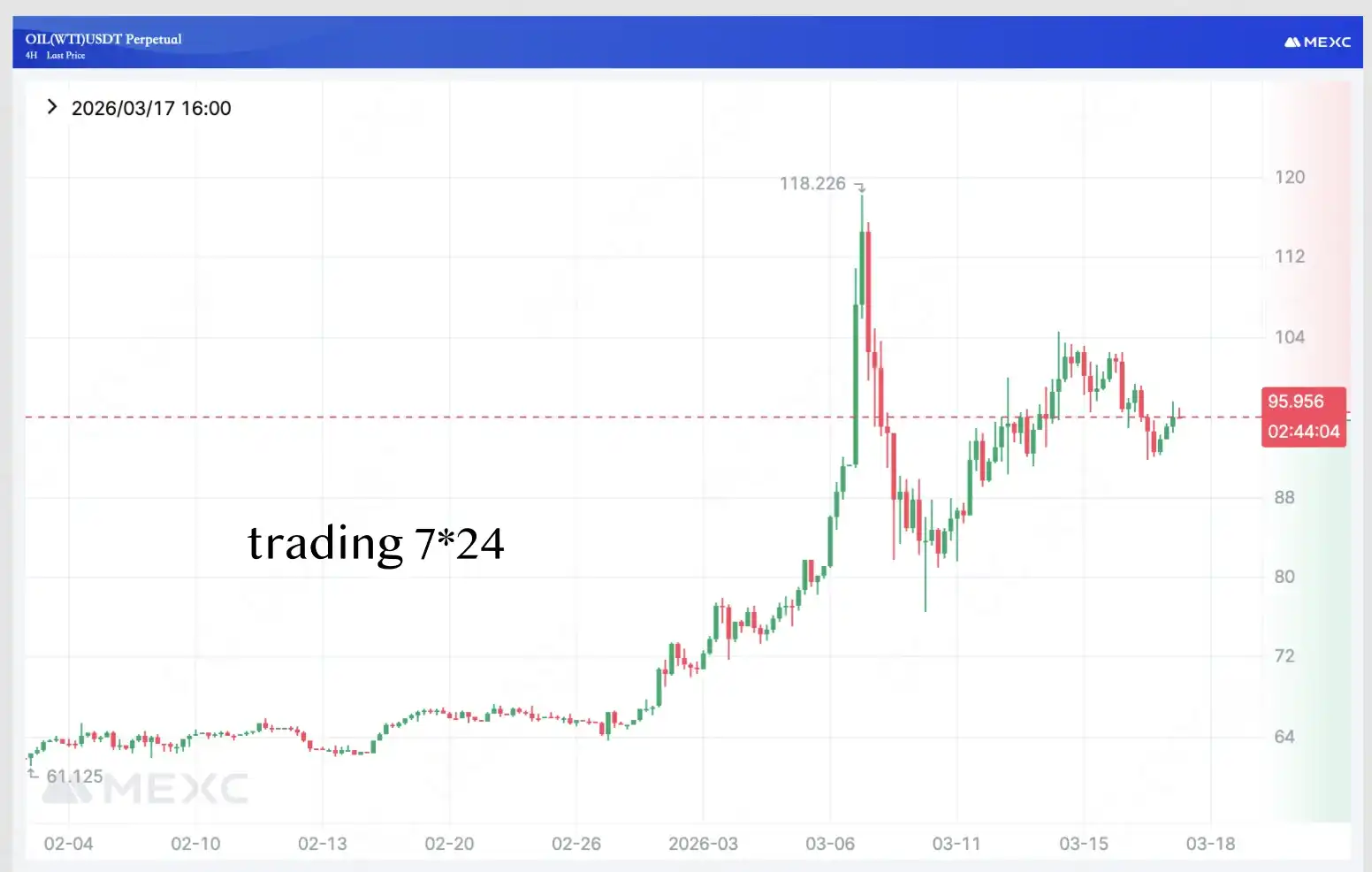
Last Saturday evening, about 20 hours before the opening of mainstream derivatives markets, the price of WTI crude oil perpetual futures on the MEXC platform surged to approximately $96 per barrel, higher than the regular crude oil futures closing price of $90.90 on Friday afternoon. In this market movement triggered by sudden conflict, crypto platforms were the first to complete the repricing of assets. Their seamless operating mechanisms made the fixed closing hours of traditional exchanges appear incredibly outdated.
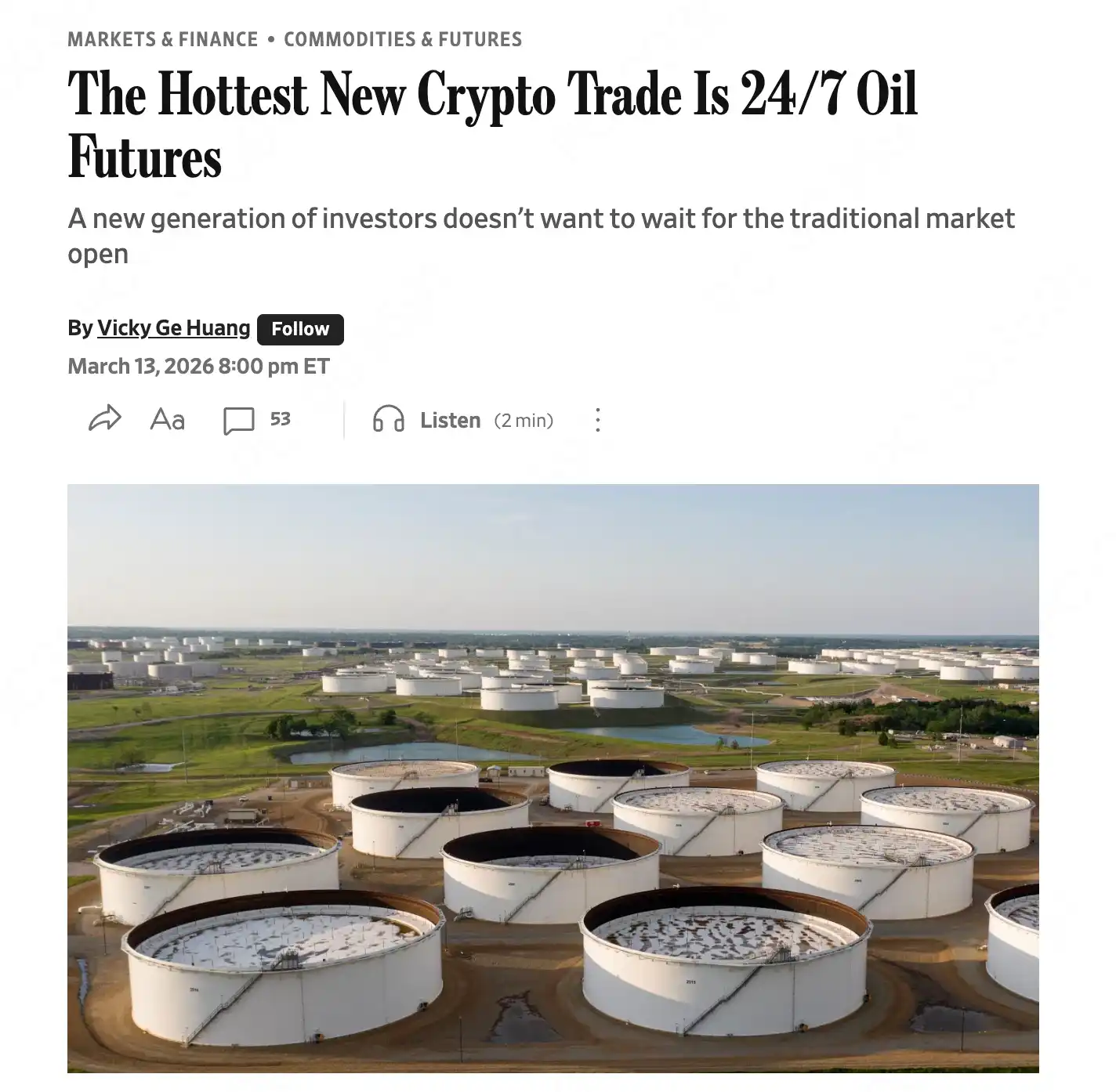
The Wall Street Journal: Accelerating Integration of Traditional and Digital Finance

This disruptive market phenomenon quickly caught the attention of The Wall Street Journal. The report pointed out that a new generation of investors is no longer willing to wait for traditional markets to open. Crypto platforms now offer perpetual futures that track commodities, a highly speculative derivative.
Perpetual contracts never expire and have no strike price (the point at which the contract becomes effective). They also allow traders to use extremely high leverage, which can amplify profits but also lead to the loss of the entire investment. As industry professionals have stated: "You don't need to wait until Monday for the market to open before everyone starts acting." This is changing the traditional model, enabling real participants to take action when weekend events occur.

Market data vividly reflects this vote of confidence with capital. In just a few days, the cumulative trading volume of oil futures surged from $339 million on February 28th to approximately $7.3 billion on Thursday.

Crossing Asset Boundaries: The 24/7 Wave from Crude Oil to U.S. Stocks

Time arbitrage in the oil market is just the beginning. Round-the-clock trading is already commonplace for cryptocurrency investors. For modern traders, the trading mechanisms provided by crypto platforms are demonstrating significant appeal for U.S. stocks and other commodities.

Wall Street is racing to utilize the digital ledger technology underpinning Bitcoin and other cryptocurrencies to tokenize stocks and other traditional assets. Similar to digital assets and prediction markets, so-called tokenized stocks are increasingly attracting the younger generation of investors who wish to trade 24/7 and react in real-time to geopolitical events and breaking company news. For example, investors can now trade contracts for popular U.S. stocks like AMD on crypto platforms at any time.
In addition to oil, crypto platforms have recently launched perpetual contracts for gold and silver, and the prices of these precious metals have also experienced abnormal volatility. Both metals saw their prices soar to historic highs, only to plummet subsequently.

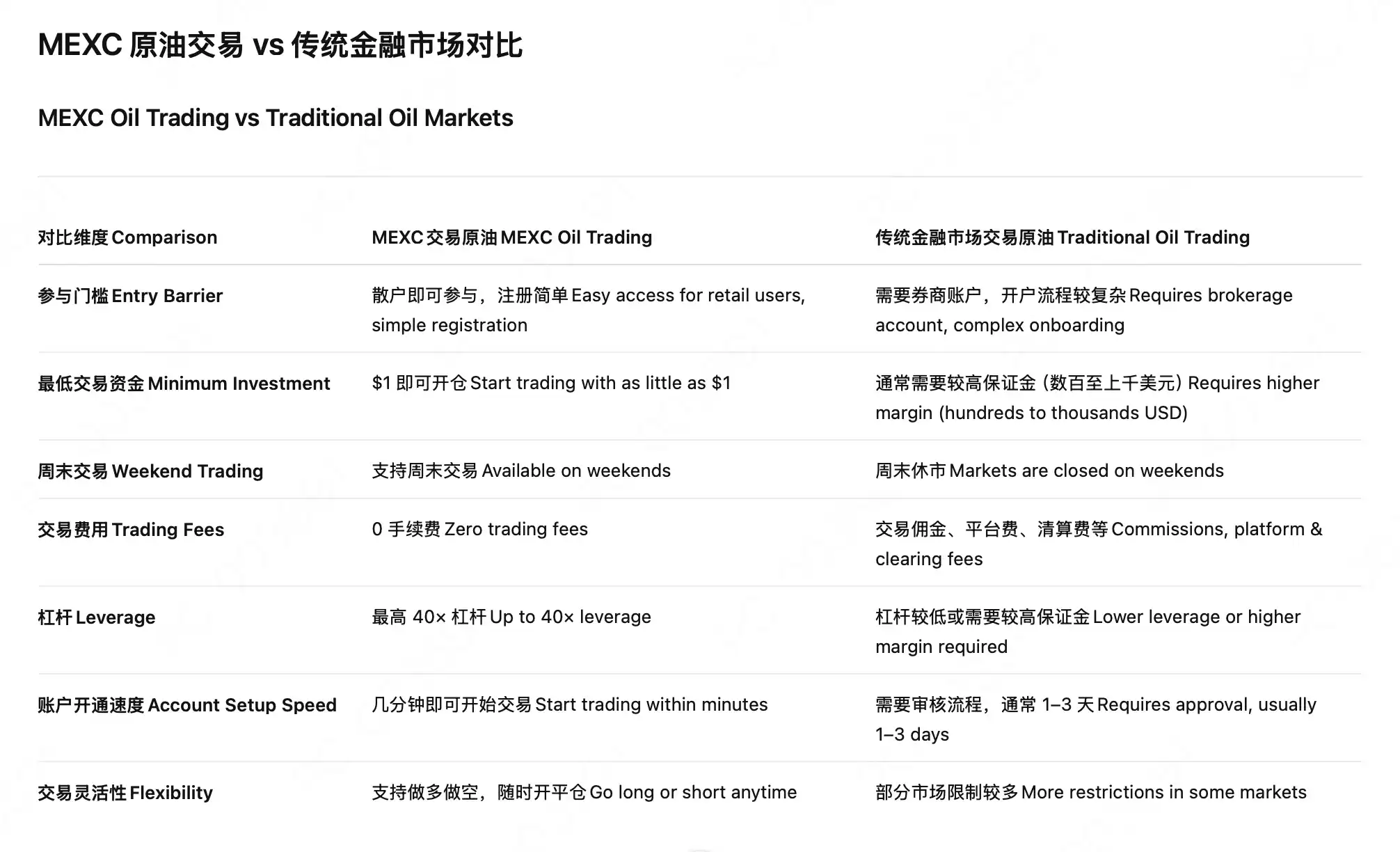
As liquidity and trading habits migrate, an irreversible trend is emerging: Crypto platforms, with their advantages of seamless 24/7 trading, high capital efficiency, and disregard for geographical and time limitations, are continuously eating into the market share of traditional trading platforms. While traditional financial institutions remain constrained by rigid operating hours, the crypto ecosystem is gradually accommodating the trading needs of a massive volume of global assets, becoming the core hub for a new generation of pricing power.

A New Paradigm of Coexisting Opportunities and Challenges

Objectively speaking, this trading model combining high leverage and 24/7 operation is a double-edged sword. The author believes that cryptocurrency traders have short attention spans, so they desire quick returns and also crave volatility. On Sunday, the author observed that oil had reached unsustainable levels and began shorting—a judgment confirmed correct: On Monday, after President Trump stated that the war with Iran was "pretty much over," crude oil futures prices fell back below $100 per barrel.

This volatility can backfire once problems arise.

For many traders, the ability to trade these assets with leverage 24/7 is highly attractive, especially on weekends when traditional markets are closed. That said, trading highly volatile assets with leverage carries genuine market risks, and the author has also noted large-scale liquidations during sudden price swings.

Despite the challenges, the recent debut of oil futures contracts on multiple crypto platforms foreshadows a future of integration between traditional and digital finance—a time when all forms of assets can be traded at any time. In this historical process, crypto exchanges are at the forefront of this transformation. For traders eager to always maintain market initiative, a trading ecosystem that never sleeps is undoubtedly the most attractive battleground for the future.


Пов'язані питання

QWhat key advantage do cryptocurrency platforms offer over traditional financial markets for trading commodities like oil, according to the article?

ACryptocurrency platforms offer 24/7 trading, allowing investors to react to geopolitical events and market-moving news in real-time, even when traditional markets are closed, thus enabling faster asset repricing.

QWhat specific financial instrument on crypto platforms is highlighted as being used to speculate on oil prices during the recent Middle East conflict?

AOil perpetual futures contracts are the instrument used, which never expire, have no strike price, and allow for the use of high leverage.

QBesides oil, what other traditional assets are mentioned as being available for trading on crypto platforms?

AThe article mentions that crypto platforms also offer perpetual contracts for gold, silver, and tokenized stocks of companies like AMD.

QWhat is one of the major risks associated with the high-leverage, 24/7 trading model described in the article?

AA major risk is the potential for massive liquidations (forced closing of positions) during periods of sudden price volatility, which can lead to traders losing their entire investment.

QWhat broader trend does the article suggest is an irreversible shift in global finance?

AThe article suggests an irreversible trend of crypto platforms, with their 24/7 operation and high capital efficiency, reshaping global asset pricing power and eroding the market share of traditional trading platforms.

Пов'язані матеріали

The King of Blind Date Attire in Korea: How SK Hynix Made a Comeback Against Samsung?

In South Korea's dating scene, SK Hynix employees are now highly sought after, a status shift fueled by the company's astronomical profits and employee bonuses, projected to reach up to 6.1 million RMB per person by 2027. This marks a dramatic reversal for the long-time second-place player in memory semiconductors, which has now surpassed its rival Samsung in annual operating profit. The turnaround story began in 2008 when a struggling Hynix, emerging from bankruptcy restructuring, took a risky bet by agreeing to develop High Bandwidth Memory (HBM) with AMD. At the time, HBM had no clear market beyond high-end graphics cards and was a costly, complex technology. Major players like Samsung, pursuing its own HMC technology, declined. For Hynix, with only memory as its core business, it was a gamble born of necessity. The pivotal moment came in 2012 when SK Group Chairman Chey Tae-won acquired Hynix. Defying industry downturns, he invested heavily in R&D and fabrication, sustaining the HBM project through over a decade of commercial uncertainty and internal challenges. A key break occurred around 2016-2017 when Samsung faced production issues supplying HBM2 for Google's TPU, allowing SK Hynix to gain a crucial foothold in the data center market. The AI explosion post-ChatGPT in 2022 was the catalyst, turning HBM into a critical bottleneck for AI accelerators like NVIDIA's GPUs. By 2025, SK Hynix captured 62% of the global HBM market, leaving Samsung at 17%. For the first time, its annual operating profit exceeded Samsung's. Analysts point to the "innovator's dilemma" to explain Samsung's miss: its vast, successful business portfolio made it risk-averse, preventing an all-in bet on the initially niche HBM technology. In contrast, SK Hynix, as a challenger with its back against the wall, had no choice but to commit fully. The story highlights how Korea's chaebol system allows for ultra-long-term bets beyond quarterly pressures. However, SK Hynix's lead isn't guaranteed. Samsung is aggressively catching up on HBM4, and challenges like customer concentration (heavy reliance on NVIDIA) and technical hurdles in advanced packaging remain. The narrative underscores a market truth: the greatest alpha often comes from betting on uncertain, long-term directions others dismiss, much like HBM in 2008.

marsbit11 хв тому

The King of Blind Date Attire in Korea: How SK Hynix Made a Comeback Against Samsung?

marsbit11 хв тому

Understanding Hash in One Article: The "Browser Miner" on Ethereum

Hash is an Ethereum-based ERC-20 token described as a "browser-minable post-quantum token." Its key features include enabling browser-based GPU mining without specialized hardware, a fixed supply cap of 21 million tokens, immutable and permissionless smart contracts with no team allocation or pre-mining, and an emphasis on post-quantum security using Keccak256 hashing. The mining mechanism is a simplified on-chain proof-of-work where miners solve unique challenges tied to their wallet address. Key design elements prevent answer theft, with epochs resetting every 100 blocks (~20 minutes) and a per-block minting limit. Emission follows a Bitcoin-like halving schedule every 100,000 mints, starting at 100 tokens per mint. Projections suggest all tokens could be mined within approximately 294 days if a target rate of one mint per minute is sustained. Hash emphasizes "post-quantum" security by leveraging hash-based primitives like Keccak256, which are considered more resistant to quantum attacks compared to elliptic-curve cryptography. While not a fully post-quantum asset, it aligns with Ethereum's broader post-quantum research narrative. The project completed its Genesis sale at $0.03 and began trading on Uniswap, with its price reaching around $0.19. The initial circulating supply is small, with 5% sold in Genesis and 5% allocated to liquidity. The majority (47.6% of total supply) is allocated to early-stage mining, leading to a front-loaded emission schedule. This structure, combined with low initial liquidity, makes Hash a high-volatility, high-risk project dependent on sustained miner participation and market demand to absorb new supply.

marsbit24 хв тому

Understanding Hash in One Article: The "Browser Miner" on Ethereum

marsbit24 хв тому

OpenAI's Largest Internal Wealth Creation: 600 People Cash Out a Total of $6.6 Billion, 75 Take Home the Maximum $30 Million Each

A Wall Street Journal report reveals OpenAI's unprecedented pre-IPO wealth creation. In a single employee stock sale last October, over 600 current and former employees sold shares, collectively cashing out approximately $6.6 billion. Due to high investor demand, the company tripled the individual sale cap to $30 million, with about 75 employees selling the maximum amount. This event represents the largest such transaction in tech industry history for a private company. OpenAI's valuation was $500 billion for this tender offer. Employees with over two years of tenure were eligible, allowing many post-ChatGPT hires their first liquidity event. The company's stock has reportedly grown over 100-fold in seven years. Following a restructuring, employees collectively hold about 26% of OpenAI. The scale of executive wealth is also staggering. In court testimony related to Elon Musk's lawsuit, President and co-founder Greg Brockman confirmed his OpenAI stake is worth around $30 billion. Analysis indicates about 165 current and former employees hold a combined ~$164.9 billion in equity, averaging nearly $1 billion per person in paper wealth. OpenAI's per-employee stock-based compensation is estimated to be 34 times the average of major tech firms before their IPOs. OpenAI continues its rapid ascent, closing a $122 billion funding round at an $852 billion valuation in March. With monthly revenue hitting $2 billion, over 900 million weekly ChatGPT users, and plans for a potential trillion-dollar IPO in late 2026, this wealth-creation engine shows no signs of stopping.

链捕手47 хв тому

OpenAI's Largest Internal Wealth Creation: 600 People Cash Out a Total of $6.6 Billion, 75 Take Home the Maximum $30 Million Each

链捕手47 хв тому

Торгівля

Спот
Ф'ючерси
活动图片




