From Pizza to Unit of Account: A Prehistory of Bitcoin Price Discovery

marsbitОпубліковано о 2026-05-19Востаннє оновлено о 2026-05-19

Анотація

From Pizza to Unit of Account: The Prehistory of Bitcoin Price Discovery This article traces Bitcoin's earliest price discovery mechanisms, focusing on its functional evolution as a unit of account rather than its price trajectory. The analysis centers on a nine-month period from October 2009 to July 2010, identifying three distinct, sequential layers of price formation. The narrative begins with the cost-of-production anchor established by NewLibertyStandard in October 2009, which calculated a unilateral USD/BTC exchange rate based on the electricity cost of mining. This constituted a posted rate, not a market-discovered price. The second layer emerged with peer-to-peer (P2P) discovery mechanisms starting in March 2010. This included Dustin Dollar's Bitcoin Market platform, which introduced a basic public order book, and forum-based实物 trades. The pivotal event in this phase was Laszlo Hanyecz's purchase of two pizzas for 10,000 BTC on May 22, 2010. Critically, the offer was made exclusively in BTC ("10,000 bitcoins for a couple of pizzas"), marking the first documented instance where Bitcoin functionally acted as a unit of account to price another good in a real transaction, 21 days before Hanyecz later provided a USD anchor (~$25). The third layer commenced in July 2010 with Jed McCaleb's launch of the Mt.Gox exchange. Its continuous order book, with last price, highs, lows, and volume, provided the first standardized, externally referenceable format for BTC/USD prices....

Prologue

On May 22, 2010, Laszlo Hanyecz exchanged 10,000 BTC for two pizzas. This day was later dubbed Bitcoin Pizza Day, commemorated annually by the crypto community in a specific way—multiplying the value of 10,000 BTC from that day by the current fiat price to produce a starkly contrasting figure, captioned "the most expensive pizza in history."

This article does not calculate that compound interest.

This article discusses something else: on May 22, 2010, Bitcoin (BTC) was, for the first time, used as a unit to price another commodity in a real transaction. This is the verifiable moment when BTC first functionally played the "unit of account" role among the three functions of money (medium of exchange / unit of account / store of value). This moment sits at the midpoint of a longer timeline of mechanisms—from cost-of-production anchoring (NewLibertyStandard), to P2P matching and discovery (Bitcoin Market), to centralized matching with continuous quotes (Mt.Gox). What Bitbase Research aims to reconstruct is this nine-month prehistory and its comparable forms with the evolutionary paths of price discovery mechanisms for various asset classes throughout history.

Chapter One · What is a "Price"—The Birth of a Unit of Account

1.1 The Three Functions of Money and the Conceptual Boundary of "Price"

The functions of money are standardly defined in financial economics textbooks. Frederic Mishkin, in Chapter 3 of the 13th edition of "The Economics of Money, Banking, and Financial Markets," divides monetary functions into three items [1]: medium of exchange, unit of account, store of value. John Hicks's judgment in the opening of "Critical Essays in Monetary Theory" (Oxford, 1967) is more concise—"money is what money does"; money is defined by its functions, not its physical form [2].

This distinction has specific methodological significance for this article. Something "having an exchange rate" is not the same as "having a price." An exchange rate can be unilaterally published—a third-party observer calculates the conversion ratio between two assets and then announces it; it does not require market participants to conclude transactions based on it, nor does it require others to reference this ratio to price their goods. Price is different. Price is the product of market matching; it requires at least two parties to agree on a conversion ratio for a specific transaction at a specific moment, and this ratio can be recognized, referenced, and reused by third parties.

By this distinction, before May 22, 2010, BTC was in a specific semantic state: it had an exchange rate, but it did not have a market price in the market sense.

1.2 The Functional Performance of "Unit of Account"

Among the three functions of money, medium of exchange and unit of account are often intuitively conflated, but they are not equivalent. The former describes "using this thing as an intermediary in a transaction"—as long as both parties are willing, anything can perform this function. The latter describes "using this thing as the unit for pricing other things." A commodity being used as a payment instrument in a transaction does not necessarily mean it simultaneously functions to price that commodity.

On May 18, 2010, Laszlo Hanyecz wrote in the initiating post of Bitcointalk topic=137: "I'll pay 10,000 bitcoins for a couple of pizzas," and explicitly allowed the other party to order Papa John's pizzas on his behalf [3]. No US Dollar (USD) amount appears in the entire initiating post—he did not say "pizzas worth how many dollars"; he said "10,000 bitcoins for two pizzas." When the completion of this transaction was reported at 19:17:26 UTC on May 22 [4], something happened at the functional level: two pizzas were priced in units of "10,000 BTC."

This is the verifiable moment when BTC was first functionally performed as a unit of account. "Functionally performing this role" and "fully satisfying this function in monetary definition" are two different things. The latter requires this unit to be consistently used as a pricing identifier across groups of traders, a condition only partially met after Mt.Gox's continuous quoting. May 22 is the first time this function appeared in an actual transaction.

Notably, the figure "about $25" does not appear in the initiating post of May 18. Hanyecz gave this fiat anchor for the first time in a subsequent reply in the same thread on June 12, 2010, at 20:14:44 UTC [5]. BTC first assumed the function of pricing pizzas in a transaction; the semantic act of "reverse identification between BTC and USD" occurred 21 days later. This temporal sequence has methodological significance: BTC's functional performance as a unit of account occurred before the bidirectional identification between BTC and USD was completed.

Chapter Two · Mechanism Timeline

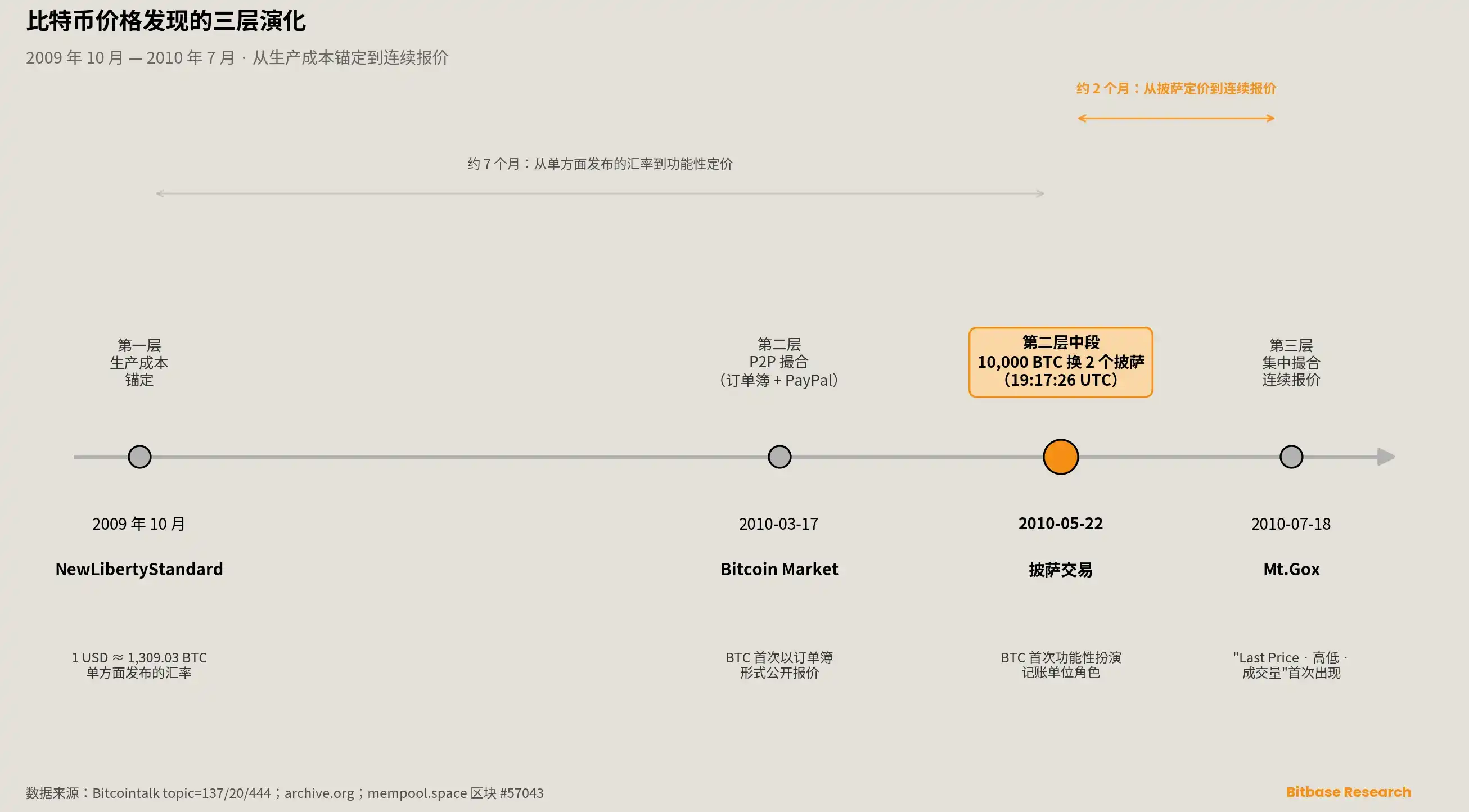
This chapter reconstructs the three-tier mechanism evolution from October 2009 to July 2010 in chronological order. Each section provides firsthand timestamps, firsthand post IDs, and a description of the mechanism itself.
2.1 Tier One · Cost-of-Production Anchoring (From October 2009)

NewLibertyStandard (hereafter NLS) published a BTC-to-USD exchange rate formula on its webpage newlibertystandard.wetpaint.com in October 2009. The website is now offline. As of May 14, 2026, the earliest recorded archive.org snapshot is from December 29, 2009, 13:26:10 UTC [6]. The formula on the snapshot reads:

During 2009 my exchange rate was calculated by dividing $1.00 by the average amount of electricity required to run a computer with high CPU for a year, 1,331.5 kWh, multiplied by the average residential cost of electricity in the United States for the previous year, $0.1136, divided by 12 months divided by the number of bitcoins generated by my computer over the past 30 days.

The methodology of this formula is to anchor BTC's value to the "marginal production cost of running a miner"—electricity cost divided by BTC output per unit time. It is essentially an extension of the classical labor-energy theory of value to digital assets: BTC had no market; it was priced by the electric meter. This is a "unilaterally published exchange rate," not a market-matched price.

The first exchange rate figure publicized by NLS, 1 USD ≈ 1,309.03 BTC, has been widely reused in secondary narratives, but there is no original post by NLS himself on the Bitcointalk forum citing this number [7]. This study adopts the archived snapshot data and honestly notes: as of May 14, 2026, this specific number is only available from the first-hand source of the archive snapshot.

Separate from NLS, the earliest recorded BTC-to-USD transaction was conducted by Martti Malmi, an early Bitcoin core contributor—on October 12, 2009, Malmi transferred 5,050 BTC to NLS, received $5.02 via PayPal, and confirmed it in a tweet on January 15, 2014 [8].

2.2 Tier Two · P2P Matching and Discovery (From March 2010)

The second tier mechanism was initiated by dwdollar (real identity Dustin Dollar). On January 15, 2010, at 09:42:18 UTC, dwdollar initiated a motion in Bitcointalk topic=20 msg=100 [9]: "I'm in the process of building an exchange. ... It will be a real market where people will be able to buy and sell Bitcoins with each other."

The platform Bitcoin Market began service on March 17, 2010. dwdollar's update post that day read: "Looks like we had our first real trade around noon!"—this was the first BTC-to-USD transaction matched via a quasi-public order book.

The matching mechanism of Bitcoin Market needs to be stated factually: it was not the complete form of order book matching. dwdollar self-described in msg=265 on February 6, 2010, at 22:37:44 UTC: "ONLY the limit orders work. Market orders will come later." [10]—the platform only supported limit orders, market orders were not implemented; settlement relied on PayPal intermediation, not pure on-chain settlement. Nevertheless, Bitcoin Market was the first platform to publicly display BTC quotes in an order book form; this form itself has mechanistic significance.

Parallel to Bitcoin Market during the same period was P2P physical matching on Bitcointalk. Hanyecz's pizza event is a representative case of this form. The two paths coexisted in parallel from March to July 2010—the dwdollar path proved BTC could be matched with USD to produce quotes, the Hanyecz path proved BTC could be matched with physical goods to produce quotes.

2.3 Midpoint · The Pizza Transaction (May 22, 2010)

Hanyecz's pizza transaction sits at the midpoint of the second tier in the mechanism timeline. Reconstructed in UTC chronological order:

  • 2010-05-18 00:35:20 UTC: Hanyecz issued the invitation in Bitcointalk topic=137 msg=1141 [3]. Hanyecz was located in Jacksonville, Florida, USA (EDT, UTC−4), corresponding to the local time of 2010-05-17 20:35. This timezone conversion explains why some secondary narratives date the initiation to May 17.

  • 2010-05-22 18:16:31 UTC: txid a1075db55d416d3ca199f55b6084e2115b9345e16c5cf302fc80e9d5fbf5d48d was included in block #57043 [11].

  • 2010-05-22 19:17:26 UTC: Hanyecz reported completion in msg=1195—"I just want to report that I successfully traded 10,000 bitcoins for pizza. Thanks jercos!" [4]

The 61-minute difference between the on-chain block time and the Bitcointalk confirmation post time is consistent with the narrative of "posting confirmation after pizza delivery." This time difference also independently confirms that the Bitcointalk forum displays timestamps in UTC, not Eastern Time.

The real identity and location of the counterparty jercos are often misstated in secondary narratives. jercos is Jeremy Sturdivant, who stated in a written interview with Bitcoin Who's Who on January 30, 2016: "I have yet to travel outside of the US, and am living on the west coast, near Santa Cruz, California." [12] According to Sturdivant's own account, he is an American, living near Santa Cruz, California, was 19 years old on May 22, 2010, and had never left the United States. The widely circulated description of a "19-year-old British person" is inconsistent with firsthand records.

Hanyecz withdrew the open invitation on June 4, 2010, at 17:51:05 UTC [13], stating "I can't afford that many more." Eight days later, on June 12, he reopened the invitation in msg=1526 and gave the USD anchor for the first time: two pizzas costing about $25, maybe $30 with a tip [5].

2.4 Tier Three · Centralized Matching with Continuous Quotes (From July 2010)

On July 18, 2010, at 01:57:19 UTC, username mtgox posted an announcement in Bitcointalk topic=444 msg=3866: "Hi Everyone, I just put up a new bitcoin exchange." [14] The operator behind this account was Jed McCaleb—founder of eDonkey, the original holder of the mtgox.com domain (an acronym for Magic: The Gathering Online eXchange). The Wayback Machine's earliest recorded capture of mtgox.com is August 17, 2007 [15], about 17 months before the BTC genesis block; this domain was repurposed as a BTC exchange in July 2010.

McCaleb described the platform's quoting architecture in msg=3873 (2010-07-18 02:15:09 UTC) of the same thread [14]: "Last Price ... High ... Low ... Volume ... Current Lowest Buy Price; Current Highest Sell Price ... All trades are between users."—"Last Price," "24-hour high/low," "volume," "best bid/ask"; this set of terms appeared for the first time in the Bitcoin context, marking that BTC now had a standard format for continuous quoting. The mechanistic difference was structural: matching between users rather than intermediary settlement, automatic continuous operation of the order book, 24/7 availability.

From this moment, BTC gained external referentiality in the unit of account dimension—others could say "my thing is worth X BTC," and X BTC had an uninterrupted USD identifier. Mt.Gox was announced to be transferred by McCaleb to MagicalTux (later Mark Karpelès) on March 6, 2011 [16]; its subsequent fate is another independent timeline not expanded here.

Chapter Three · Structural Similarity—The Same Curve Across Three Hundred Years

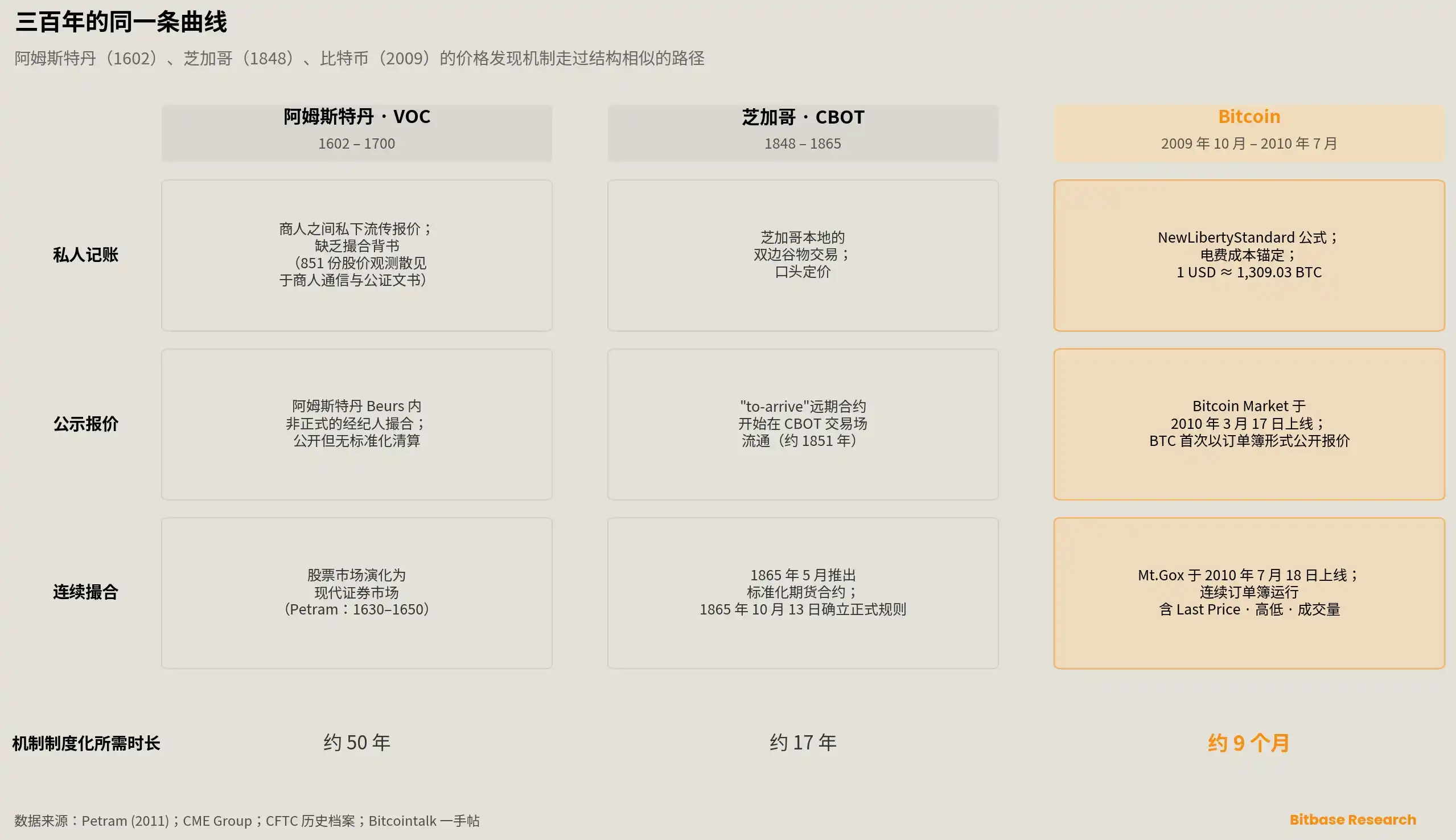
The proposition of this chapter is: The three-tier mechanism evolution completed by BTC between October 2009 and July 2010—cost-of-production anchoring → P2P matching and discovery → centralized matching with continuous quotes—has comparable structural forms with the evolutionary paths of various asset classes throughout history. This chapter presents two cases for structural comparison and does not construct a quantifiable cross-asset comparison model.

3.1 Amsterdam · The 17th-Century VOC Secondary Market

The Dutch East India Company (VOC) was established in 1602, issuing shares to 1,143 subscribers; share transfers required in-person registration by the company bookkeeper at the East India House [17]. This is generally regarded as the earliest identifiable scenario of an equity secondary market [17].

The maturation of its price discovery mechanism occurred about half a century later. Lodewijk Petram, in his 2011 PhD dissertation "The world's first stock exchange" at the University of Amsterdam, states: the stock market "evolved into a modern securities market" between 1630 and 1650, and "a continuous price discovery process took shape in that period" [17]. Petram's judgment is based on 851 sets of 17th-century stock price observation data. These data were not from official exchange records—neither the VOC nor the exchange systematically recorded prices; data were scattered in merchant correspondence, notarial deeds, and occasional newspapers. The very "dataset" of 17th-century VOC share prices grew from private bookkeeping and oral exchange rates.

The structural similarity with BTC's early path is specific. The NLS formula is to BTC what privately circulated VOC quotes among 17th-century merchants were: unilaterally published, private bookkeeping, lacking matching endorsement. Bitcoin Market is to BTC what informal broker matching within the Amsterdam Beurs was: public but lacking standardized clearing. Mt.Gox is to BTC the starting point of continuous quoting institutionalization—not the end point.

3.2 Chicago · 19th-Century CBOT Standardized Futures Contracts

The second comparison comes from 19th-century American grain trading. The Chicago Board of Trade (CBOT) was founded in 1848, initially as a spot market for commodities [18]. Around 1851, "to-arrive" forward contracts began circulating at CBOT—traders promised to deliver grain at a future date at a specified price [18].

The key institutionalization date for the price discovery mechanism is 1865. CME Group historical archives and the official history of the U.S. Commodity Futures Trading Commission (CFTC) both record [18][19]: CBOT introduced standardized futures contracts in May 1865 and established formal trading rules on October 13, 1865. There is academic controversy over this—one view holds that mature futures trading did not appear until around 1874 [18]. This study adopts 1865 as the starting point and acknowledges this periodization dispute.

The structural similarity between the CBOT path and the BTC path lies in this: the evolution from dispersed bilateral forward contracts to standardized, tradable futures contracts with margin and delivery rules follows the same curve of price discovery mechanism institutionalization. Chicago took 17 years, Bitcoin took 9 months. The difference in time scale does not dissolve the structural similarity. Price discovery in all markets does not start from an exchange; it grows from specific bilateral transactions, oral exchange rates, and private bookkeeping.
3.3 The Explanatory Power and Boundaries of Structural Similarity

Placing BTC's early path within the three-hundred-year sequence of Amsterdam–Chicago–Bitcoin yields a judgment at the mechanism level, not a quantitative model. Three assets, three institutional environments, three technological conditions, yet the price discovery mechanisms all follow the same coarse-grained path: private bookkeeping → publicized quotes → continuous matching. In other words, crypto derivatives infrastructure was not invented out of thin air; it lies on a financial institution evolution line spanning centuries.

This structural similarity argument is not a causal argument. It does not claim "BTC inevitably followed the same path as VOC and grain futures," nor does it claim "all future digital assets will follow the same curve." It claims that: when an observer faces a new asset class, the "prehistory of price discovery mechanisms" is a more enduring subject of study than "asset price trends."

Chapter Four · Acknowledging Limitations and Leaving Gaps

This piece does not expand on contemporary price discovery mechanism comparisons. ETF fund flows, CME open interest, Perpetual Futures funding rates, on-chain market-making—these are the current forms of this 16-year path, but the space and methodology required to expand on them are left for subsequent research.

There are three reverse signals for this article's core argument. First, if academic or on-chain archaeology research reveals an earlier effective entity publishing exchange rates before NewLibertyStandard, the positioning of the "first externally publicized exchange rate" needs revision. Second, if the timestamps of the three core Bitcointalk threads—topic=20, topic=137, topic=444—are proven false at the archival layer, the event anchors need resetting. Third, if the "semantic transition of unit of account" framework is replaced by a more precise monetary function evolution theory, the core argument requires revision.

This article acknowledges the following boundaries. First, "BTC's first functional performance as a unit of account" is an interpretive proposition, not the full establishment of the function in monetary definition. Second, labeling Bitcoin Market as "P2P matching and discovery" is a simplification. Third, the structural similarity argument with Amsterdam and Chicago serves only as a mechanism-level comparison and does not construct a quantifiable cross-asset comparison model. This article does not predict BTC price movements and makes no statements regarding BTC's investment attributes as a single asset.


Пов'язані питання

QWhat was the key significance of the Bitcoin Pizza Day transaction on May 22, 2010, according to the article?

AThe transaction marked the first documented instance where Bitcoin (BTC) functionally acted as a unit of account, pricing the two pizzas at 10,000 BTC, distinct from its use merely as a medium of exchange.

QDescribe the three-layer evolution of Bitcoin's price discovery mechanism in its first nine months as outlined in the article.

AThe evolution comprised: 1) Cost-of-production anchoring (NewLibertyStandard, October 2009), 2) P2P matching discovery (Bitcoin Market platform and Bitcointalk bartering, starting March 2010), and 3) Centralized continuous matching and quoting (Mt.Gox, starting July 2010).

QHow does the article distinguish between 'having an exchange rate' and 'having a price' in the context of early Bitcoin?

A'Having an exchange rate' refers to a unilaterally published conversion ratio that doesn't require market consensus or real transactions. 'Having a price' refers to a ratio resulting from market matching where at least two parties agree on a specific transaction, making the ratio identifiable and reusable by third parties.

QWhat structural similarity does the article draw between Bitcoin's early price discovery and the 17th-century Amsterdam VOC stock market?

ABoth followed a similar path: starting with private valuations or unilaterally published rates (NLS formula/merchant quotes), moving to informal public matching (Bitcoin Market/Beurs brokerages), and eventually evolving towards a formalized system of continuous, standardized quoting (Mt.Gox/VOC's mature price discovery process in the 1630s-1650s).

QAccording to the article, what are the potential signals that would require a revision of its core arguments?

AThe core arguments would need revision if: 1) An entity earlier than NewLibertyStandard publishing a valid exchange rate is discovered. 2) The timestamps in the core Bitcointalk threads (topics 20, 137, 444) are proven false. 3. A more precise theoretical framework for the evolution of monetary functions replaces the 'semantic leap as a unit of account' framework.

Пов'язані матеріали

Warsh's First Day in Office, Markets Deliver a 'Wake-up Call': Rate Hike Expected This Year

On his first day in office, newly inaugurated Federal Reserve Chairman Warsh received a stark market warning, with expectations now fully pricing in a 25-basis-point interest rate hike this year. The shift was triggered by hawkish remarks from Fed Governor Waller, who stated that inflation is now the key policy "driver" and that the odds of a hike or cut are evenly split. This sent short-term Treasury yields higher. Waller signaled a significant pivot in his stance, citing disappointing inflation and labor data. He suggested removing "easing bias" language from Fed statements and did not rule out future rate increases if inflation fails to recede, though he noted immediate action isn't warranted without signs of unanchored inflation expectations. Chairman Warsh faces immediate pressure at his first FOMC meeting in June. With the preferred inflation gauge at a three-year high, analysts warn that failing to hike could be interpreted as an implicit easing of policy. The geopolitical situation in the Middle East is adding to existing price pressures. The market's expectation for a hike contrasts sharply with earlier forecasts for multiple cuts. While long-term Treasury yields have been contained by lower energy prices recently, analysts note they remain under structural upward pressure. Warsh's swearing-in at the White House highlights political scrutiny over Fed independence. However, the market has made it clear that inflation is the most urgent challenge, leaving the new chairman little time to settle in.

marsbit1 год тому

Warsh's First Day in Office, Markets Deliver a 'Wake-up Call': Rate Hike Expected This Year

marsbit1 год тому

Has Microsoft Lost Its Way in the AI Race, and Can Copilot Bring It Back on Track?

Microsoft, once seen as an early AI frontrunner due to its investment in OpenAI, is navigating a strategic shift amid increased competition. Its initial reliance on OpenAI’s GPT models has been complicated by OpenAI’s growing ambitions as a direct competitor, rapid advancements from rivals like Claude and Gemini, and the disruptive rise of AI agents, which challenge its traditional SaaS business model. These factors contributed to stock declines and slower-than-expected adoption of its flagship Copilot products. In response, CEO Satya Nadella has taken a hands-on role in product development, signaling the urgency of change. Microsoft is pivoting from a model-centric strategy to a "model-agnostic" enterprise platform approach. It aims to become the foundational layer connecting various AI models—from OpenAI, Anthropic, or its own new "Superintelligence" team—with enterprise workflows, data, security, and cloud services. Recent organizational changes merged consumer and enterprise Copilot teams to accelerate innovation, exemplified by new products like Copilot Tasks and Copilot Cowork. However, this transformation comes at a high cost. Microsoft faces massive capital expenditures, potentially reaching ~$190 billion by 2026, to support AI infrastructure. While its platform strategy shows early signs of traction with growing Azure AI revenue, it must balance startup-like agility with the reliability expected by enterprise clients. The core challenge is no longer being the sole AI winner but defending its position as the essential enterprise software entry point amidst rapid technological commoditization and the shift towards always-on AI agents.

marsbit2 год тому

Has Microsoft Lost Its Way in the AI Race, and Can Copilot Bring It Back on Track?

marsbit2 год тому

Why Haven't Forex Stablecoins Taken Off?

Why FX Stablecoins Never Took Off: A Path Forward via Synthetic FX Despite the explosive growth of stablecoin-powered digital banking, which has seen ~$6B in VC investment and a 24x surge in crypto card spending in under a year, a major limitation persists: these banks are essentially dollar-only accounts. This leaves 95-99% of global accounts, which are denominated in non-USD currencies, underserved. Attempts to create native foreign currency (FX) stablecoins (like EURC) have largely failed, with total FX stablecoin TVL at ~$600M compared to $400B for USD stablecoins—a 700x gap. These FX tokens face critical challenges: fragile pegs due to low liquidity, limited exchange/FinTech acceptance, poor on/off-ramps, complex regional compliance, and a chicken-and-egg adoption problem. The article argues that the solution lies not in competing with entrenched USD stablecoin networks (USDT/USDC), but in adopting a synthetic FX model inspired by traditional finance. Specifically, it advocates for Mark-to-Market Non-Deliverable Forwards (NDFs)—cash-settled FX derivatives that allow users to maintain underlying USD stablecoin holdings while having their account balance and P&L denominated in a foreign currency. This approach offers key advantages: strong oracle-based pegs, retention of deep USD stablecoin liquidity and yield, superior on/off-ramps, scalability to any currency with a reliable feed, and capital efficiency. It mirrors how modern institutional FX markets operate. Primary use cases for on-chain NDFs include: 1. **Digital Banks/Wallets:** Enabling multi-currency accounts for international users without leaving the USD stablecoin ecosystem, boosting deposits and retention. 2. **FX Carry Trade Vaults:** Offering access to sovereign interest rate differentials (e.g., earning yield on BRL) in a more stable and scalable format than crypto-native products like Ethena. 3. **Global Enterprise Payments:** Allowing merchants to receive payments in local currency equivalents while settling in USD stablecoins, similar to services offered by Stripe for fiat. The conclusion is that synthetic FX, not native FX stablecoins, is the viable path to integrating foreign exchange into the growing stablecoin digital banking landscape, potentially unlocking the next phase of institutional DeFi and multi-trillion-dollar global adoption.

链捕手2 год тому

Why Haven't Forex Stablecoins Taken Off?

链捕手2 год тому

Торгівля

Спот
Ф'ючерси

Популярні статті

Що таке BITCOIN

Розуміння HarryPotterObamaSonic10Inu (ERC-20) та його позиції у крипто-просторі Останніми роками ринок криптовалют спостерігав за зростанням популярності мем-коінів, які привертають інтерес не тільки трейдерів, але й тих, хто шукає спілкування та розважальну цінність. Серед цих унікальних токенів є HarryPotterObamaSonic10Inu (ERC-20), інтригуючий проект, що поєднує культурні посилання з тканинами криптовалюти. Ця стаття досліджує ключові аспекти HarryPotterObamaSonic10Inu, вивчаючи його механізми, спільноту та його взаємодію з ширшим крипто-ландшафтом. Що таке HarryPotterObamaSonic10Inu (ERC-20)? Як випливає з його назви, HarryPotterObamaSonic10Inu є мем-коіном, побудованим на блокчейні Ethereum, класифікованим за стандартом ERC-20. На відміну від традиційних криптовалют, які можуть підкреслювати практичну корисність або інвестиційний потенціал, цей токен процвітає завдяки розважальній цінності та силі своєї спільноти. Проект спрямований на створення середовища, де зацікавлені користувачі можуть об'єднуватися, ділитися ідеями та брати участь у заходах, натхненних різноманітними культурними явищами. Однією з примітних особливостей HarryPotterObamaSonic10Inu є нульовий податок на транзакції. Цей привабливий елемент має на меті заохочувати торгівлю та участь у спільноті, позбавлену додаткових витрат, які можуть відлякувати дрібних трейдерів. Загальна пропозиція монет становить один мільярд токенів, що позначає намір підтримувати суттєву циркуляцію в межах спільноти. Творець HarryPotterObamaSonic10Inu (ERC-20) Походження HarryPotterObamaSonic10Inu дещо окутане таємницею; деталі про творця залишаються невідомими. Розвиток цього токена позбавлений впізнаваної команди або чіткої стратегії, що не є рідкістю в секторі мем-коінів. Натомість проект виник органічно, а його розвиток значною мірою залежить від ентузіазму та участі його спільноти. Інвестори HarryPotterObamaSonic10Inu (ERC-20) Щодо зовнішніх інвестицій та підтримки, HarryPotterObamaSonic10Inu також залишається невизначеним. Токен не зазначає жодних відомих інвестиційних фондів або значної організаційної підтримки. Натомість життєва сила проекту полягає в його базовій спільноті, яка інформує про його зростання та стійкість через колективні дії та залученість у крипто-просторі. Як працює HarryPotterObamaSonic10Inu (ERC-20)? Як мем-коін, HarryPotterObamaSonic10Inu функціонує передусім поза традиційними рамками, що часто регулюють вартість активів. Є кілька відмінних аспектів, що визначають, як працює проект: Транзакції без податку: Завдяки відсутності податкових зборів на транзакції, користувачі можуть вільно купувати та продавати токен, не турбуючись про приховані витрати. Залучення спільноти: Проект процвітає завдяки взаємодії спільноти, використовуючи соціальні медіа для створення шуму та сприяння залученню. Обговорення, обмін контентом та залученість є ключовими елементами, що допомагають розширити його охоплення та зміцнити лояльність серед прихильників. Відсутність практичної корисності: Слід зазначити, що HarryPotterObamaSonic10Inu не пропонує конкретної корисності в рамках фінансової екосистеми. Натомість він класифікується як токен, що призначений в основному для розваги та спільнотних активностей. Культурне посилання: Токен кмітливо вплітає елементи популярної культури, щоб привернути інтерес, зв'язуючи з ентузіастами мемів та крипто-стежками. HarryPotterObamaSonic10Inu ілюструє, як мем-коіни функціонують інакше, ніж традиційні криптовалютні проекти, увійшовши на ринок як інноваційні соціальні конструкти, а не утилітарні активи. Хронологія HarryPotterObamaSonic10Inu (ERC-20) Історія HarryPotterObamaSonic10Inu відзначена кількома значними етапами: Створення: Токен виник з вірусного мему, захопивши уяву багатьох крипто-ентузіастів. Конкретні дати створення недоступні, що підкреслює його органічний розвиток. Лістинг на біржах: HarryPotterObamaSonic10Inu з'явився на різних біржах, дозволяючи зручніший доступ і торгівлю спільноти. Ініціативи залучення спільноти: Ведення діяльності, спрямованої на покращення взаємодії спільноти, включаючи конкурси, кампанії в соціальних мережах та створення контенту від фанатів та прихильників. Плани на майбутнє: Дорожня карта проекту включає запуск колекції NFT, мерчандайзинг та електронну комерцію, пов'язану з його культурними темами, що далі залучає спільноту та намагається додати більше вимірів до його екосистеми. Ключові моменти про HarryPotterObamaSonic10Inu (ERC-20) Спільнотний підхід: Проект надає пріоритет колективному внеску та креативності, забезпечуючи, щоб участь користувачів була в центрі його розвитку. Класифікація як мем-коін: Це є його епігенез розважальної криптовалюти, що відрізняється від традиційних інвестиційних інструментів. Жодного прямого відношення до Bitcoin: Незважаючи на схожість у назві, HarryPotterObamaSonic10Inu є відмінним і не має жодного зв’язку з Bitcoin або іншими усталеними криптовалютами. Зосередженість на співпраці: HarryPotterObamaSonic10Inu створено для того, щоб надати простір для співпраці та обміну історіями серед його власників, забезпечуючи шлях для творчості та спільного зв'язку. Перспективи на майбутнє: Амбіція розширитися за межі початкової концепції в NFT та мерчандайз відкриває шлях для проекту потенційно потрапити в більш мейнстрімні сфери цифрової культури. Оскільки мем-коіни продовжують захоплювати уяву спільноти криптовалют, HarryPotterObamaSonic10Inu (ERC-20) вирізняється своїми культурними зв'язками та орієнтованим на спільноту підходом. Хоча він може не відповідати типовій моделі утилітарного токена, його суть полягає в радощах і товариськості, що підтримуються серед його прихильників, підкреслюючи еволюційну природу криптовалют в усе більш цифрову епоху. Оскільки проект продовжує розвиватися, важливо спостерігати за тим, як динаміка спільноти вплине на його траєкторію в постійно змінюваному ландшафті технології блокчейн.

1.9k переглядів усьогоОпубліковано 2024.04.01Оновлено 2024.12.03

Що таке BITCOIN

Як купити BTC

Ласкаво просимо до HTX.com! Ми зробили покупку Bitcoin (BTC) простою та зручною. Дотримуйтесь нашої покрокової інструкції, щоб розпочати свою криптовалютну подорож.Крок 1: Створіть обліковий запис на HTXВикористовуйте свою електронну пошту або номер телефону, щоб зареєструвати обліковий запис на HTX безплатно. Пройдіть безпроблемну реєстрацію й отримайте доступ до всіх функцій.ЗареєструватисьКрок 2: Перейдіть до розділу Купити крипту і виберіть спосіб оплатиКредитна/дебетова картка: використовуйте вашу картку Visa або Mastercard, щоб миттєво купити Bitcoin (BTC).Баланс: використовуйте кошти з балансу вашого рахунку HTX для безперешкодної торгівлі.Треті особи: ми додали популярні способи оплати, такі як Google Pay та Apple Pay, щоб підвищити зручність.P2P: Торгуйте безпосередньо з іншими користувачами на HTX.Позабіржова торгівля (OTC): ми пропонуємо індивідуальні послуги та конкурентні обмінні курси для трейдерів.Крок 3: Зберігайте свої Bitcoin (BTC)Після придбання Bitcoin (BTC) збережіть його у своєму обліковому записі на HTX. Крім того, ви можете відправити його в інше місце за допомогою блокчейн-переказу або використовувати його для торгівлі іншими криптовалютами.Крок 4: Торгівля Bitcoin (BTC)Легко торгуйте Bitcoin (BTC) на спотовому ринку HTX. Просто увійдіть до свого облікового запису, виберіть торгову пару, укладайте угоди та спостерігайте за ними в режимі реального часу. Ми пропонуємо зручний досвід як для початківців, так і для досвідчених трейдерів.

4.6k переглядів усьогоОпубліковано 2024.12.12Оновлено 2025.03.21

Як купити BTC

Що таке $BITCOIN

ЦИФРОВЕ ЗОЛОТО ($BITCOIN): Комплексний аналіз Вступ до ЦИФРОВОГО ЗОЛОТА ($BITCOIN) ЦИФРОВЕ ЗОЛОТО ($BITCOIN) — це проект на основі блокчейну, що працює в мережі Solana, який має на меті поєднати характеристики традиційних дорогоцінних металів з інноваціями децентралізованих технологій. Хоча він має таку ж назву, як і Bitcoin, який часто називають “цифровим золотом” через його сприйняття як засобу збереження вартості, ЦИФРОВЕ ЗОЛОТО є окремим токеном, розробленим для створення унікальної екосистеми в ландшафті Web3. Його мета — позиціонувати себе як життєздатний альтернативний цифровий актив, хоча деталі щодо його застосувань і функціональностей все ще розробляються. Що таке ЦИФРОВЕ ЗОЛОТО ($BITCOIN)? ЦИФРОВЕ ЗОЛОТО ($BITCOIN) — це токен криптовалюти, спеціально розроблений для використання в блокчейні Solana. На відміну від Bitcoin, який виконує широко визнану роль зберігання вартості, цей токен, здається, зосереджується на більш широких застосуваннях і характеристиках. Помітні аспекти включають: Інфраструктура блокчейну: Токен побудований на блокчейні Solana, відомому своєю здатністю обробляти швидкі та низьковартісні транзакції. Динаміка постачання: ЦИФРОВЕ ЗОЛОТО має максимальне постачання, обмежене 100 квадрильйонами токенів (100P $BITCOIN), хоча деталі щодо його обігового постачання наразі не розголошуються. Утиліта: Хоча точні функціональності не викладені, є вказівки на те, що токен може бути використаний для різних застосувань, потенційно пов'язаних з децентралізованими додатками (dApps) або стратегіями токенізації активів. Хто є творцем ЦИФРОВОГО ЗОЛОТА ($BITCOIN)? На даний момент особа творців і команди розробників, що стоять за ЦИФРОВИМ ЗОЛОТОМ ($BITCOIN), залишається невідомою. Ця ситуація є типовою для багатьох інноваційних проектів у сфері блокчейну, особливо тих, що пов'язані з децентралізованими фінансами та феноменом мем-коінів. Хоча така анонімність може сприяти культурі, орієнтованій на спільноту, вона посилює занепокоєння щодо управління та підзвітності. Хто є інвесторами ЦИФРОВОГО ЗОЛОТА ($BITCOIN)? Доступна інформація вказує на те, що ЦИФРОВЕ ЗОЛОТО ($BITCOIN) не має жодних відомих інституційних спонсорів або помітних венчурних капіталовкладень. Проект, здається, працює за моделлю “рівний до рівного”, зосереджуючись на підтримці та прийнятті спільноти, а не на традиційних шляхах фінансування. Його активність і ліквідність переважно розташовані на децентралізованих біржах (DEX), таких як PumpSwap, а не на встановлених централізованих торгових платформах, що ще більше підкреслює його підхід знизу вгору. Як працює ЦИФРОВЕ ЗОЛОТО ($BITCOIN) Операційні механізми ЦИФРОВОГО ЗОЛОТА ($BITCOIN) можна детальніше розглянути на основі його дизайну блокчейну та характеристик мережі: Механізм консенсусу: Використовуючи унікальний proof-of-history (PoH) Solana в поєднанні з моделлю proof-of-stake (PoS), проект забезпечує ефективну валідацію транзакцій, що сприяє високій продуктивності мережі. Токеноміка: Хоча конкретні дефляційні механізми не були детально описані, велике максимальне постачання токенів вказує на те, що воно може задовольняти мікротранзакції або нішеві випадки використання, які ще потрібно визначити. Інтероперабельність: Існує потенціал для інтеграції з більш широкою екосистемою Solana, включаючи різні платформи децентралізованих фінансів (DeFi). Однак деталі щодо конкретних інтеграцій залишаються невизначеними. Хронологія ключових подій Ось хронологія, яка підкреслює значні віхи, пов'язані з ЦИФРОВИМ ЗОЛОТОМ ($BITCOIN): 2023: Початкове розгортання токена відбувається на блокчейні Solana, позначене його адресою контракту. 2024: ЦИФРОВЕ ЗОЛОТО набуває видимості, оскільки стає доступним для торгівлі на децентралізованих біржах, таких як PumpSwap, що дозволяє користувачам торгувати ним проти SOL. 2025: Проект спостерігає спорадичну торгову активність і потенційний інтерес до ініціатив, очолюваних спільнотою, хоча на даний момент не зафіксовано жодних значних партнерств або технічних досягнень. Критичний аналіз Сильні сторони Масштабованість: Основна інфраструктура Solana підтримує високі обсяги транзакцій, що може підвищити утиліту $BITCOIN у різних сценаріях транзакцій. Доступність: Потенційно низька торгова ціна за токен може привабити роздрібних інвесторів, сприяючи більш широкій участі завдяки можливостям дробового володіння. Ризики Відсутність прозорості: Відсутність публічно відомих спонсорів, розробників або процесу аудиту може викликати скептицизм щодо стійкості та надійності проекту. Волатильність ринку: Торгова активність сильно залежить від спекулятивної поведінки, що може призвести до значної волатильності цін і невизначеності для інвесторів. Висновок ЦИФРОВЕ ЗОЛОТО ($BITCOIN) постає як цікавій, але неоднозначний проект у швидко розвиваючійся екосистемі Solana. Хоча він намагається використати наратив “цифрового золота”, його відхід від встановленої ролі Bitcoin як засобу збереження вартості підкреслює необхідність чіткішого розмежування його передбачуваної утиліти та структури управління. Майбутнє прийняття та адаптація, ймовірно, залежатиме від вирішення поточної непрозорості та більш чіткого визначення його операційних та економічних стратегій. Примітка: Цей звіт охоплює синтезовану інформацію, доступну станом на жовтень 2023 року, і можуть відбутися події, що виходять за межі дослідницького періоду.

75 переглядів усьогоОпубліковано 2025.05.13Оновлено 2025.05.13

Що таке $BITCOIN

Обговорення

Ласкаво просимо до спільноти HTX. Тут ви можете бути в курсі останніх подій розвитку платформи та отримати доступ до професійної ринкової інформації. Нижче представлені думки користувачів щодо ціни BTC (BTC).

活动图片













