Original Title:Can L1s Compete Against BTC as Cryptomoney?
Original Author: AvgJoesCrypto, Messari
Original Compilation: Dingdang, Odaily Planet Daily
Editor's Note: Recently, Haseeb Qureshi, a well-known partner at Dragonfly, published a lengthy article rejecting cynicism and embracing exponential thinking, unexpectedly bringing the community discussion back to the core issue: How much value do L1s really have left? The following content is excerpted from the upcoming "The Crypto Theses 2026" by @MessariCrypto, compiled by Odaily Planet Daily.
Cryptocurrency Drives the Entire Industry
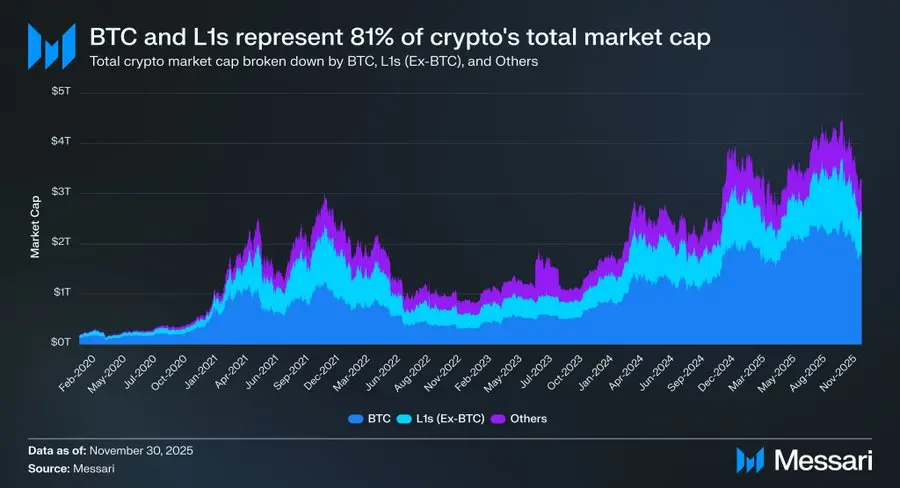
It is crucial to refocus the discussion on "cryptocurrency" itself, as most capital in the crypto industry is ultimately seeking exposure to "monetized assets." The total market capitalization of the crypto market is currently $3.26 trillion, with BTC accounting for $1.80 trillion, or 55%. Of the remaining $1.45 trillion, approximately $0.83 trillion is concentrated in various L1 public chains. This means that about $2.63 trillion, or roughly 81% of the entire market's capital, is invested in assets that the market already views as money or believes may gain a monetary premium in the future.
In this context, whether you are a trader, investor, capital manager, or developer, understanding how the market assigns or withdraws monetary premiums is essential. In the crypto industry, nothing drives valuation changes more than the market's willingness to view an asset as "money." Therefore, predicting which assets will gain monetary premiums in the future is arguably the most critical variable when building an investment portfolio.
So far, we have focused primarily on BTC, but it is also necessary to discuss those L1 assets among the remaining $0.83 trillion that "may or may not be money." As mentioned earlier, we expect BTC to continue capturing market share from gold and other non-sovereign stores of value in the coming years. But this raises a question: How much room is left for L1s? When the tide rises, will all boats (assets) rise (benefit)? Or will BTC, in its pursuit of gold, also absorb some of the monetary premium from L1 public chains?
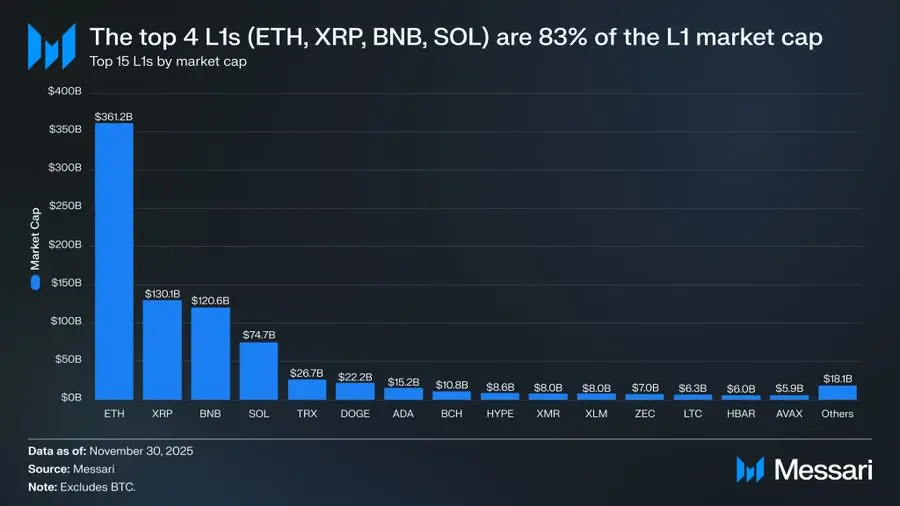
To answer these questions, we first need to look at the current valuation landscape of L1s. The top four L1s by market cap—ETH ($361.15 billion), XRP ($130.11 billion), BNB ($120.64 billion), and SOL ($74.68 billion)—have a combined market cap of $686.58 billion, accounting for 83% of the entire L1 sector. After these top four, there is a significant gap in market cap (e.g., TRX at $26.67 billion), but the tail end still holds considerable value. The total market cap of L1s outside the top 15 is still $18.06 billion, representing 2% of the total L1 market cap.
More importantly, L1 market cap is not equivalent to pure "monetary premium." There are three main valuation frameworks for L1s:
(i) Monetary Premium
(ii) Real Economic Value (REV)
(iii) Economic Security Demand
Therefore, a project's market cap is not solely determined by the market viewing it as money.
What Drives L1 Valuations Is Monetary Premium, Not Revenue
Despite the existence of multiple valuation frameworks, the market is increasingly inclined to evaluate L1s from the perspective of "monetary premium" rather than a "revenue-driven" angle. Over the past few years, the overall price-to-earnings (P/E) ratio for all L1s with a market cap exceeding $1 billion has generally remained between 150x and 200x. However, this aggregate data is misleading because it includes TRON and Hyperliquid. Over the past 30 days, TRX and HYPE contributed 70% of the revenue in this group but accounted for only 4% of the total market cap.
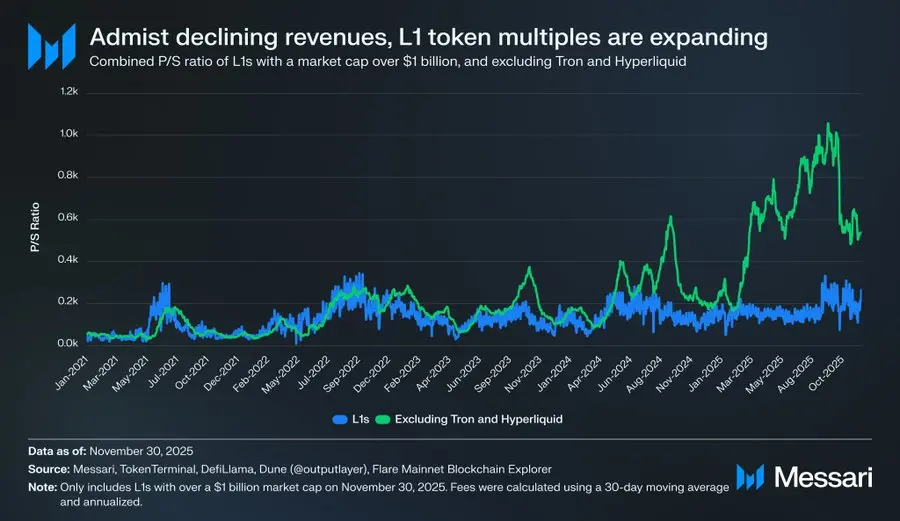
After removing these two outliers, the real story emerges. Despite continuously declining revenue, L1 valuations are rising. The adjusted P/E ratio shows a clear upward trend:
· November 30, 2021: 40x
· November 30, 2022: 212x
· November 30, 2023: 137x
· November 30, 2024: 205x
· November 30, 2025: 536x
If interpreted from an REV perspective, one might argue that the market is pricing in future revenue growth. However, this explanation does not hold, as revenue for the same group (still excluding TRON and Hyperliquid) has declined almost every year:
· 2021: $12.33 billion
· 2022: $4.89 billion (YoY -60%)
· 2023: $2.72 billion (YoY -44%)
· 2024: $3.55 billion (YoY +31%)
· 2025: Annualized $1.70 billion (YoY -52%)
In our view, the simplest and most straightforward explanation is: These valuations are primarily driven by monetary premium, not current or future revenue.
L1s Have Consistently Underperformed Bitcoin
If L1 valuations are primarily driven by the market's expectation of their monetary premium, the next question is: What shapes this expectation? A simple method is to compare their price performance with BTC's. If changes in monetary premium mainly reflect BTC's movements, these assets should perform similarly to BTC's "beta coefficient"; if the monetary premium comes from each L1's unique factors, their correlation with BTC should be weaker, and their performance should be more idiosyncratic.
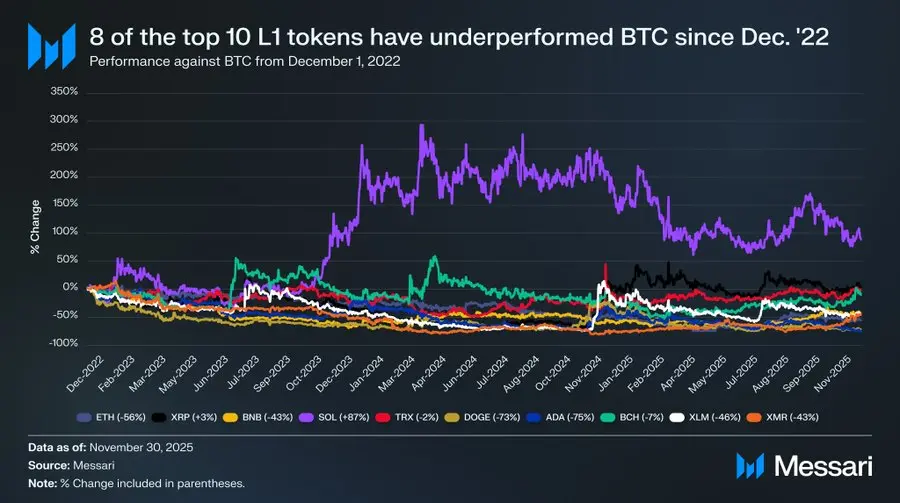
As representatives of L1s, we selected the top ten L1 tokens by market cap (excluding HYPE) and measured their performance relative to BTC since December 1, 2022. These ten assets represent about 94% of the L1 market cap, making them highly representative. During this period, eight assets underperformed BTC in absolute returns, with six lagging by more than 40%. Only two assets outperformed BTC: XRP and SOL. However, XRP's excess return was only 3%, and given its history of being driven by retail capital, we will not overinterpret this. The only asset with significant excess returns was SOL, which beat BTC by 87%.
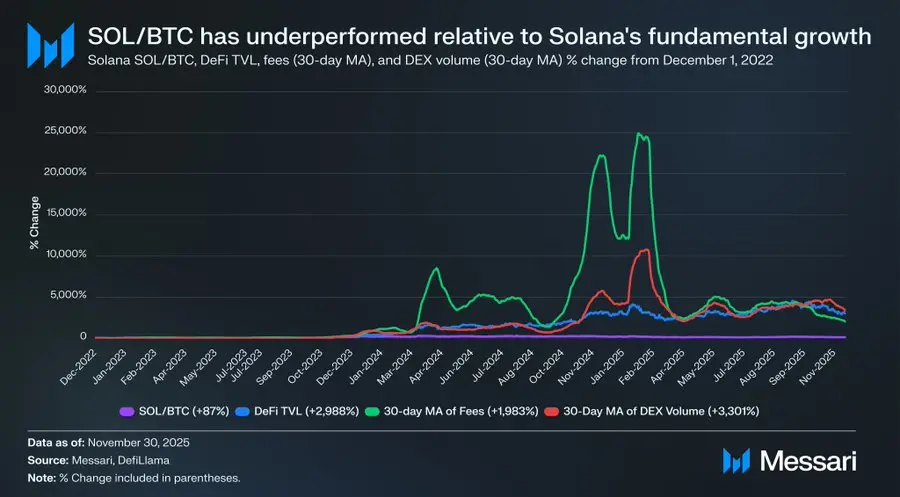
But upon closer examination, SOL's "outperformance" may not be as strong as it appears. During the same period that SOL outperformed BTC by 87%, Solana's fundamentals experienced exponential growth: DeFi TVL increased by 2,988%, fees grew by 1,983%, and DEX trading volume surged by 3,301%. By any reasonable measure, the Solana ecosystem expanded by 20 to 30 times since the end of 2022, yet SOL's price only outperformed BTC by 87%.
Please read that sentence again.
To achieve truly significant excess returns against BTC, an L1 doesn't need ecosystem growth of 200% or 300%—it needs growth of 2,000%-3,000% just to barely gain a few dozen percentage points of outperformance.
Combining the above, our judgment is: Although the market still prices L1s based on the expectation that they "may gain monetary premium in the future," confidence in these expectations is quietly waning. Meanwhile, the market's monetary premium for BTC as "cryptomoney" remains unshaken, and one could even argue that BTC's lead over various L1s is continuously widening.
Although cryptocurrency itself does not require fees or revenue to support its valuation, these metrics are crucial for L1s. Unlike BTC, the narrative for L1s depends on building an ecosystem (applications, users, throughput, economic activity, etc.) to support their token value. However, if an L1's ecosystem is showing annual declines (partly reflected in decreasing revenue and fees), it loses its only competitive advantage relative to BTC. Without real economic growth, its "cryptomoney" story becomes increasingly difficult for the market to accept.
Looking Ahead
Looking ahead, we do not believe this trend will reverse in 2026 or beyond. With few possible exceptions, we expect the L1 sector to continue losing market share, further squeezed by BTC. Since their valuations primarily rely on expectations of future monetary premium, as the market gradually concludes that BTC has the strongest claim to the "cryptomoney" narrative, L1 valuations will continue to contract. Although BTC will also face challenges in the coming years, these issues remain too distant and variable to provide effective support for the monetary premium of competing L1s.
For L1s, the bar for proving their value has been raised. Their narratives are no longer sufficiently attractive compared to BTC's, nor can they rely on market euphoria to support their valuations long-term. The era when the story of "we might become money in the future" could support trillion-dollar market caps is closing. Investors now have a decade of data proving that an L1's monetary premium can only be sustained when the ecosystem experiences extreme growth. Once growth stalls, L1s will consistently underperform BTC, and the monetary premium will dissipate.