From Bitcoin Core to Trump's Cabinet: Uncovering Epstein, Peter Thiel, and Putin's Crypto Power Network

marsbitОпубліковано о 2026-02-09Востаннє оновлено о 2026-02-09

Анотація

From Bitcoin Core to Trump's Cabinet: Uncovering Epstein, Peter Thiel, and Putin's Crypto Power Network This investigation reveals how Jeffrey Epstein leveraged his international connections to position cryptocurrency at the center of geopolitics. Through recently disclosed emails, the article traces the complex ties between Epstein, Silicon Valley billionaire Peter Thiel, former Trump strategist Steve Bannon, and high-ranking Russian officials. Epstein advised Russia to use Bitcoin to achieve a "leapfrog" reshaping of the global financial system, provided critical funding to Blockstream to sustain Bitcoin Core development, and was deeply involved in Thiel's venture capital firm. These early crypto-political maneuvers, now influencing global elections and state power through figures like J.D. Vance, represent Epstein's most隐秘 and damaging legacy. The network connected Kremlin interests, far-right populist movements, and Silicon Valley's anti-regulatory ideology, using cryptocurrency as a tool for political disruption and unaccountable financial influence.

Author: Byline Times

Translated by: Deep Tide TechFlow

Original Link:In Putin’s Orbit: The Crypto Politics of Jeffrey Epstein and Peter Thiel

Deep Tide Introduction: This article reveals how Jeffrey Epstein used his complex international network to push cryptocurrency to the center stage of geopolitics. Through recently disclosed emails, the article traces the intricate connections between Epstein, Silicon Valley magnate Peter Thiel, former Trump strategist Steve Bannon, and high-level Russian officials. Epstein not only advised Russia to use Bitcoin to 'leapfrog' and reshape the financial system but also injected capital into Blockstream at a critical moment to sustain Bitcoin Core development, and was deeply involved in Thiel's venture capital firm. These early crypto-political maneuvers are now, through the rise of figures like J.D. Vance, profoundly influencing global democratic elections and the contest for national power, becoming Epstein's most hidden and destructive legacy.

In 1957, when the Soviet Union launched the first artificial satellite, 'Sputnik,' into space, the Western world was caught off guard by a technological and cultural revolution that had been brewing for almost a decade.

In a 2013 email, Jeffrey Epstein invoked the 'Sputnik' analogy to a senior Russian official, stating that 'Russia taking the lead in finance, the same thing could happen now.' He argued that instead of merely imitating Silicon Valley and catching up with Microsoft, Apple, and Google, Russia could achieve a 'leapfrog development over global society by reinventing the 21st-century financial system' through a new type of currency and securitization.

This Russian official was Sergey Belyakov. After graduating from the FSB (Federal Security Service) spy academy, Belyakov served as a senior advisor to Oleg Deripaska, one of Vladimir Putin's most devoted oligarchs and international agents—Deripaska himself was a close associate of Epstein and Labour Party colleague Peter Mandelson. By 2013, he had become Deputy Minister of Economic Development of Russia.

Epstein reminded Belyakov that he had helped establish the US derivatives market in the 1970s, which was a precursor to the 'more advanced, disruptive securitization plans now made feasible by technology.'

Epstein insisted that Russia had a unique advantage in executing this 'grand vision of establishing a new global currency... which is larger than any single project conceived by any government, and its core is actually not difficult to achieve.'

He had reason to believe his words would be heard at the highest levels.

In a letter dated May 22, 2013, Epstein revealed: 'Putin asked me to be present at the economic conference in St. Petersburg. I refused him. If he wants to meet, he needs to set aside real, dedicated time and privacy.'
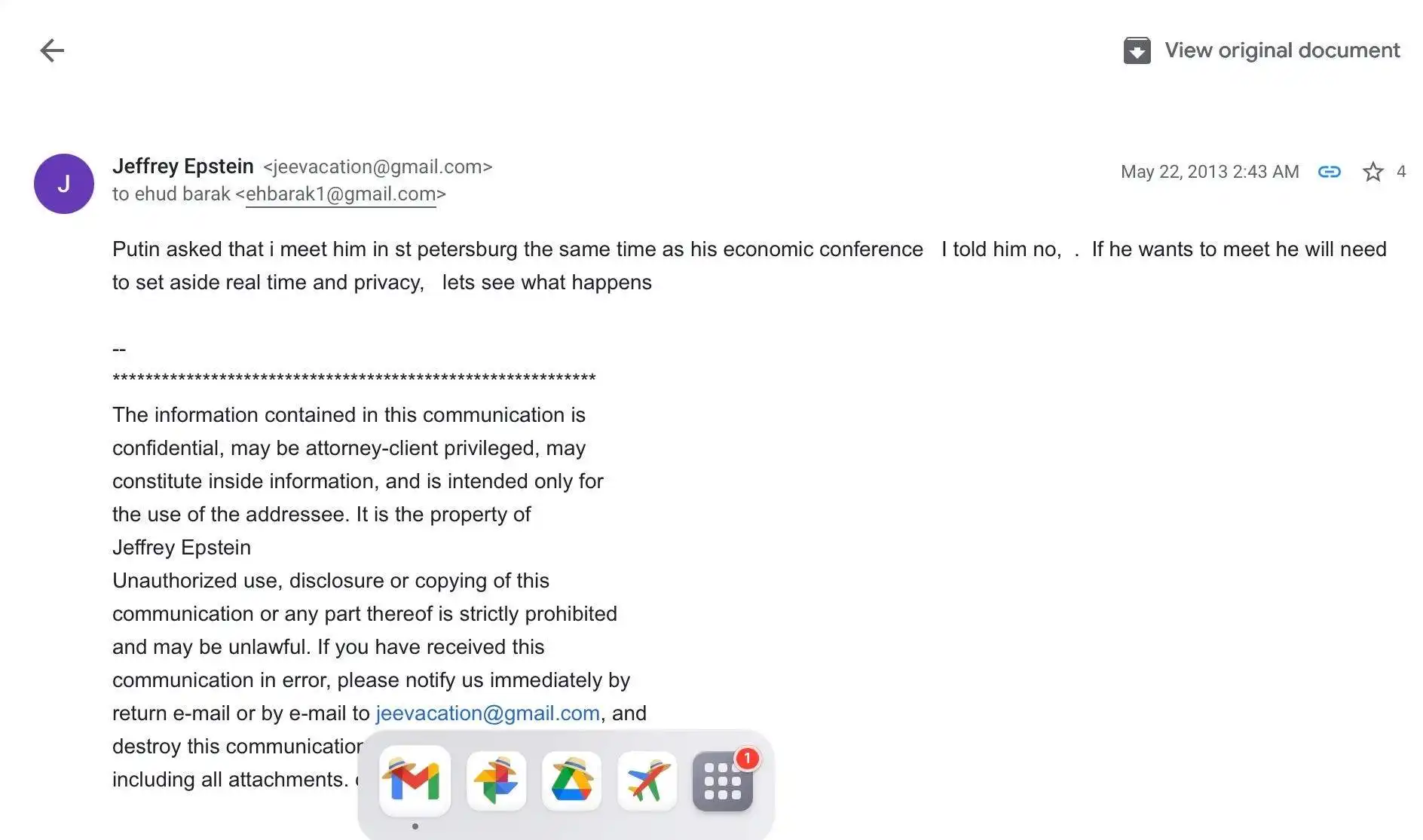
Caption: Clues to Epstein's relationship with the Kremlin

This was not baseless chatter. Epstein shared this information with former Israeli Prime Minister Ehud Barak, who was to meet Putin in person a few weeks later and could easily verify this claim through Kremlin channels.

In January 2014, Thorbjørn Jagland (then Secretary General of the Council of Europe) wrote to Epstein, stating he was planning to meet the Russian president in Sochi. Epstein told Jagland to 'explain to Putin that there should be a sophisticated Russian version of Bitcoin,' calling it 'the most advanced financial instrument globally.'

This is the prism through which to understand the rest of the crypto network built around Epstein, Vladimir Putin, Peter Thiel, and Steve Bannon.

Social Capital

Peter Thiel, co-founder of Palantir and a core member of the so-called 'PayPal Mafia' alongside Elon Musk, is an avid follower of cryptocurrency, valuing its ability to provide an alternative to government-controlled fiat currency. He once declared: 'Bitcoin is what PayPal should have been.'

He had long been a target of Epstein.

As early as 2012, Epstein received an email from fintech entrepreneur Ian Osborne suggesting they 'have a drink with Peter Thiel,' calling Thiel 'the best person to study currency,' and linking him to Abu Dhabi's sovereign wealth fund.

In 2013, Epstein urged former Israeli minister Ehud Barak to 'spend some real time with Peter Thiel.'

By July 2014, Thiel and Epstein were exchanging emails about Bitcoin regulation at the New York Stock Exchange. In September of the same year, Epstein hosted consecutive meetings with Thiel and William Burns, who was then Deputy Secretary of State in the Obama administration and is now the Director of the CIA (Central Intelligence Agency).

By 2015, Epstein proposed Thiel as one of the people Belyakov should meet. Following Epstein's advice, Belyakov contacted Thiel directly, and Thiel asked his executive assistant to schedule a face-to-face meeting for July 2015.

Epstein had multiple interests here. First was cryptocurrency. Emails from MIT (Massachusetts Institute of Technology) show that Joi Ito solicited and accepted donations from Epstein, which helped pay the salaries of Bitcoin Core developers after the Bitcoin Foundation collapsed. Another email thread shows Epstein was involved in the seed round financing of Bitcoin infrastructure development company Blockstream in 2014, increasing his allocation from $50,000 to $500,000 after Ito requested more shares in the oversubscribed deal.

But just as Thiel was interested in blockchain currency, surveillance, and data systems like Palantir, Epstein joined in, investing $40 million in Thiel's Valar Ventures. According to Ehud Barak, Thiel and Epstein 'co-owned' the firm and used it to take a share in the Israeli surveillance technology company Carbyne.

(A spokesperson for Peter Thiel later denied this, stating that Epstein was merely a 'limited partner (LP).')

As Epstein and Thiel aligned financially, their political inclinations also converged. Both were unusually important early supporters of Donald Trump's first presidential term. A brief exchange in the emails captures the tone of this relationship. Epstein wrote to Peter Thiel: 'I like your exaggeration about Trump, it's not a lie,' then suggested Thiel 'come see me in the Caribbean.'

Thiel broke with most of Silicon Valley, publicly supported Trump, and injected millions of dollars into pro-Trump super PACs. Epstein's communications show he closely followed Trump's polls against Hillary, campaign staff, and appointments related to Bitcoin and fintech.

In his speech at the 2016 Republican National Convention, Thiel used the platform of Trump's coronation to attack 'financial bubbles' and praise 'new forms of money,' later telling audiences that Bitcoin could be 'China's financial weapon' or a hedge against the dollar's reserve status.

As Russia's interference activities around the US election escalated through massive social media offensives and hacking of the Hillary campaign's emails, Epstein also arranged a luncheon at his New York townhouse, attended by Trump supporters Thiel, Tom Barrack, and Russia's Permanent Representative to the UN, Vitaly Churkin—a seasoned Kremlin operator.

After Churkin's sudden death in 2017, Epstein emailed Thiel: 'My Russian ambassador friend died. Life is short, eat dessert first.'

"Brexit is Just the Beginning"

Epstein was a frequent visitor to the UK, even beyond his connections to Ghislaine Maxwell and Andrew Mountbatten, and he closely watched British finance and politics.

In recently disclosed information and emails, he saw the UK's decision to leave the EU in the June 2016 vote as a political reshuffling and trading opportunity—something that could be shorted financially and leveraged politically. As he wrote to Peter Thiel about the chaos triggered by the referendum: 'Brexit is just the beginning.'

To achieve broader goals, beyond his maneuvers in Silicon Valley and Russia, Epstein invested significant time and intellectual capital in a major project led by former Trump campaign manager, White House Chief of Staff, Breitbart publisher, and Cambridge Analytica co-founder Steve Bannon, who had just lost his position as White House Chief of Staff and was looking for a new role.

He initially found opportunity in the pan-European populist 'Movement' (The Movement), founded in 2017 by allies like Nigel Farage's partner Laure Ferrari and People's Party leader Mischaël Modrikamen, initially led by Bannon's friend Nigel Farage himself.

Registered in Brussels, the organization's mission was to unite 'populist and conservative movements in Europe,' defending 'national sovereignty' and 'effective national borders.'

Behind the scenes, Jeffrey Epstein became a funder and strategist for Bannon's Movement, providing financial advice on how to circumvent financial regulations, offering transportation and accommodation, and introducing key figures in Europe.

During the turbulent Brexit transition, as Theresa May's government struggled to find a solution acceptable to the Brexit right wing, Bannon was flying to the UK to organize opposition.

In 2018, Bannon told Epstein he was meeting with Boris Johnson, Nigel Farage, and Jacob Rees-Mogg to organize them to overthrow Theresa May. Writer Michael Wolff wrote to Epstein, claiming to be an intermediary with leadership challenger Boris Johnson.

However, the UK was just one stop in Bannon's international populist plan. He soon texted Epstein about his broader European ambitions, claiming: 'My advisory role now covers Front National, Salvini's League, Germany's AfD, the Swiss People's Party, Orban, Land and Freedom Party, Farage—next May is the European Parliament election—we can increase from 92 seats to 200—block any crypto legislation or anything we want.'

By the time Theresa May was replaced by Boris Johnson in 2019, Bannon was ecstatic: 'May is gone... we really crushed them... we are on a roll.'

Even then, cryptocurrency never left the agenda, with Bannon agreeing: 'Crypto is currency, blockchain is equivalent to Internet 2.0.'

The Legacy of Crypto Politics

The UK left the EU in 2020. Epstein was arrested and subsequently died in prison. Farage's UKIP was replaced by his more domestically focused Reform UK. However, the lessons about fintech and its ability to reshape or disrupt democracy did not disappear.

When Farage's confidant, former UKIP MEP and Reform UK Wales leader Nathan Gill, was arrested in September 2021 on suspicion of accepting pro-Russian bribes, he was actually on his way to attend a Kremlin-backed forum on Russia's DEG electronic voting system.

He was scheduled to give a speech titled 'The Same Technology That Gives Us Crypto Will Also Change How We Vote,' explicitly linking blockchain to election infrastructure.

Subsequently, Farage's Reform UK became the first UK political party to solicit cryptocurrency donations through an overseas processor not fully regulated by the FCA (Financial Conduct Authority)—precisely the kind of opaque funding channel anti-corruption experts had warned about.

Meanwhile, Vice President J.D. Vance—whose Ohio Senate campaign was heavily funded by Thiel and who echoes Thiel's grievances against the 'Deep State' and globalism—is now at the core of Trump's plans as Vice President and the clearest advocate of national conservatism within the government.

Vance's rise implants Thiel's worldview into the executive branch: a politics that sees technology (from surveillance companies like Palantir to Bitcoin and other cryptocurrencies) as tools of national power and civilizational competition, rather than neutral infrastructure.

Against the backdrop of Epstein's 2013 Sputnik email to Moscow—urging Russia to 'reinvent the 21st-century financial system' by creating 'a new type of currency on a global scale'—the layers of the crypto-political project are exposed through Epstein's documents.

Although Epstein is no longer alive, the cryptocurrency infrastructure he helped save, Silicon Valley's ideological resistance to regulation, and the dark, unaccountable influence of crypto politics in democratic elections remain some of his most destructive legacies.

Updated on February 5, 2026, to include comments from Thiel's representative regarding Epstein's role in Valar Ventures.


Пов'язані питання

QWhat was Jeffrey Epstein's proposal to Russian officials regarding the financial system in 2013?

AEpstein proposed that Russia should not just imitate Silicon Valley but instead achieve a 'leapfrog development' over global society by reinventing the 21st-century financial system through a new type of currency and securitization, suggesting that Russia had a unique advantage in creating a 'global new currency'.

QHow did Jeffrey Epstein influence the development of Bitcoin Core according to the disclosed emails?

AEpstein provided donations that helped pay the salaries of Bitcoin Core developers after the Bitcoin Foundation collapsed. He was also involved in the seed round financing of Blockstream in 2014, increasing his allocation from $50,000 to $500,000 upon request.

QWhat role did Peter Thiel play in the relationship between Epstein and Russian officials?

AEpstein recommended Peter Thiel as a key contact for Russian Deputy Minister Sergey Belyakov. Thiel subsequently arranged a face-to-face meeting with Belyakov in July 2015, facilitated by Epstein's influence and network.

QHow did Steve Bannon and Jeffrey Epstein collaborate in the context of European populist movements?

AEpstein became a funder and strategist for Bannon's 'The Movement,' a pan-European populist initiative. He provided financial advice on circumventing regulations, offered travel and accommodation support, and introduced key European figures to advance their political goals, including influencing elections and crypto legislation.

QWhat is the connection between Nigel Farage's Reform UK and cryptocurrency, as mentioned in the article?

AReform UK became the first UK political party to solicit cryptocurrency donations through an overseas processor not fully regulated by the UK's Financial Conduct Authority (FCA), creating an opaque channel for funds that raised concerns among anti-corruption experts.

Пов'язані матеріали

Behind HYPE's Repeated Record Highs, the 'Minions' in the Ecosystem Can't Keep Up

While HYPE, the native token of the Hyperliquid ecosystem, surges to new all-time highs above $76 and attracts significant institutional ETF inflows, a starkly different reality unfolds within its HyperEVM application layer. Multiple core DeFi protocols across lending, NFTs, stablecoins, and DEXs have announced shutdowns between May and June. The article argues HYPE functions more like an "application stock" than a traditional ecosystem token. Its value is anchored to the trading fees from Hyperliquid's core perpetual contracts platform (HyperCore), which boasts a diversified revenue stream from crypto, commodities, and indices. Approximately 97% of protocol fees fund buybacks and burns of HYPE. This means HYPE's price is largely decoupled from the health of projects built on HyperEVM. The closures of significant projects like lending protocol HypurrFi (peak TVL >$300M) and NFT marketplace Drip.Trade highlight a structural tension. Hyperliquid's minimalist philosophy offers infrastructure without official grants, liquidity support, or marketing coordination for HyperEVM projects. This forces protocols into a fiercely competitive environment from day one. Furthermore, the success of HyperCore creates a liquidity vacuum, and mechanisms like HIP-3 (allowing direct perpetual market deployment) divert user attention and capital away from application-layer projects. The stronger the core perpetual trading business becomes, the more difficult it is for peripheral "DeFi lego" projects to survive and capture value, despite the flagship token's rising price.

Foresight News8 хв тому

Behind HYPE's Repeated Record Highs, the 'Minions' in the Ecosystem Can't Keep Up

Foresight News8 хв тому

Conversation with Arthur Hayes: AI Has Drained Market Liquidity, BTC Will Be Below 100k by Year-End

In this June 2026 podcast interview, BitMEX co-founder Arthur Hayes explains his decision to sell his major crypto holdings (HYPE, NEAR, Worldcoin, Zcash). His rationale is based on a macro view linking oil prices, the Iran conflict, US politics, and an impending AI bubble burst. Hayes argues that high oil prices, driven by the ongoing war, will pressure domestic US inflation. To salvage the Republican Party's chances in the midterm elections, he believes Donald Trump may pivot to a populist, anti-AI stance—advocating for taxes and regulation—which would deflate the AI investment narrative. He sees the AI sector, particularly massive capital expenditure on data centers, as having absorbed nearly all excess market liquidity (around $1.5 trillion in debt issuance since 2025), starving other assets like Bitcoin. He highlights the upcoming SpaceX IPO at a ~$1.8 trillion valuation and 100x price-to-sales ratio as a potential tipping point. If these hyped IPOs underperform, it could shatter market confidence in AI. In such a scenario, all risk assets, including crypto, would fall together as correlations converge to 1 during a broad correction. Hayes has moved his portfolio into Treasuries and energy stocks (like ExxonMobil), predicting Bitcoin will be below $100k by year-end. He sees a potential crypto bull market only after the AI frenzy cools, liquidity stops flowing exclusively into AI, and possibly after a significant market downturn prompts new monetary stimulus.

marsbit19 хв тому

Conversation with Arthur Hayes: AI Has Drained Market Liquidity, BTC Will Be Below 100k by Year-End

marsbit19 хв тому

Fed's Internal Doves Flock to Hawkish Stance, Warsh's Debut "Between a Rock and a Hard Place"

U.S. Federal Reserve officials who previously advocated for rate cuts, including Governor Christopher Waller, have recently shifted their stance, with many now not ruling out the possibility of future rate hikes. This sets a challenging stage for new Fed Chair Kevin Warsh's first policy meeting. Appointed by President Trump based on his dovish views, Warsh now faces a committee where the debate has pivoted from "when to cut" to "whether to hike," driven by persistent inflation above 3%, a strong labor market, and supply-side pressures from AI infrastructure demands and geopolitical tensions. Key figures illustrate the shift. Governor Waller, once concerned about employment, now says data has pushed him toward considering rate increases. Even moderate voices like Governor Lisa Cook, while expecting inflation to ease, have indicated readiness to hike if it fails to do so. Long-time hawks such as regional Fed presidents Beth Hammack, Lorie Logan, and Neel Kashkari have grown more vocal, arguing that the real policy rate is effectively falling and that action may soon be needed. The upcoming Fed meeting is expected to keep rates steady but will likely remove the "easing bias" from its statement, signaling a neutral stance between cuts and hikes. The quarterly "dot plot" is anticipated to show most officials projecting no cuts this year, with some potentially indicating hikes. Chair Warsh, a critic of the Fed's reliance on forward guidance like the dot plot, must navigate communicating this pivot using tools he has questioned, all while steering policy in a direction counter to the preferences of the president who appointed him. The consensus suggests the Fed's next move could well be a rate increase.

marsbit1 год тому

Fed's Internal Doves Flock to Hawkish Stance, Warsh's Debut "Between a Rock and a Hard Place"

marsbit1 год тому

The Trillion-Yuan Market Cap 'Yi Zhong Tian': Who is the True Value King?

The article analyzes the three leading Chinese optical module companies, collectively nicknamed "Yi Zhong Tian": Xinyisheng, Zhongji Innolight, and TFC Optical Communication. It evaluates their "cost-performance" not by current stock price, but through three lenses: PEG ratio (growth vs. valuation), earnings quality, and premium/discount for certainty. Xinyisheng shows the most attractive PEG ratio and high profitability, but its valuation reflects discounts for risks like high customer concentration and reliance on overseas markets. Zhongji Innolight, the most expensive, commands a premium for its market leadership, dominant share in key products like 800G/1.6T modules, and higher earnings certainty, though it faces geopolitical risks. TFC Optical, as an upstream component supplier ("water seller"), has the highest gross margin and bets on the long-term CPO/NPO architecture trend, but trades at a high valuation with more stable, less explosive growth. The core argument is that while these companies dominate module assembly, the true profit pool and technological moat lie upstream in laser and switch chips, currently controlled by U.S. firms like Lumentum and Coherent. The long-term "cost-performance" for these Chinese leaders hinges on whether the domestic industry, exemplified by companies like Yuanjie Technology, can successfully move up the value chain into high-power laser chips. Otherwise, their high growth may remain confined to the lower-margin assembly segment.

marsbit1 год тому

The Trillion-Yuan Market Cap 'Yi Zhong Tian': Who is the True Value King?

marsbit1 год тому

Торгівля

Спот
Ф'ючерси

Популярні статті

Що таке $S$

Розуміння SPERO: Комплексний огляд Вступ до SPERO Оскільки ландшафт інновацій продовжує еволюціонувати, виникнення технологій web3 та криптовалютних проектів відіграє ключову роль у формуванні цифрового майбутнього. Один з проектів, який привернув увагу в цій динамічній сфері, — це SPERO, позначений як SPERO,$$s$. Ця стаття має на меті зібрати та представити детальну інформацію про SPERO, щоб допомогти ентузіастам та інвесторам зрозуміти його основи, цілі та інновації в рамках web3 та крипто-сектору. Що таке SPERO,$$s$? SPERO,$$s$ — це унікальний проект у криптопросторі, який прагне використати принципи децентралізації та технології блокчейн для створення екосистеми, що сприяє залученню, корисності та фінансовій інклюзії. Проект розроблений для полегшення взаємодії між користувачами новими способами, надаючи їм інноваційні фінансові рішення та послуги. У своїй основі SPERO,$$s$ прагне надати можливості індивідам, забезпечуючи інструменти та платформи, які покращують користувацький досвід у криптовалютному просторі. Це включає в себе можливість більш гнучких методів транзакцій, сприяння ініціативам, що підтримуються спільнотою, та створення шляхів для фінансових можливостей через децентралізовані додатки (dApps). Основна концепція SPERO,$$s$ обертається навколо інклюзивності, прагнучи зменшити розриви в традиційній фінансовій системі, використовуючи переваги технології блокчейн. Хто є творцем SPERO,$$s$? Особистість творця SPERO,$$s$ залишається дещо невідомою, оскільки є обмежені публічно доступні ресурси, що надають детальну інформацію про його засновників. Ця відсутність прозорості може бути наслідком зобов'язання проекту до децентралізації — етики, яку багато проектів web3 поділяють, ставлячи колективні внески вище за індивідуальне визнання. Зосереджуючи обговорення навколо спільноти та її колективних цілей, SPERO,$$s$ втілює суть наділення без виділення конкретних осіб. Таким чином, розуміння етики та місії SPERO є більш важливим, ніж ідентифікація єдиного творця. Хто є інвесторами SPERO,$$s$? SPERO,$$s$ підтримується різноманітними інвесторами, починаючи від венчурних капіталістів до ангельських інвесторів, які прагнуть сприяти інноваціям у крипто-секторі. Зосередження цих інвесторів зазвичай узгоджується з місією SPERO — пріоритет надається проектам, які обіцяють технологічний прогрес у суспільстві, фінансову інклюзію та децентралізоване управління. Ці інвесторські фонди зазвичай зацікавлені в проектах, які не лише пропонують інноваційні продукти, але й позитивно впливають на спільноту блокчейн та її екосистеми. Підтримка з боку цих інвесторів підкріплює SPERO,$$s$ як значного конкурента в швидко змінюваній сфері крипто-проектів. Як працює SPERO,$$s$? SPERO,$$s$ використовує багатогранну структуру, яка відрізняє його від традиційних криптовалютних проектів. Ось деякі ключові особливості, які підкреслюють його унікальність та інноваційність: Децентралізоване управління: SPERO,$$s$ інтегрує моделі децентралізованого управління, надаючи користувачам можливість активно брати участь у процесах прийняття рішень щодо майбутнього проекту. Цей підхід сприяє відчуттю власності та відповідальності серед членів спільноти. Корисність токена: SPERO,$$s$ використовує свій власний криптовалютний токен, розроблений для виконання різних функцій в екосистемі. Ці токени дозволяють здійснювати транзакції, отримувати винагороди та полегшувати послуги, що пропонуються на платформі, підвищуючи загальну залученість та корисність. Шарова архітектура: Технічна архітектура SPERO,$$s$ підтримує модульність та масштабованість, що дозволяє безперешкодно інтегрувати додаткові функції та додатки в міру розвитку проекту. Ця адаптивність є надзвичайно важливою для збереження актуальності в постійно змінюваному крипто-ландшафті. Залучення спільноти: Проект підкреслює ініціативи, що підтримуються спільнотою, використовуючи механізми, які стимулюють співпрацю та зворотний зв'язок. Підтримуючи сильну спільноту, SPERO,$$s$ може краще задовольняти потреби користувачів та адаптуватися до ринкових тенденцій. Фокус на інклюзію: Пропонуючи низькі комісії за транзакції та зручні інтерфейси, SPERO,$$s$ прагне залучити різноманітну базу користувачів, включаючи осіб, які раніше не брали участі в крипто-просторі. Це зобов'язання до інклюзії узгоджується з його загальною місією наділення через доступність. Хронологія SPERO,$$s$ Розуміння історії проекту надає важливі уявлення про його розвиток та етапи. Нижче наведено пропоновану хронологію, що відображає значні події в еволюції SPERO,$$s$: Етап концептуалізації та ідеації: Початкові ідеї, що стали основою SPERO,$$s$, були сформовані, тісно пов'язані з принципами децентралізації та фокусом на спільноті в індустрії блокчейн. Запуск білого паперу проекту: Після концептуального етапу був випущений комплексний білий папір, що детально описує бачення, цілі та технологічну інфраструктуру SPERO,$$s$, щоб залучити інтерес та зворотний зв'язок від спільноти. Створення спільноти та ранні залучення: Активні зусилля були спрямовані на створення спільноти ранніх прихильників та потенційних інвесторів, що полегшило обговорення цілей проекту та отримання підтримки. Подія генерації токенів: SPERO,$$s$ провів подію генерації токенів (TGE) для розподілу своїх рідних токенів серед ранніх прихильників та встановлення початкової ліквідності в екосистемі. Запуск початкового dApp: Перший децентралізований додаток (dApp), пов'язаний з SPERO,$$s$, став доступним, дозволяючи користувачам взаємодіяти з основними функціями платформи. Постійний розвиток та партнерства: Безперервні оновлення та вдосконалення пропозицій проекту, включаючи стратегічні партнерства з іншими учасниками блокчейн-простору, сформували SPERO,$$s$ у конкурентоспроможного та еволюціонуючого гравця на крипто-ринку. Висновок SPERO,$$s$ є свідченням потенціалу web3 та криптовалют для революціонізації фінансових систем та наділення індивідів. Завдяки зобов'язанню до децентралізованого управління, залучення спільноти та інноваційно спроектованих функцій, він прокладає шлях до більш інклюзивного фінансового ландшафту. Як і з будь-якими інвестиціями в швидко змінюваному крипто-просторі, потенційним інвесторам та користувачам рекомендується ретельно досліджувати та обдумано взаємодіяти з поточними подіями в SPERO,$$s$. Проект демонструє інноваційний дух крипто-індустрії, запрошуючи до подальшого дослідження його численних можливостей. Хоча подорож SPERO,$$s$ ще триває, його основні принципи можуть справді вплинути на майбутнє того, як ми взаємодіємо з технологією, фінансами та один з одним у взаємопов'язаних цифрових екосистемах.

73 переглядів усьогоОпубліковано 2024.12.17Оновлено 2024.12.17

Що таке $S$

Що таке AGENT S

Агент S: Майбутнє автономної взаємодії в Web3 Вступ У постійно змінюваному ландшафті Web3 та криптовалюти інновації постійно переосмислюють, як люди взаємодіють з цифровими платформами. Один з таких новаторських проектів, Агент S, обіцяє революціонізувати взаємодію людини з комп'ютером через свою відкриту агентну структуру. Прокладаючи шлях для автономних взаємодій, Агент S прагне спростити складні завдання, пропонуючи трансформаційні застосування в штучному інтелекті (ШІ). Це детальне дослідження заглиблюється в складності проекту, його унікальні особливості та наслідки для сфери криптовалюти. Що таке Агент S? Агент S є революційною відкритою агентною структурою, спеціально розробленою для вирішення трьох основних викликів в автоматизації комп'ютерних завдань: Набуття специфічних знань у галузі: Структура інтелектуально навчається з різних зовнішніх джерел знань та внутрішнього досвіду. Цей подвійний підхід дозволяє їй створити багатий репозиторій специфічних знань у галузі, покращуючи її продуктивність у виконанні завдань. Планування на довгих горизонтах завдань: Агент S використовує планування з підкріпленням досвіду, стратегічний підхід, який полегшує ефективний розподіл та виконання складних завдань. Ця функція значно підвищує її здатність ефективно та результативно управляти кількома підзавданнями. Обробка динамічних, неоднорідних інтерфейсів: Проект представляє Інтерфейс Агент-Комп'ютер (ACI), інноваційне рішення, яке покращує взаємодію між агентами та користувачами. Використовуючи багатомодальні великі мовні моделі (MLLMs), Агент S може безперешкодно орієнтуватися та маніпулювати різноманітними графічними інтерфейсами користувача. Завдяки цим новаторським функціям Агент S надає надійну структуру, яка вирішує складнощі, пов'язані з автоматизацією людської взаємодії з машинами, прокладаючи шлях для численних застосувань у ШІ та за його межами. Хто є творцем Агент S? Хоча концепція Агент S є фундаментально новаторською, конкретна інформація про його творця залишається невідомою. Творець наразі невідомий, що підкреслює або початкову стадію проекту, або стратегічний вибір зберегти засновників у таємниці. Незважаючи на анонімність, акцент залишається на можливостях та потенціалі структури. Хто є інвесторами Агент S? Оскільки Агент S є відносно новим у криптографічній екосистемі, детальна інформація про його інвесторів та фінансових спонсорів не задокументована. Відсутність публічно доступних відомостей про інвестиційні фонди або організації, що підтримують проект, викликає питання щодо його фінансової структури та дорожньої карти розвитку. Розуміння підтримки є критично важливим для оцінки стійкості проекту та потенційного впливу на ринок. Як працює Агент S? В основі Агент S лежить передова технологія, яка дозволяє йому ефективно функціонувати в різних умовах. Його операційна модель побудована навколо кількох ключових функцій: Взаємодія з комп'ютером, подібна до людської: Структура пропонує розширене планування ШІ, прагнучи зробити взаємодії з комп'ютерами більш інтуїтивними. Імітуючи людську поведінку при виконанні завдань, вона обіцяє підвищити досвід користувачів. Наративна пам'ять: Використовується для використання високорівневого досвіду, Агент S використовує наративну пам'ять для відстеження історій завдань, тим самим покращуючи свої процеси прийняття рішень. Епізодична пам'ять: Ця функція надає користувачам покрокові інструкції, дозволяючи структурі пропонувати контекстуальну підтримку в міру виконання завдань. Підтримка OpenACI: Завдяки можливості працювати локально, Агент S дозволяє користувачам зберігати контроль над своїми взаємодіями та робочими процесами, узгоджуючи з децентралізованою етикою Web3. Легка інтеграція з зовнішніми API: Його універсальність і сумісність з різними платформами ШІ забезпечують те, що Агент S може безперешкодно вписатися в існуючі технологічні екосистеми, роблячи його привабливим вибором для розробників та організацій. Ці функціональні можливості колективно сприяють унікальному положенню Агент S у крипто-просторі, оскільки він автоматизує складні, багатоступеневі завдання з мінімальним втручанням людини. У міру розвитку проекту його потенційні застосування в Web3 можуть переосмислити, як відбуваються цифрові взаємодії. Хронологія Агент S Розробка та етапи Агент S можуть бути узагальнені в хронології, яка підкреслює його значні події: 27 вересня 2024 року: Концепція Агент S була представлена в комплексній науковій статті під назвою “Відкрита агентна структура, яка використовує комп'ютери як людина”, що демонструє основи проекту. 10 жовтня 2024 року: Наукова стаття була опублікована на arXiv, пропонуючи детальне дослідження структури та її оцінки продуктивності на основі бенчмарку OSWorld. 12 жовтня 2024 року: Було випущено відеопрезентацію, що надає візуальне уявлення про можливості та особливості Агент S, ще більше залучаючи потенційних користувачів та інвесторів. Ці маркери в хронології не лише ілюструють прогрес Агент S, але й вказують на його прихильність до прозорості та залучення громади. Ключові моменти про Агент S У міру розвитку структури Агент S кілька ключових характеристик виділяються, підкреслюючи її новаторський характер та потенціал: Інноваційна структура: Розроблена для забезпечення інтуїтивного використання комп'ютерів, подібного до людської взаємодії, Агент S пропонує новий підхід до автоматизації завдань. Автономна взаємодія: Здатність автономно взаємодіяти з комп'ютерами через GUI означає стрибок до більш інтелектуальних та ефективних обчислювальних рішень. Автоматизація складних завдань: Завдяки своїй надійній методології він може автоматизувати складні, багатоступеневі завдання, роблячи процеси швидшими та менш схильними до помилок. Безперервне вдосконалення: Механізми навчання дозволяють Агенту S покращуватися на основі минулого досвіду, постійно підвищуючи свою продуктивність та ефективність. Універсальність: Його адаптивність до різних операційних середовищ, таких як OSWorld та WindowsAgentArena, забезпечує його здатність служити широкому спектру застосувань. Оскільки Агент S займає своє місце в ландшафті Web3 та криптовалюти, його потенціал покращити можливості взаємодії та автоматизувати процеси означає значний прогрес у технологіях ШІ. Завдяки своїй інноваційній структурі Агент S є прикладом майбутнього цифрових взаємодій, обіцяючи більш безперешкодний та ефективний досвід для користувачів у різних галузях. Висновок Агент S представляє собою сміливий крок вперед у поєднанні ШІ та Web3, з можливістю переосмислити, як ми взаємодіємо з технологією. Хоча проект все ще на ранніх стадіях, можливості для його застосування є величезними та переконливими. Завдяки своїй комплексній структурі, що вирішує критичні виклики, Агент S прагне вивести автономні взаємодії на передній план цифрового досвіду. У міру того, як ми заглиблюємося в сфери криптовалюти та децентралізації, проекти, подібні до Агент S, безсумнівно, відіграватимуть ключову роль у формуванні майбутнього технологій та співпраці людини з комп'ютером.

701 переглядів усьогоОпубліковано 2025.01.14Оновлено 2025.01.14

Що таке AGENT S

Як купити S

Ласкаво просимо до HTX.com! Ми зробили покупку Sonic (S) простою та зручною. Дотримуйтесь нашої покрокової інструкції, щоб розпочати свою криптовалютну подорож.Крок 1: Створіть обліковий запис на HTXВикористовуйте свою електронну пошту або номер телефону, щоб зареєструвати обліковий запис на HTX безплатно. Пройдіть безпроблемну реєстрацію й отримайте доступ до всіх функцій.ЗареєструватисьКрок 2: Перейдіть до розділу Купити крипту і виберіть спосіб оплатиКредитна/дебетова картка: використовуйте вашу картку Visa або Mastercard, щоб миттєво купити Sonic (S).Баланс: використовуйте кошти з балансу вашого рахунку HTX для безперешкодної торгівлі.Треті особи: ми додали популярні способи оплати, такі як Google Pay та Apple Pay, щоб підвищити зручність.P2P: Торгуйте безпосередньо з іншими користувачами на HTX.Позабіржова торгівля (OTC): ми пропонуємо індивідуальні послуги та конкурентні обмінні курси для трейдерів.Крок 3: Зберігайте свої Sonic (S)Після придбання Sonic (S) збережіть його у своєму обліковому записі на HTX. Крім того, ви можете відправити його в інше місце за допомогою блокчейн-переказу або використовувати його для торгівлі іншими криптовалютами.Крок 4: Торгівля Sonic (S)Легко торгуйте Sonic (S) на спотовому ринку HTX. Просто увійдіть до свого облікового запису, виберіть торгову пару, укладайте угоди та спостерігайте за ними в режимі реального часу. Ми пропонуємо зручний досвід як для початківців, так і для досвідчених трейдерів.

1.5k переглядів усьогоОпубліковано 2025.01.15Оновлено 2026.06.02

Як купити S

Обговорення

Ласкаво просимо до спільноти HTX. Тут ви можете бути в курсі останніх подій розвитку платформи та отримати доступ до професійної ринкової інформації. Нижче представлені думки користувачів щодо ціни S (S).

活动图片













