Frenzied Sell-off

cryptonews.ruОпубліковано о 2026-08-20Востаннє оновлено о 2026-08-20

Анотація

On the evening of August 19th, Bitcoin's price surged sharply, leading to a record closure of short positions totaling over $1.6 billion. This rally, lifting Bitcoin above $72,000 for the first time since early June, was mirrored by significant gains in other cryptocurrencies like Ethereum, Solana, and XRP. The price movement was attributed to a combination of factors, including substantial inflows into Bitcoin ETFs—approximately $518 million on August 19th alone—and market reactions to former President Donald Trump's meeting with crypto industry representatives, where he advocated for the Clarity Act. However, experts caution this growth is likely temporary and technical, fueled largely by the massive short squeeze rather than a fundamental increase in demand. Institutional demand for Bitcoin remains low, with ETF inflows recovering only cautiously after major outflows in June, and retail investor activity is seasonally weak. Market participants believe Bitcoin's price trajectory in the coming months will depend heavily on the U.S. Senate's decision on the Clarity Act, which aims to provide clear crypto regulation, and on the Federal Reserve's signals regarding potential interest rate cuts. Until these events provide clearer direction, Bitcoin is expected to trade within its recent range, with volatility influenced by derivative market liquidations.

The sharp rise in the price of Bitcoin on the evening of August 19 led to a record closure of short positions: the total volume of liquidations has already exceeded $1.6 billion. The price increase is likely temporary, as investors are anticipating regulatory changes, as well as a signal from the US Federal Reserve regarding its intention to lower the key interest rate. Institutional demand for Bitcoin remains extremely low, as does retail trader activity, given its seasonal decline.

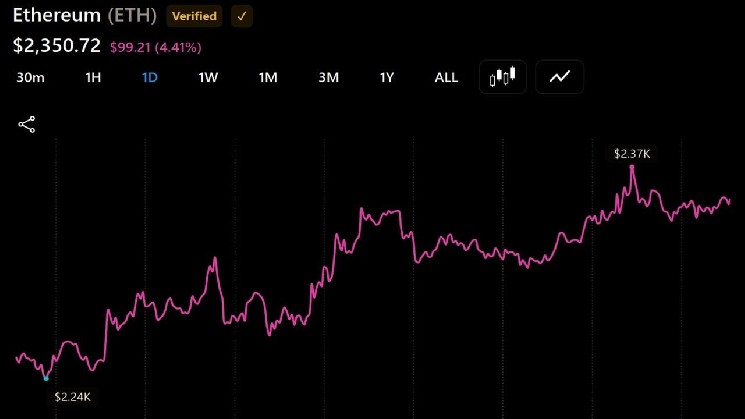
On the evening of August 19, the price of Bitcoin (BTC) began a rapid rise that continued through trading on August 20. According to Investing.com, the cryptocurrency's price soared by 10% over two days, with quotes managing to consolidate above $72K, setting new highs since early June. The sharp price increase was also noticeable in other cryptocurrencies: the price of Ether (ETH) rose by 17% over two days, surpassing $2.3K, its highest since mid-May. The price of Solana (SOL) increased by 12%, and Ripple (XRP) by 20%.

Investors significantly increased inflows into ETF funds.

According to Coinmarket.cap, on August 19 alone, they invested about $518 million, almost one and a half times more than the net inflow for the entire month of July. Experts note that such a reaction could have been prompted by the results of US President Donald Trump's meeting with representatives of the crypto industry, where the White House head reaffirmed his intention to push for the passage of the Clarity Act in the US Congress—a bill that aims to delineate cryptocurrency regulation among US agencies and make the industry more accessible to institutional investors.

However, the sharp price surge was caused not only by "hand purchases" but also by the mass closure of short positions, notes Alexander Peresichan, CEO of Technobit. According to CoinGlass, the volume of closed short positions in Bitcoin on August 19 alone exceeded a record $1.37 billion; on August 20, the liquidation volume exceeded $330 million. "Given that since the beginning of summer, the price of Bitcoin has fluctuated in the $57K–66K range, some participants bet on a further decline in quotes and placed short positions," explains Mr. Peresichan.

Considering this, the current rise in Bitcoin's price is more of a technical nature; this increase is likely to be temporary, as many investors will rush to lock in profits, market participants note. "A sharp closure of positions can temporarily lift the price, but it does not indicate increased interest in the asset," believes Igor Plotnikov, COO of Millpay. Strong institutional demand for Bitcoin is not currently observed. Despite the fact that the total net inflow into Bitcoin ETFs for July and the first two decades of August amounted to $1.8 billion, in June alone, the net outflow of funds exceeded a record $4 billion (see Kommersant, June 27). "Low inflow volumes confirm that large investors are returning to Bitcoin cautiously and are not ready to aggressively build up positions," points out Mr. Peresichan. Retail investor investments are also extremely low, including due to seasonal decline in activity, states Dmitry Tsarkov, Director of the Trading Operations Department at GBig Holdings.

In the coming months, the determining factor for cryptocurrency prices will be the US Senate's decision on the adoption of the Clarity Act, which the current US president is actively promoting, experts indicate.

"The bill should create a clear regulatory structure for the US crypto market, but its passage has stalled in the Senate due to political disagreements, so if it is not adopted in September, pressure on Bitcoin's price will increase," notes Oleg Abelev, Head of the Analytical Department at IC Rikom-Trust. "Investors are counting on the bill's passage, as without it, any current easing could be easily reversed by a future White House administration," notes Dmitry Tsarkov.

Large investors are also waiting for "a clearer position from the Fed on lowering the key interest rate," notes Mr. Plotnikov. Until then, the Bitcoin price will most likely "remain within the current price range, adjusted for position liquidations in the derivatives market," believes Mr. Tsarkov.

end-content

Пов'язані питання

QWhat event on the evening of August 19 led to a record-breaking closure of short positions in Bitcoin?

AA sharp rise in the price of Bitcoin led to a record-breaking closure of short positions, with total liquidations exceeding $1.6 billion.

QAccording to experts, what are the two main reasons for the likely temporary nature of Bitcoin's price surge in late August?

AFirst, investors are anticipating regulatory changes, specifically the passage of the Clarity Act in the U.S. Congress. Second, they are waiting for a clear signal from the U.S. Federal Reserve about its intention to lower the key interest rate.

QWhat specific legislative action by the U.S. government, discussed by former President Donald Trump, is cited as a potential catalyst for the increased ETF inflows?

AThe potential catalyst is the Clarity Act, a bill discussed by Donald Trump with crypto industry representatives. It aims to clarify cryptocurrency regulation among U.S. agencies and make the industry more accessible to institutional investors.

QWhat does the data on ETF flows indicate about institutional demand for Bitcoin despite the recent price increase?

AInstitutional demand remains extremely low. While there were inflows in July and August, the total net inflow of $1.8 billion is small compared to the record net outflow of over $4 billion in June, indicating large investors are returning cautiously.

QWhat is the expected impact on Bitcoin's price if the U.S. Clarity Act is not passed in September, according to market experts?

AAccording to experts, if the Clarity Act is not passed in September, pressure on Bitcoin's price will increase, as investors are counting on the bill to provide a clear regulatory framework and prevent future administrations from easily reversing any current easing measures.

Пов'язані матеріали

Haiwei Huaxin's Official Seal Seized by Over a Hundred People, High-Stakes Corporate Battle's 'Nuclear Deterrence' in Action Again

On August 18th, Haowei Huaxin, a semiconductor firm specializing in gallium arsenide and gallium nitride wafers, reported that over a hundred individuals forcibly entered its offices and seized the company's official seals from a safe, including the corporate, contract, and party committee seals. The incident is the latest escalation in a protracted control dispute. Haowei Huaxin, established in 2010, was originally a joint venture. Control became contested after 2021 when Zhenwei Financial Holding injected capital, becoming the largest shareholder (34.01%), while former parent Haite High-Tech's stake was diluted to 33.79%. An agreed-upon governance structure collapsed, leading to mutual accusations. Haite claimed it was locked out of the subsidiary's premises, while also alleging improper management like livestock being kept on the chip fabrication site. After state-owned Qingdao Haiyue Holdings took over Zhenwei's stake in 2023, Haite accused it of illegally seizing control. Despite Haite winning several legal battles in 2024-2026, which affirmed its rights to nominate directors and the chairman, it failed to regain physical control or recover the seals. The stakes are high: market valuations for Haite's stake in Haowei Huaxin are estimated between 3.7 to 5 billion USD, yet it is only valued at about 83 million USD on Haite's books. Losing control effectively jeopardizes a significant portion of Haite's value. In response to the seal seizure, Haite framed it as a "shareholder rights protection" action agreed upon by five shareholders. This mirrors a pattern in Chinese corporate disputes where seizing physical seals becomes a tactic to paralyze the opponent's daily operations, seen in past conflicts at companies like Dangdang and Bitmain. However, such actions don't resolve underlying ownership issues; the opposing party can report the seals stolen, declare them void, and apply for new ones, albeit with significant delay. The incident underscores how fragile corporate governance can devolve into physical confrontations over symbols of authority, with control ultimately determined by law and shareholding, not possession of a seal.

marsbit31 хв тому

Haiwei Huaxin's Official Seal Seized by Over a Hundred People, High-Stakes Corporate Battle's 'Nuclear Deterrence' in Action Again

marsbit31 хв тому

Bernstein Interprets MRNA's 177% Surge: What's Fundamentals and What's Hype?

Bernstein's analysis of Moderna's 177% stock surge following positive Phase 3 results for its individualized neoantigen therapy (INT) in melanoma distinguishes fundamental drivers from market speculation. The clinical breakthrough is real: the INTerpath-001 trial met its primary and key secondary endpoints, providing crucial validation for mRNA technology in oncology beyond infectious diseases. However, Bernstein argues the magnitude of the stock move cannot be justified by this single trial's fundamentals alone. The surge was amplified by three key factors: 1) A re-rating of Moderna's mRNA platform potential for expansion into other cancers, 2) A massive short squeeze, given ~15% of shares were sold short pre-announcement, and 3) The compelling "cancer vaccine" narrative that fueled broader investor enthusiasm. While the melanoma success is significant, Bernstein cautions that replication in lung, kidney, and bladder cancers—which have different immunogenicity—is not guaranteed. Furthermore, INT's commercial model faces challenges: it's a personalized treatment, not a mass-market vaccine, implying higher production costs and potential margin pressures despite a projected multi-billion dollar peak sales opportunity. The report also notes sector rotation, with some funds moving from crowded AI/semiconductor trades into defensive healthcare stocks, adding further momentum. In conclusion, Bernstein maintains a "Market-Perform" rating and a $45 price target, far below the post-surge price. It views the current valuation as pricing in an optimistic multi-cancer platform success and efficient commercialization that are yet to be proven. The clinical inflection point is clear, but the earnings inflection point awaits validation across future trials and commercial execution.

marsbit32 хв тому

Bernstein Interprets MRNA's 177% Surge: What's Fundamentals and What's Hype?

marsbit32 хв тому

Торгівля

Спот
活动图片