Former SEC Chair Made Shocking Revelation to Ripple’s CEO During White House Meet

bitcoinistОпубліковано о 2026-03-03Востаннє оновлено о 2026-03-03

Анотація

Former SEC Chair Gary Gensler privately apologized to Ripple CEO Brad Garlinghouse during a White House meeting on digital asset policy in late 2024, admitting he was wrong about XRP and praising Ripple’s work. This marked a significant shift after a four-year legal battle where the SEC sued Ripple for an unregistered securities offering involving XRP. Although the case created regulatory uncertainty and led to exchange delistings, Ripple secured a partial victory in 2023 when a judge ruled XRP was not a security on public markets. Gensler, who resigned in early 2025, had been a controversial figure in crypto for his aggressive enforcement approach. His apology validates Ripple’s stance and suggests a potential change in how Washington may engage with crypto.

XRP Australia 2026 turned into an unexpected window into Washington’s inner workings when Ripple CEO Brad Garlinghouse revealed that former SEC Chair Gary Gensler had privately apologized and admitted, during a high‐level White House meeting, that he had been wrong about XRP. The revelation marks an unbelievable shift in tone after years of aggressive SEC enforcement and a bruising legal battle against Ripple.

Related Reading: XRP Ledger Positioned For Real World Asset Explosion As Securitize Teases $400-T Market

The Room Where It Happened

Ripple CEO Brad Garlinghouse could hardly believe it himself as he recounted to a stunned audience the encounter he had with former SEC Chair Gary Gensler near the end of 2024 at the White House, during a meeting on digital asset policy, just after the SEC–Ripple legal battle had finally wrapped up. According to Garlinghouse’s account, Gensler approached him in private after the session ended: “He comes up to me and he says sorry,” Garlinghouse recalled, laughing, still visibly astonished:

“I’m sorry, I was wrong, and you guys have done an incredible job”

How the SEC vs Ripple Battle Defined XRP

The four-year legal battle between the SEC and Ripple began in December 2020, when the U.S. Securities and Exchange Commission sued Ripple for allegedly raising $1.3 billion through an unregistered securities offering tied to XRP, framing XRP itself as an investment contract. This resulted in many exchanges delisting XRP, putting the token under a huge regulatory cloud for years and the Ripple vs. SEC case becoming a symbol for the entire crypto market.

However, in 2023, Ripple achieved a very important partial victory, when a judge ruled that, despise some issues with certain institutional sales, XRP was not a security when sold on public markets.

More Than An Apology

Gensler, who stepped down from his role as SEC Chair in early 2025, became the face of the enemy for many in crypto as he pushed an aggressive “regulation by enforcement” strategy against digital asset projects, with Garlinghouse himself previously labeling him a “political liability” and an “autocrat”.

Related Reading: XRP’s Macro Plan Hasn’t Changed, And This Target Remains Valid

Therefore, his brief apology to Garlinghouse behind closed doors carries immense weight: it not only validates Ripple’s narrative that the SEC overreached but also hints at a broader shift in how Washington may choose to engage with XRP and the wider crypto industry going forward.
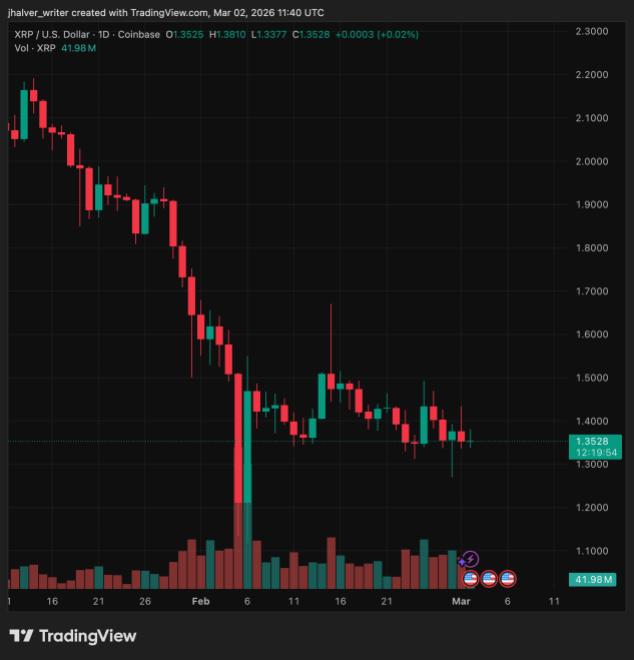
XRP's price trends to the downside on the daily chart. Source: XRPUSD on Tradingview

Cover image from ChatGPT, XRPUSD on TradingView

Пов'язані питання

QWhat shocking revelation did former SEC Chair Gary Gensler make to Ripple's CEO during a White House meeting?

AFormer SEC Chair Gary Gensler privately apologized to Ripple CEO Brad Garlinghouse and admitted, 'I'm sorry, I was wrong, and you guys have done an incredible job.'

QWhen and where did the encounter between Gary Gensler and Brad Garlinghouse take place?

AThe encounter took place near the end of 2024 at the White House, during a meeting on digital asset policy, shortly after the SEC-Ripple legal battle had concluded.

QWhat was the core allegation made by the SEC against Ripple in its 2020 lawsuit?

AThe SEC sued Ripple for allegedly raising $1.3 billion through an unregistered securities offering tied to XRP, framing XRP itself as an investment contract.

QWhat was the significant legal outcome for Ripple in 2023 that preceded this apology?

AIn 2023, a judge ruled that, despite some issues with certain institutional sales, XRP was not a security when sold on public markets, marking a major partial victory for Ripple.

QWhy does Gary Gensler's apology carry immense weight for the crypto industry, according to the article?

AThe apology not only validates Ripple's narrative that the SEC overreached but also hints at a broader shift in how Washington may choose to engage with XRP and the wider crypto industry going forward.

Пов'язані матеріали

The King of Blind Date Attire in Korea: How SK Hynix Made a Comeback Against Samsung?

In South Korea's dating scene, SK Hynix employees are now highly sought after, a status shift fueled by the company's astronomical profits and employee bonuses, projected to reach up to 6.1 million RMB per person by 2027. This marks a dramatic reversal for the long-time second-place player in memory semiconductors, which has now surpassed its rival Samsung in annual operating profit. The turnaround story began in 2008 when a struggling Hynix, emerging from bankruptcy restructuring, took a risky bet by agreeing to develop High Bandwidth Memory (HBM) with AMD. At the time, HBM had no clear market beyond high-end graphics cards and was a costly, complex technology. Major players like Samsung, pursuing its own HMC technology, declined. For Hynix, with only memory as its core business, it was a gamble born of necessity. The pivotal moment came in 2012 when SK Group Chairman Chey Tae-won acquired Hynix. Defying industry downturns, he invested heavily in R&D and fabrication, sustaining the HBM project through over a decade of commercial uncertainty and internal challenges. A key break occurred around 2016-2017 when Samsung faced production issues supplying HBM2 for Google's TPU, allowing SK Hynix to gain a crucial foothold in the data center market. The AI explosion post-ChatGPT in 2022 was the catalyst, turning HBM into a critical bottleneck for AI accelerators like NVIDIA's GPUs. By 2025, SK Hynix captured 62% of the global HBM market, leaving Samsung at 17%. For the first time, its annual operating profit exceeded Samsung's. Analysts point to the "innovator's dilemma" to explain Samsung's miss: its vast, successful business portfolio made it risk-averse, preventing an all-in bet on the initially niche HBM technology. In contrast, SK Hynix, as a challenger with its back against the wall, had no choice but to commit fully. The story highlights how Korea's chaebol system allows for ultra-long-term bets beyond quarterly pressures. However, SK Hynix's lead isn't guaranteed. Samsung is aggressively catching up on HBM4, and challenges like customer concentration (heavy reliance on NVIDIA) and technical hurdles in advanced packaging remain. The narrative underscores a market truth: the greatest alpha often comes from betting on uncertain, long-term directions others dismiss, much like HBM in 2008.

marsbit13 хв тому

The King of Blind Date Attire in Korea: How SK Hynix Made a Comeback Against Samsung?

marsbit13 хв тому

Understanding Hash in One Article: The "Browser Miner" on Ethereum

Hash is an Ethereum-based ERC-20 token described as a "browser-minable post-quantum token." Its key features include enabling browser-based GPU mining without specialized hardware, a fixed supply cap of 21 million tokens, immutable and permissionless smart contracts with no team allocation or pre-mining, and an emphasis on post-quantum security using Keccak256 hashing. The mining mechanism is a simplified on-chain proof-of-work where miners solve unique challenges tied to their wallet address. Key design elements prevent answer theft, with epochs resetting every 100 blocks (~20 minutes) and a per-block minting limit. Emission follows a Bitcoin-like halving schedule every 100,000 mints, starting at 100 tokens per mint. Projections suggest all tokens could be mined within approximately 294 days if a target rate of one mint per minute is sustained. Hash emphasizes "post-quantum" security by leveraging hash-based primitives like Keccak256, which are considered more resistant to quantum attacks compared to elliptic-curve cryptography. While not a fully post-quantum asset, it aligns with Ethereum's broader post-quantum research narrative. The project completed its Genesis sale at $0.03 and began trading on Uniswap, with its price reaching around $0.19. The initial circulating supply is small, with 5% sold in Genesis and 5% allocated to liquidity. The majority (47.6% of total supply) is allocated to early-stage mining, leading to a front-loaded emission schedule. This structure, combined with low initial liquidity, makes Hash a high-volatility, high-risk project dependent on sustained miner participation and market demand to absorb new supply.

marsbit27 хв тому

Understanding Hash in One Article: The "Browser Miner" on Ethereum

marsbit27 хв тому

OpenAI's Largest Internal Wealth Creation: 600 People Cash Out a Total of $6.6 Billion, 75 Take Home the Maximum $30 Million Each

A Wall Street Journal report reveals OpenAI's unprecedented pre-IPO wealth creation. In a single employee stock sale last October, over 600 current and former employees sold shares, collectively cashing out approximately $6.6 billion. Due to high investor demand, the company tripled the individual sale cap to $30 million, with about 75 employees selling the maximum amount. This event represents the largest such transaction in tech industry history for a private company. OpenAI's valuation was $500 billion for this tender offer. Employees with over two years of tenure were eligible, allowing many post-ChatGPT hires their first liquidity event. The company's stock has reportedly grown over 100-fold in seven years. Following a restructuring, employees collectively hold about 26% of OpenAI. The scale of executive wealth is also staggering. In court testimony related to Elon Musk's lawsuit, President and co-founder Greg Brockman confirmed his OpenAI stake is worth around $30 billion. Analysis indicates about 165 current and former employees hold a combined ~$164.9 billion in equity, averaging nearly $1 billion per person in paper wealth. OpenAI's per-employee stock-based compensation is estimated to be 34 times the average of major tech firms before their IPOs. OpenAI continues its rapid ascent, closing a $122 billion funding round at an $852 billion valuation in March. With monthly revenue hitting $2 billion, over 900 million weekly ChatGPT users, and plans for a potential trillion-dollar IPO in late 2026, this wealth-creation engine shows no signs of stopping.

链捕手50 хв тому

OpenAI's Largest Internal Wealth Creation: 600 People Cash Out a Total of $6.6 Billion, 75 Take Home the Maximum $30 Million Each

链捕手50 хв тому

Торгівля

Спот
Ф'ючерси

Популярні статті

Як купити HOUSE

Ласкаво просимо до HTX.com! Ми зробили покупку Housecoin (HOUSE) простою та зручною. Дотримуйтесь нашої покрокової інструкції, щоб розпочати свою криптовалютну подорож.Крок 1: Створіть обліковий запис на HTXВикористовуйте свою електронну пошту або номер телефону, щоб зареєструвати обліковий запис на HTX безплатно. Пройдіть безпроблемну реєстрацію й отримайте доступ до всіх функцій.ЗареєструватисьКрок 2: Перейдіть до розділу Купити крипту і виберіть спосіб оплатиКредитна/дебетова картка: використовуйте вашу картку Visa або Mastercard, щоб миттєво купити Housecoin (HOUSE).Баланс: використовуйте кошти з балансу вашого рахунку HTX для безперешкодної торгівлі.Треті особи: ми додали популярні способи оплати, такі як Google Pay та Apple Pay, щоб підвищити зручність.P2P: Торгуйте безпосередньо з іншими користувачами на HTX.Позабіржова торгівля (OTC): ми пропонуємо індивідуальні послуги та конкурентні обмінні курси для трейдерів.Крок 3: Зберігайте свої Housecoin (HOUSE)Після придбання Housecoin (HOUSE) збережіть його у своєму обліковому записі на HTX. Крім того, ви можете відправити його в інше місце за допомогою блокчейн-переказу або використовувати його для торгівлі іншими криптовалютами.Крок 4: Торгівля Housecoin (HOUSE)Легко торгуйте Housecoin (HOUSE) на спотовому ринку HTX. Просто увійдіть до свого облікового запису, виберіть торгову пару, укладайте угоди та спостерігайте за ними в режимі реального часу. Ми пропонуємо зручний досвід як для початківців, так і для досвідчених трейдерів.

340 переглядів усьогоОпубліковано 2025.04.27Оновлено 2025.04.27

Як купити HOUSE

Обговорення

Ласкаво просимо до спільноти HTX. Тут ви можете бути в курсі останніх подій розвитку платформи та отримати доступ до професійної ринкової інформації. Нижче представлені думки користувачів щодо ціни HOUSE (HOUSE).

活动图片