Former New York Mayor Involved in Rug Pull Allegations: On-Chain Investigation into NYC Token

marsbitОпубліковано о 2026-01-15Востаннє оновлено о 2026-01-15

Анотація

Former New York City Mayor Eric Adams faces allegations of a "rug pull" following the launch of the NYC token. Shortly after its debut on January 13, the token’s value plummeted over 80% when the liquidity pool creator address (9Ty4M4t9MZArhJBKFWbYrzeqdMf2Ua5eHWSRW3LXKyGt) removed approximately 2.377 million USDC just 30 minutes post-launch. This caused the token’s market cap to crash from a high of $600 million to under $100 million. Beosin’s on-chain analysis traced the initial funding to a Mayan bridge and Kraken. After the crash, the same address began making small purchases of NYC tokens, but the price only recovered to around $0.133. The address still holds 1.332 million USDC, resulting in an estimated profit of $330,000. Adams denied personal profit or involvement in removing funds. However, the analysis confirms liquidity manipulation, with only about $1 million returned to liquidity after $2.37 million was withdrawn. This incident highlights the significant risks associated with celebrity-backed tokens.

Author: Beosin

On January 13-14, former New York City Mayor Eric Adams faced significant scrutiny after the token he launched, NYC, experienced a sharp price drop shortly after its release. The Beosin security team conducted a detailed on-chain analysis of the incident and shares the findings below:

Event Overview

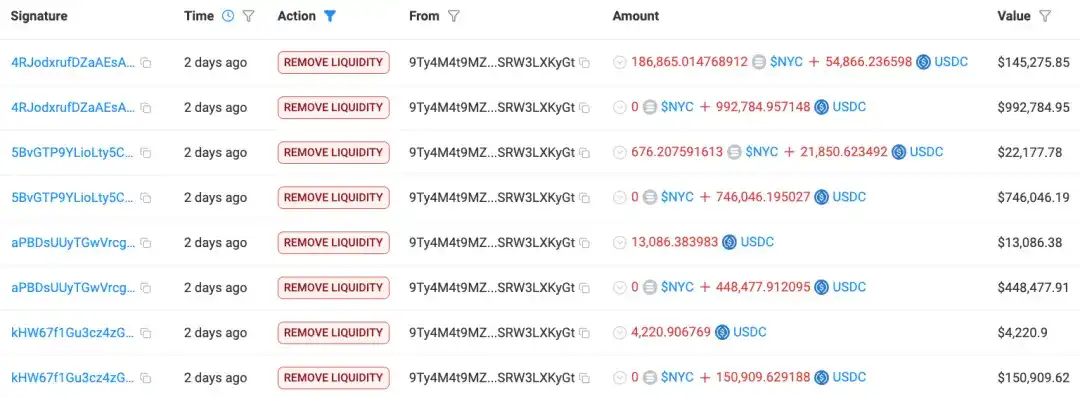
On January 13, Beijing time, former New York City Mayor Eric Adams announced the launch of the NYC token (token contract address: Ho5fkxk9uqUuVN5kt7TUFacduWCpKPAuYkM9HD3KAXA2) on social media. However, just 30 minutes after the token went live, the address that created the liquidity pool, 9Ty4M4t9MZArhJBKFWbYrzeqdMf2Ua5eHWSRW3LXKyGt, began removing liquidity:
https://solscan.io/account/9Ty4M4t9MZArhJBKFWbYrzeqdMf2Ua5eHWSRW3LXKyGt

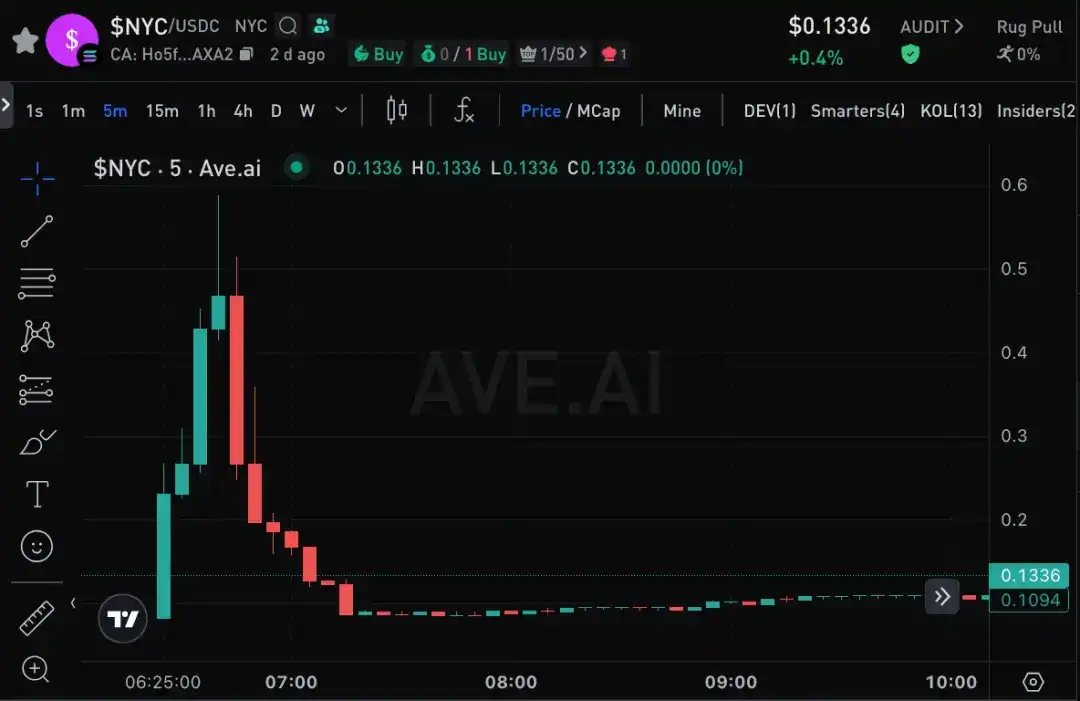
This address removed approximately 2,377,376 USDC, causing the price of the NYC token to plummet by over 80%, and its market capitalization to shrink from a peak of $600 million to less than $100 million.
https://ave.ai/token/Ho5fkxk9uqUuVN5kt7TUFacduWCpKPAuYkM9HD3KAXA2-solana

On January 15, Adams continued to promote the NYC token by retweeting related posts and issued a statement through his representative, Todd Shapiro, claiming that he did not profit from the NYC token and did not withdraw any funds from it. However, the community remains skeptical.

On-Chain Data Analysis

Using BeosinTrace to analyze the Solana address 9Ty4M4t9MZArhJBKFWbYrzeqdMf2Ua5eHWSRW3LXKyGt, we obtained the following results regarding its on-chain activities.

1. On-Chain Activity Overview

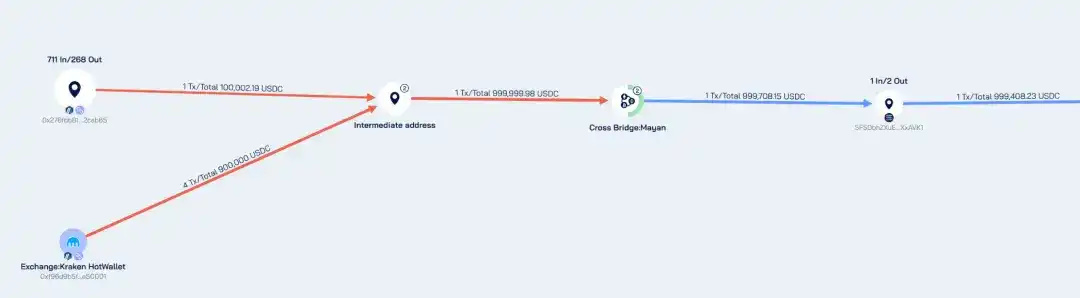
The address 9Ty4M obtained 1,000,001 USDC from the Mayan cross-chain bridge and a Kraken user address, then created the NYC-USDC liquidity pool. After removing liquidity at 6:43 Beijing time on January 13, which caused the price to crash, the address 9Ty4M began making small purchases of NYC tokens starting at 16:15 on the same day, continuing to the present.
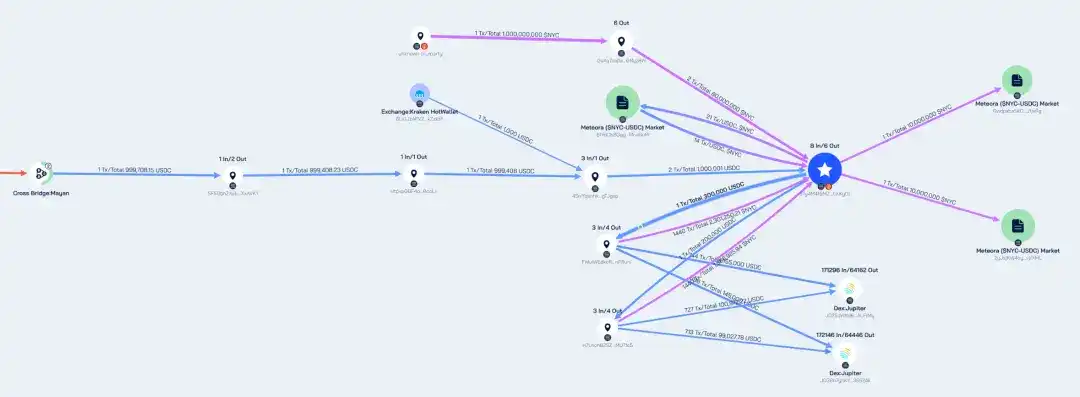
Further tracing of the cross-chain funds reveals that they originated from the Arbitrum address 0xBc985b167C5F3801B19E2Dec7082c2fcbBF07e91. Continuing the trace, it was found that 90% of these funds were withdrawn from Kraken, while 10% came from an unknown multi-chain active trading address, 0x276fbb81c8a7567ad2412469a549bd4dc82cab65.
2. Transaction Data Analysis

According to BeosinTrace data statistics, the address 9Ty4M has purchased 2,301,250 and 1,566,926 NYC tokens via the addresses FWuiWEdkcR1NLPjozcEuErtGGDZG5kyPu3oszmnF8uni and H7Lnoh82SZghsXmoqffoCiFz7U3D1cwZ8ZPjRUMU7fc5, respectively, on Jupiter. However, the price of NYC has only recovered to 0.133-0.134, with a total market capitalization of approximately $130 million.
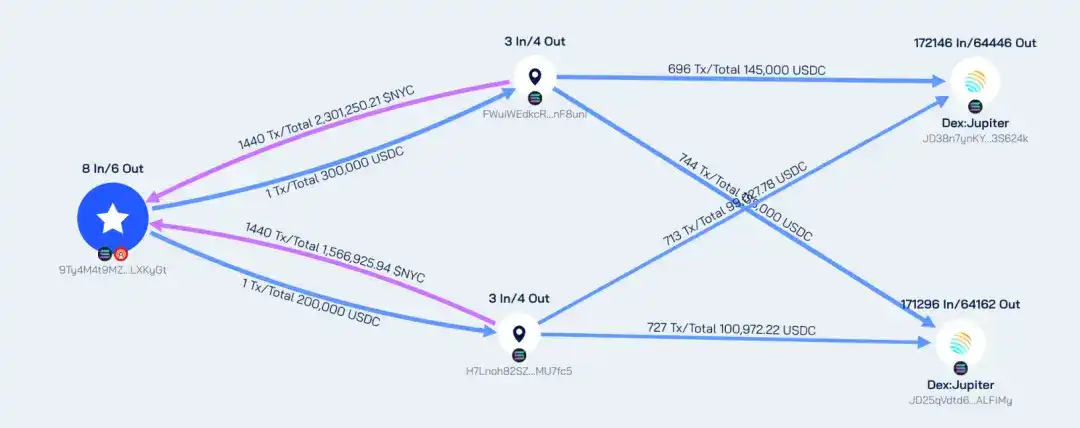
Currently, the address 9Ty4M still holds 1,332,243.85 USDC. Excluding any gains from NYC tokens, this address has profited by approximately $330,000 due to the limited liquidity of the NYC token.

Conclusion

This celebrity token launch has once again sparked significant controversy. Token issuance itself involves risks related to compliance, technology, and fund security. The removal of liquidity, which led to a sharp decline in the token's price, has negatively impacted investors and the market.

The on-chain analysis using BeosinTrace confirms the existence of "liquidity manipulation" behavior. After withdrawing $2.37 million in liquidity, the issuer continued to make purchases but only returned approximately $1 million, with the remaining $1.33 million still held in the issuer's address. Users should enhance their security awareness and avoid trading such high-risk, easily manipulated tokens. Beosin will continue to monitor the token's liquidity situation and the fund movements of related addresses to safeguard users' funds.


Пов'язані питання

QWhat is the main controversy surrounding former New York City Mayor Eric Adams and the NYC token?

AFormer NYC Mayor Eric Adams is facing controversy after the NYC token, which he promoted, experienced a price crash of over 80% shortly after launch. This occurred when the address that set up the liquidity pool removed approximately 2.38 million USDC, leading to accusations of a 'Rug Pull'.

QWhat on-chain evidence from BeosinTrace suggests a 'liquidity manipulation' in the NYC token incident?

ABeosinTrace analysis revealed that the address '9Ty4M...' removed liquidity worth about 2.38 million USDC 30 minutes after the token launch, causing the price to crash. Later, the same address began buying back NYC tokens in small amounts, but only returned approximately 1 million USDC worth of value, while 1.33 million USDC remained in their wallet, indicating a net withdrawal of funds.

QWhat was the source of the initial funds used to create the NYC token liquidity pool according to the investigation?

AThe investigation traced the initial 1,000,001 USDC used to create the liquidity pool. It originated from the Mayan cross-chain bridge and a Kraken user address. Further tracing showed these funds came from an Arbitrum address, with 90% withdrawn from Kraken and 10% from an unknown multi-chain active trading address.

QHow did Eric Adams and his spokesperson respond to the allegations regarding the NYC token?

AEric Adams continued to promote the NYC token after the incident. His spokesperson, Todd Shapiro, stated that Adams did not personally profit from the token and did not remove any funds from it, though the statement did not alleviate community skepticism.

QWhat is the current status of the address that removed the liquidity, and what is their estimated profit?

AThe address '9Ty4M...' still holds 1,332,243.85 USDC. After accounting for the value of the NYC tokens it bought back, the investigation estimates the address has a profit of approximately $330,000 from this activity.

Пов'язані матеріали

My Coding Betting Dashboard is Profiting, but Polymarket is Truly Not a Good Place for 'Arbitrage'

The author built a custom monitoring dashboard for Polymarket, a prediction market platform, and tested it with $1,600, achieving over 30% returns. However, the core argument is that Polymarket is not a good venue for traditional arbitrage. The dashboard has two main sections: a "Portfolio Dashboard" for tracking active positions with key metrics like total capital, P&L, and a risk-control module using a tier system (T1, T2, T3), and an "Opportunity Watchlist" for monitoring markets. The article details a critical structural trap in binary markets: a bet with a high perceived probability of success still carries a 100% loss risk if wrong. The author's T1/T2/T3 system is designed to manage this by limiting position sizes based on conviction and time horizon, emphasizing that high confidence should not equal high concentration. A key insight is the danger of "pseudo-diversification"—betting on different markets driven by the same underlying variable. The author concludes that Polymarket offers few true low-risk, arbitrage opportunities. It is instead a high-risk environment where wins can create a false sense of mastery, leading to large losses. The platform is better viewed as a training ground for honing judgment through disciplined, framework-driven betting rather than a reliable income source. The tools help transform intuition into structured, rule-based decisions to mitigate the risk of catastrophic errors.

marsbit1 год тому

My Coding Betting Dashboard is Profiting, but Polymarket is Truly Not a Good Place for 'Arbitrage'

marsbit1 год тому

WeChat AI Card Hands-On Guide: Has the AI Shopping Era Arrived?

**"WeChat AI Card" Practical Test Guide: Has the Era of AI Shopping Arrived?** WeChat has officially launched the "AI Exclusive Card," a feature integrated into its Workbuddy AI assistant. This card is designed to handle payments for AI-initiated purchases. Our hands-on test reveals it's not yet a tool for fully autonomous AI shopping, but rather a controlled payment layer for AI agents. The AI Card functions as an isolated sub-wallet within WeChat Pay. Users must bind the card and transfer funds into it from their main wallet. Crucially, every transaction requires explicit user confirmation via smartphone scan; AI cannot spend autonomously. Currently accessible through the Workbuddy agent, the card targets specific digital consumption scenarios: purchasing paid content (reports, data), calling paid APIs/tools, and subscribing to services. Its design prioritizes security and control by separating funds and mandating approval for each payment. We tested a real-world scenario: ordering bubble tea via Workbuddy using a "Meituan Life Assistant" skill. The process encountered multiple hurdles: high "skill" usage costs (exceeding daily free credits), and most importantly, while a payment was successfully initiated, the AI purchased an incorrect product (a mismatched group-buy coupon instead of the desired drink). This highlights the current limitation: the **AI Card only solves the payment step**. The broader challenge lies in the **AI agent's execution chain**—accurately understanding intent, navigating third-party platforms, selecting the right product, and ensuring proper fulfillment. The payment succeeded, but the purchase failed to meet the user's need. In conclusion, the WeChat AI Exclusive Card is a cautious, early-step experiment in AI commerce. It provides a secure, user-controlled payment method for agent interactions but is not yet capable of reliable, end-to-end complex purchases. For now, it's best used for low-value, low-risk digital services with careful user verification at each step. The vision of AI handling complete shopping tasks remains a work in progress.

marsbit4 год тому

WeChat AI Card Hands-On Guide: Has the AI Shopping Era Arrived?

marsbit4 год тому

Deconstructing Notion's Growth: From a Note-taking Tool to 100 Million Users—How Notion Built a Triple Growth Flywheel Through Product, Templates, and Community

Notion's growth from a niche note-taking tool to a platform with 100 million users is powered by three interconnected flywheels: Product-Led Growth (PLG), a Template Economy, and Community-Driven Growth. First, Notion's PLG strategy relies on a highly flexible, "plastic" product that users can adapt to countless personal and team workflows. Its freemium model lowers the barrier to entry, while features like page sharing and collaboration drive organic, usage-based viral growth as users naturally invite others. Second, the Template Economy solves the "blank page" problem. Templates, created by both Notion and its community, transform abstract product capabilities into concrete, copyable solutions for specific scenarios (e.g., project management, content calendars). This dramatically lowers activation costs for new users and fuels SEO-driven discovery. Third, a vibrant Community acts as a distributed growth engine. Users and official Ambassadors create tutorials, share use cases, and host local events. This community not only educates users but also fosters a sense of identity around pursuing "better ways of working," strengthening loyalty and enabling global, low-cost expansion. Together, these flywheels create a self-reinforcing ecosystem: a great product attracts users who create templates and community content, which in turn attracts more users and deepens engagement. This system allowed Notion to scale from individuals to teams and enterprises through a bottom-up adoption path. Looking ahead, AI integration promises to accelerate these flywheels further by making templates smarter and the platform a potential AI-native work operating system. Ultimately, Notion's defensible advantage is not just its features, but this deeply entrenched network of user assets, creators, and community trust.

marsbit4 год тому

Deconstructing Notion's Growth: From a Note-taking Tool to 100 Million Users—How Notion Built a Triple Growth Flywheel Through Product, Templates, and Community

marsbit4 год тому

$10 Billion, Qualcomm to Acquire Chip Legend Jim Keller's Company

Global mobile chip giant Qualcomm is in advanced talks to acquire AI chip startup Tenstorrent in a deal valued between $8-10 billion, according to media reports. This potential acquisition would be one of the largest in the AI chip sector in recent years. Tenstorrent, led by legendary chip architect Jim Keller, has gained prominence for its RISC-V architecture and AI accelerator designs. The move highlights Qualcomm's strategic push to diversify beyond its core smartphone chip business. As the smartphone market matures, Qualcomm is aggressively targeting growth in automotive, data center, and cloud AI. Acquiring Tenstorrent would allow Qualcomm to rapidly enter the high-end AI computing market, bypassing lengthy in-house development cycles. Tenstorrent's cost-effective system architecture, which avoids expensive HBM memory and relies on standard Ethernet for clustering, offers a potential alternative to Nvidia's costly solutions. Furthermore, Tenstorrent's high-performance RISC-V CPU technology and its focus on the automotive and edge computing segments align with Qualcomm's strategic goals, including its "Snapdragon Digital Chassis" platform. Despite the strategic rationale, the high valuation has sparked some investor caution. The successful integration of Tenstorrent's open-source culture and independent team into Qualcomm's organization, along with the commercialization of its technology, remains a key challenge.

marsbit4 год тому

$10 Billion, Qualcomm to Acquire Chip Legend Jim Keller's Company

marsbit4 год тому

Торгівля

Спот
Ф'ючерси
活动图片