Forbes Editorial: The Most Accurate Short Signal in the Crypto World?

marsbitОпубліковано о 2026-02-06Востаннє оновлено о 2026-02-06

Анотація

Forbes magazine covers have become an infamous bearish signal in the crypto world, often marking the peak of market cycles just before major crashes. The article highlights three key examples: 1. **CZ (2018)**: Featured on the cover during Bitcoin's downturn from its late-2017 high. Bitcoin fell 58% after the issue. 2. **SBF (2021)**: Called "crypto's most powerful man" before FTX collapsed 13 months later, wiping out billions. 3. **Michael Saylor (2025)**: Dubbed "The Bitcoin Alchemist" near Bitcoin's $104K peak. A year later, Bitcoin dropped 40%, and his company faced $6.5B in unrealized losses. The "magazine cover indicator" suggests mainstream media attention often coincides with market euphoria and impending reversals. While Sun Yuchen’s March 2025 cover briefly defied the trend (as Bitcoin continued rising), multiple crypto covers in quick succession were themselves a signal of overheated sentiment. The conclusion: bull markets don’t end in panic—they end on magazine covers. When a trend becomes too popular and even non-traders are talking about it, it may be time to reconsider positions.

Author: Curry, Deep Tide TechFlow
Bitcoin recently hit $60,000, marking the largest single-day drop since the FTX collapse.

Michael Saylor's company, Strategy (formerly MicroStrategy), holds 713,000 bitcoins with an average cost of $76,052. As of last night, the unrealized loss reached $6.5 billion. The stock price has plummeted from a high of $457 last year to $110, wiping out more than three-quarters of its value.

However, a year ago, Saylor graced the cover of the renowned magazine Forbes. The headline read:

The Bitcoin Alchemist. At that time, Bitcoin was priced at $104,000, and Saylor's net worth was $9.4 billion.

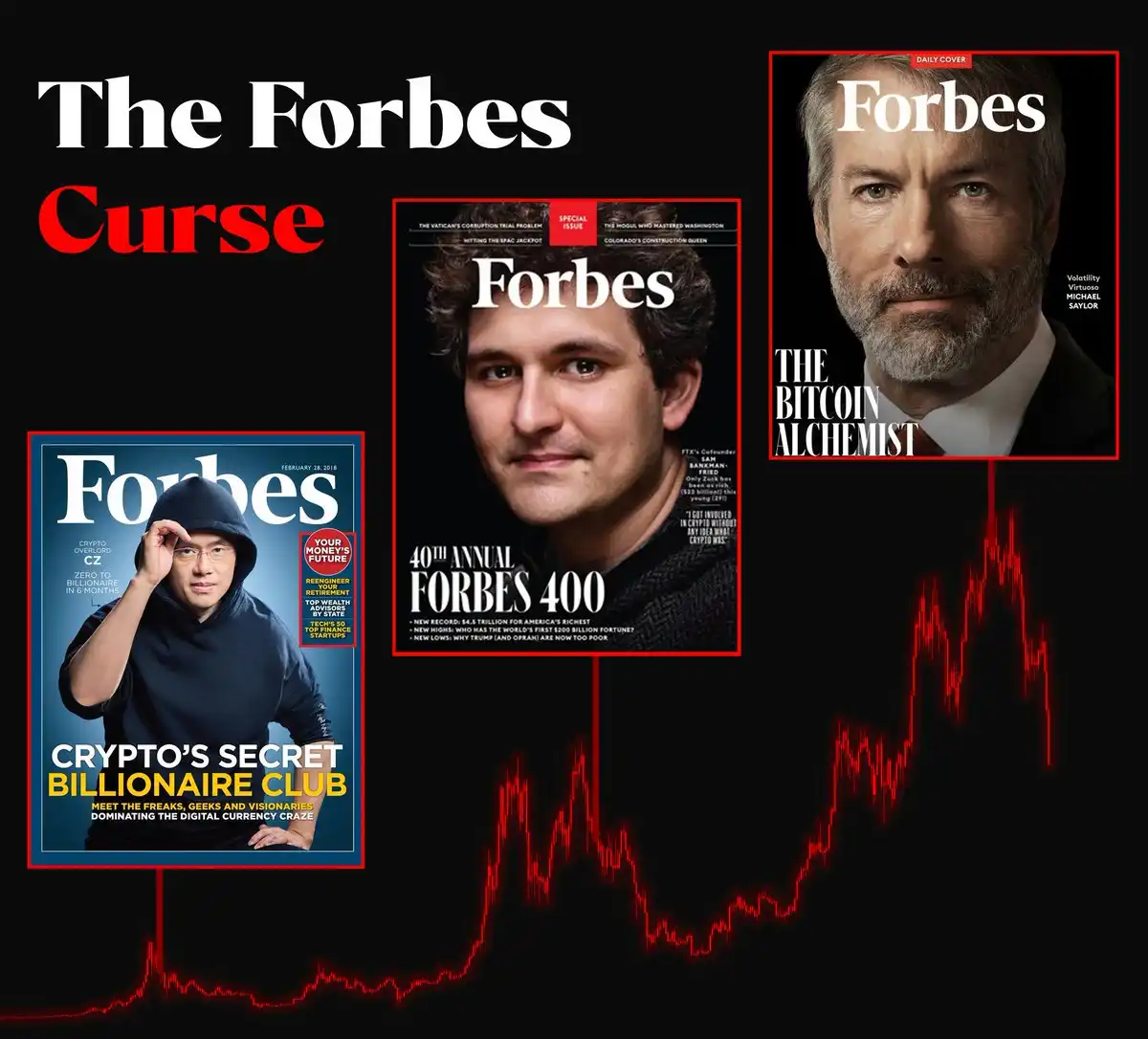
Now, a chart circulating on Twitter lines up three Forbes covers with Bitcoin's price chart. Each cover perfectly marks the starting point of a sharp decline.

Of these three individuals, one has been to prison, one is currently in prison, and the third just lost $6.5 billion.

The Cover: Captured at the Peak of Hype

The first crypto figure to appear on a Forbes cover was CZ.

In February 2018, Forbes featured a cover titled "Crypto's Secret Billionaire Club," with CZ standing in the center, hoodie on, exuding a rugged aura. The fine print read:

From zero to billionaire in just 6 months.

At that time, Bitcoin had just fallen from nearly $20,000 at the end of 2017 to around $7,600. Forbes estimated CZ's net worth to be at least $1.1 billion. Binance, only six months old, was already the world's largest exchange by trading volume.

After the cover was released, Bitcoin briefly rebounded to $10,000. Then, it went nowhere but down.

By December 2018, Bitcoin had fallen to $3,156. From the day the cover was published, the decline was:

58%.

CZ's later story is well-known. On Forbes' 2025 global billionaires list, CZ's net worth was $62.9 billion, ranking first in the crypto industry.

But he hasn't appeared on the cover since.

The second Forbes cover featured Sam Bankman-Fried.

In October 2021, Forbes released its 40th Forbes 400 Richest Americans list, with SBF as the cover star. Under 30 years old, with a net worth of $26.5 billion, he ranked as the 41st richest person in the U.S.

On the cover, he wore his signature gray T-shirt, with curly hair, looking like a college student who had just pulled an all-nighter playing League of Legends.

In hindsight, the magazine's tone was surreal. Forbes called him "the most powerful person in the crypto industry," praising him for building an exchange while donating to charity, a blend of Wall Street and Silicon Valley.

When the cover was released, Bitcoin was around $60,000, just a step away from its then-all-time high of $69,000.

Thirteen months later, FTX collapsed.

SBF had misappropriated over $8 billion in customer funds to cover losses at his other company, Alameda Research. In November 2022, users rushed to withdraw their assets, and FTX couldn't meet the demand. Within a week, the world's third-largest exchange went bankrupt. Bitcoin plummeted from $20,000 to $16,000.

Eventually, SBF was arrested in his luxury apartment in the Bahamas.

He was convicted on all seven charges and sentenced to 25 years in prison. Forbes later created a "30 Under 30 Hall of Shame," with SBF prominently featured.

From cover to handcuffs:

13 months.

The third was Michael Saylor.

On January 30, 2025, the Forbes cover featured "The Bitcoin Alchemist." Bitcoin had just broken through $100,000, and Saylor's net worth had surged from $1.9 billion the previous year to $9.4 billion, nearly a fivefold increase. His company, MicroStrategy, saw its stock price rise 700% in a year and was newly included in the Nasdaq 100 index.

The Forbes article recorded a detail:

On New Year's Eve, Saylor hosted a 500-person party at his estate in Miami. Dancers waved orange Bitcoin glow balls, and outside, a 154-foot yacht named Usher ferried institutional investors and crypto industry leaders to the event.

At the time, Saylor told Forbes:

"We've put a crypto reactor in the middle of the company, sucking in capital and spinning it. Volatility drives everything." This statement was, of course, sincere. Saylor's alchemy boils down to one thing: issuing debt to buy Bitcoin.

When the Forbes cover was released, Bitcoin was at $104,000. One year and six days later, it's at $63,000. A decline of:

40%.

Saylor said on an earnings call that Strategy had built a "digital fortress."

The last crypto mogul to call his company a "fortress" was SBF. That was in June 2022. Five months later, FTX went bankrupt.

The Cover: Both Praise and Curse

There's an old Wall Street concept called the "magazine cover indicator":

When a trend makes it to the cover of a mainstream magazine, that trend has often already peaked.

The reasoning is simple. Forbes editors aren't prophets; like all retail investors, they only notice a story when it's at its most hyped.

The moment a magazine deems "someone in some industry worthy of a cover" is precisely the moment when market frenzy has reached its peak.

The cover isn't the cause of the curse; it's a symptom of the bubble.

However, there was one brief exception to this rule.

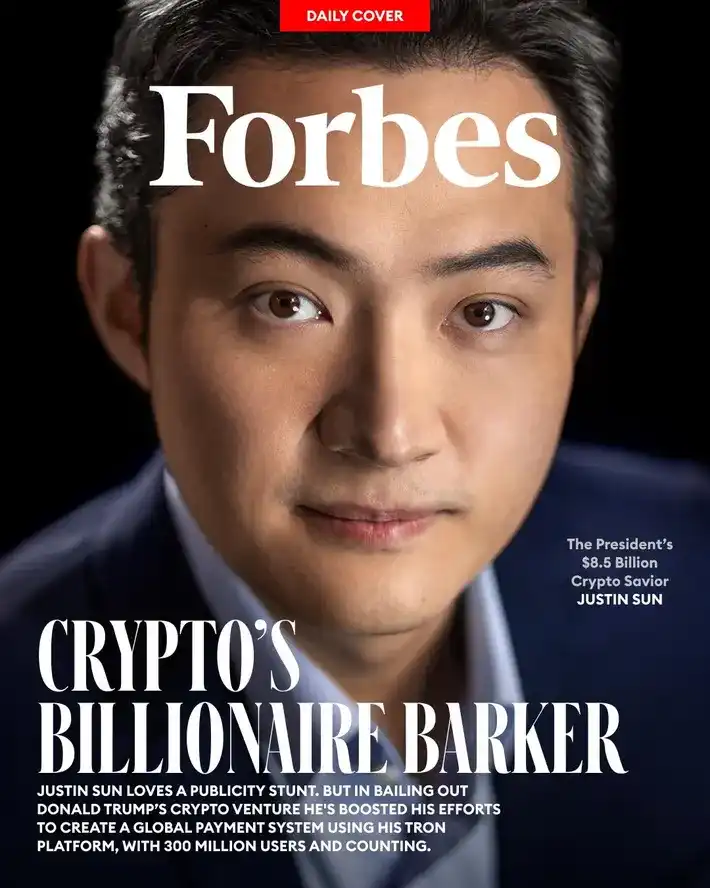
In March of last year, Justin Sun graced the Forbes cover with the headline "The Crypto Billionaire Who Helped the Trump Family Make $400 Million."

When the cover was released, Bitcoin was at $87,000. It didn't crash; instead, it rallied to a historic high of $126,000 in October.
Did the curse fail?

Not entirely. When Sun appeared on the cover, it was only two months after Saylor's. One cover in January, another in March—the密集 appearance of crypto figures on mainstream magazine covers was itself a signal. It indicated that the industry's narrative had become so hot that even Forbes editors felt one issue wasn't enough.

When covers start appearing in clusters, in hindsight, the peak of a bull market might have a checklist of symptoms:

Forbes covers, taxi drivers discussing crypto, relatives asking how to open an account... If two out of three signals appear, it's time to think about your position.

So, the real question isn't "Is the Forbes cover accurate?" but rather:

When everyone around you is telling the same story, when that story is so good that even people who don't trade crypto have heard of it, when mainstream media starts deifying figures in an industry...

Are you the one still buying, or the one already selling?

Bull markets don't end in panic. They end on magazine covers.

It's just that the cover stars may change, but the long bear market is always paid for by me.

Пов'язані питання

QWhat is the 'magazine Cover Indicator' mentioned in the article, and how does it relate to the cryptocurrency market?

AThe 'Magazine Cover Indicator' is an old Wall Street concept suggesting that when a trend or person makes the cover of a mainstream magazine like Forbes, it often signals that the trend has peaked and is about to reverse. In the context of the cryptocurrency market, the article argues that Forbes covers featuring crypto billionaires like CZ, SBF, and Michael Saylor have each coincided with the start of a major price crash, as the cover is a symptom of peak market euphoria and mainstream attention.

QAccording to the article, what happened to Bitcoin's price after Michael Saylor appeared on the cover of Forbes?

AAccording to the article, when Michael Saylor appeared on the cover of Forbes on January 30, 2025, Bitcoin was priced at $104,000. One year and six days later, the price had fallen to $63,000, representing a decline of 40%.

QWho were the three crypto figures featured on Forbes covers, and what were their respective outcomes?

AThe three crypto figures featured on Forbes covers were: 1. CZ (Changpeng Zhao): Featured in February 2018. Bitcoin fell 58% after his cover. He later became the wealthiest person in crypto but faced legal issues. 2. Sam Bankman-Fried (SBF): Featured in October 2021. FTX collapsed 13 months later, and SBF was arrested and sentenced to 25 years in prison. 3. Michael Saylor: Featured in January 2025. His company, MicroStrategy, faced billions in unrealized losses on its Bitcoin holdings, and the price fell 40% after the cover.

QWhy does the article claim that a Forbes cover is a symptom of a market top and not the cause of a crash?

AThe article claims that a Forbes cover is a symptom, not a cause, because magazine editors are not prophets. They only feature a trend or person on the cover when the story is at its most popular and mainstream attention is at its peak. This moment of maximum hype and widespread recognition often coincides with the top of a market cycle, making the cover an indicator of excessive euphoria rather than a catalyst for the subsequent decline.

QWhat exception to the 'Forbes cover curse' does the article mention, and how does it explain this anomaly?

AThe article mentions that Justin Sun (Sun Yuchen) appeared on the cover of Forbes in March of an unspecified year (likely 2025), and instead of crashing, Bitcoin's price continued to rise to a new all-time high of $126,000 by October. The article explains this anomaly by stating that the curse wasn't entirely broken. The fact that crypto figures appeared on Forbes covers so frequently (Saylor in January, Sun in March) was itself a signal that the market narrative was overheated. The high frequency of covers was a symptom of the peak, even if the immediate crash for one specific cover was delayed.

Пов'язані матеріали

The AI Agent Era Accelerates Its Arrival: Questflow Defines a New Paradigm of Financial Intelligence with On-Chain AI Brokerage

The AI Agent era is accelerating, with the CB Insights AI 100 list highlighting global investment confidence. The focus has shifted from whether AI works to its speed of deployment and ability to manage complex workflows, with autonomous AI Agents driving this transformation. At the forefront is Questflow, a Singapore-based startup redefining financial intelligence through its on-chain AI brokerage. Unlike tools that merely provide data dashboards, Questflow deploys AI Agents that proactively scan markets, form judgments, and execute trades via a conversational interface—operating 24/7 without requiring manual confirmation for each decision. This embodies the new AI paradigm of agents capable of executing multi-step workflows autonomously. Questflow's mission is to democratize institutional-grade trading intelligence. Historically reserved for the ultra-wealthy, this capability is now accessible starting from just $1 through Questflow's "AI Clone + Copy Trade" model. The platform charges only a 1% execution fee, aligning its incentives directly with users and eliminating traditional management or performance fees. The timing is opportune, aligning with key trends identified by CB Insights: the scalable deployment of AI Agents, accelerated AI adoption in financial services, and the maturation of on-chain infrastructure. With robust liquidity on platforms like Hyperliquid and Polymarket, alongside advancements in AI reasoning and non-custodial wallet security, Questflow is positioned to merge the roles of broker, fund, and exchange into a single, accessible platform for millions.

链捕手21 хв тому

The AI Agent Era Accelerates Its Arrival: Questflow Defines a New Paradigm of Financial Intelligence with On-Chain AI Brokerage

链捕手21 хв тому

Why Pricing Social Interactions is Doomed to Fail?

Titled "Why Putting a Price on Social Interaction Is Doomed to Fail," this article critiques attempts to monetize social networks directly through SocialFi models, arguing their inevitable failure stems from a fundamental misunderstanding of media dynamics. Using Marshall McLuhan's theory of "hot" and "cold" media, the author posits that social networks are inherently "cold" media. Their value isn't contained in individual posts but is co-created through user participation, interpretation, and fragmented, ongoing interaction (e.g., replies, shares). This ambiguity and need for user involvement are core to their function. The article asserts that SocialFi projects like Friend.tech failed because introducing real-time, tradable financial pricing (a definitive "hot" signal) into this "cold" environment doesn't add a layer—it replaces the medium's essence. The unambiguous price signal overshadows and nullifies the nuanced, participatory social signal. Users become traders, not participants, and when speculative profits vanish, the underlying social ecosystem—never genuinely cultivated—collapses entirely. This principle extends beyond crypto. The author argues platforms like Twitter have gradually "heated up" through metrics (likes, retweets counts, algorithmically defined value), shifting users from participants to performers and eroding organic engagement. The solution isn't to abandon capital but to manage its entry point. Successful models like Substack, Patreon, or Bandcamp allow capital to "condense" at specific, isolated nodes (e.g., subscriptions, one-time payments) without permeating and "heating" every social interaction. They preserve the core "cold," participatory medium while enabling monetization at designated boundaries. The NFT boom and bust serves as a stark parallel: the ancient "cold" medium of collecting (valued for story, community, gradual accumulation) was rapidly destroyed by platforms that introduced real-time floor prices, rarity scores, and trading dashboards, transforming collectors into speculators and vaporizing cultural value when prices fell. The core lesson: "Liquidity equals heat." Injecting high liquidity and definitive pricing into a "cold" participatory medium doesn't optimize it; it fundamentally alters and destroys its value-creating mechanism. The future lies not in pricing every social gesture but in finding precise, non-invasive points for capital to condense without overheating the entire ecosystem.

marsbit29 хв тому

Why Pricing Social Interactions is Doomed to Fail?

marsbit29 хв тому

Jensen Huang's CMU Speech: In the AI Era, Don't Just Watch, Build

Jensen Huang, CEO of NVIDIA and a first-generation immigrant, delivered the commencement address to Carnegie Mellon University's class of 2026. He shared his personal journey from a humble background to founding NVIDIA, emphasizing resilience, learning from failure, and the responsibility that comes with leadership. Huang framed the present moment as the dawn of the AI revolution, a shift he believes is more profound than previous computing waves. He described AI as fundamentally resetting computing—moving from human-written software to machines that understand, reason, and use tools. This will create a new industry for generating intelligence and transform every sector. While acknowledging AI's potential to automate tasks and displace some jobs, Huang distinguished between the *tasks* of a job and its core *purpose*. He argued AI will augment human capability, not replace humans. The real risk, he stated, is not AI itself, but people being left behind by those who effectively use AI. He presented AI as a generational opportunity for massive infrastructure investment—in chip factories, data centers, energy grids, and advanced manufacturing—that could re-industrialize nations like the U.S. and bridge the digital divide by making computing and intelligent tools accessible to all. Huang called for a balanced approach: advancing AI safely and responsibly, establishing prudent policies, ensuring broad access, and encouraging universal participation. He urged the graduates not to fear the future but to engage with optimism and ambition, reminding them of CMU's motto, "My heart is in the work." His core message was clear: this is their moment to actively build and shape the AI-powered future, not merely observe it.

marsbit1 год тому

Jensen Huang's CMU Speech: In the AI Era, Don't Just Watch, Build

marsbit1 год тому

Торгівля

Спот
Ф'ючерси

Популярні статті

Як купити LA

Ласкаво просимо до HTX.com! Ми зробили покупку Lagrange (LA) простою та зручною. Дотримуйтесь нашої покрокової інструкції, щоб розпочати свою криптовалютну подорож.Крок 1: Створіть обліковий запис на HTXВикористовуйте свою електронну пошту або номер телефону, щоб зареєструвати обліковий запис на HTX безплатно. Пройдіть безпроблемну реєстрацію й отримайте доступ до всіх функцій.ЗареєструватисьКрок 2: Перейдіть до розділу Купити крипту і виберіть спосіб оплатиКредитна/дебетова картка: використовуйте вашу картку Visa або Mastercard, щоб миттєво купити Lagrange (LA).Баланс: використовуйте кошти з балансу вашого рахунку HTX для безперешкодної торгівлі.Треті особи: ми додали популярні способи оплати, такі як Google Pay та Apple Pay, щоб підвищити зручність.P2P: Торгуйте безпосередньо з іншими користувачами на HTX.Позабіржова торгівля (OTC): ми пропонуємо індивідуальні послуги та конкурентні обмінні курси для трейдерів.Крок 3: Зберігайте свої Lagrange (LA)Після придбання Lagrange (LA) збережіть його у своєму обліковому записі на HTX. Крім того, ви можете відправити його в інше місце за допомогою блокчейн-переказу або використовувати його для торгівлі іншими криптовалютами.Крок 4: Торгівля Lagrange (LA)Легко торгуйте Lagrange (LA) на спотовому ринку HTX. Просто увійдіть до свого облікового запису, виберіть торгову пару, укладайте угоди та спостерігайте за ними в режимі реального часу. Ми пропонуємо зручний досвід як для початківців, так і для досвідчених трейдерів.

234 переглядів усьогоОпубліковано 2025.06.04Оновлено 2025.06.04

Як купити LA

Обговорення

Ласкаво просимо до спільноти HTX. Тут ви можете бути в курсі останніх подій розвитку платформи та отримати доступ до професійної ринкової інформації. Нижче представлені думки користувачів щодо ціни LA (LA).

活动图片













