European and British financial institutions are moving towards the same digital asset economy, but their starting points differ.
The Fireblocks 'Financial Grid 2026' survey, based on responses from over 600 senior executives, revealed near-unanimous confidence in regulatory prospects. Approximately 99% of institutions in continental Europe and all respondents from the UK expect policy to facilitate the adoption of digital assets.
The difference lies in implementation.
The European Markets in Crypto-Assets (MiCA) regulation has provided companies with a clearly defined framework. As a result, 53% of continental institutions have allocated funds until 2026, whereas the global average is 42%.
In the UK, where the regulatory framework is still under development, 36% have already approved budgets. Another 59% plan to allocate funds within 2026.
Regulation defines each market's priorities
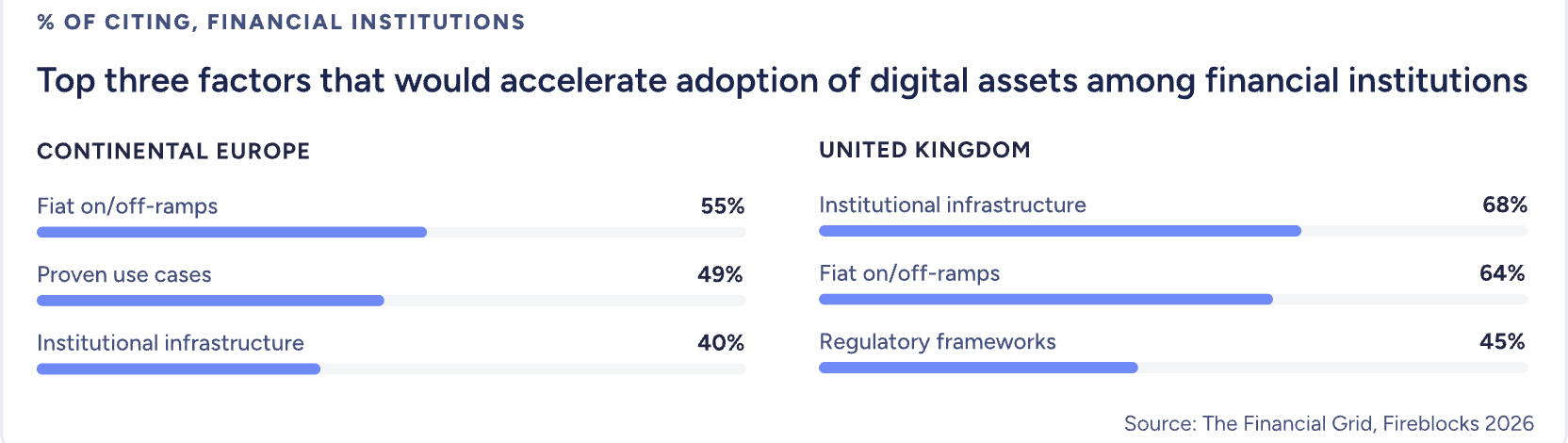
European institutions currently view practical infrastructure as the main obstacle to faster adoption. 55% of respondents pointed to robust connections between digital assets and fiat currencies. Proven production use cases came second at 49%, and 40% chose institutional-grade infrastructure.
Their internal challenges are predominantly operational. Nearly half cited operational model readiness as the primary obstacle. Governance and limited experience also ranked high, while only 29% pointed to legacy core technology.
In the UK, the picture is almost the opposite. Legacy system limitations were an obstacle for 71% of British institutions. They also placed greater emphasis on infrastructure support, fiat currency connectivity, and regulatory clarity.
This uncertainty affects how UK companies choose vendors. About 60% cited reputation and long-term financial stability as critical factors, compared to 33% in continental Europe.
Settlements - a priority when building institutional infrastructure
Both markets are primarily focused on the 'communications' of the financial system.
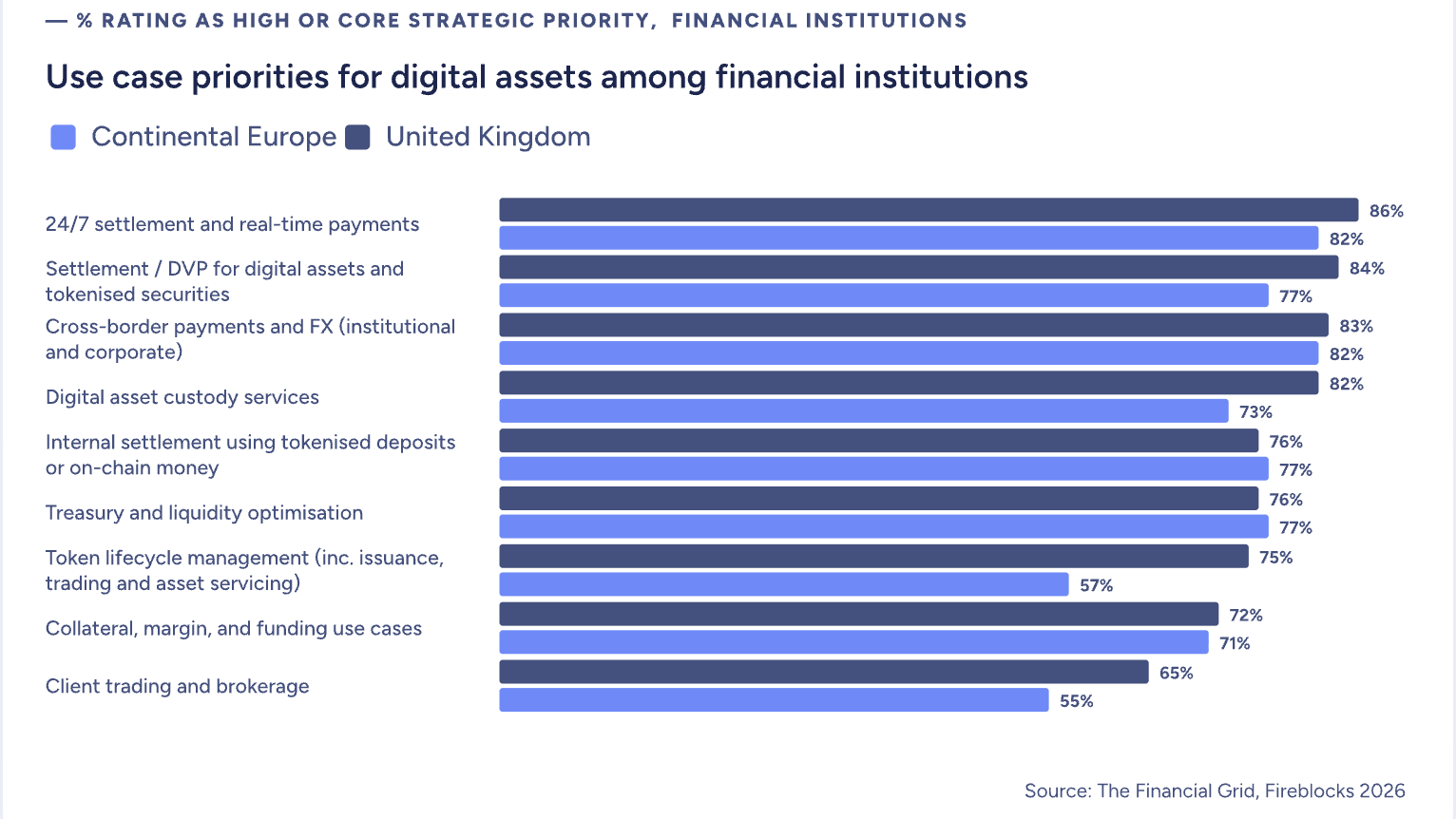
24/7 real-time settlement and payments emerged as the top use case for 86% of European respondents and 82% of UK respondents. Cross-border payments and settlement of tokenized securities were also key priorities.
However, Europe is progressing faster towards tokenized investment products. About 62% plan to utilize tokenized money market funds, compared to 45% in the UK. European institutions also lead in tokenized securities and deposits.
The UK stands out in one area: 50% of institutions plan to issue their own stablecoins, outpacing continental Europe at 40%.
Despite these differences, both regions expect the same from technology partners. Security, custody, integration, and resilience must be provided as part of a single package.
The survey results indicate that Europe is evolving under established rules, while the UK is doing so anticipating their final version. Both sides expect digital assets to become part of the core financial infrastructure, but Europe currently has a shorter path to adoption.