Highlights of This Issue
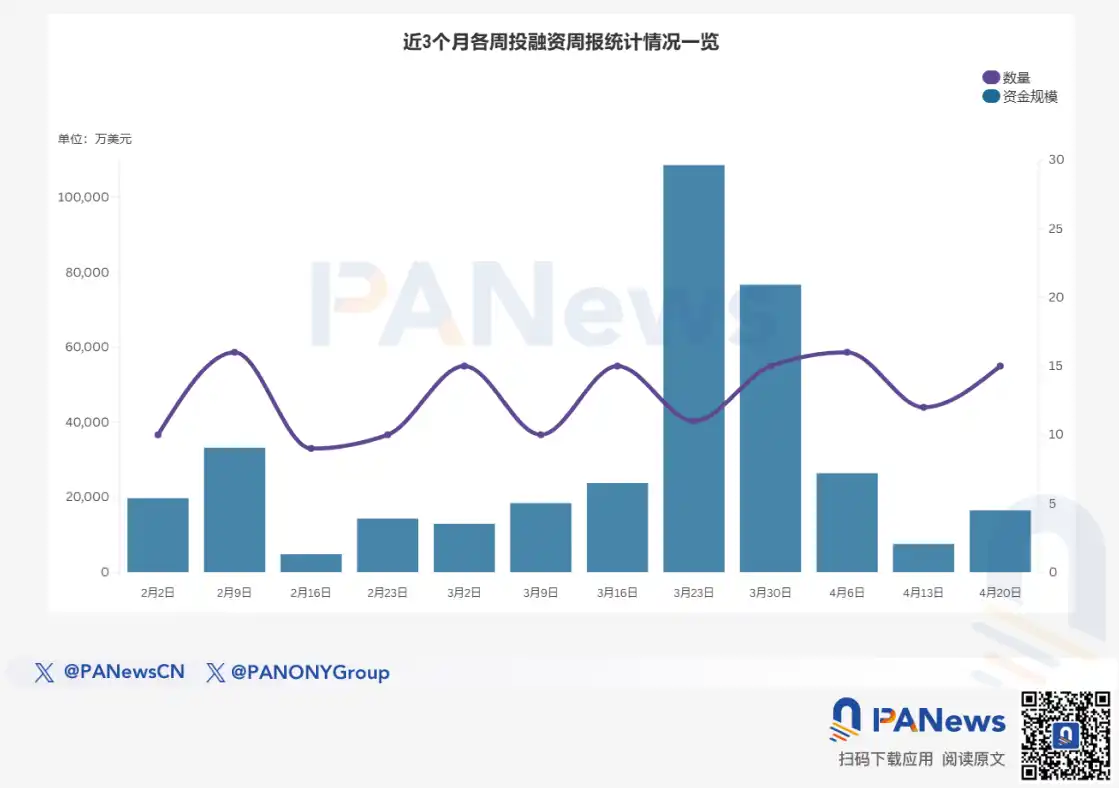
According to incomplete statistics from PANews, there were 15 investment and financing events in the global blockchain sector last week (4.13-4.19), with a total funding scale exceeding $165 million. The overview is as follows:
- The DeFi track announced 4 investment and financing events, among which Brix completed a $5.5 million financing, with investors including FRWRD, a subsidiary of Turkish bank Yapı Kredi, etc.;
- The AI+Web3 sector announced 4 investment and financing events, among which OpenGradient announced it has raised a total of $9.5 million, with investors including a16z crypto;
- The Infrastructure & Tools track announced 2 investment and financing events, among which Paxos Labs completed a $12 million financing led by Blockchain Capital;
- The Centralized Finance field announced 2 investment and financing events, among which the digital banking platform Slash completed a $100 million Series C financing led by Ribbit Capital;
- The Prediction Market track announced 2 investment and financing events, among which Pumpcade, a live-streaming prediction market supported by Pump.fun, completed a $5 million seed round with participation from Jump Crypto;
- The Other Web3 Applications field announced 1 investment and financing event, the DePIN project SHARE completed a seed round led by Greenfield Capital.
DeFi
Brix Completes $5.5 Million Financing, to Launch Turkish Lira Yield Token iTRY on MegaETH
Brix, focused on tokenizing assets in emerging markets, completed a $5.5 million financing. Investors include FRWRD, a subsidiary of Turkish bank Yapı Kredi, İş Asset Management, as well as Circle Ventures, Consensys, Borderless Capital, etc. Brix plans to launch its first product, iTRY, on the "World Markets" platform of the Ethereum scaling network MegaETH on April 20th. This asset is backed by a Turkish Lira money market fund and can be used for trading, collateral, and accessing DeFi. Brix will subsequently launch tokenized products related to stocks, funds, and bonds in markets such as the UAE, Egypt, Mexico, Brazil, and South Korea.
Crypto Lending Platform Votre Completes $3.75 Million Seed Round Led by a16z CSX
New York-based fully on-chain investment bank Votre completed a $3.75 million seed round led by a16z Crypto Startup Accelerator (CSX), with participation from MaC Venture Capital, Druid Ventures, and angel investors from Goldman Sachs, Harvard University, and OrangeDAO. Votre stated that the funds will be used to expand technical infrastructure, increase platform capacity, optimize liquidity management tools, and strengthen risk and compliance systems. Votre was founded in 2025 and operates a non-custodial crypto lending platform on Coinbase's Base Layer 2 network. Its core product allows borrowers to obtain same-day USD loans collateralized by Bitcoin while maintaining on-chain transparency and asset ownership. Platform loans range from approximately $25,000 to $5 million, with automated margin control and real-time monitoring through smart contracts.
Crypto Futures Exchange KieDex Completes $3.5 Million Seed Round
Crypto futures exchange KieDex announced the completion of a $3.5 million seed round led by Marqel Capital, with participation from Hidden Street Capital, Caviar, Kinetic Kollective (formerly CSP DAO), Solulu Club, Rocket, TPC, Devmons, TATATU, etc. It is reported that KieDex is a crypto futures trading platform focused on the leveraged perpetual contracts market, where users can earn KDX rewards through trading activities.
Fintech Company Superstate Completes Series B Follow-on Financing, Invesco Private Capital Joins as New Investor
Fintech company Superstate announced the completion of a Series B follow-on financing, with asset management giant Invesco's Invesco Private Capital joining as a new investor. The amount was not disclosed. Meanwhile, Invesco will serve as the investment manager for Superstate's flagship tokenized fund USTB (Short-Term U.S. Treasury Fund) starting Q2 2026. The fund size is approximately $900 million, making it one of the largest tokenized treasury products globally. After the transition, the fund will be renamed, with Superstate retaining the digital transfer agent function. This move marks Invesco's full entry into the blockchain fund sector.
AI
OpenGradient Raises $9.5 Million to Advance Verifiable AI Network
Decentralized AI infrastructure company OpenGradient announced it has raised a total of $9.5 million. Investors include a16z crypto, Coinbase Ventures, SV Angel, Foresight Ventures, etc. OpenGradient positions itself as the compute layer for "verifiable AI," serving as a network of dedicated AI coprocessors that provide model inference based on GPU and TEE nodes for applications, blockchains, and agents. Each inference is accompanied by a cryptographically verifiable proof, supporting external independent verification of the model, input, and output. Its network currently serves over 2 million users, has handled more than 2 million verifiable inferences, generated over 500,000 cryptographic proofs, integrated 2000+ models from 100+ developers on its Model Hub, and has formed 6 revenue streams.
AI Financial Agent Risk Control Company Nava Completes $8.3 Million Financing Led by Polychain and Archetype
Startup Nava, focused on AI financial agent risk control, completed an $8.3 million seed round led by Polychain and Archetype, with participation from EigenLayer founder Sreeram Kannan, among others. Nava uses custodied accounts for funds and a verification framework to compare user intent with transaction results before an AI agent initiates a transaction, releasing funds only upon verification success, otherwise continuing to hold them. Its reasons for rejecting or approving transactions will be publicly recorded on-chain for other AIs to reference. Nava currently operates as a Layer 3 chain deployed on Arbitrum and plans a parallel deployment on Tempo. It will also issue a stablecoin later to provide insurance and risk underwriting for agent actions.
Web3 Intelligence Layer Project Claw Intelligence Completes $3 Million Seed Round
Web3 intelligence layer project Claw Intelligence announced the completion of a $3 million seed round with participation from Castrum Istanbul, Titans Ventures, Super Labs, and Genesis Capital. It is reported that Claw Intelligence is building a unified intelligence layer to lower the barrier for users to interact with the Web3 ecosystem and computational resources through crypto-native MCP services and by transforming fragmented data endpoints into conversational workflows. The platform's main features include: a secure isolated LLM code execution sandbox, supporting large language models to execute code without endangering the host system security; and LLM-based cross-device multi-computer control, allowing users to centrally manage multiple computers, servers, and devices using natural language through a single web interface.
Decentralized AI Economy Protocol Mindra AI Announces Completion of Strategic Financing with Participation from LandScape Capital, etc.
Decentralized AI economy protocol Mindra AI announced the completion of a new round of strategic financing with participation from LandScape Capital, Harbor Digital Ventures, and Candaq Fintech Group. It is reported that Mindra AI is a full-stack decentralized AI economy protocol that aims to break intelligent hegemony and reshape AI production relations through dynamic inference routing, Agent cross-chain collaboration, and compute power financialization (AI-Fi).
Mindra AI stated that this round of funding will mainly be used to accelerate the development of its full-stack four-layer protocol, advance the construction of the dynamic inference routing layer, Agent collaboration ecosystem, compute power financialization (AI-Fi), and economic value flywheel, aiming to build a decentralized "Intelligence Grid" to fundamentally solve issues like centralized monopoly in AI inference, algorithmic black boxes, and ecosystem fragility.
Infrastructure & Tools
Paxos Labs Completes $12 Million Financing Led by Blockchain Capital
Paxos Labs, a startup spun off from stablecoin and blockchain infrastructure company Paxos, completed a $12 million financing led by Blockchain Capital, with participation from Robot Ventures, Maelstrom, and Uniswap Labs. Paxos has long-term partnerships with institutions like PayPal and Nubank. Paxos Labs is responsible for DeFi-focused infrastructure, helping enterprises provide retail users with access to stablecoins and crypto lending. Paxos Labs provides a suite of software tools supporting institutions to issue branded stablecoins and allowing users to use stablecoins for on-chain lending and collateral. Co-founder Bhaumik Kotecha said the company expects to achieve breakeven by the end of this year and currently serves neobank Hyperbeat and the privacy blockchain Aleo team.
Bond Tokenization Platform BlockInvest Completes €4 Million Strategic Round with Participation from UniCredit
Bond tokenization platform BlockInvest announced the completion of a €4 million strategic round with participation from Italian bank UniCredit, which acquired a 16% stake in the company. It is reported that BlockInvest will assist UniCredit in issuing Italy's first native digital mini-bond, the first public chain-based tokenized structured note for wealth management clients, and build a technical infrastructure that combines the programmability of digital ledgers with financial regulatory requirements.
Centralized Finance
Digital Banking Platform Slash Completes $100 Million Series C Financing Led by Ribbit Capital</p
Digital banking platform for businesses, Slash, announced the completion of a $100 million Series C financing, with a post-money valuation of approximately $1.4 billion and total funding raised reaching $160 million. The new round was led by Ribbit Capital, with co-leadership from Goodwater Capital and Khosla Ventures, and continued follow-on investment from NEA and YC. Slash claims to serve over 5,000 enterprise customers, providing business accounts, virtual accounts, stablecoin payments, expense management, bookkeeping automation, real-time payments, and other functions. The company stated that it will use the new funds to accelerate product iteration and advance its strategy of "bank account as the command center for corporate finance."
AI Quant Platform AlphaNet Completes $10 Million Seed Round Led by Joffre Capital
Institutional-grade quantitative AI trading platform AlphaNet announced the completion of a $10 million seed round led by private equity firm Joffre Capital, with participation from Huashan Capital and an Asian quantitative trading consortium. This round of funding will support its transition from an invite-only whitelist model to a public platform launch. It is reported that AlphaNet was incubated by Asian proprietary trading firm Tensor Investment and is positioned as an institutional-grade "systematic alpha" trading platform, aiming to provide retail users with trading capabilities previously only available to institutions.
Prediction Markets
Pumpcade, a Live Prediction Market Supported by Pump.fun, Completes $5 Million Seed Round with Participation from Jump Crypto
Live prediction market and Meme coin issuance platform Pumpcade announced the completion of a $5 million seed round with investors including Jump Crypto and Foundation Capital. Pumpcade is a platform for instant creation and trading of Meme coins based on Solana. Integrated into Pump.fun's chat system, Pumpcade supports one-click creation of prediction markets in live streams. Previously, on April 2nd, it was reported that Pump.fun led a $1 million pre-seed round for Pumpcade.
Totalis Completes $500,000 Seed Round, Becomes First Company to Receive YC Investment Entirely in USDC
Prediction market derivatives layer Totalis announced that its $500,000 seed round financing from Y Combinator was completed in USDC, making it the first company in Y Combinator's history to receive the full investment amount in stablecoin form. The funds were transferred via the Solana network in three on-chain transactions: a $1 test transfer, followed by $124,999 and $375,000; all funds went directly into the company's treasury.
Totalis stated that current prediction markets suffer from issues like single-position exposure, fragmented liquidity, and low capital efficiency. The company is building a prediction market derivatives layer that can be composable across categories, markets, and venues, enabling users to construct composite bets across assets such as geopolitics, crypto, and sports.
Others
DePIN Project SHARE Completes Seed Round Led by Greenfield Capital
Decentralized physical infrastructure network SHARE completed a seed round led by Greenfield Capital, with participation from Kosmos Ventures, Generative Ventures, Zee Prime Capital, and other strategic funds and angel investors. The specific financing amount was not disclosed.






