Finance Needs Speed and Brakes

marsbitОпубліковано о 2026-03-26Востаннє оновлено о 2026-03-26

Анотація

Financial systems require both speed and safeguards. Just as a car's persistent seatbelt alarm saves lives, or a banking payment confirmation step prevents costly errors, strategic "brakes" are essential in finance. While the industry often prioritizes frictionless transactions, history shows that unchecked speed leads to catastrophic failures—like the 1987 Black Monday crash or Knight Capital's $440 million loss in 45 minutes. The recent Aave-CoW incident in crypto, where a user lost millions due to a poorly executed trade, underscores this need. Decentralized finance must integrate intelligent safeguards—pre-trade simulations, liquidity checks, and transaction splitting—to prevent irreversible errors. Trust in financial systems isn’t built through seamless speed alone but through well-timed interventions that protect users. As emerging infrastructures like blockchain evolve, embedding these brakes will be crucial to achieving both safety and scalability.

Written by: Prathik Desai

Compiled by: Block unicorn

Small annoyances can sometimes save lives.

Think about that incessant beep in your car that reminds you to fasten your seatbelt. This constant reminder is annoying, and many people have complained about it. But it is this persistent beep that has prompted countless people to buckle up. The result? According to the Insurance Institute for Highway Safety (IIHS) in the United States, these constant reminders save approximately 1,500 lives each year in the U.S. alone. A true lifesaver.

Small irritations can also save you a lot of money.

One of the annoying aspects of modern banking is when you think you've completed a wire transfer, only to be interrupted. You've entered the account number, routing number, and recipient's name. Instead of processing the transfer immediately, the bank pauses to confirm whether the recipient's name matches the account information. This adds an extra click, disrupting the flow. In product team terms, this is considered friction. However, this pause has become one of the most effective security measures for payments globally.

The "Confirmation of Payee" service provided by Pay.UK enables individuals and institutions in the UK to make transfers, currently covering over 99% of transactions across various payment channels. The volume of checks has grown from 14,000 per month in June 2020 to over 70 million per month by July 2025. It has reduced "incorrect account" transactions by 59% and decreased end-user financial losses by 20% to 40%.

This is crucial at a time when the financial industry has been striving for over a decade to make transactions seamless. We've seen efforts like "one-tap," "one-swipe," and "click-to-trade," all attempting to make funds flow silently in the background. The industry's instinct is often to view every pause as a flaw. As finance evolves, it has become increasingly obsessed with seamlessness. But this evolution has repeatedly reminded us that certain so-called "frictions" are actually necessary brakes that prevent the system from collapsing.

Traditional Finance's Need for Brakes

Today, the financial industry has embedded these safeguards into every new piece of infrastructure it builds.

In the United States, broker-dealers with market access must implement risk controls to limit their financial exposure and ensure regulatory compliance. When the Securities and Exchange Commission (SEC) adopted Rule 15c3-5, it stated that the rule was designed to address the risks posed by automated high-speed trading and to prevent unfettered access to exchanges.

The reason the industry repeatedly relearns this lesson is simple: when brakes fail, the damage often exceeds what institutions can bear and recover from.

In 1987, on Black Monday, the Dow Jones Industrial Average plummeted 22% in a single day. The Brady Commission recommended adding a pause button in the form of "circuit breakers," which mandate a 15-minute trading halt when market declines reach a certain percentage. Without these limits, Black Monday alone wiped out $1.7 trillion in global market capitalization. Adjusted for inflation, that loss is equivalent to over $4.7 trillion today, surpassing the current GDP of Germany, the world's third-largest economy.

These brakes taught the financial world that sometimes the only way to maintain speed is to briefly stop the machine. In other cases, a brief pause is all it takes.

In August 2012, Knight Capital Group experienced a software glitch that caused its computers to buy and sell millions of shares of stock in just 45 minutes. The malfunction caused $440 million in losses in less than an hour, pushing the market maker to the brink of bankruptcy. Knight Capital had optimized its system for speed, which is crucial in market trading. But an uncontrolled system without brakes, even the fastest one, can collapse in an instant. The lesson? The faster the system, the more important the braking mechanisms.

Retail finance itself has faced its share of issues.

For years, brokers have worked to make high-risk products easy to use to drive retail user growth. They persevered, only to lose trust. In the 2021 disciplinary action against Robinhood, FINRA noted that the company failed to conduct due diligence before approving customers for options trading and relied heavily on unregulated automated "approval bots." The non-profit self-regulatory organization responsible for investor protection claimed that Robinhood's system approved customers based on inconsistent or illogical information. FINRA stated that the company's system allowed applicants whose risk profiles were clearly questionable to gain approval.

Robinhood's system was optimized to process applications quickly, avoiding potential customer wait times. But what it lacked was a meaningful pause between curiosity and security. Speed, but no brakes.

The Curious Case of Cryptocurrency

The recent Aave-CoW incident in the cryptocurrency space has elevated the need for brakes in finance to a whole new level.

On March 12, 2025, a user executed a $50 million swap through CoW Swap, a decentralized exchange (DEX) aggregator designed to protect users from bot front-running. The transaction was integrated into the front end of the DeFi protocol Aave. Due to insufficient liquidity, the user ended up receiving tokens worth only $36,930, while paying $50 million.
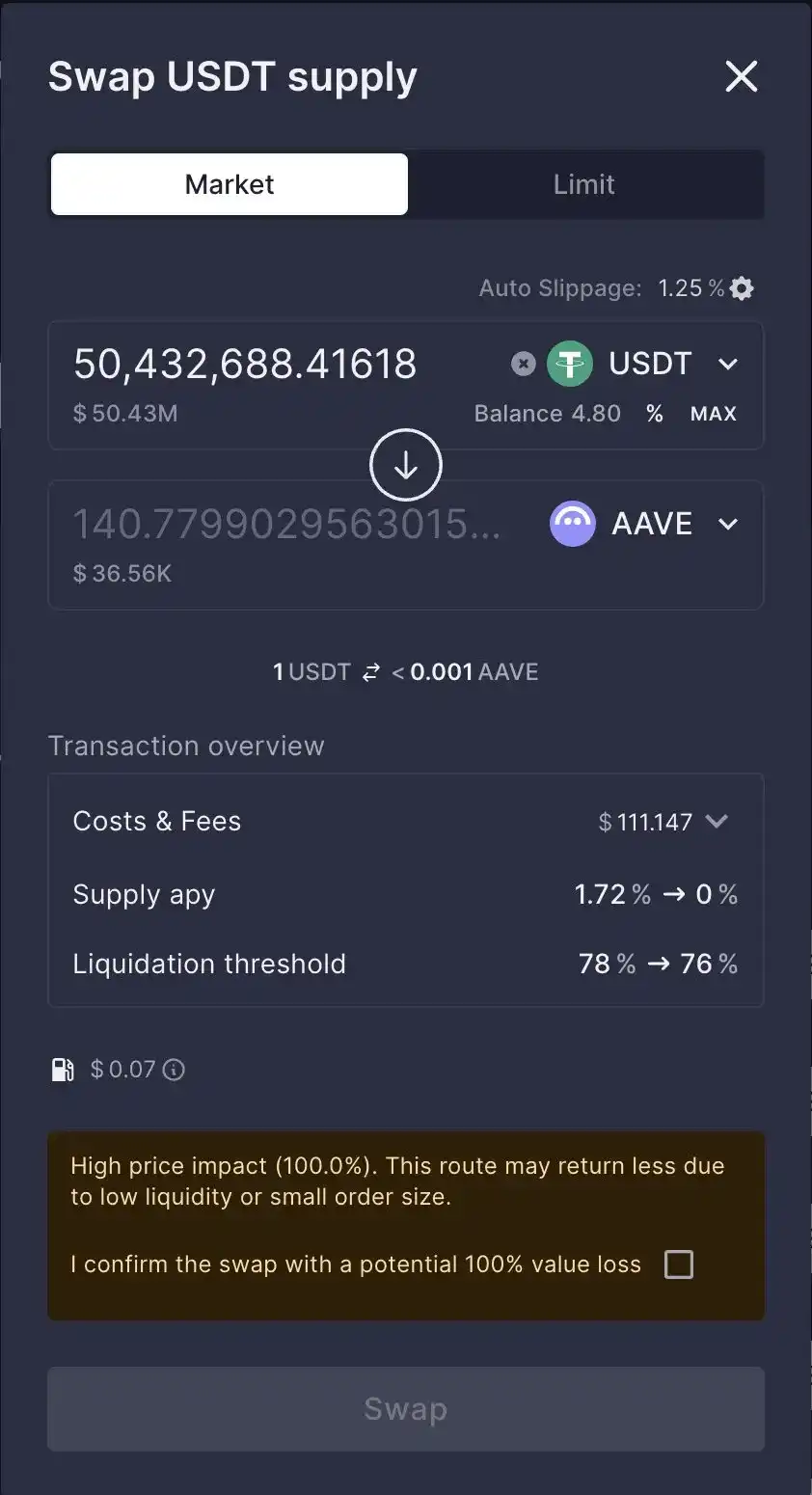
Although Aave explained in its post-mortem that the user ignored explicit high-price impact warnings, its founder and CEO Stani Kulechov posted on X that the Aave team "will look into how to improve these safeguards."

Jargon aside, the takeaway is clear: a fast interface allowed a catastrophic trade to proceed too far before the system could react. While one might question the user's judgment and disregard for warnings, treating this as an isolated incident is both convenient and counterproductive for the development of new financial infrastructures like blockchain.

If cryptocurrency wants to avoid repeating past mistakes, the solution lies in building smarter execution layers. Some decentralized finance (DeFi) trading protocols are already moving in this direction.

For example, Definitive.Fi argues that large on-chain transactions should not simply be processed along the technically possible path. They should be simulated before submission, tested against actual market conditions, split into smaller lots if necessary, and routed through broader liquidity pools. Thus, a good trading system should not only check if it *can* execute the trade but also determine the *best* path to fulfill the order.
For any emerging infrastructure, trust and additional security are not optional features, especially in finance. A product that makes trading, lending, or transferring funds easy and convenient can help it grow rapidly, but when it fails, the consequences are severe. We've seen this pattern in all the traditional finance cases above. Systems try to minimize visible points of friction—even when those frictions are necessary limits—mask their complexity, and hope that a smooth operation will win more consumer trust.

But confidence in finance is rarely built this way. It often comes from financial institutions identifying critical moments that require intervention and taking some unpleasant but necessary steps to stop the action. This is the case with Pay.UK's Confirmation of Payee. While repeatedly being asked to confirm a bank account name is certainly not a pleasant experience, it does stop the action at a point where a mistake could be costly and irreversible.

Aave's Stani understands this well. That's why he acknowledged that customers aren't always clear about the order flow, who they are paying, or if there's a better channel for the trade. This understanding is especially important in emerging industries like cryptocurrency and blockchain, where few users understand the technical flow of a transaction and the consequences of each click. In such contexts, acknowledging pain points and taking steps to address them is crucial for building consumer trust.

The tricky part is that the line between a braking mechanism and random inconvenience or friction is thin. Good brakes don't slow things down completely; they apply slight resistance with precise timing. In the case of the Aave-CoW incident, we can imagine a good brake as a kind of economic sanity check. It allows the system to scan more trading venues before routing, prevents order intent from falling into the wrong hands, simulates outcomes before execution, and splits large trades to avoid users being penalized for their size. These mechanisms are key to ensuring financial infrastructure is trustworthy.

This distinction is important because genuine pain points still exist in finance. For example, cumbersome and useless paperwork, inefficient compliance processes that slow everything down, hidden fees disguised as part of the process, and intimidating,繁琐 registration processes that scare away new users.

None of these should be defended. Installing "brakes" is not about defending uglier products or adding more pop-ups; it's about designing a pause when a user is about to make an irreversible decision based on incomplete information. This is especially true when customers are handling large orders in illiquid markets, selling high-risk products, exploring new payment methods, and performing one-click actions where the risk is immediate and speed is not the primary consideration.

There are business implications here too.

The finance industry often talks about building safeguards *after* achieving product-market fit. This gets it backwards. In finance, safeguards are an integral part of product-market fit. When implemented well, safeguards aren't even hindrances. The Pay.UK case further confirms that "Confirmation of Payee" is not just an optional anti-fraud feature but has become a "utility service that customers expect to see" when using the system to transact.

Emerging financial infrastructures, such as blockchain, aim to earn trust and withstand errors, scandals, and market pressures just like traditional finance. But this is not easy. It must think more proactively about how to earn trust *before* winning users, because trust will naturally bring users. The reverse is not necessarily true.

If blockchain can adopt strategic braking measures, its speed will surpass that of any other financial infrastructure.


Пов'язані питання

QWhat is the main argument of the article 'Finance Needs Speed and Brakes'?

AThe main argument is that while the financial industry has long pursued frictionless, high-speed transactions, certain types of 'brakes' or intentional frictions are essential safety mechanisms that prevent catastrophic errors, build trust, and are a necessary part of a robust financial infrastructure.

QWhat example from traditional banking is given to illustrate a beneficial 'brake'?

AThe article cites Pay.UK's 'Confirmation of Payee' service, which introduces a pause to verify a recipient's name before a wire transfer is completed. This friction has significantly reduced mistaken payments and user financial losses.

QWhat historical market event is mentioned to demonstrate the catastrophic cost of lacking 'brakes'?

AThe 1987 Black Monday crash is mentioned, where the Dow Jones fell 22% in a single day, erasing $1.7 trillion in global market value. This led to the implementation of 'circuit breakers' as a necessary pause mechanism.

QHow does the Aave-CoW Swap incident relate to the article's core theme?

AThe Aave-CoW incident, where a user lost millions due to a poorly executed large swap, exemplifies the danger of a high-speed DeFi system without adequate 'brakes,' such as pre-trade simulations or liquidity checks, to prevent such catastrophic user errors.

QAccording to the article, what is the key difference between a good 'brake' and a bad friction point in finance?

AA good brake is a precisely timed intervention that creates a meaningful pause to prevent an irreversible, bad decision based on incomplete information (e.g., large trades, high-risk products). Bad friction is pointless inefficiency that adds no value, like cumbersome paperwork or hidden fees that slow down processes without enhancing safety.

Пов'язані матеріали

If It's Not a Clear Yes, It's a No: A Nine-Year Retrospective by a VC Who Survived Four Cycles

**"Invest Only When Certain": A Nine-Year Retrospective from a VC Across Four Cycles** IOSG founder Jocy shares hard-earned lessons from nine years and over a hundred investments in Web3. The core challenge isn't identifying successful founders, but understanding why talented founders with solid ideas still fail. Through building a "failed founder database," IOSG identified six recurring failure patterns. **Founder Trait Red Flags:** 1. **Emotionally Unstable:** Founders who react defensively to criticism or publicly lash out under pressure (e.g., 80% drawdowns) often fail. Resilience is key. 2. **Lacking Hunger / Having a Fallback:** Founders with significant safety nets (family wealth, cushy fallback jobs) may lack the "do-or-die" commitment needed to survive crypto's brutal cycles. 3. **Unchecked Ego:** Includes "polished execution machines" who excel in known frameworks but struggle when paradigms shift, and "professor-types" who are technically brilliant but resistant to commercial feedback or coaching. **Project Structure Red Flags:** 4. **Token-First, Not Product-First:** Treating the token solely as a fundraising tool with no real utility or connection to product value is a major warning sign. The project should have value even if the token goes to zero. 5. **No Day-1 Exit Thesis:** Founders must have a clear, staged capital strategy from the start, understanding what each funding round needs to prove to unlock the next. "Exit before entry" is crucial. 6. **No Full-Cycle Experience:** Founders who haven't lived through a complete crypto bull/bear cycle (e.g., 2018, 2022) often underestimate their vulnerability. IOSG limits initial checks for such teams to $250k, sizing for risk. **The Positive Flipside: Desirable Founder Traits** The ideal candidate exhibits: obsessive problem-depth, being a second-time founder with a non-consensus vision, strong communication skills with *controlled* ego, relentless perseverance, and a global perspective with agency and taste (increasingly vital in the AI era). **Three Survival Tips for Founders:** 1. **Cash Flow Over Narrative:** Real revenue is what sustains projects, not vanity metrics. 2. **Tokens Are a Liability:** Avoid issuing a token unless absolutely necessary. The hidden costs (market making, liquidity, compliance) are immense, often a multi-million-dollar burden. 3. **Respect Liquidity:** Sell during peaks to build treasury, buy back to support the protocol during troughs. Be realistic about valuations and your ability to deliver for the next round. The final principle is simple yet paramount: **"If it's a borderline 'yes' or 'no,' don't invest."** In an industry that reinvents itself every few years, the discipline to consistently say "no" is the ultimate secret to longevity.

Foresight News21 хв тому

If It's Not a Clear Yes, It's a No: A Nine-Year Retrospective by a VC Who Survived Four Cycles

Foresight News21 хв тому

SemiAnalysis Deep Dive into CXMT: $50 Billion Revenue, An IPO Amidst a Supercycle

SemiAnalysis' in-depth report on ChangXin Memory Technologies (CXMT) details its rapid rise as China's largest upcoming semiconductor IPO. Founded in 2016 by Zhu Yiming, CXMT built its DRAM foundation on acquired patents and talent from the bankrupt German firm Qimonda. It achieved its first annual profit in 2025 after nearly a decade of significant capital support, primarily from patient Hefei municipal investors who fostered a local supply chain. The company is now capitalizing on a strong DRAM supercycle. Its revenue soared from ~$3.3B in 2024 to ~$8.6B in 2025, with Q1 2026 alone reaching ~$7.3B. SemiAnalysis projects full-year 2026 revenue could exceed $50B, driven by soaring ASPs rather than massive market share gains. While CXMT is closing the capacity gap with Micron, its product mix remains heavily focused on commodity DDR/LPDDR, which currently offers higher margins than its nascent HBM business. CXMT faces significant challenges in HBM, struggling with yield and stability for HBM3 8-Hi stacks while lagging behind the big three (Samsung, SK Hynix, Micron) in advanced nodes. However, strategic national priorities for AI self-sufficiency may push it to accelerate HBM capacity. Its complex IPO structure reveals heavy state-backed ownership and voting control over its fabs, with Alibaba appearing as both a key cloud customer and a minority shareholder. The IPO aims to raise ~$4.1B, primarily to strengthen its core DRAM manufacturing base.

marsbit41 хв тому

SemiAnalysis Deep Dive into CXMT: $50 Billion Revenue, An IPO Amidst a Supercycle

marsbit41 хв тому

From Corning to Ciena: The 10x Opportunity in the AI Optical Communication Chain

The transition from copper to optical communication in AI data centers is creating significant investment opportunities beyond just chipmakers. The entire photonics supply chain, from glass and fiber to connectors and test equipment, is critical. Corning, a key fiber supplier, has locked in multi-billion dollar, multi-year contracts with major cloud providers (Meta, Amazon, Google, Microsoft, OpenAI, NVIDIA), demonstrating pricing power and scale. Its profit growth is outpacing revenue growth. In the interconnect layer, Amphenol benefits from high growth in AI data centers, driven by strategic acquisitions and operational efficiency, while Credo Technology acts as a bridge between copper and optical solutions, though with high customer concentration risk. At the systems level, Ciena enables higher data capacity on existing fiber lines, with a strong backlog and cloud customer adoption. Further upstream, AXT is a bottleneck supplier of key indium phosphide wafers for lasers but faces geopolitical supply chain risks. VEO Solutions provides essential testing equipment for the entire photonics industry. A new pure-play photonics ETF (FOTO) offers a consolidated investment approach. The core thesis is that the physical limits of copper are driving an inevitable shift to optical technologies, with wealth flowing to essential, often overlooked, suppliers across the photonics value chain.

marsbit53 хв тому

From Corning to Ciena: The 10x Opportunity in the AI Optical Communication Chain

marsbit53 хв тому

Collector Crypt's DAU Is Only 800, Yet It's Already One of Crypto's Most Profitable Projects?

"Collector Crypt: A Highly Profitable Crypto Project with Only 800 Daily Active Users?" Collector Crypt (CARDS) is a crypto project tokenizing physical graded trading cards (primarily Pokémon) on Solana, achieving significant real-world profitability and growth. According to a Maelstrom Fund analysis, it generated approximately $53M in annualized profit in May, with a June run-rate nearing $109M, against a $550M FDV. Its core revenue driver is a digital pack-opening 'Gacha' system. The platform bulk-buys cards at a 5-15% discount. Users can open digital packs and choose to keep cards or sell them back to the platform at a 7-15% discount to market price. Most users sell back common cards, creating an efficient model: users get packs with a ~2% positive expected value, while Collector Crypt captures ~4.5% profit. The project aims to disrupt the inefficient $22.2B GMV (Q1 2026) eBay trading card market, which charges sellers 16-20% in total fees. Collector Crypt offers 2% fees, instant settlement, insured custody, and one-click trading. Beyond Gacha, future revenue streams include secondary market trading fees, infrastructure partnerships, and an eBay "snipe" tool. It holds ~$23M in card inventory and ~$10M in cash, and has already begun token buybacks. With a total supply of 2B tokens, effective circulation post-2027 unlocks is estimated at ~1.3B. Trading primarily on DEXs has so far limited large institutional entry. The project is expanding into sports cards and attracting Web2 users. Maelstrom Fund's price target is $4 by summer's end, positioning Collector Crypt at the forefront of migrating collectibles on-chain.

Foresight News1 год тому

Collector Crypt's DAU Is Only 800, Yet It's Already One of Crypto's Most Profitable Projects?

Foresight News1 год тому

Торгівля

Спот
Ф'ючерси
活动图片