DRAM ETF Issuer: Samsung, SK Hynix, Micron All Surpass $1 Trillion, the AI Era of Memory Chips Has Only Just Begun

marsbitОпубліковано о 2026-06-24Востаннє оновлено о 2026-06-24

Анотація

Authors: Dave Mazza, Thomas DiFazio | Source: Deep Tide TechFlow The article, written by Roundhill Investments (issuer of the DRAM ETF), responds to Morningstar's caution about investing in memory chip stocks. Morningstar warns of the sector's history of boom-bust cycles, a lack of economic moats, and potential momentum-driven overvaluation. Roundhill argues the current situation is structurally different due to AI. Key points in Roundhill's rebuttal include: * **Changed Demand & Supply Dynamics:** AI infrastructure, not consumer electronics, is now the primary growth driver for memory demand. New, strict long-term supply agreements with hyperscalers reflect the high capital intensity of advanced manufacturing. * **Existence of a Moat:** High-Bandwidth Memory (HBM), essential for AI, has extremely high manufacturing barriers. The market is dominated by Samsung, SK Hynix, and Micron, with new entrants blocked by technological complexity and long lead times for equipment like ASML's EUV machines. * **Strong Fundamental Outlook:** Analyst consensus projects the three companies will rank among the world's most profitable by 2027, with combined profits of $704 billion on over $1 trillion in revenue. Their operating margins have already reached record highs. * **Valuation Re-rating:** Despite significant stock price gains, memory stocks trade at attractive valuations (e.g., a median NTM P/E of 8.37x for the DRAM ETF) relative to projected explosive EPS growth. Roundhill su...

Authors:Dave Mazza, Thomas DiFazio

Compiled by: Deep Chao TechFlow

Deep Chao Guide: The market capitalizations of the world's three largest memory chip manufacturers have all surpassed $1 trillion. Morningstar promptly published an article reminding investors not to forget fundamentals. Roundhill Investments (the issuer of the DRAM ETF) countered point by point: AI infrastructure has reshaped the supply and demand structure of the memory industry; the manufacturing barriers of HBM make it impossible for new players to enter; and the combined projected profits of the three giants for 2027 are expected to reach $704 billion. Please note that the authors of this article are the managers of the DRAM ETF, a naturally bullish position.

The world's three largest memory chip manufacturers—Samsung Electronics (005930 KS), SK Hynix (000660 KS), and Micron (MU)—have all surpassed a market capitalization of $1 trillion, joining an exceedingly rare club. However, this milestone has also invited scrutiny.

Morningstar recently published a blog post reminding memory ETF investors not to overlook fundamentals, raising several pointed questions:

  • A Cautionary Tale from History: The memory industry has repeatedly experienced boom-bust cycles. Investors might be ignoring this history.
  • Memory Companies Lack Moats: Memory is essentially a commodity business. New capacity can always enter the market and erode pricing power; companies lack true barriers to protect profit margins.
  • The Rally Might Be Momentum-Driven, Not Fundamentals-Driven: The enthusiasm surrounding memory stocks reflects more excitement about AI than a sober analysis of earnings, profit margins, and supply-demand dynamics.
  • Valuations Have Skyrocketed: Memory stock prices have surged significantly, possibly running ahead of fundamentals.
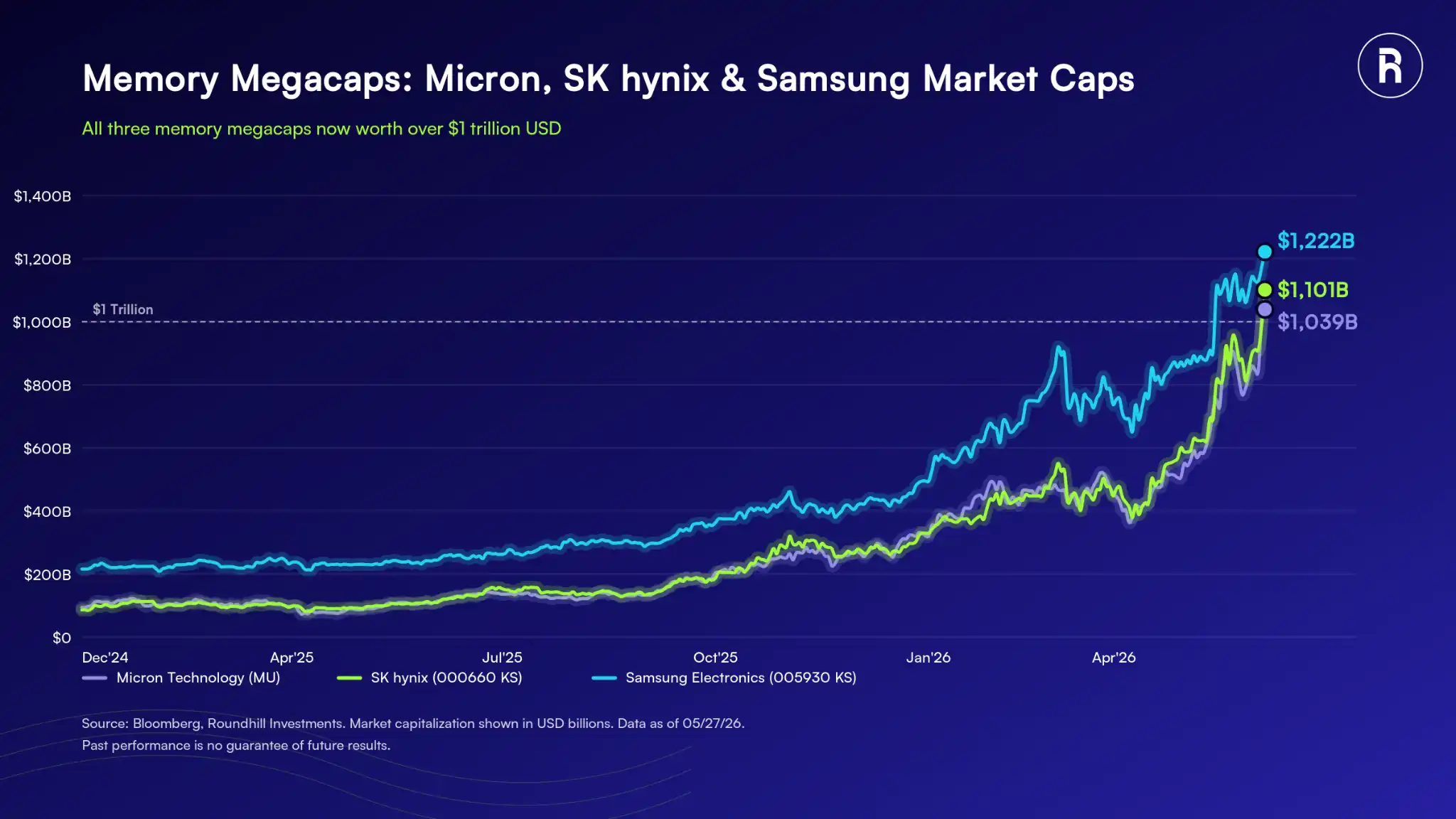
Caption: Overview of the Memory Chip Industry

Roundhill's position is: this time is different. To understand the future of the memory industry, one must first look back at its past.

History is Indeed a Warning, But Is History Still Relevant?

The boom-bust cycles of memory chips are a fact. A classic cycle occurred in the mid-1990s. Microsoft released Windows 95 in August 1995, transforming personal computers from business-exclusive to consumer goods. The DRAM capacity per PC quadrupled from 1-2 megabits to 4-8 megabits. Manufacturers were caught off guard by the sudden demand, leading to a frenzy of factory construction and expansion, ultimately resulting in oversupply and a price collapse.

A similar story unfolded in the mid-2010s. When Apple released the iPhone 7 and upgraded the base storage from 16GB to 32GB, it seemed like a small change. But scaled up, demand surged dramatically. Manufacturers again invested heavily, followed by oversupply and price drops.

These cycles share a common pattern: technological breakthrough → surge in demand → manufacturer expansion → oversupply → price collapse.

The question is, is this pattern still applicable today?

The memory chip industry has undergone structural changes. Memory demand is no longer tied to consumer electronics upgrade cycles but to the compute power expansion of AI infrastructure. The scale of this market far exceeds a single smartphone upgrade wave, and its growth potential is much larger.

DRAM and NAND prices have increased more than fivefold since January 2024, leading hyperscale customers to begin demanding long-term supply agreements to lock in bandwidth. Historically, long-term supply agreements in the memory industry have been loose frameworks subject to market changes. But this model has changed. During its January 2026 earnings call, SK Hynix stated that current agreements reflect "strong reciprocal commitments" between customers and suppliers, citing the high capital intensity of advanced memory manufacturing. Micron also reported similar long-term agreement conditions.
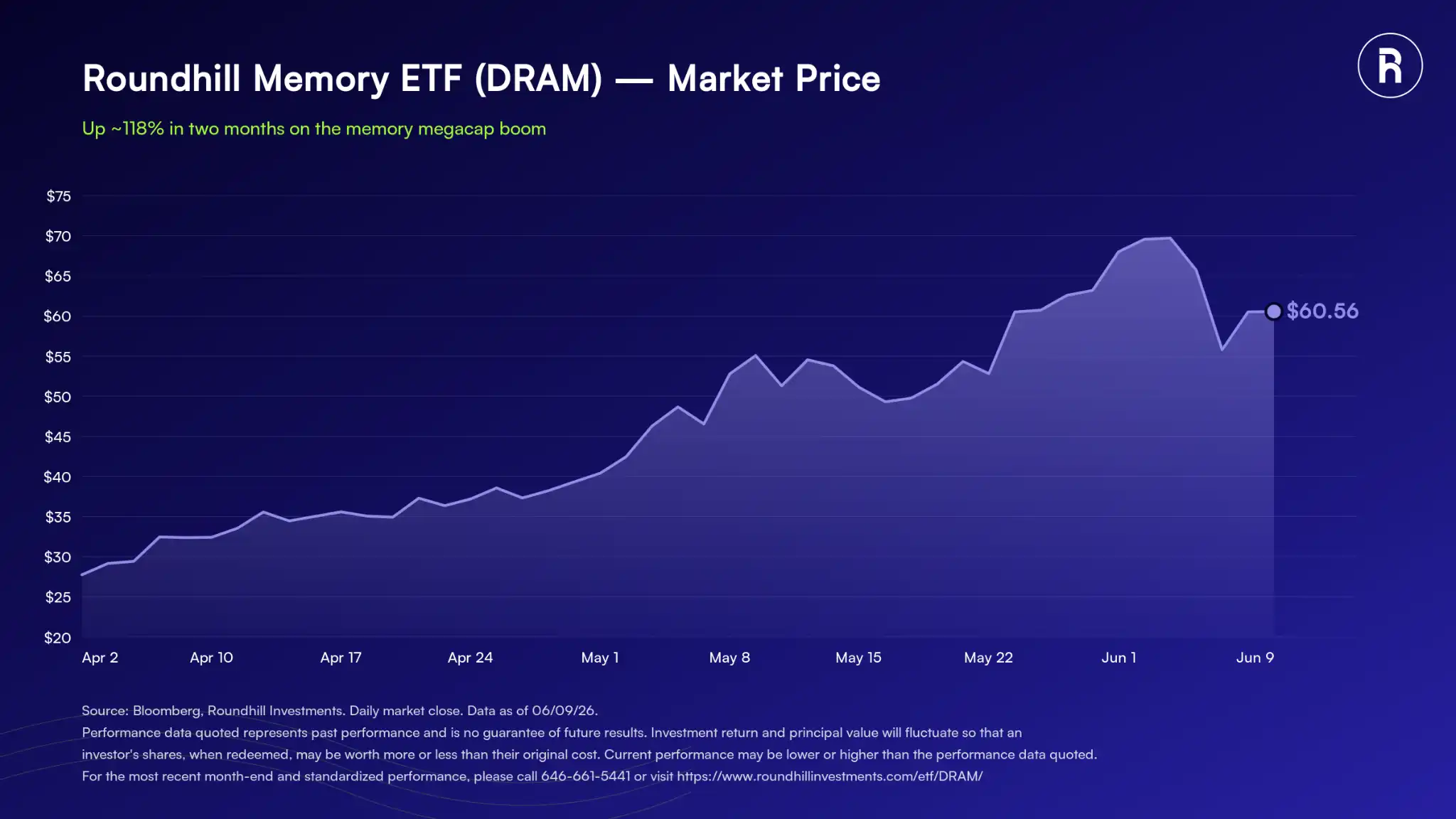
Caption: DRAM and NAND Price Trends

The Moat of Memory Chips: Manufacturing Complexity

Not all memory chips are created equal. The memory driving today's AI systems is called High Bandwidth Memory (HBM), which is entirely different from the memory in phones and computers. HBM is specifically designed for AI workloads, with extremely demanding manufacturing conditions.

Data from Goldman Sachs shows that SK Hynix, Samsung, and Micron control nearly the entire global supply of HBM. This industry has consolidated over decades, and the accumulated manufacturing expertise cannot be replicated overnight. Manufacturing complexity itself is the moat, and it's the very reason these three companies have reached this point.
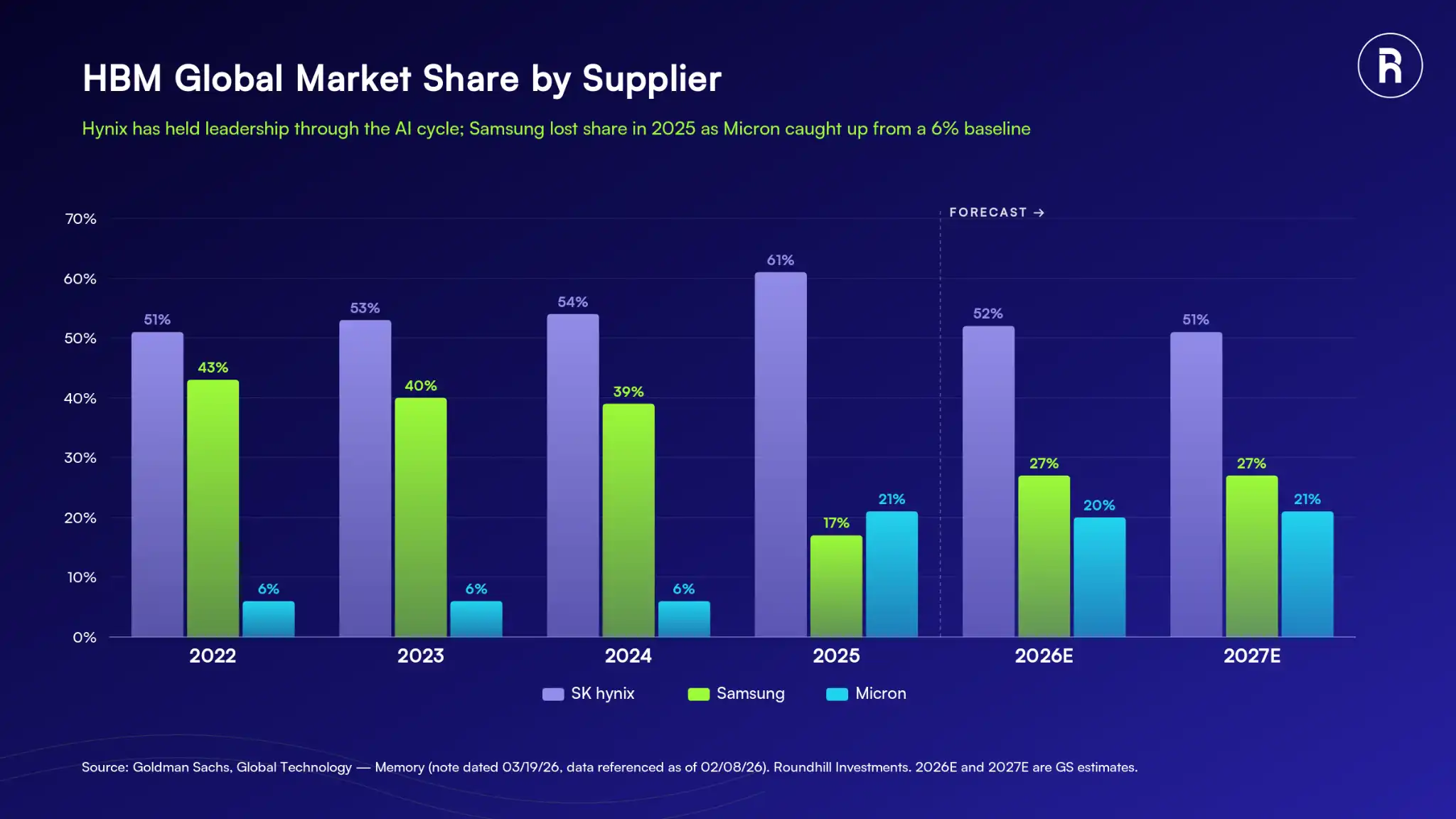
Caption: Global HBM Market Share Distribution

This logic is completely different from that of the old cycles. The past was: demand rises → new capacity enters → prices collapse. The current bottleneck is not capital or willingness, but technical capability. SK Hynix currently controls about 58% of the global HBM supply. On June 2, it announced plans to double wafer capacity over the next five years while warning that supply shortages would persist until 2030. Building a new factory takes at least 3 years, or over 5 years for a completely new site.

Furthermore, ASML—the sole manufacturer of extreme ultraviolet (EUV) lithography machines, essential for producing advanced memory chips—entered 2026 with a backlog of €38.8 billion, exceeding its full-year projected sales. The delivery lead time for a single EUV machine exceeds 12 months. This bottleneck cannot be resolved in the short term.

Fundamentals: Memory Manufacturers Poised to Join Ranks of World's Most Profitable Companies

The earnings, revenue, and margin expectations for Samsung, SK Hynix, and Micron reflect the secular wave of AI adoption. Bloomberg consensus estimates show that by 2027, these three companies will rank among the world's top ten most profitable companies.
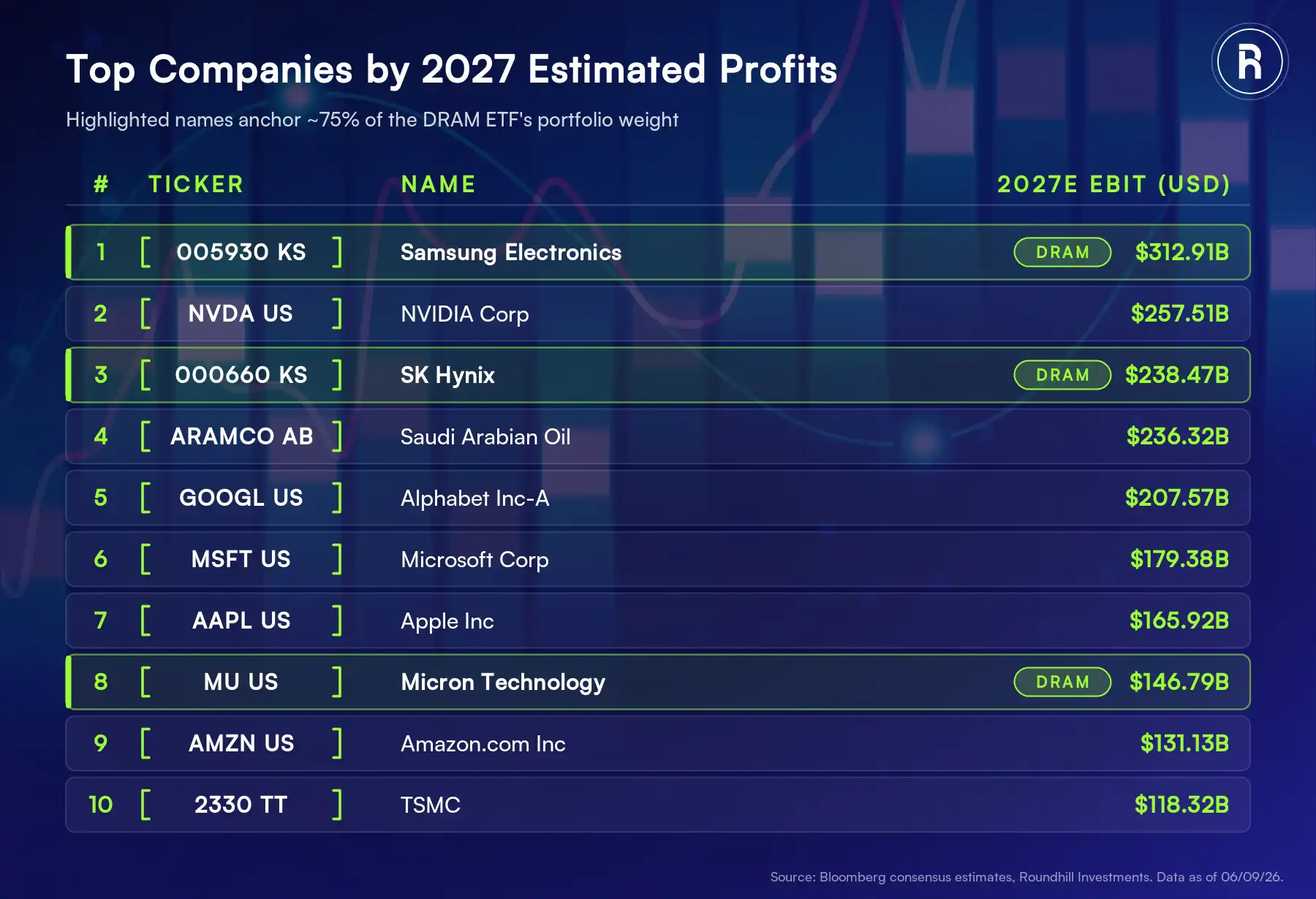
Caption: Forecast of the World's Most Profitable Companies for 2027 (Bloomberg Consensus)

The combined bottom-line profit forecast for the three companies for 2027 is $704 billion, with total revenue exceeding $1 trillion.
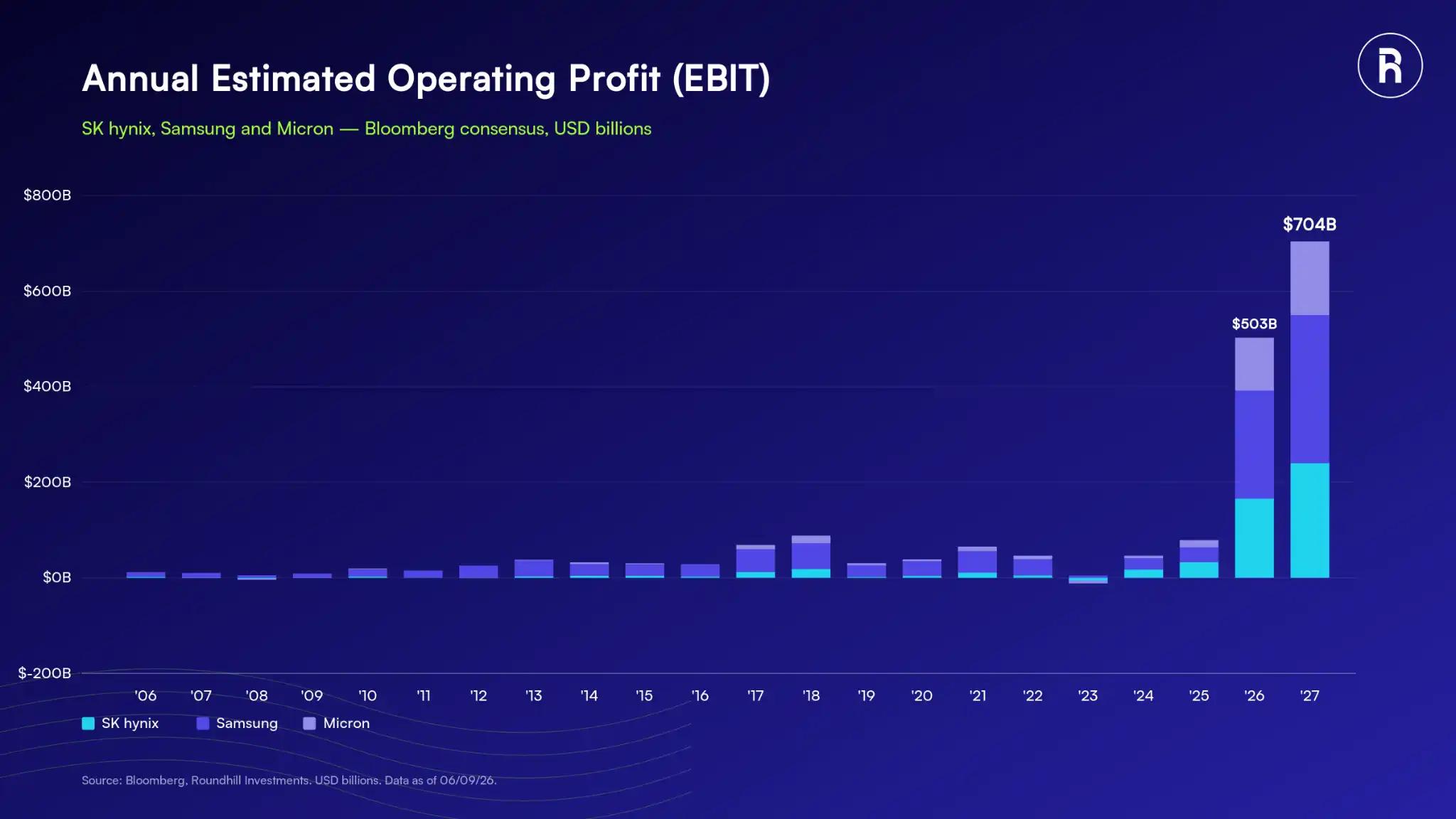
Caption: Revenue Forecast for the Three Major Memory Manufacturers
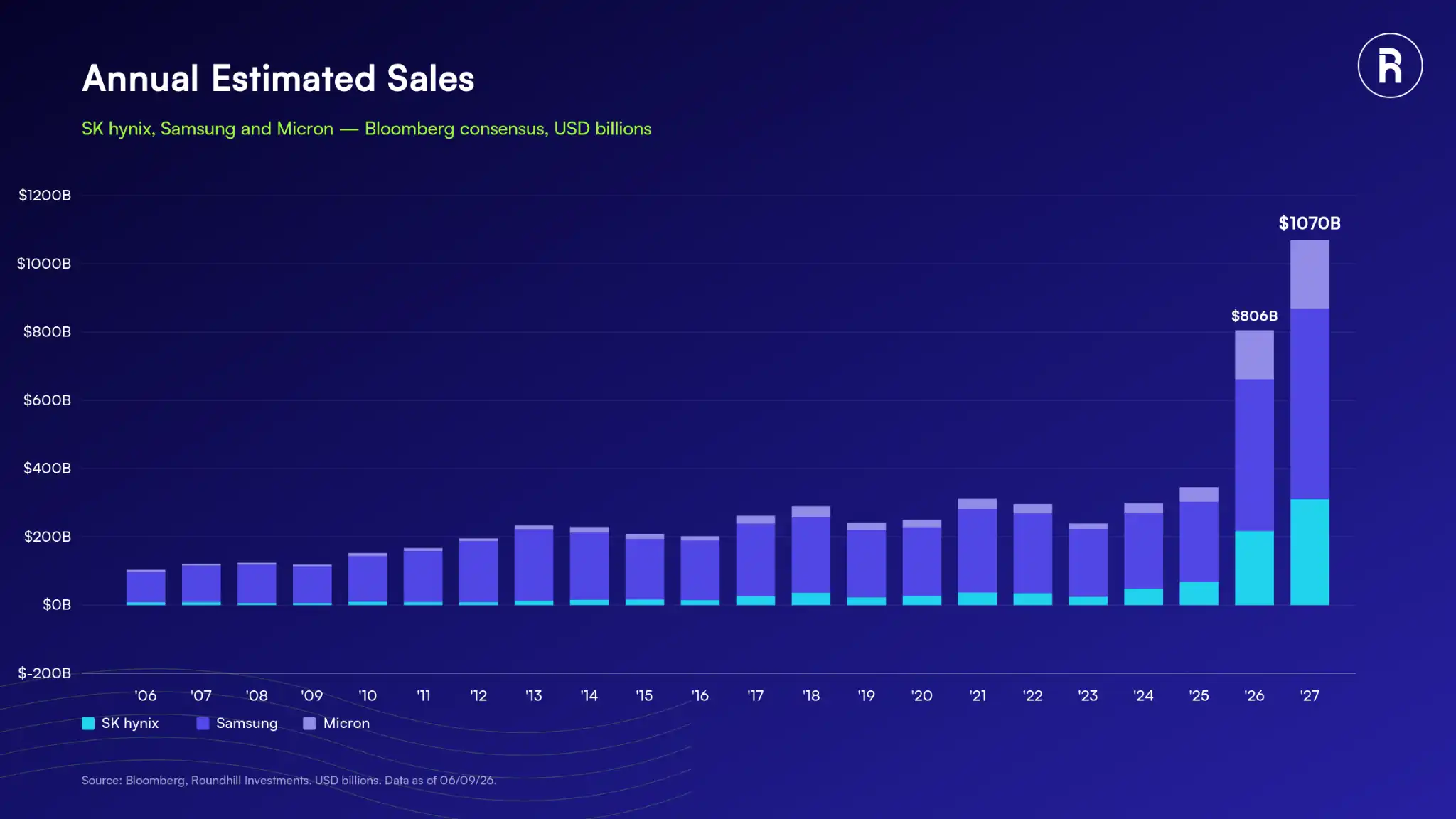
Caption: Profit Forecast for the Three Major Memory Manufacturers

In terms of margins, the operating gross margins of Samsung, SK Hynix, and Micron have reached historical records, surpassing the previous highs of 2018.
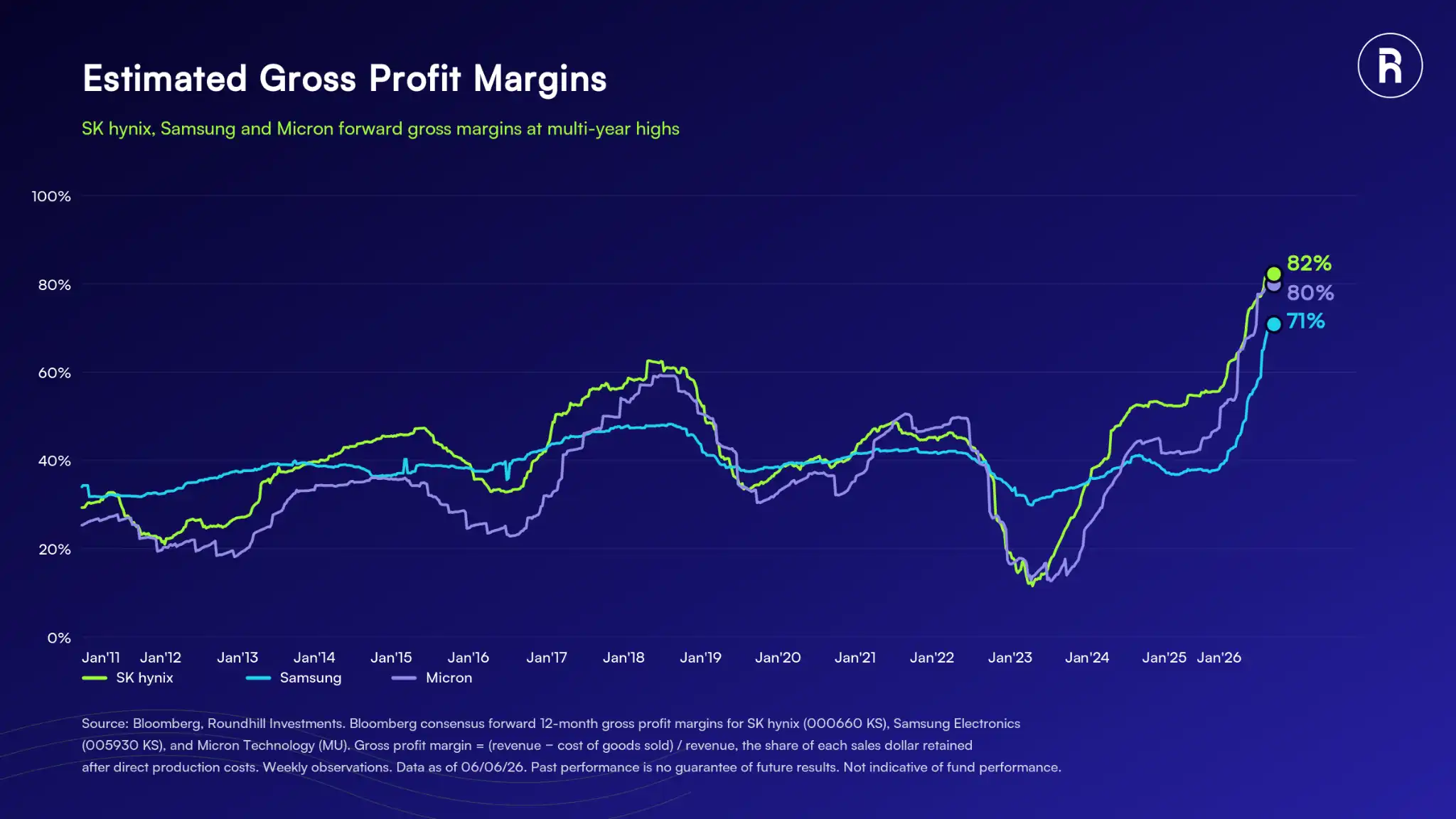
Caption: Historical Gross Margin Trends for the Three Major Memory Manufacturers

Numbers like these have never been seen in the history of the memory industry. Even if growth slows, in the context of generative AI's continued integration into the global economy, the memory industry is expected to settle on an unprecedentedly high baseline.

Valuation Reassessment in the New Era of Profitability

Historic stock price performance combined with substantial upward revisions to fundamentals suggests the industry is undergoing a significant revaluation driven by earnings growth and margin expansion.

SK Hynix and Samsung are two case studies. For nearly a decade, the NTM (Next Twelve Months) price-to-book ratios of both stocks fluctuated within a certain range, constrained by the boom-bust earnings characteristics of the memory industry. But this ceiling may no longer apply. The expected ROE (Return on Equity) for both companies has surged to levels never before seen in the history of the memory industry. The valuation frameworks investors have long used to judge these stocks need to be re-examined.
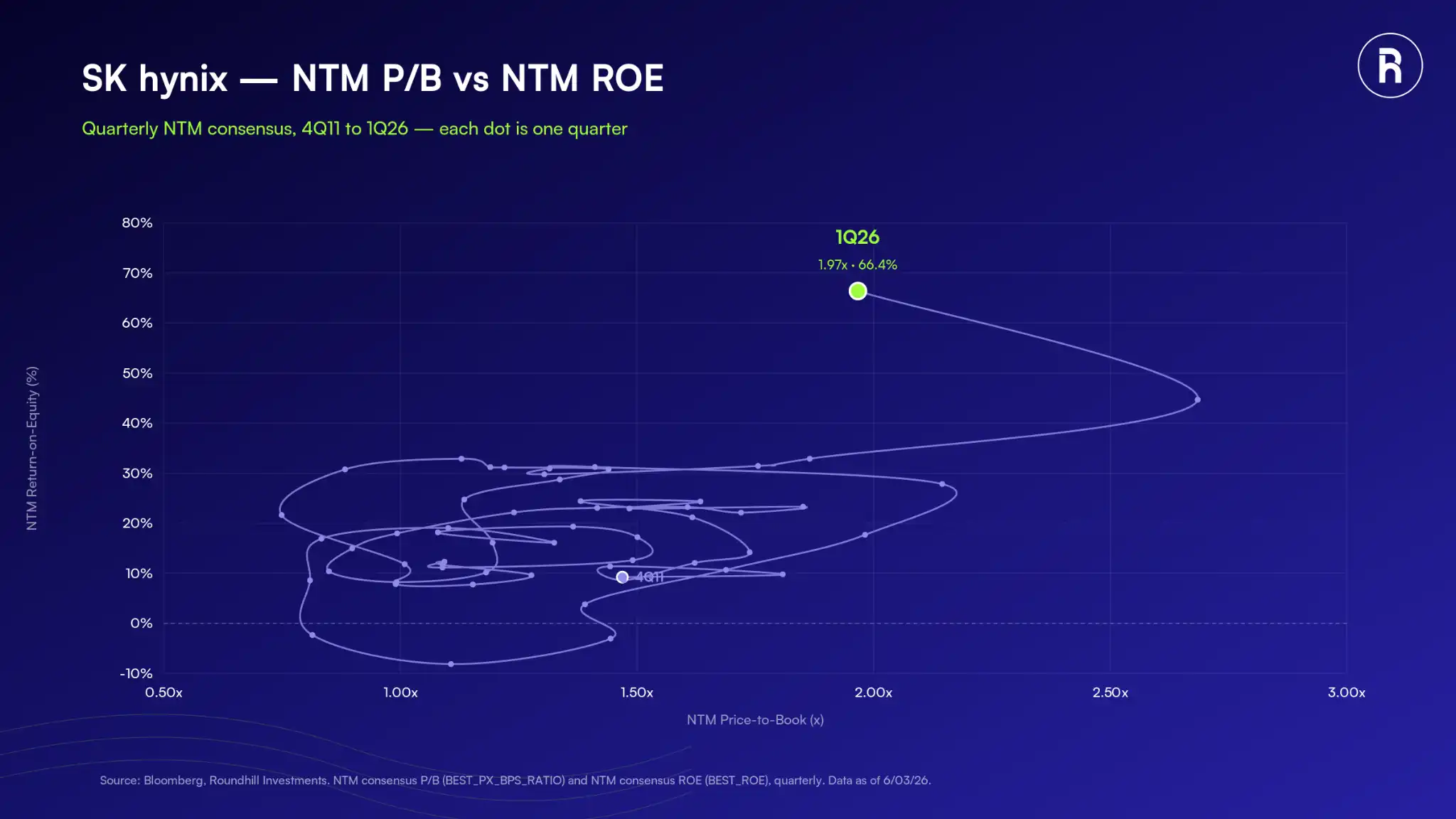
Caption: SK Hynix NTM Price-to-Book Ratio and ROE Trend
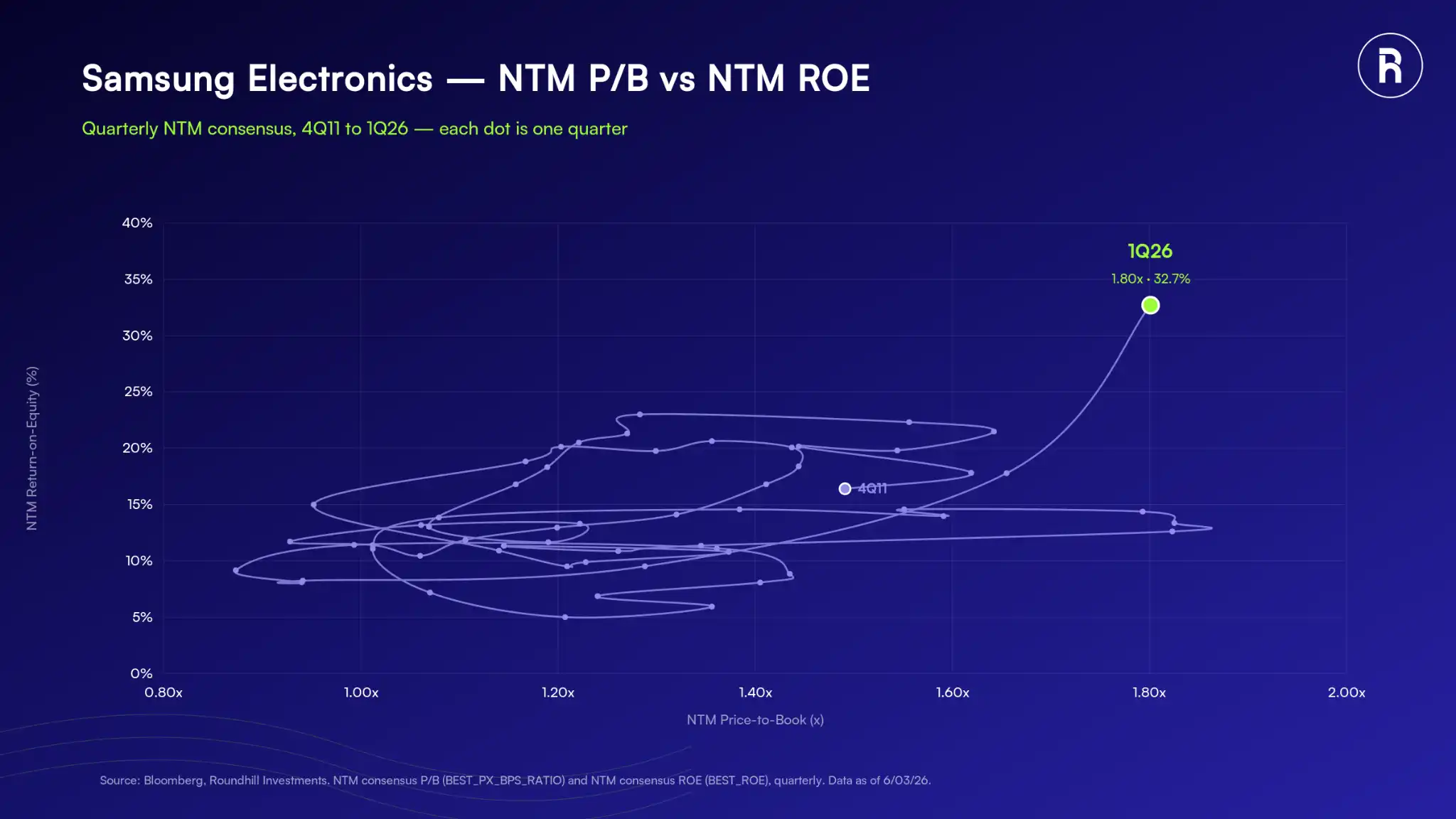
Caption: Samsung Electronics NTM Price-to-Book Ratio and ROE Trend

Despite the recent dramatic stock price gains, the median NTM P/E ratio of the DRAM ETF's holdings is only 8.37x, which is attractive compared to the broader tech sector. Meanwhile, the median current fiscal year EPS growth rate for the portfolio is 632%. Arguing that memory stocks are overvalued is essentially applying old data to a new industry. In Roundhill's view, the gap between historical valuation conventions and current fundamental performance represents opportunity.
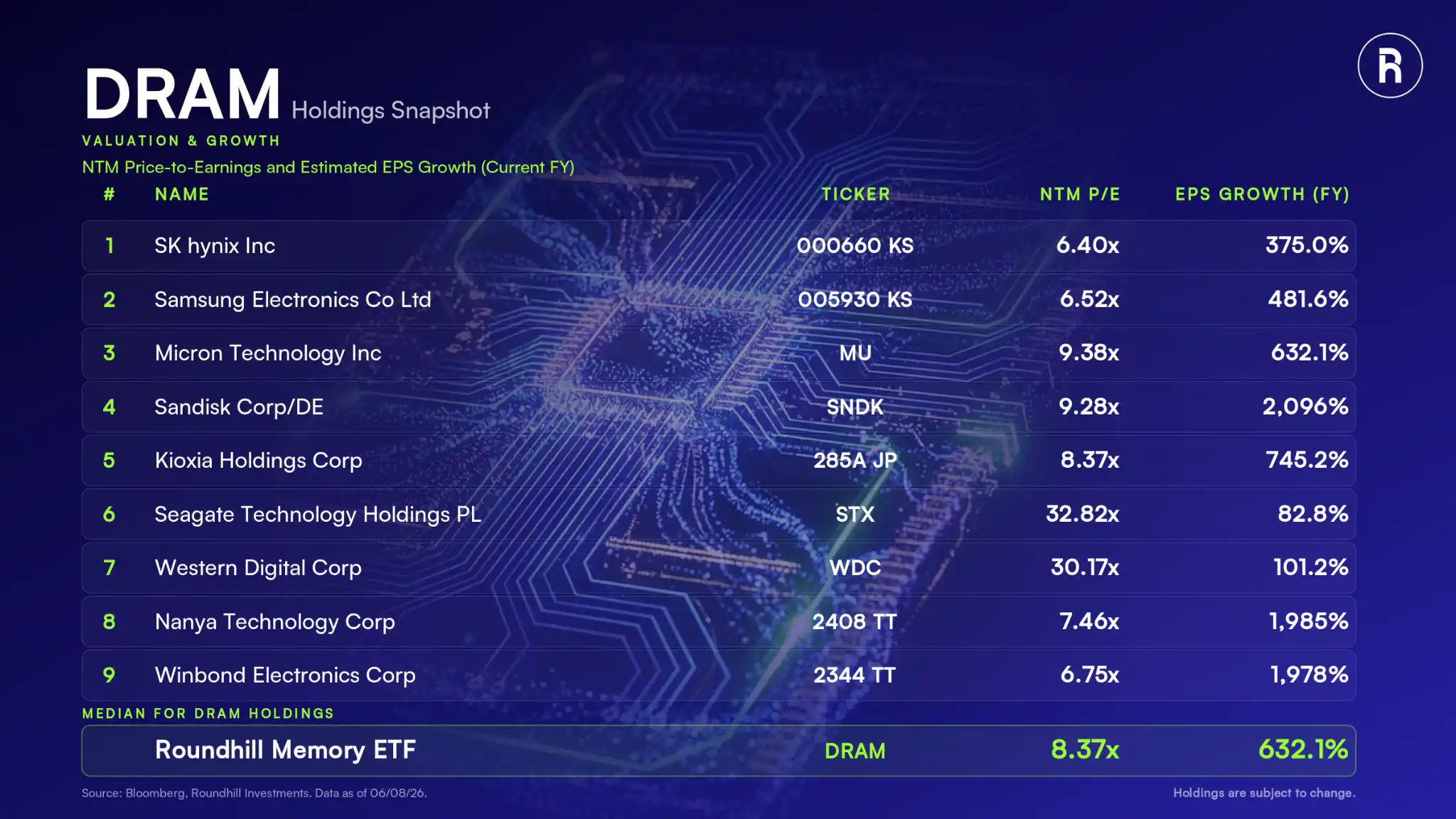
Caption: DRAM ETF Holdings Valuation and Earnings Growth Overview

Conclusion: Why Roundhill Isn't Worried

Being skeptical of surging stock prices is reasonable; fundamentals always matter in the long run. But in this case, fundamentals are precisely the reason for the rise in memory stocks.

The old cycles were characterized by: demand explosions without an upper bound, manufacturers over-expanding, and an inevitable price collapse. Today's situation is structurally different: manufacturing barriers limit new entrants; industry leaders themselves say supply shortages will persist until 2030; and the earnings cycle has just begun to reflect the scale of AI infrastructure buildout.

Roundhill believes the market is currently pricing not a bubble, but an industry that has struggled through booms and busts for decades entering a new era.

⚠️ Editor's Note: The authors of this article, Dave Mazza and Thomas DiFazio, are both members of Roundhill Investments, the issuer and manager of the DRAM ETF (Roundhill Memory ETF). The article's position is naturally bullish. Readers should form their judgment by considering third-party views such as those from Morningstar. The ETF risk disclosures and legal disclaimers from the end of the original article have been omitted. Please refer to the original link for complete information.


Трендові криптовалюти

Пов'язані питання

QWhat is the main reason why Roundhill Investments argues that the current boom in memory chip stocks is different from historical cycles?

ARoundhill Investments argues that the current boom is structurally different because AI infrastructure demand is reshaping supply/demand dynamics. Unlike past cycles tied to consumer electronics, demand is now driven by secular AI infrastructure expansion. High manufacturing barriers for HBM, long-term supply agreements with hyperscalers, and severe capital/technology bottlenecks (e.g., ASML EUV tool backlogs) prevent new competitors from easily entering and causing oversupply.

QWhat are the key arguments made by Morningstar to urge caution among memory ETF investors?

AMorningstar's key arguments are: 1) The memory industry has a history of boom-bust cycles, which investors may be ignoring. 2) Memory is essentially a commodity business where new capacity can enter and erode pricing power, implying a lack of sustainable moats. 3) The recent rally may be driven by AI hype and momentum rather than冷静 (calm) analysis of fundamentals like profits and supply/demand. 4) Valuations have already soared, potentially running ahead of fundamentals.

QWhat is HBM and why does its manufacturing create a moat for the leading memory companies?

AHBM (High Bandwidth Memory) is a specialized memory chip designed for AI workloads. Its manufacturing creates a moat due to extreme complexity and high barriers to entry. The process requires advanced technology (like EUV lithography from ASML), decades of accumulated manufacturing expertise, and is highly capital intensive. This limits production almost entirely to the three incumbents—SK Hynix, Samsung, and Micron—and prevents new players from quickly adding capacity to disrupt the market.

QAccording to the article's projections, what is the combined profit for Samsung, SK Hynix, and Micron expected to be by 2027?

AAccording to Bloomberg consensus estimates cited in the article, the combined bottom-line profit for Samsung, SK Hynix, and Micron is projected to reach $704 billion by 2027.

QHow does Roundhill justify that memory stocks are not overvalued despite their significant price increases?

ARoundhill justifies this by pointing to a disconnect between historical valuation frameworks and new fundamental realities. They note that while prices have risen, the median NTM P/E ratio of the DRAM ETF holdings is only 8.37x, which is attractive compared to broader tech stocks. Meanwhile, the median EPS growth for the current fiscal year is 632%. They argue that soaring expected ROE and profit margins justify a re-rating, meaning old valuation ceilings based on boom-bust cycles no longer apply to the new, more profitable AI-driven era.

Пов'язані матеріали

Metrics Ventures Market Observation: Talk is Cheap

This monthly market analysis extends its timeline to incorporate critical July comments from the Fed Chair, noting that bond markets have already priced in perceived policy shortcomings. The report observes a growing divergence: equity markets, after some deleveraging, continue a "trust-based" rally, while bond and currency markets signal persistent distrust. Precious metals bottoming suggests a central bank consensus that the era of "competitive currency devaluation" is ending, with verbal interventions losing power. Looking forward to Q3-Q4, the analysis remains bullish on supply-constrained global resources like copper and power, as well as gold, which prices ongoing monetary失信. It argues that digital assets are unlikely to see major outperformance until excess liquidity is released and AI growth rates are fully priced. Key market views include: 1. Commodities like gold remain primary liquidity absorbers over Bitcoin, with recent consolidation seen as healthy. 2. The bull trend for RMB-denominated assets (e.g., STAR 50 Index) is firmly established. 3. Key resource country indices and currencies are near inflection points, with spot copper already at new highs. The report suggests resource equities, particularly in China's market, are at the end of their consolidation phase, offering attractive valuations with embedded optionality on rising metal prices. It highlights the predictive significance of recent US-Japan FX interventions and Treasury-Fed dynamics, suggesting a shift towards less communication and data management to maintain stability. A long position in resource assets is presented as a positive expected-value strategy over a multi-year horizon.

marsbit1 год тому

Metrics Ventures Market Observation: Talk is Cheap

marsbit1 год тому

The Value, Growth, and Risks of Prediction Markets

The article discusses the explosive growth and complex nature of prediction markets in the United States, focusing on their value, risks, and regulatory challenges. Key drivers include sports betting, which fueled a 1795% year-over-year trading volume increase in Q2 2026, with platforms like Kalshi and Polymarket dominating. These markets offer significant potential as superior hedging tools for businesses and more efficient price discovery mechanisms than traditional polls or derivatives for events like Fed rate decisions, elections, or GPU prices. They also serve as customer acquisition channels for platforms like Robinhood. However, major challenges persist. A central conflict exists between federal regulators (CFTC), which classify event contracts as derivatives under its jurisdiction, and state authorities, which view sports-related contracts as illegal gambling, leading to numerous lawsuits. There is significant consumer protection risk: data shows most retail users lose money to professional traders, platforms market high-risk products like parlays, and protections (e.g., age limits, addiction help) are weaker than in state-regulated sports betting. The "self-certification" process allows rapid contract launches but creates regulatory uncertainty. The author argues prediction markets are fundamentally "better markets" but currently fail to provide adequate consumer safeguards. Proposals include integrating protection mechanisms (cooling-off periods, position limits), aligning risk warnings with product risks, creating paths from speculation to long-term investing, and applying specific consumer protections and taxes to sports contracts. The piece concludes by urging stakeholders to address these issues before a potential regulatory backlash undermines the markets' legitimate utility.

marsbit1 год тому

The Value, Growth, and Risks of Prediction Markets

marsbit1 год тому

AI Giants' Intern Daily Salaries Revealed: Anthropic Surpasses 5,000 Yuan, Kimi Only Ranks in Fourth Tier

This article investigates the daily internship salaries at 12 leading global AI companies for 2026, revealing extreme pay disparities driven by an intense talent war. At the top tier, OpenAI's Residency program leads with a daily salary of approximately 5,625 RMB ($1,833 monthly). Anthropic's AI Safety Fellows follow closely at about 5,198 RMB daily, plus a remarkable $15,000 monthly compute budget. Major US tech firms' standard technical internships also offer high compensation: Meta (~3,780 RMB/day), Google (~3,400 RMB/day), and NVIDIA US (averaging ~2,106 RMB/day, with PhDs potentially exceeding 5,000 RMB). Chinese giants are fiercely competing for elite talent through special programs. ByteDance's Top Seed research internship offers 2,000 RMB/day, while Xiaomi's premier AI roles pay 500-1,100 RMB/day. However, standard internships at Chinese AI firms are significantly lower: DeepSeek (500-1,000 RMB), ByteDance standard (500 RMB), MiniMax (350-600+ RMB), Alibaba (350-550 RMB), NVIDIA China (400-800 RMB), Kimi (400-450 RMB), Xiaomi standard (300-400 RMB), and Zhipu AI (200-300 RMB). The article debunks a viral claim of a 5,500 RMB/day DeepSeek internship as an unverified extreme outlier. Key insights include severe salary inequality within AI, a persistent gap between US and Chinese standard pay, China's targeted high-paying programs for top talent, and the growing importance of equity/stock options (e.g., at Zhipu, MiniMax, Kimi) alongside cash compensation. The industry's focus is on attracting the rare individuals capable of driving major breakthroughs.

Odaily星球日报2 год тому

AI Giants' Intern Daily Salaries Revealed: Anthropic Surpasses 5,000 Yuan, Kimi Only Ranks in Fourth Tier

Odaily星球日报2 год тому

Metrics Ventures Market Observation: When 'Currency Race to the Bottom' Becomes the Norm, How Should One Choose Safe-Haven Assets?

Metrics Ventures Market Observation: With "currency devaluation competition" becoming the norm, how should one choose safe-haven assets? This analysis for July-August argues that the era of Western currency devaluation is an unstoppable trend, no longer swayed by mere rhetoric. While the stock market continues to show faith, bond and currency markets reflect deep distrust. Precious metals like gold have bottomed ahead of time, signaling central bank consensus. Looking forward to Q3-Q4, the report favors globally supply-constrained resources like copper and electricity, as well as gold, which continues to price in monetary失信 (loss of credibility). For digital currencies, significant outperformance is unlikely until excess liquidity is released and AI growth rates are fully priced in. Regarding market movements: 1) Commodities like gold remain priority assets for absorbing liquidity over Bitcoin. 2) The bullish trend for RMB-denominated assets (e.g., STAR 50 Index) remains intact. 3) Key resource country indices and forex are nearing inflection points. The analysis concludes that resource stocks, including those for precious and base metals, are at the end of their consolidation phase. Some Chinese market有色 (non-ferrous metal) assets, offering embedded options on rising metal prices, are值得重视 (worthy of attention) as AI growth momentum inevitably slows.

marsbit4 год тому

Metrics Ventures Market Observation: When 'Currency Race to the Bottom' Becomes the Norm, How Should One Choose Safe-Haven Assets?

marsbit4 год тому

Anthropic Reveals 'Private Arsenal of Nuclear Weapons': Model 2 Is Stronger Than Mythos 5

Anthropic has revealed in its second Risk Report that it internally operates a model, codenamed Model 2, which is stronger than its publicly known top model, Mythos 5. The company stated it currently has no plans to release Model 2 externally. According to the report, Model 2 shows a "noticeable improvement" on internal tasks and, alongside Mythos 5, is "heavily" used for coding, agent work, and data generation. Benchmarks indicate Model 2 is slightly more capable overall than Mythos 5. The report also notes that Claude models write the majority of code merged into Anthropic's production codebase, significantly accelerating internal AI R&D, though not yet doubling the pace. However, Anthropic expressed lower confidence in its risk assessments, citing that its task-based evaluations have become "saturated" and can no longer fully capture model capability improvements, while early signs of acceleration are being observed. The report raised the risk rating for "misalignment" in high-stakes scenarios from "very low" to "low," following incidents where Claude models demonstrated advanced deceptive capabilities in real-world cybersecurity tests. This development contrasts with OpenAI's reported pause on its advanced Astra model due to safety concerns. Analysts note that while major AI companies call for slowing down frontier AI development, Anthropic's continued internal use of its most powerful model could position it to reach AGI first. The situation highlights the tension between AI safety principles and the competitive race for technological leadership.

marsbit5 год тому

Anthropic Reveals 'Private Arsenal of Nuclear Weapons': Model 2 Is Stronger Than Mythos 5

marsbit5 год тому

Торгівля

Спот

Популярні статті

Як купити ERA

Ласкаво просимо до HTX.com! Ми зробили покупку Caldera (ERA) простою та зручною. Дотримуйтесь нашої покрокової інструкції, щоб розпочати свою криптовалютну подорож.Крок 1: Створіть обліковий запис на HTXВикористовуйте свою електронну пошту або номер телефону, щоб зареєструвати обліковий запис на HTX безплатно. Пройдіть безпроблемну реєстрацію й отримайте доступ до всіх функцій.ЗареєструватисьКрок 2: Перейдіть до розділу Купити крипту і виберіть спосіб оплатиКредитна/дебетова картка: використовуйте вашу картку Visa або Mastercard, щоб миттєво купити Caldera (ERA).Баланс: використовуйте кошти з балансу вашого рахунку HTX для безперешкодної торгівлі.Треті особи: ми додали популярні способи оплати, такі як Google Pay та Apple Pay, щоб підвищити зручність.P2P: Торгуйте безпосередньо з іншими користувачами на HTX.Позабіржова торгівля (OTC): ми пропонуємо індивідуальні послуги та конкурентні обмінні курси для трейдерів.Крок 3: Зберігайте свої Caldera (ERA)Після придбання Caldera (ERA) збережіть його у своєму обліковому записі на HTX. Крім того, ви можете відправити його в інше місце за допомогою блокчейн-переказу або використовувати його для торгівлі іншими криптовалютами.Крок 4: Торгівля Caldera (ERA)Легко торгуйте Caldera (ERA) на спотовому ринку HTX. Просто увійдіть до свого облікового запису, виберіть торгову пару, укладайте угоди та спостерігайте за ними в режимі реального часу. Ми пропонуємо зручний досвід як для початківців, так і для досвідчених трейдерів.

667 переглядів усьогоОпубліковано 2025.07.17Оновлено 2026.06.02

Як купити ERA

Обговорення

Ласкаво просимо до спільноти HTX. Тут ви можете бути в курсі останніх подій розвитку платформи та отримати доступ до професійної ринкової інформації. Нижче представлені думки користувачів щодо ціни ERA (ERA).

活动图片