Fed's $400 Billion Liquidity Signal: Bitcoin Under Pressure Awaits a Breakthrough

深潮Опубліковано о 2025-12-09Востаннє оновлено о 2025-12-09

Анотація

Bitcoin's price appears stable but is under significant structural pressure, with investors facing nearly $500 million in daily losses and over 6.5 million BTC held at unrealized losses. This coincides with a potential shift in U.S. monetary policy, as the Federal Reserve ends its quantitative tightening program—which reduced its balance sheet by $2.4 trillion—and signals a move toward "Reserve Management Purchases." This could inject over $400 billion annually in liquidity by reinvesting in short-term Treasuries. Market attention is focused on Fed Chair Powell’s upcoming remarks regarding labor market softening and the timing of liquidity expansion. A clear signal toward reserve rebuilding could push Bitcoin above the $92k–$93.5k resistance, while a cautious tone may keep it range-bound between $75k–$82k. Despite miner capitulation and weak short-term holder sentiment, large wallets are accumulating Bitcoin, exchange reserves are declining, and stablecoin inflows suggest latent demand. This combination of pressure and accumulation often precedes a market bottom. Bitcoin’s next major move hinges on the Fed’s liquidity signals and broader macroeconomic conditions.

Written by: Oluwapelumi Adejumo

Compiled by: Saoirse, Foresight News

Bitcoin's price movement is fluctuating alongside the Fed's final policy decision of the year, showing almost no significant surface-level changes, yet the deep market structure presents a completely different picture.

Beneath the seemingly stable price range lies a period of concentrated pressure: on-chain data shows investors are facing daily losses nearing $500 million, leverage in the futures market has significantly decreased, and nearly 6.5 million Bitcoin are currently in an unrealized loss position.
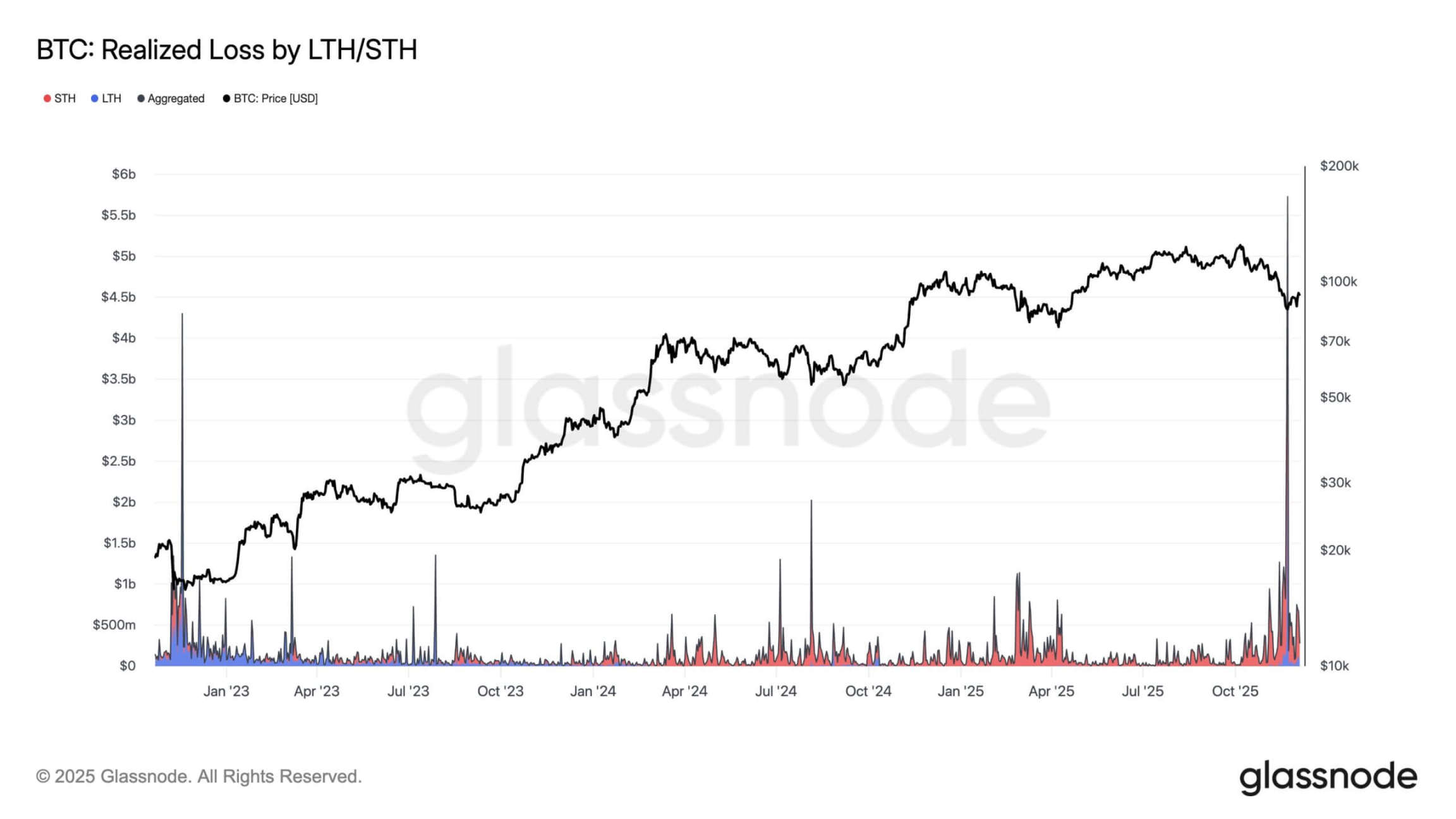
Bitcoin Realized Loss Level, Source: Glassnode

This situation resembles the final stages of past market contractions more than a healthy consolidation phase.

However, structural adjustments occurring beneath a calm surface are not uncommon for Bitcoin, but the timing of this adjustment is noteworthy.

The internal market "capitulation selling"恰好 coincides with an external inflection point in US monetary policy. The Federal Reserve has ended its most aggressive balance sheet reduction phase in over a decade, and the market expects its December meeting to outline a clearer framework for a "turn towards reserve rebuilding."

Given this, the on-chain market pressure and the pending liquidity shift together form the backdrop for this week's macro events.

Liquidity Shift

According to the Financial Times, Quantitative Tightening (QT) officially ended on December 1st. During this period, the Fed reduced its balance sheet by approximately $2.4 trillion.

This move pushed bank reserve levels down into a range historically associated with funding stress, while the Secured Overnight Financing Rate (SOFR) repeatedly tested the upper limit of the policy rate band.

These changes indicate that the market system is no longer flush with liquidity but is gradually entering a phase of "concern triggered by scarce reserves."

Against this backdrop, the most critical signal from the Federal Open Market Committee (FOMC) is not the widely anticipated 25 basis point rate cut, but rather the direction of its balance sheet strategy.

The market expects the Fed to clarify its transition plan to "Reserve Management Purchases (RMP)" through an explicit statement or policy implementation document.

According to analysis by investment research firm Evercore ISI, this plan could launch as early as January 2026, involving monthly around $35 billion in purchases of short-term Treasury bills — funds recouped from maturing mortgage-backed securities will be reallocated into short-term assets.

The details of this mechanism are crucial: although the Fed is unlikely to define RMP as "stimulus policy," continuous reinvestment into short-term Treasury bills will steadily rebuild bank reserves and shorten the asset maturity structure of the System Open Market Account (SOMA).

This operation will gradually increase the scale of reserves, ultimately leading to an annualized balance sheet growth exceeding $400 billion.

Such a shift would mark the first sustained expansionary policy signal from the Fed since the start of quantitative tightening. Historical data suggests Bitcoin's sensitivity to these types of liquidity cycles is far greater than its sensitivity to changes in policy rates.

Meanwhile, broader monetary aggregate data indicates that the liquidity cycle may have already begun to turn.

Notably, the M2 money supply has reached a historical peak of $22.3 trillion, surpassing the high of early 2022 after a prolonged period of contraction.

(Note: M2 is a core measure of money supply, falling under the "broad money" category. It has a wider scope than base money (M0) and narrow money (M1), providing a more comprehensive reflection of the overall liquidity situation in society.)
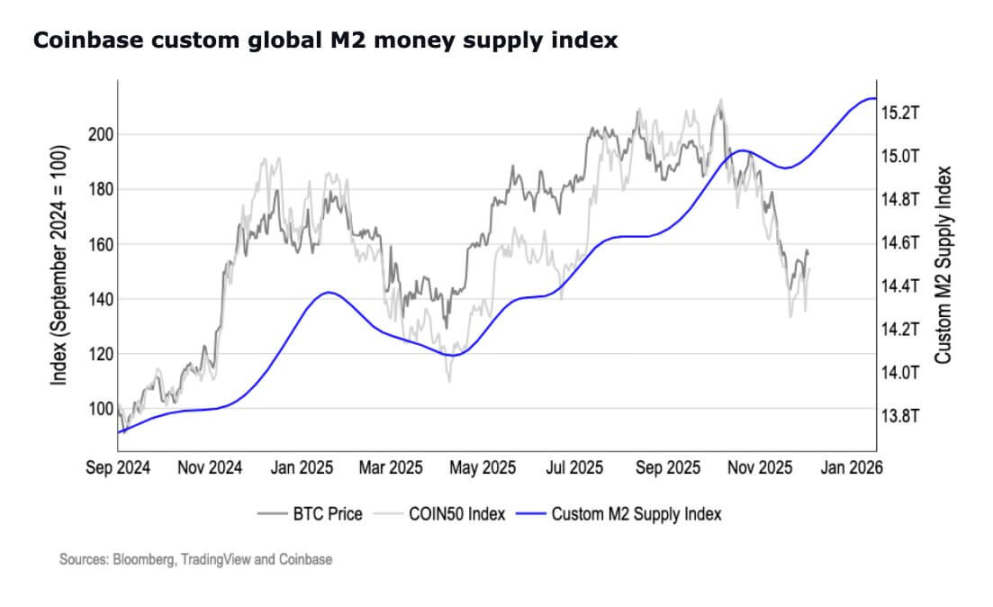
US M2 Money Supply, Source: Coinbase

Therefore, if the Fed confirms the start of "reserve rebuilding," Bitcoin's sensitivity to balance sheet dynamics could quickly rebound.

Macro Trap

The core rationale for this policy shift stems from changes in employment data.

Nonfarm payrolls have declined in 5 out of the past 7 months; simultaneously, job openings, the hiring rate, and the quits rate have all shown signs of slowing, shifting the employment market narrative from "highly resilient" to "fragile and under pressure."

As these indicators cool, the theoretical framework of an "economic soft landing" becomes increasingly difficult to sustain, and the Fed's policy options continue to narrow.

While current inflation has receded, it remains above the policy target; meanwhile, the cost of "maintaining restrictive policy for longer" is rising.

The potential risk is that weakness in the labor market could intensify further before inflation fully returns to target levels. Therefore, the informational value of the Fed press conference this week might exceed that of the rate decision itself.

The market will focus intently on how Fed Chair Powell balances the dual objectives — maintaining labor market stability while ensuring credibility in the inflation path. His remarks on "reserve adequacy," "balance sheet strategy," and the "timing of RMP launch" will dominate market expectations for 2026.

For Bitcoin, this means its price movement won't be a binary outcome of simply rising or falling, but will depend on the specific direction of the policy signals.

If Powell acknowledges labor market weakness and clearly outlines the reserve rebuilding plan, the market might perceive the current range-bound price as disconnected from the policy direction — a break above the $92k - $93.5k range would indicate traders are anticipating liquidity expansion.

Conversely, if Powell emphasizes policy caution or delays clarifying RMP details, Bitcoin could remain within the lower consolidation range of $82k - $75k — a zone that concentrates ETF holding bottoms, corporate treasury reserve thresholds, and historical structural demand areas.

Will Bitcoin See 'Capitulation Selling'?

Meanwhile, Bitcoin's internal market dynamics further corroborate the view that "the asset is undergoing a reset beneath the surface."

Short-term holders continue to sell tokens during market weakness; as mining costs approach $74k, mining economics have significantly deteriorated.

Simultaneously, Bitcoin mining difficulty saw its largest single drop since July 2025, indicating marginal miners are scaling back operations or shutting down rigs entirely.

However, these pressure signals coexist with early signs of "supply tightening."

Research firm BRN Research disclosed to CryptoSlate: large wallets have accumulated approximately 45,000 BTC over the past week; Bitcoin exchange balances continue to decline; stablecoin inflows show that capital is poised to re-enter the market should conditions improve.

Furthermore, supply metrics from asset manager Bitwise show that despite retail sentiment being in "extreme fear," wallets of all types are accumulating Bitcoin. Tokens are moving from high-liquidity platforms to long-term custody accounts, further reducing the proportion of supply available to absorb sell-offs.

This pattern of "forced selling, miner pressure, and selective accumulation" often forms the foundation for a long-term market bottom.

Bitwise further added:

"Bitcoin's capital expansion continues to contract, with the 30-day realized cap growth rate falling to just 0.75% per month. This suggests profit-taking and stop-loss selling in the current environment are roughly balanced, with losses only slightly outweighing profits. This rough balance indicates the market has entered a 'calm period,' with neither bulls nor bears holding clear dominance."

Technical Perspective

From a market structure perspective, Bitcoin remains constrained by two key ranges.

A sustained break above $93.5k would push the asset into a zone where "momentum models are more easily triggered," with subsequent targets at $100k, $103.1k (the short-term holder cost basis), and long-term moving averages.

Conversely, failure to break resistance in the face of cautious Fed signals could see the market retreat to the $82k - $75k range — an area that has repeatedly acted as a "reservoir" for structural demand.

BRN Research notes that cross-asset performance also confirms this sensitivity: ahead of the Fed meeting, gold and Bitcoin showed inverse correlations, reflecting asset rotation driven by changes in liquidity expectations, rather than purely risk sentiment-driven volatility.

Therefore, if Powell's comments reinforce the expectation that "reserve rebuilding is the core of the next policy phase," capital could quickly rotate towards assets that respond positively to "liquidity expansion."


Трендові криптовалюти

Пов'язані питання

QWhat is the key liquidity signal from the Fed mentioned in the article, and how might it impact Bitcoin?

AThe Fed is expected to transition to a 'Reserve Management Purchases' (RMP) program, potentially starting as early as January 2026, which would involve monthly purchases of around $35 billion in short-term Treasury bills. This would steadily rebuild bank reserves, leading to an annualized expansion of the balance sheet by over $400 billion. Historically, Bitcoin has shown high sensitivity to such liquidity cycles, and this shift could provide a tailwind for its price if the policy direction is confirmed.

QAccording to on-chain data, what are the signs of underlying market stress in Bitcoin despite its seemingly stable price?

AOn-chain data shows that investors are realizing losses of nearly $500 million daily, leverage in the futures market has significantly decreased, and approximately 6.5 million Bitcoin are currently in a state of unrealized loss. This points to a period of concentrated selling pressure and capitulation beneath the surface of the price action.

QWhat are the two key price ranges that are constraining Bitcoin's movement, as per the technical analysis in the article?

ABitcoin is constrained between two key ranges. A sustained break above $93,500 would signal a move into a momentum-driven phase with targets at $100,000 and $103,100. Conversely, a failure to break resistance could see a retracement to the lower consolidation range of $82,000 to $75,000, which has historically acted as a structural demand zone.

QHow does the article characterize the current state of the mining industry and its impact on the market?

AThe mining economics have significantly deteriorated as mining costs approach $74,000. This has been accompanied by the largest single drop in Bitcoin mining difficulty since July 2025, indicating that marginal miners are scaling back operations or shutting down rigs. This represents a source of selling pressure and is a sign of a market under stress.

QWhat conflicting forces are at play in the Bitcoin market that could be forming a long-term bottom?

AThe market is experiencing conflicting forces: forced selling from short-term holders and pressured miners exists alongside selective accumulation by large wallets. There has been a net outflow of Bitcoin from exchanges, and stablecoin inflows suggest capital is ready to re-enter the market. This pattern of distribution to strong hands and a reduction in easily sellable supply is often a foundation for a long-term market bottom.

Пов'язані матеріали

Must-Watch Events Next Week|CLARITY Act Could Face Senate Vote; SpaceX, Circle to Report Earnings (8.3-8.9)

**Summary: Key Events and Developments to Watch (August 3-9)** The upcoming week is marked by significant financial disclosures, key legislative deadlines, and notable product updates. **Major Financial Events:** Several companies are scheduled to release their Q2 2026 earnings. American Bitcoin (ABTC) will report on August 3, followed by SpaceX and Hut 8 Mining Corp. on August 4, and Circle on August 5. Notably, a significant portion of SpaceX shares (up to 12% of total shares) will be unlocked on August 6 following their earnings release. **Key Legislative Deadline:** The U.S. Senate faces an August 7 deadline to secure 60 votes for the CLARITY Act, a bipartisan bill aiming to establish a federal regulatory framework for cryptocurrencies. The Senate may hold a full vote on the bill during the week. **Economic Data:** The U.S. July Non-Farm Payrolls report will be released on August 7, providing crucial labor market data. **Technology & Product Updates:** * **Shutdowns:** DeFi portfolio tracker Zapper and wallet app Ctrl Wallet will cease operations on August 3. * **Upgrades:** LayerZero will deprecate its v1 relayers on August 3. XRP Ledger's new version 3.3.0, featuring five new functions, is expected next week. * **AI:** Elon Musk announced that the advanced Grok 4.6 AI model is set for release around August 7. * **Bitcoin:** The BIP-110 forced signaling for a potential Bitcoin network change is scheduled to begin around August 8. **Other Notable Events:** Chinese robotics firm Unitree Tech has set its preliminary price inquiry for its IPO for August 5. South Korean exchange Upbit will delist AQT and AERGO tokens on August 3.

marsbit52 хв тому

Must-Watch Events Next Week|CLARITY Act Could Face Senate Vote; SpaceX, Circle to Report Earnings (8.3-8.9)

marsbit52 хв тому

Stocks Are Plummeting More Sharply Than Cryptocurrencies. Where Has the Money Gone?

Stock Markets Plunge Deeper Than Cryptocurrencies: Where Did the Money Go? In late July, Seoul's Kospi index triggered circuit breakers for two consecutive days, plummeting over 40% from its June high. The collapse was led by heavyweight stocks like SK Hynix, whose record profits still disappointed investors, and devastating leveraged ETFs, with one major product losing over 83% of its value. This signaled a global, forced deleveraging targeting the most crowded trades. Interestingly, while stocks exhibited extreme volatility akin to crypto markets, Bitcoin rose nearly 15% in July after a prior steep drop. Analysis shows the money fleeing equities did not flow into Bitcoin. Instead, Bitcoin had already absorbed its sell-off in May-June, when U.S. spot Bitcoin ETFs saw historic outflows. The true safe-haven beneficiary was gold, whose price rose over 20% year-on-year, highlighting a decoupling between Bitcoin and gold as "digital gold." The sell-off was a targeted unwinding of leveraged positions in tech and semiconductors, accelerated by broker-dealer risk management and shifts in the AI narrative, including new competition from Chinese memory chipmakers. The retreat path was clear: from high-valuation tech stocks to cash and U.S. Treasuries, then to gold. For Bitcoin to attract sustained institutional inflows, conditions like eased global liquidity pressure, a "soft-landing" Fed rate cut, and U.S. regulatory clarity via legislation like the stalled CLARITY Act are needed. Currently, Bitcoin is not a safe haven but an already-cleared asset. Its low correlation with tech stocks, however, makes it a potential diversification play for institutional portfolios once the storm passes. The money isn't here yet, but the positioning is underway.

marsbit52 хв тому

Stocks Are Plummeting More Sharply Than Cryptocurrencies. Where Has the Money Gone?

marsbit52 хв тому

In Conversation with Ray Dalio: We Are Currently in an AI Bubble, with 1% of My Portfolio in Bitcoin

Ray Dalio, founder of Bridgewater Associates, warns in an interview that the current AI boom shows classic bubble characteristics, which could lead to significant economic downturns as seen in past cycles like 1929 or 2000. He explains that speculative enthusiasm, fueled by debt and overvaluation, often precedes a crash when rising rates or taxation force asset sales, causing widespread losses and recession. Dalio also outlines his "Big Cycle" theory, describing an approximate 80-year pattern where widening wealth gaps, massive government deficits, and shifting geopolitical power (like China's rise) create internal conflict and global instability. He emphasizes that we are in a late-cycle, transitional phase where traditional powers like the US and UK face decline. For personal wealth protection, Dalio advises diversification beyond cash into assets like stocks, bonds, real estate, and particularly gold, which he prefers over Bitcoin. While he holds about 1% of his portfolio in Bitcoin as a non-printable hard asset, he views gold as more secure from technological or governmental threats. Regarding AI's impact, Dalio believes it will disproportionately benefit capital owners, worsening inequality by replacing both physical and cognitive labor. He suggests that human intuition and emotional intelligence, combined with AI, will be key for future workers. On taxation, Dalio argues that wealth taxes are impractical and risk triggering asset sell-offs, reducing productive investment. He points to the UK as a cautionary example of debt, low productivity, and political strife. Geopolitically, Dalio foresees a more regionalized world, with the US showing weakness in prolonged conflicts like with Iran, akin to past imperial declines. The ideal outcome, he suggests, is coexisting powerful blocs (e.g., Americas, China-Asia Pacific) without major war.

marsbit4 год тому

In Conversation with Ray Dalio: We Are Currently in an AI Bubble, with 1% of My Portfolio in Bitcoin

marsbit4 год тому

Daily 7.2 Trillion KRW: Foreign Capital's Record Net Buying on Friday! Wall Street Says Headwinds for Korean Stock Fund Flows Have Subsided

South Korean stock market sees a dramatic shift in fund flows. On July 31, foreign investors made a record net purchase of approximately KRW 7.2 trillion in KOSPI stocks, marking a fundamental reversal from the persistent large-scale net outflows seen in previous months. This contributed to a significant narrowing of foreign net selling in July to KRW 9.8 trillion, down sharply from KRW 48.4 trillion in June and KRW 44.5 trillion in May. Simultaneously, domestic institutional pressure eased. South Korean pension funds and asset managers turned to a net buying position in July, purchasing KRW 1.0 trillion worth of KOSPI shares, contrasting with net sales in May and June. Market volatility is expected to be dampened by new financial regulations. Effective July 31, the Financial Services Commission tightened access for retail investors to single-stock leveraged ETFs by raising the minimum cash deposit requirement. Trading volumes for these products subsequently dropped to about 50% of their monthly average. Citigroup Research maintains its year-end KOSPI target of 10,000 points. The firm cites several supportive factors: the substantial easing of headwinds from capital outflows, a robust fundamental outlook for the semiconductor sector, historically low market valuations, strong economic fundamentals, and the potential for policy support from financial authorities if needed.

marsbit4 год тому

Daily 7.2 Trillion KRW: Foreign Capital's Record Net Buying on Friday! Wall Street Says Headwinds for Korean Stock Fund Flows Have Subsided

marsbit4 год тому

Торгівля

Спот

Популярні статті

Що таке $S$

Розуміння SPERO: Комплексний огляд Вступ до SPERO Оскільки ландшафт інновацій продовжує еволюціонувати, виникнення технологій web3 та криптовалютних проектів відіграє ключову роль у формуванні цифрового майбутнього. Один з проектів, який привернув увагу в цій динамічній сфері, — це SPERO, позначений як SPERO,$$s$. Ця стаття має на меті зібрати та представити детальну інформацію про SPERO, щоб допомогти ентузіастам та інвесторам зрозуміти його основи, цілі та інновації в рамках web3 та крипто-сектору. Що таке SPERO,$$s$? SPERO,$$s$ — це унікальний проект у криптопросторі, який прагне використати принципи децентралізації та технології блокчейн для створення екосистеми, що сприяє залученню, корисності та фінансовій інклюзії. Проект розроблений для полегшення взаємодії між користувачами новими способами, надаючи їм інноваційні фінансові рішення та послуги. У своїй основі SPERO,$$s$ прагне надати можливості індивідам, забезпечуючи інструменти та платформи, які покращують користувацький досвід у криптовалютному просторі. Це включає в себе можливість більш гнучких методів транзакцій, сприяння ініціативам, що підтримуються спільнотою, та створення шляхів для фінансових можливостей через децентралізовані додатки (dApps). Основна концепція SPERO,$$s$ обертається навколо інклюзивності, прагнучи зменшити розриви в традиційній фінансовій системі, використовуючи переваги технології блокчейн. Хто є творцем SPERO,$$s$? Особистість творця SPERO,$$s$ залишається дещо невідомою, оскільки є обмежені публічно доступні ресурси, що надають детальну інформацію про його засновників. Ця відсутність прозорості може бути наслідком зобов'язання проекту до децентралізації — етики, яку багато проектів web3 поділяють, ставлячи колективні внески вище за індивідуальне визнання. Зосереджуючи обговорення навколо спільноти та її колективних цілей, SPERO,$$s$ втілює суть наділення без виділення конкретних осіб. Таким чином, розуміння етики та місії SPERO є більш важливим, ніж ідентифікація єдиного творця. Хто є інвесторами SPERO,$$s$? SPERO,$$s$ підтримується різноманітними інвесторами, починаючи від венчурних капіталістів до ангельських інвесторів, які прагнуть сприяти інноваціям у крипто-секторі. Зосередження цих інвесторів зазвичай узгоджується з місією SPERO — пріоритет надається проектам, які обіцяють технологічний прогрес у суспільстві, фінансову інклюзію та децентралізоване управління. Ці інвесторські фонди зазвичай зацікавлені в проектах, які не лише пропонують інноваційні продукти, але й позитивно впливають на спільноту блокчейн та її екосистеми. Підтримка з боку цих інвесторів підкріплює SPERO,$$s$ як значного конкурента в швидко змінюваній сфері крипто-проектів. Як працює SPERO,$$s$? SPERO,$$s$ використовує багатогранну структуру, яка відрізняє його від традиційних криптовалютних проектів. Ось деякі ключові особливості, які підкреслюють його унікальність та інноваційність: Децентралізоване управління: SPERO,$$s$ інтегрує моделі децентралізованого управління, надаючи користувачам можливість активно брати участь у процесах прийняття рішень щодо майбутнього проекту. Цей підхід сприяє відчуттю власності та відповідальності серед членів спільноти. Корисність токена: SPERO,$$s$ використовує свій власний криптовалютний токен, розроблений для виконання різних функцій в екосистемі. Ці токени дозволяють здійснювати транзакції, отримувати винагороди та полегшувати послуги, що пропонуються на платформі, підвищуючи загальну залученість та корисність. Шарова архітектура: Технічна архітектура SPERO,$$s$ підтримує модульність та масштабованість, що дозволяє безперешкодно інтегрувати додаткові функції та додатки в міру розвитку проекту. Ця адаптивність є надзвичайно важливою для збереження актуальності в постійно змінюваному крипто-ландшафті. Залучення спільноти: Проект підкреслює ініціативи, що підтримуються спільнотою, використовуючи механізми, які стимулюють співпрацю та зворотний зв'язок. Підтримуючи сильну спільноту, SPERO,$$s$ може краще задовольняти потреби користувачів та адаптуватися до ринкових тенденцій. Фокус на інклюзію: Пропонуючи низькі комісії за транзакції та зручні інтерфейси, SPERO,$$s$ прагне залучити різноманітну базу користувачів, включаючи осіб, які раніше не брали участі в крипто-просторі. Це зобов'язання до інклюзії узгоджується з його загальною місією наділення через доступність. Хронологія SPERO,$$s$ Розуміння історії проекту надає важливі уявлення про його розвиток та етапи. Нижче наведено пропоновану хронологію, що відображає значні події в еволюції SPERO,$$s$: Етап концептуалізації та ідеації: Початкові ідеї, що стали основою SPERO,$$s$, були сформовані, тісно пов'язані з принципами децентралізації та фокусом на спільноті в індустрії блокчейн. Запуск білого паперу проекту: Після концептуального етапу був випущений комплексний білий папір, що детально описує бачення, цілі та технологічну інфраструктуру SPERO,$$s$, щоб залучити інтерес та зворотний зв'язок від спільноти. Створення спільноти та ранні залучення: Активні зусилля були спрямовані на створення спільноти ранніх прихильників та потенційних інвесторів, що полегшило обговорення цілей проекту та отримання підтримки. Подія генерації токенів: SPERO,$$s$ провів подію генерації токенів (TGE) для розподілу своїх рідних токенів серед ранніх прихильників та встановлення початкової ліквідності в екосистемі. Запуск початкового dApp: Перший децентралізований додаток (dApp), пов'язаний з SPERO,$$s$, став доступним, дозволяючи користувачам взаємодіяти з основними функціями платформи. Постійний розвиток та партнерства: Безперервні оновлення та вдосконалення пропозицій проекту, включаючи стратегічні партнерства з іншими учасниками блокчейн-простору, сформували SPERO,$$s$ у конкурентоспроможного та еволюціонуючого гравця на крипто-ринку. Висновок SPERO,$$s$ є свідченням потенціалу web3 та криптовалют для революціонізації фінансових систем та наділення індивідів. Завдяки зобов'язанню до децентралізованого управління, залучення спільноти та інноваційно спроектованих функцій, він прокладає шлях до більш інклюзивного фінансового ландшафту. Як і з будь-якими інвестиціями в швидко змінюваному крипто-просторі, потенційним інвесторам та користувачам рекомендується ретельно досліджувати та обдумано взаємодіяти з поточними подіями в SPERO,$$s$. Проект демонструє інноваційний дух крипто-індустрії, запрошуючи до подальшого дослідження його численних можливостей. Хоча подорож SPERO,$$s$ ще триває, його основні принципи можуть справді вплинути на майбутнє того, як ми взаємодіємо з технологією, фінансами та один з одним у взаємопов'язаних цифрових екосистемах.

221 переглядів усьогоОпубліковано 2024.12.17Оновлено 2024.12.17

Що таке $S$

Що таке AGENT S

Агент S: Майбутнє автономної взаємодії в Web3 Вступ У постійно змінюваному ландшафті Web3 та криптовалюти інновації постійно переосмислюють, як люди взаємодіють з цифровими платформами. Один з таких новаторських проектів, Агент S, обіцяє революціонізувати взаємодію людини з комп'ютером через свою відкриту агентну структуру. Прокладаючи шлях для автономних взаємодій, Агент S прагне спростити складні завдання, пропонуючи трансформаційні застосування в штучному інтелекті (ШІ). Це детальне дослідження заглиблюється в складності проекту, його унікальні особливості та наслідки для сфери криптовалюти. Що таке Агент S? Агент S є революційною відкритою агентною структурою, спеціально розробленою для вирішення трьох основних викликів в автоматизації комп'ютерних завдань: Набуття специфічних знань у галузі: Структура інтелектуально навчається з різних зовнішніх джерел знань та внутрішнього досвіду. Цей подвійний підхід дозволяє їй створити багатий репозиторій специфічних знань у галузі, покращуючи її продуктивність у виконанні завдань. Планування на довгих горизонтах завдань: Агент S використовує планування з підкріпленням досвіду, стратегічний підхід, який полегшує ефективний розподіл та виконання складних завдань. Ця функція значно підвищує її здатність ефективно та результативно управляти кількома підзавданнями. Обробка динамічних, неоднорідних інтерфейсів: Проект представляє Інтерфейс Агент-Комп'ютер (ACI), інноваційне рішення, яке покращує взаємодію між агентами та користувачами. Використовуючи багатомодальні великі мовні моделі (MLLMs), Агент S може безперешкодно орієнтуватися та маніпулювати різноманітними графічними інтерфейсами користувача. Завдяки цим новаторським функціям Агент S надає надійну структуру, яка вирішує складнощі, пов'язані з автоматизацією людської взаємодії з машинами, прокладаючи шлях для численних застосувань у ШІ та за його межами. Хто є творцем Агент S? Хоча концепція Агент S є фундаментально новаторською, конкретна інформація про його творця залишається невідомою. Творець наразі невідомий, що підкреслює або початкову стадію проекту, або стратегічний вибір зберегти засновників у таємниці. Незважаючи на анонімність, акцент залишається на можливостях та потенціалі структури. Хто є інвесторами Агент S? Оскільки Агент S є відносно новим у криптографічній екосистемі, детальна інформація про його інвесторів та фінансових спонсорів не задокументована. Відсутність публічно доступних відомостей про інвестиційні фонди або організації, що підтримують проект, викликає питання щодо його фінансової структури та дорожньої карти розвитку. Розуміння підтримки є критично важливим для оцінки стійкості проекту та потенційного впливу на ринок. Як працює Агент S? В основі Агент S лежить передова технологія, яка дозволяє йому ефективно функціонувати в різних умовах. Його операційна модель побудована навколо кількох ключових функцій: Взаємодія з комп'ютером, подібна до людської: Структура пропонує розширене планування ШІ, прагнучи зробити взаємодії з комп'ютерами більш інтуїтивними. Імітуючи людську поведінку при виконанні завдань, вона обіцяє підвищити досвід користувачів. Наративна пам'ять: Використовується для використання високорівневого досвіду, Агент S використовує наративну пам'ять для відстеження історій завдань, тим самим покращуючи свої процеси прийняття рішень. Епізодична пам'ять: Ця функція надає користувачам покрокові інструкції, дозволяючи структурі пропонувати контекстуальну підтримку в міру виконання завдань. Підтримка OpenACI: Завдяки можливості працювати локально, Агент S дозволяє користувачам зберігати контроль над своїми взаємодіями та робочими процесами, узгоджуючи з децентралізованою етикою Web3. Легка інтеграція з зовнішніми API: Його універсальність і сумісність з різними платформами ШІ забезпечують те, що Агент S може безперешкодно вписатися в існуючі технологічні екосистеми, роблячи його привабливим вибором для розробників та організацій. Ці функціональні можливості колективно сприяють унікальному положенню Агент S у крипто-просторі, оскільки він автоматизує складні, багатоступеневі завдання з мінімальним втручанням людини. У міру розвитку проекту його потенційні застосування в Web3 можуть переосмислити, як відбуваються цифрові взаємодії. Хронологія Агент S Розробка та етапи Агент S можуть бути узагальнені в хронології, яка підкреслює його значні події: 27 вересня 2024 року: Концепція Агент S була представлена в комплексній науковій статті під назвою “Відкрита агентна структура, яка використовує комп'ютери як людина”, що демонструє основи проекту. 10 жовтня 2024 року: Наукова стаття була опублікована на arXiv, пропонуючи детальне дослідження структури та її оцінки продуктивності на основі бенчмарку OSWorld. 12 жовтня 2024 року: Було випущено відеопрезентацію, що надає візуальне уявлення про можливості та особливості Агент S, ще більше залучаючи потенційних користувачів та інвесторів. Ці маркери в хронології не лише ілюструють прогрес Агент S, але й вказують на його прихильність до прозорості та залучення громади. Ключові моменти про Агент S У міру розвитку структури Агент S кілька ключових характеристик виділяються, підкреслюючи її новаторський характер та потенціал: Інноваційна структура: Розроблена для забезпечення інтуїтивного використання комп'ютерів, подібного до людської взаємодії, Агент S пропонує новий підхід до автоматизації завдань. Автономна взаємодія: Здатність автономно взаємодіяти з комп'ютерами через GUI означає стрибок до більш інтелектуальних та ефективних обчислювальних рішень. Автоматизація складних завдань: Завдяки своїй надійній методології він може автоматизувати складні, багатоступеневі завдання, роблячи процеси швидшими та менш схильними до помилок. Безперервне вдосконалення: Механізми навчання дозволяють Агенту S покращуватися на основі минулого досвіду, постійно підвищуючи свою продуктивність та ефективність. Універсальність: Його адаптивність до різних операційних середовищ, таких як OSWorld та WindowsAgentArena, забезпечує його здатність служити широкому спектру застосувань. Оскільки Агент S займає своє місце в ландшафті Web3 та криптовалюти, його потенціал покращити можливості взаємодії та автоматизувати процеси означає значний прогрес у технологіях ШІ. Завдяки своїй інноваційній структурі Агент S є прикладом майбутнього цифрових взаємодій, обіцяючи більш безперешкодний та ефективний досвід для користувачів у різних галузях. Висновок Агент S представляє собою сміливий крок вперед у поєднанні ШІ та Web3, з можливістю переосмислити, як ми взаємодіємо з технологією. Хоча проект все ще на ранніх стадіях, можливості для його застосування є величезними та переконливими. Завдяки своїй комплексній структурі, що вирішує критичні виклики, Агент S прагне вивести автономні взаємодії на передній план цифрового досвіду. У міру того, як ми заглиблюємося в сфери криптовалюти та децентралізації, проекти, подібні до Агент S, безсумнівно, відіграватимуть ключову роль у формуванні майбутнього технологій та співпраці людини з комп'ютером.

842 переглядів усьогоОпубліковано 2025.01.14Оновлено 2025.01.14

Що таке AGENT S

Як купити S

Ласкаво просимо до HTX.com! Ми зробили покупку Sonic (S) простою та зручною. Дотримуйтесь нашої покрокової інструкції, щоб розпочати свою криптовалютну подорож.Крок 1: Створіть обліковий запис на HTXВикористовуйте свою електронну пошту або номер телефону, щоб зареєструвати обліковий запис на HTX безплатно. Пройдіть безпроблемну реєстрацію й отримайте доступ до всіх функцій.ЗареєструватисьКрок 2: Перейдіть до розділу Купити крипту і виберіть спосіб оплатиКредитна/дебетова картка: використовуйте вашу картку Visa або Mastercard, щоб миттєво купити Sonic (S).Баланс: використовуйте кошти з балансу вашого рахунку HTX для безперешкодної торгівлі.Треті особи: ми додали популярні способи оплати, такі як Google Pay та Apple Pay, щоб підвищити зручність.P2P: Торгуйте безпосередньо з іншими користувачами на HTX.Позабіржова торгівля (OTC): ми пропонуємо індивідуальні послуги та конкурентні обмінні курси для трейдерів.Крок 3: Зберігайте свої Sonic (S)Після придбання Sonic (S) збережіть його у своєму обліковому записі на HTX. Крім того, ви можете відправити його в інше місце за допомогою блокчейн-переказу або використовувати його для торгівлі іншими криптовалютами.Крок 4: Торгівля Sonic (S)Легко торгуйте Sonic (S) на спотовому ринку HTX. Просто увійдіть до свого облікового запису, виберіть торгову пару, укладайте угоди та спостерігайте за ними в режимі реального часу. Ми пропонуємо зручний досвід як для початківців, так і для досвідчених трейдерів.

1.8k переглядів усьогоОпубліковано 2025.01.15Оновлено 2026.06.02

Як купити S

Обговорення

Ласкаво просимо до спільноти HTX. Тут ви можете бути в курсі останніх подій розвитку платформи та отримати доступ до професійної ринкової інформації. Нижче представлені думки користувачів щодо ціни S (S).

活动图片













