Fed rate cut may pump stocks but Bitcoin options call sub-$100K in January

cointelegraphОпубліковано о 2025-12-10Востаннє оновлено о 2025-12-10

Анотація

Bitcoin derivatives markets show growing skepticism about BTC sustaining a rally above $100,000, despite the Federal Reserve’s recent rate cut and shift toward expansionary policy. Options pricing implies a 70% probability that Bitcoin remains below $100,000 by the end of January. While the Fed’s liquidity measures and bond-buying program may boost stocks and credit markets, Bitcoin continues to underperform compared to assets like gold. Traders cite macroeconomic uncertainty, inflation concerns, and Bitcoin’s perceived lack of safe-haven appeal as factors limiting bullish momentum. Large investors and market makers remain cautious, indicating weak conviction in a sustained Bitcoin breakout.

Key takeaways:

  • BTC derivatives pricing indicates weak conviction in a move above $100,000, reflecting macroeconomic uncertainty and Bitcoin’s underperformance compared to gold.

  • Despite improved liquidity from Federal Reserve actions, whales remain cautious, signaling skepticism toward a durable Bitcoin breakout.

Bitcoin (BTC) derivatives markets are becoming increasingly skeptical that the cryptocurrency can sustain bullish momentum, despite the shift toward an expansionist monetary policy by the US Federal Reserve (Fed). Traders remain wary of risk aversion amid uncertain economic conditions and Bitcoin’s continued underperformance relative to gold.
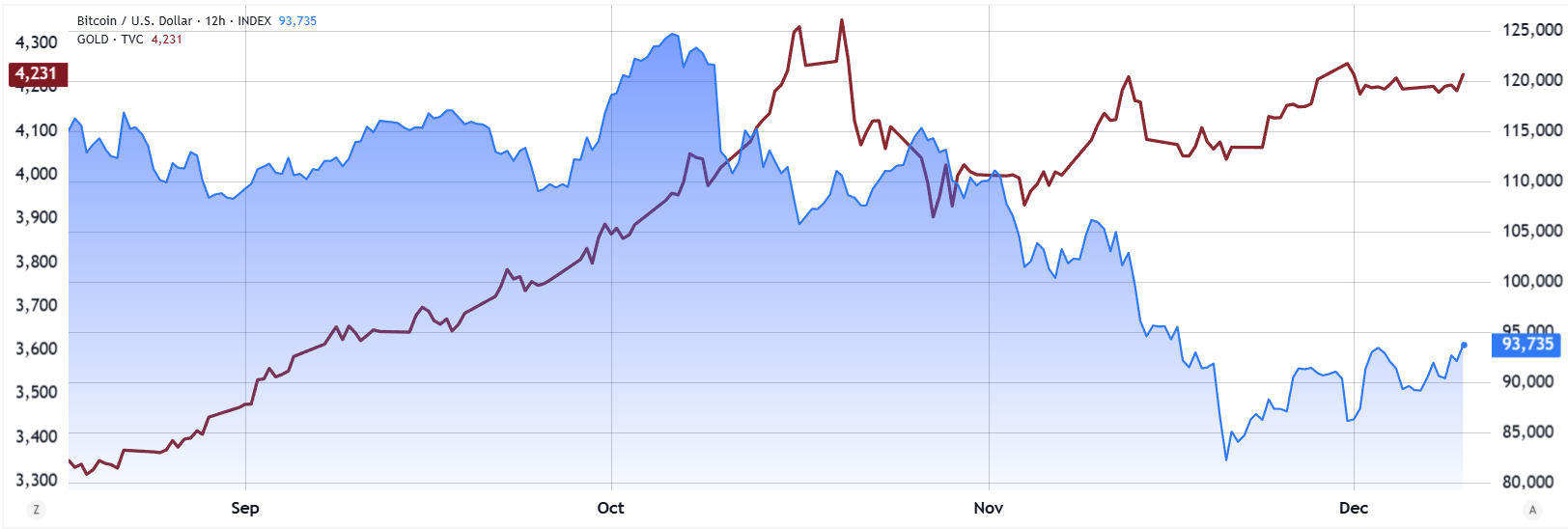
Gold/USD (left) vs. Bitcoin/USD (right). Source: TradingView

The Fed’s split decision on Wednesday to cap interest rates at 3.75% was widely expected, and Fed Chair Jerome Powell struck a restrained tone during the press conference following the committee meeting. Powell highlighted the ongoing risks tied to labor market weakness and stubborn inflation. Two Fed members, however, voted to keep rates at 4%, an unusually sharp divergence for a committee that typically shows strong internal alignment.

More notable was the Fed’s announcement that it will begin purchasing short-dated government bonds to “help manage liquidity levels.” The initial $40 billion program authorized on Wednesday marks a significant reversal from the past couple of years, which were characterized by a steady drawdown of the Fed’s balance sheet, culminating in the current $6.6 trillion after a peak of $9 trillion in 2022.

This added liquidity increases the cash banks can lend, supporting credit growth, boosting business investment, and encouraging consumer borrowing during periods when economic momentum is slowing across the economy.

Bitcoin options imply 70% odds BTC staying under $100,000

The $100,000 BTC call (buy) option implies a 70% probability that Bitcoin will remain at or below $100,000 by Jan. 30, according to the Black & Scholes model.

$100k BTC call option at Deribit, USD. Source: laevitas.ch

To secure the right to acquire Bitcoin at a fixed $100,000 on Jan. 30, buyers must pay a $3,440 premium upfront. For comparison, the same call option traded at $12,700 just one month earlier. The instrument effectively serves as insurance and expires worthless if Bitcoin finishes below the strike price. Still, upside for the holder remains unlimited as long as the market moves decisively above $100,000.

Interestingly, Bitcoin’s monthly options expiry in January falls two days after the next FOMC meeting on Jan. 28. Based on the CME Group FedWatch Tool, traders assign a 24% probability to another interest rate cut in January. Uncertainty increased after the government funding shutdown in November limited visibility into US employment and inflation data.

The stock market benefits directly from the Federal Reserve’s expansionist stance, as companies anticipate a lower cost of capital and easier consumer financing. Bitcoin, however, tends to react less predictably since investors rotating out of safe short-term government bonds are unlikely to view the cryptocurrency as a reliable store of value.
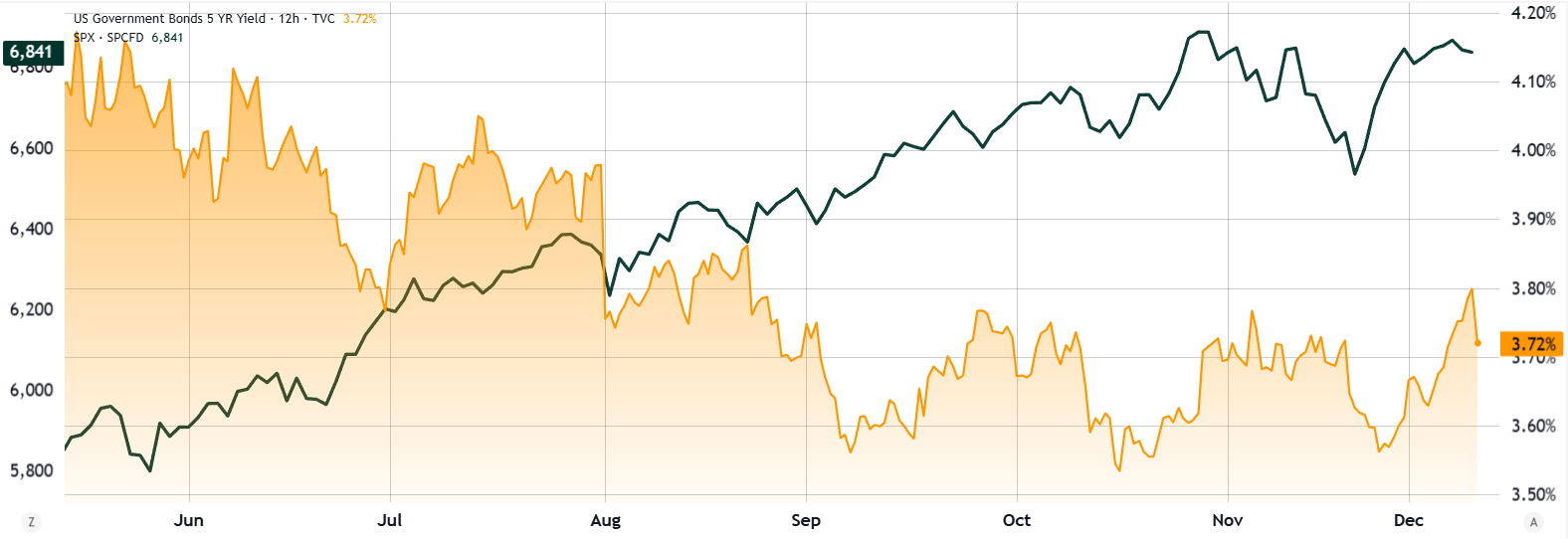
S&P 500 index (left) vs. US 5-year Treasury yield (right). Source: TradingView

Yields on the US 5-year Treasury stood at 3.72% on Wednesday, down from 4.10% six months earlier, while the S&P 500 gained 13% in the same period. Traders worry that the growth of US government debt could weaken the dollar and fuel inflationary pressure, making the relative scarcity of equities more appealing despite concerns about stretched valuations.

What could ignite a Bitcoin rally remains uncertain, but the rising cost of default protection in the artificial intelligence sector might push traders to reduce exposure to stocks.

For now, Bitcoin whales and market makers remain highly skeptical of a sustained move above $100,000, even as the Fed’s policy shift creates more favorable conditions.

Related: Conflicted Fed cuts rates but Bitcoin’s ‘fragile range’ pins BTC under $100K

This article is for general information purposes and is not intended to be and should not be taken as, legal, tax, investment, financial, or other advice. The views, thoughts, and opinions expressed here are the author’s alone and do not necessarily reflect or represent the views and opinions of Cointelegraph. While we strive to provide accurate and timely information, Cointelegraph does not guarantee the accuracy, completeness, or reliability of any information in this article. This article may contain forward-looking statements that are subject to risks and uncertainties. Cointelegraph will not be liable for any loss or damage arising from your reliance on this information.


Трендові криптовалюти

Пов'язані матеріали

In Just 11 Days, Claude Rewrote Millions of Lines of Code, an Epic AI Engineering Feat Sparks Fury

In just 11 days, Bun's founder Jarred Sumner used Anthropic's Claude AI models to rewrite its million lines of code from Zig to Rust. This move sparked significant controversy, particularly from Zig's creator, Andrew Kelley, who publicly criticized Sumner's engineering practices and the decision to use AI for such a massive rewrite. Bun, a high-performance JavaScript/TypeScript runtime and rival to Node.js, was originally written in Zig. After Anthropic acquired Bun, the team encountered persistent stability and memory safety bugs in the Zig codebase. These issues, combined with Zig's strict policy against LLM-generated code, led to the decision to rewrite in Rust. The rewrite was executed using Claude AI tools at an estimated API cost of $165,000, dramatically reducing the expected time and financial cost. Andrew Kelley's response was scathing. He blamed the original bugs on poor engineering habits, calling Bun's Zig code a collection of "hacks on top of hacks." He expressed relief that Bun was no longer associated with Zig, fearing it would misrepresent the language and attract low-quality, AI-generated contributions. The tech community is divided; some view Kelley's critique as unprofessional, while others see it as a defense of engineering integrity. A major concern about the AI-driven rewrite is the resulting code quality. The translation from Zig left approximately 27,000 lines of unsafe Rust code, raising fears about long-term maintainability and technical debt. The debate centers on whether this project is a milestone in AI-assisted development or a future maintenance nightmare.

marsbit45 хв тому

In Just 11 Days, Claude Rewrote Millions of Lines of Code, an Epic AI Engineering Feat Sparks Fury

marsbit45 хв тому

From Auto Finance to Bitcoin to AI Engines: An Analysis of Cango's 'What Not to Do' Strategy

From Auto Finance to Bitcoin and Now AI: Cango's "What Not to Do" Strategy Cango, a Chinese auto finance platform that went public on the NYSE in 2018, is undergoing its third major transformation. After selling its entire auto business in 2024, it pivoted to become a large-scale Bitcoin miner, acquiring 50 exahash of mining rigs from Bitmain. However, its true goal was never Bitcoin, but owning and controlling energy infrastructure. Now, Cango is pivoting again. While most listed Bitcoin miners are leasing power to giant hyperscalers for AI training clusters, Cango is taking the opposite path. It has launched an AI inference subsidiary called EcoHash, focusing not on training but on distributed inference. The company's strategy hinges on the insight that over 70% of mining industry power is controlled by small, independent sites (10-50 MW), which are too small for hyperscalers but ideal for low-latency AI inference. Cango aims to partner with these small operators, providing the AI technology, customers, and financing through its EcoLink software layer, which can distribute workloads across sites for reliability. Cango maintains a hybrid model, running roughly 31.7 EH/s of Bitcoin mining for cash flow while aggressively cleaning its balance sheet—slashing long-term debt by 94.5% to $30.6 million and raising $75 million for its AI venture. Its first AI deployment will be at a 50 MW site in Georgia. The strategy faces skepticism, given the high costs of converting mining sites and the potential for an AI bubble. However, Cango's leadership believes discipline around "what not to do"—avoiding direct competition with hyperscalers in training—positions it to capture the long-tail demand for distributed AI inference power.

Foresight News1 год тому

From Auto Finance to Bitcoin to AI Engines: An Analysis of Cango's 'What Not to Do' Strategy

Foresight News1 год тому

Strategy's Bitcoin Sales Cap Far Exceeds $1.25 Billion: A Detail the Market Overlooked

The article discusses how MicroStrategy's potential Bitcoin sales go far beyond the announced $1.25 billion "reserve-building capacity." It clarifies a key distinction in the company's "BTC Monetization Program": selling Bitcoin to *build* a new dollar reserve (the $1.25B cap) versus selling to *replenish* the existing USD Reserve after it's used for expenses like preferred share dividends. The recent $216M BTC sale for dividend payments was a "replenishment," leaving the headline $1.25B building quota untouched. The plan actually outlines three potential funding pools from BTC sales: 1) Building the reserve ($1.25B cap), 2) Covering preferred share/ debt costs (no specified cap), and 3) Funding buyback programs (up to $20B). This means the structured sales potential exceeds $30 billion, not including uncapped replenishment sales. The piece argues this marks MicroStrategy's shift from a passive "buy-and-hold" Bitcoin proxy to an actively managed entity using BTC as a balance-sheet tool to manage its complex capital structure (common stock, preferred shares, debt, reserve). This creates new dynamics and potential conflicts, as actions benefiting one part (e.g., selling BTC to pay dividends) may pressure another (e.g., undermining the "never sell" narrative). Investors must now parse the company's specific terminology ("build" vs. "replenish") to understand the true scope of future BTC sales, which is significantly larger than the market initially perceived.

marsbit1 год тому

Strategy's Bitcoin Sales Cap Far Exceeds $1.25 Billion: A Detail the Market Overlooked

marsbit1 год тому

Goldman Sachs Report Deconstructs the Competitive Landscape of China's AI Large Models: Who Will Be the Long-Term Winner?

Goldman Sachs analyzes China's AI large language model (LLM) landscape, identifying key players and a strategic shift towards efficiency and global expansion. The report highlights that Chinese open-source/open-weight models are closing the performance gap with top global proprietary models at significantly lower cost, driven by architectural innovations like MoE. This enables a "two-tier" market: a high-end segment (e.g., GLM5.2, Qwen3.7 Max) with pricing at ~$1 per million tokens, and a low-end, price-sensitive global segment. Open-source strategies aid adoption but limit monetization, as deployments via third-party platforms (e.g., AWS Bedrock, Alibaba Cloud) may not generate direct revenue for model creators. The industry is thus moving towards "open-weight + community license" models with revenue-sharing to improve unit economics. Internationally, the focus is shifting from "token maximization" to ROI-driven enterprise adoption, particularly in non-U.S. markets. Major cloud platforms are integrating Chinese models (e.g., DeepSeek, MiniMax). Using a competitive framework based on pricing power, cost advantage, and financial strength, Goldman Sachs identifies **Zhipu AI** and **DeepSeek** as leaders in foundational text models, and **ByteDance** (with Seedance) leading in multimodal/video generation. **MiniMax** and **Kuaishou** are also rated favorably. The firm forecasts China's AI model API/subscription revenue growing from ~RMB 35bn (2026E) to RMB 879bn by 2030.

marsbit1 год тому

Goldman Sachs Report Deconstructs the Competitive Landscape of China's AI Large Models: Who Will Be the Long-Term Winner?

marsbit1 год тому

Торгівля

Спот

Популярні статті

Як купити PUMP

Ласкаво просимо до HTX.com! Ми зробили покупку Big Pump (PUMP) простою та зручною. Дотримуйтесь нашої покрокової інструкції, щоб розпочати свою криптовалютну подорож.Крок 1: Створіть обліковий запис на HTXВикористовуйте свою електронну пошту або номер телефону, щоб зареєструвати обліковий запис на HTX безплатно. Пройдіть безпроблемну реєстрацію й отримайте доступ до всіх функцій.ЗареєструватисьКрок 2: Перейдіть до розділу Купити крипту і виберіть спосіб оплатиКредитна/дебетова картка: використовуйте вашу картку Visa або Mastercard, щоб миттєво купити Big Pump (PUMP).Баланс: використовуйте кошти з балансу вашого рахунку HTX для безперешкодної торгівлі.Треті особи: ми додали популярні способи оплати, такі як Google Pay та Apple Pay, щоб підвищити зручність.P2P: Торгуйте безпосередньо з іншими користувачами на HTX.Позабіржова торгівля (OTC): ми пропонуємо індивідуальні послуги та конкурентні обмінні курси для трейдерів.Крок 3: Зберігайте свої Big Pump (PUMP)Після придбання Big Pump (PUMP) збережіть його у своєму обліковому записі на HTX. Крім того, ви можете відправити його в інше місце за допомогою блокчейн-переказу або використовувати його для торгівлі іншими криптовалютами.Крок 4: Торгівля Big Pump (PUMP)Легко торгуйте Big Pump (PUMP) на спотовому ринку HTX. Просто увійдіть до свого облікового запису, виберіть торгову пару, укладайте угоди та спостерігайте за ними в режимі реального часу. Ми пропонуємо зручний досвід як для початківців, так і для досвідчених трейдерів.

330 переглядів усьогоОпубліковано 2024.12.12Оновлено 2026.06.02

Як купити PUMP

Обговорення

Ласкаво просимо до спільноти HTX. Тут ви можете бути в курсі останніх подій розвитку платформи та отримати доступ до професійної ринкової інформації. Нижче представлені думки користувачів щодо ціни PUMP (PUMP).

活动图片