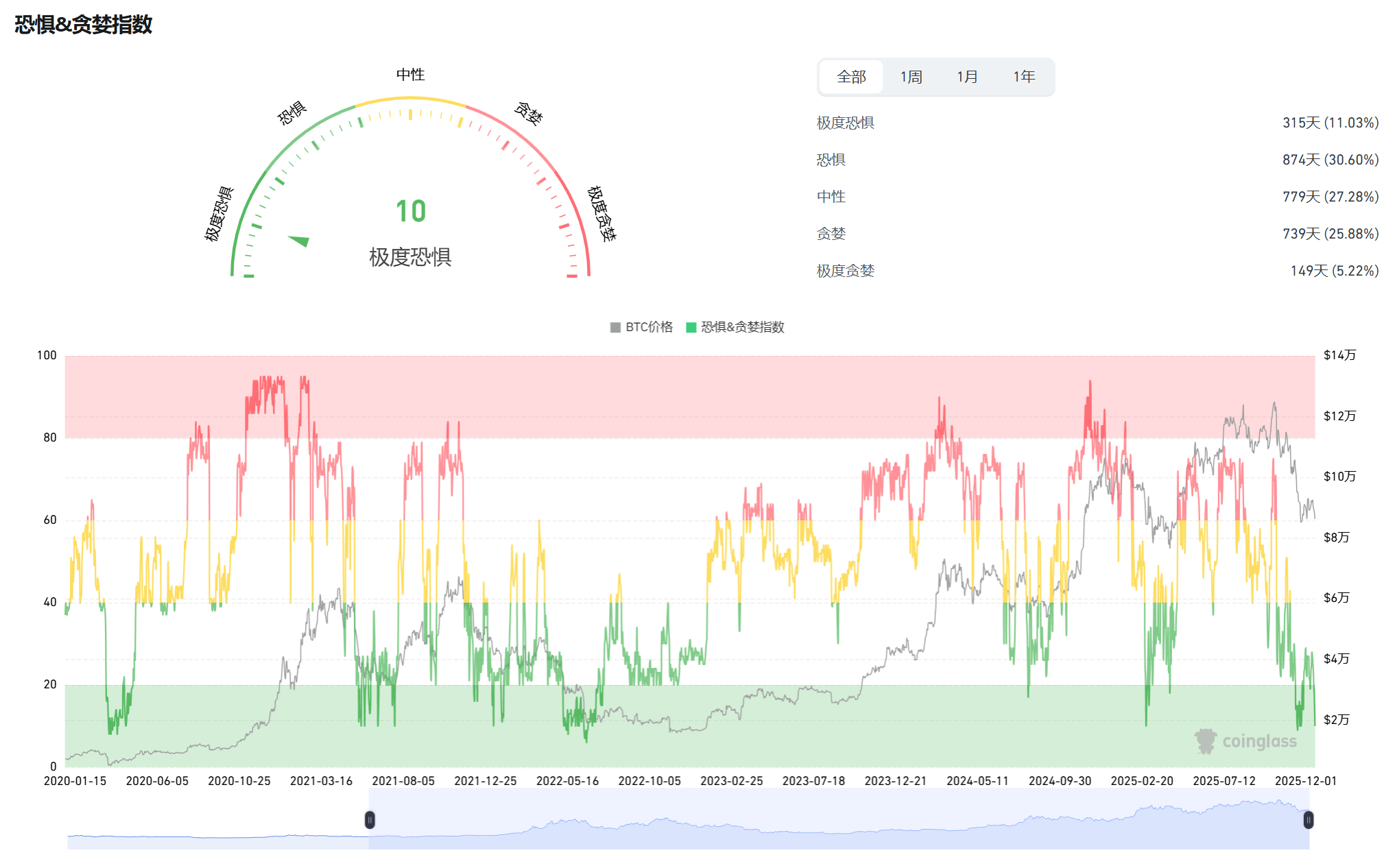
Fear & Greed Index Hits New Low of 10! Bitcoin Breaks Below $86K! Are All Blockchains Dead Except Tron, SOL, and BNB?

marsbitОпубліковано о 2025-12-16Востаннє оновлено о 2025-12-16

Анотація

The Crypto Fear & Greed Index has plummeted to a shocking 10, indicating "extreme fear" in the market—the lowest level since the COVID-19 crash of March 2020. Bitcoin fell to around $85,100, while Ethereum dropped to $2,880. On-chain data reveals a stark divergence among blockchains. Tron leads with $1.24 million in 24-hour fees, followed by Solana ($589,088) and BNB Chain ($435,075). Ethereum ranked fourth with just $418,425. Many once-popular chains like Celestia, Sui, and Algorand generated less than $50 in fees, raising serious concerns about their utility and sustainability. The panic stems from macro liquidity tightening—due to delayed Fed rate cuts and Bank of Japan hikes—and cracks in crypto’s core narratives. Bitcoin ETFs have seen net outflows of over $2.3 billion since November, and long-term holders are selling aggressively. Ethereum’s staking model faces scrutiny: with 27.89% of ETH staked, yields rely heavily on token inflation rather than organic fee revenue, creating economic vulnerability. Historically, such extreme fear has often marked market bottoms. While retail and mid-sized whales panic-sell, large entities continue accumulating Bitcoin. The current sell-off may present a long-term opportunity, echoing past cycles where despair preceded major rallies.

Today, the Crypto Fear & Greed Index has plummeted to a shocking value of 10, officially marking market sentiment as entering the "Extreme Fear" zone.

This is the lowest level since the global market crash triggered by the COVID-19 pandemic in March 2020, even surpassing the panic levels of the Terra/Luna collapse in 2022.

In this morning's sharp decline, Bitcoin briefly touched a low of $85,100, while Ethereum also fell to a low of $2,880.

Market participant sentiment has nearly frozen solid; this panic is not only reflected in prices but is deeply etched into every byte of on-chain data.

The Harsh Truth of On-Chain Fees: The "Survival Stress Test" for Blockchains

The ranking of fees generated across all blockchains in the past 24 hours presents an extremely polarized picture:
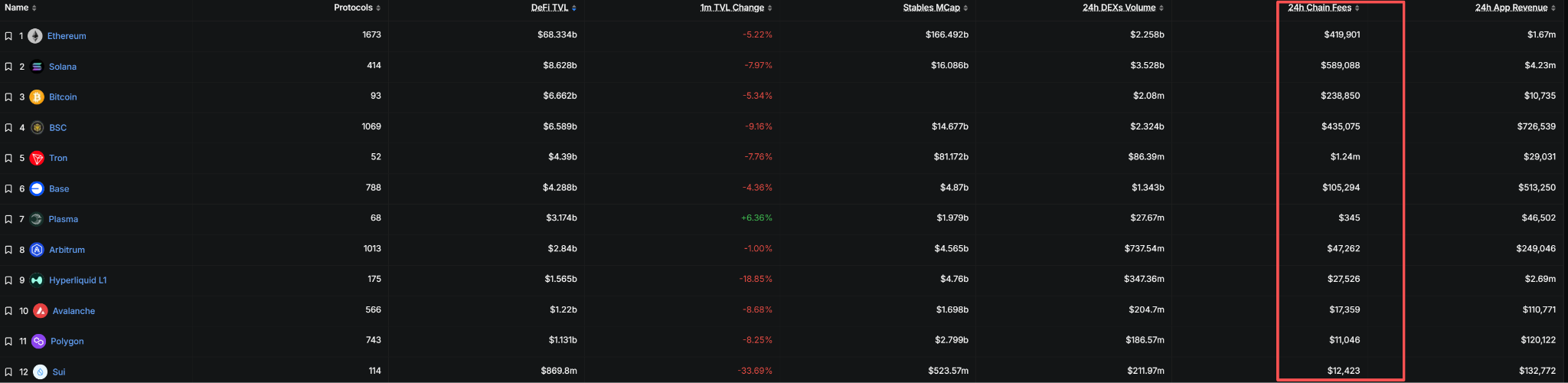
Tron leads with $1.24 million, SOL follows closely with $589,088, the BNB Chain ranks third with $435,075, while Ethereum trails in fourth place with only $418,425.

This data far exceeds general expectations, with several so-called star blockchains like SUI and Plasma generating less than 1/10th of Tron's fees.


However, the truly alarming situation is the survival state of the long-tail blockchains.
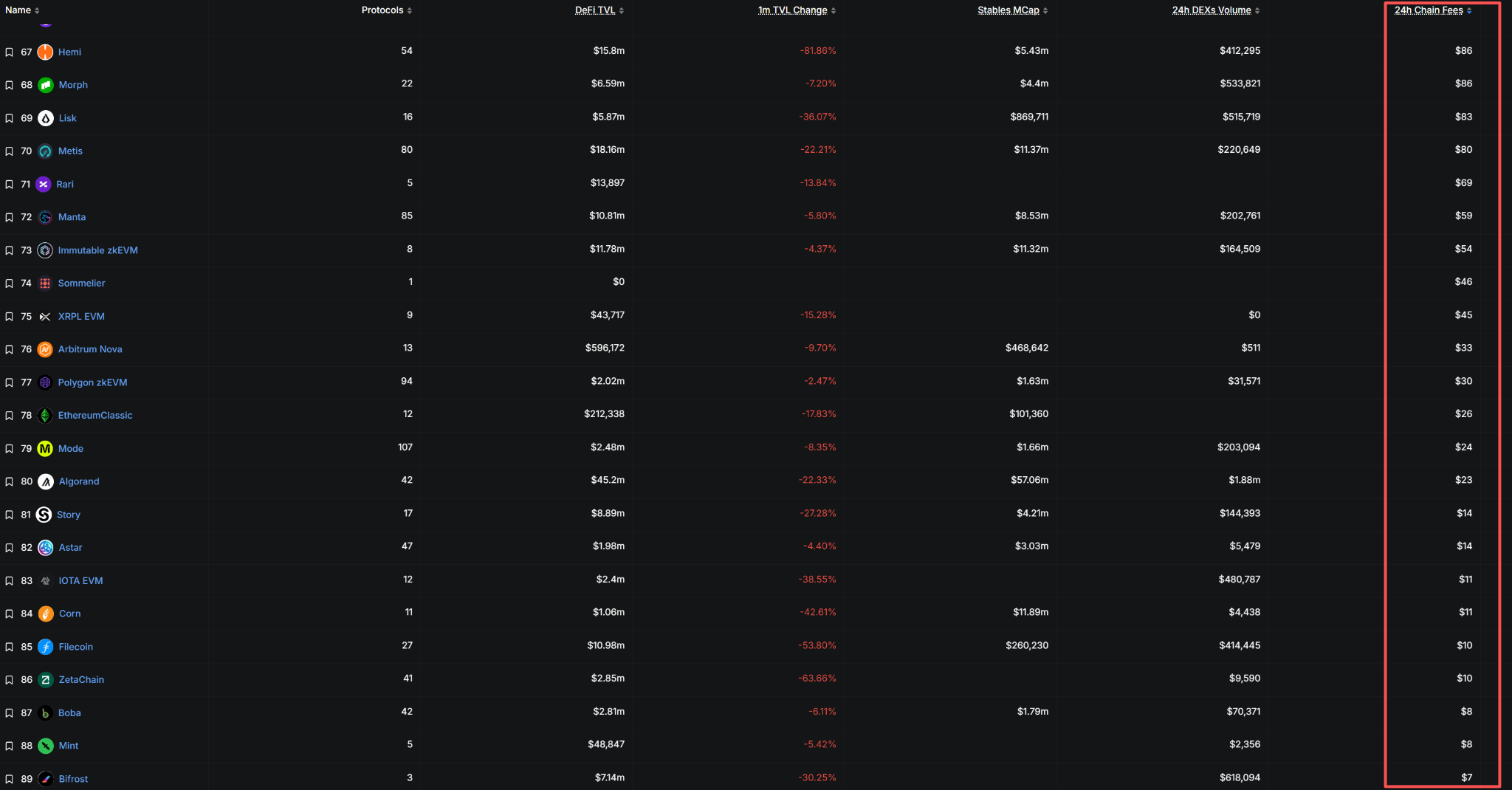
Blockchains that were once popular, such as Celestia, Hemi, Morph, Manta, Immutable zkEVM, EthereumClassic, Algorand, Story, and Filecoin, generated less than $50 in fees in the past 24 hours—less than a roadside stall.

This data undoubtedly indicates that the actual usage of these blockchains is nearing zero.

Fees are the direct "tax" of a blockchain's economy and a core metric for measuring network value.

When a blockchain's daily fees are less than $50, its network security, degree of decentralization, and long-term sustainability are all called into serious question.


The Macro Backdrop of Market Panic: Liquidity Crisis and Narrative Breakdown

This market panic is not due to a single factor but is the result of a combination of tightening global liquidity and the breakdown of internal crypto narratives.

On one hand, global USD liquidity is facing severe challenges. The Fed's maintained hawkish stance, delaying rate cut expectations, has led to a heavy blow to global risk assets.

The Bank of Japan's rate hike has further intensified global liquidity contraction. Historical data shows that BoJ hiking cycles often coincide with global liquidity tightening; the two rounds of hikes in March 2024 and January 2025 both caused Bitcoin to retreat by over 30%.

On the other hand, two core internal narratives of the crypto market are being severely tested.

Bitcoin spot ETFs have turned from an "engine" into a "pump," with net outflows exceeding $2.3 billion since November alone.
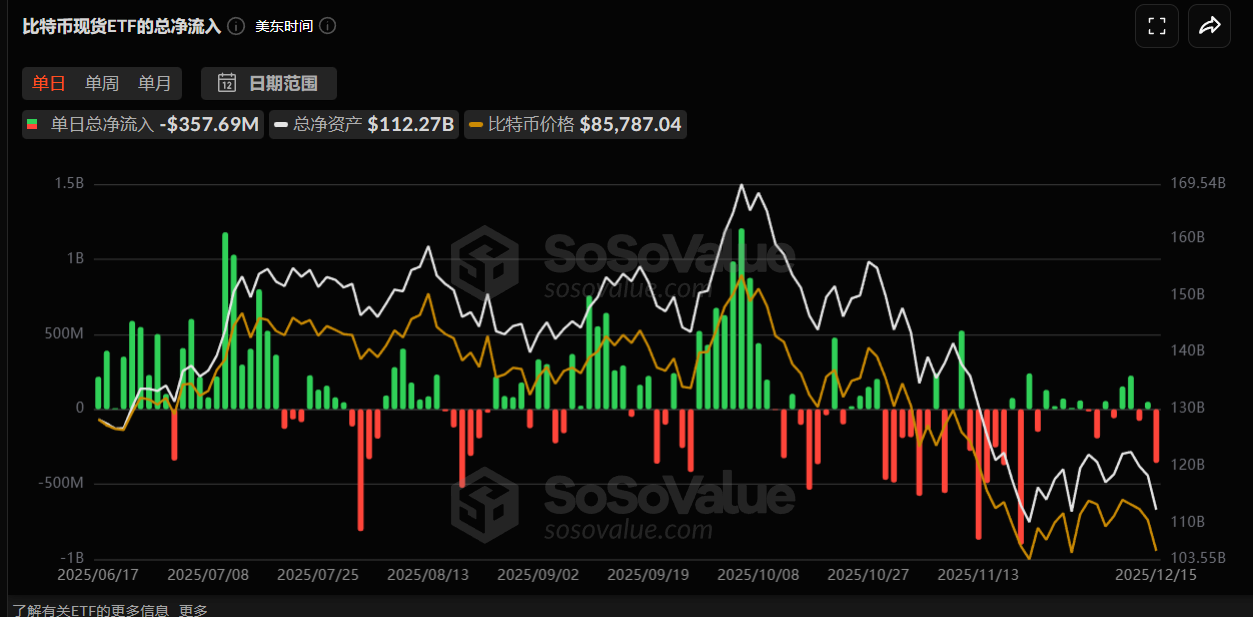
More worryingly, long-term holders have been selling Bitcoin on a large scale, a rare occurrence, selling approximately 815,000 BTC just in early November. When the two major narratives of "institutional adoption" and "long-term holding" show cracks simultaneously, market confidence collapses like an avalanche.

On-chain data shows the market just experienced "the largest realized loss day in the past six months," meaning a massive amount of assets were sold below their purchase price, and investors are纷纷 "cutting losses" and exiting.


The Economic Paradox of Ethereum Staking: Who is Paying for the Whales' Profits?

Against the bear market backdrop, Ethereum's economic model deserves particular scrutiny.

Ethereum's problem gets to the core: Big players staking Ethereum are taking so much money from the protocol every day; who is paying for that?

In reality, the Ethereum Beacon Chain staking annual yield is approximately 3.5%. These returns primarily come from two parts: block rewards (paid by the protocol issuing new tokens, effectively diluting the value for all token holders) and transaction fees (paid by users engaged in on-chain activity).

During a bull market, high Gas fees can be absorbed by active users through DeFi, NFT, and other applications;

but in a bear market, on-chain activity plummets, and staking rewards rely more on token issuance—this essentially means later participants are "transfusing" early stakers through inflation.
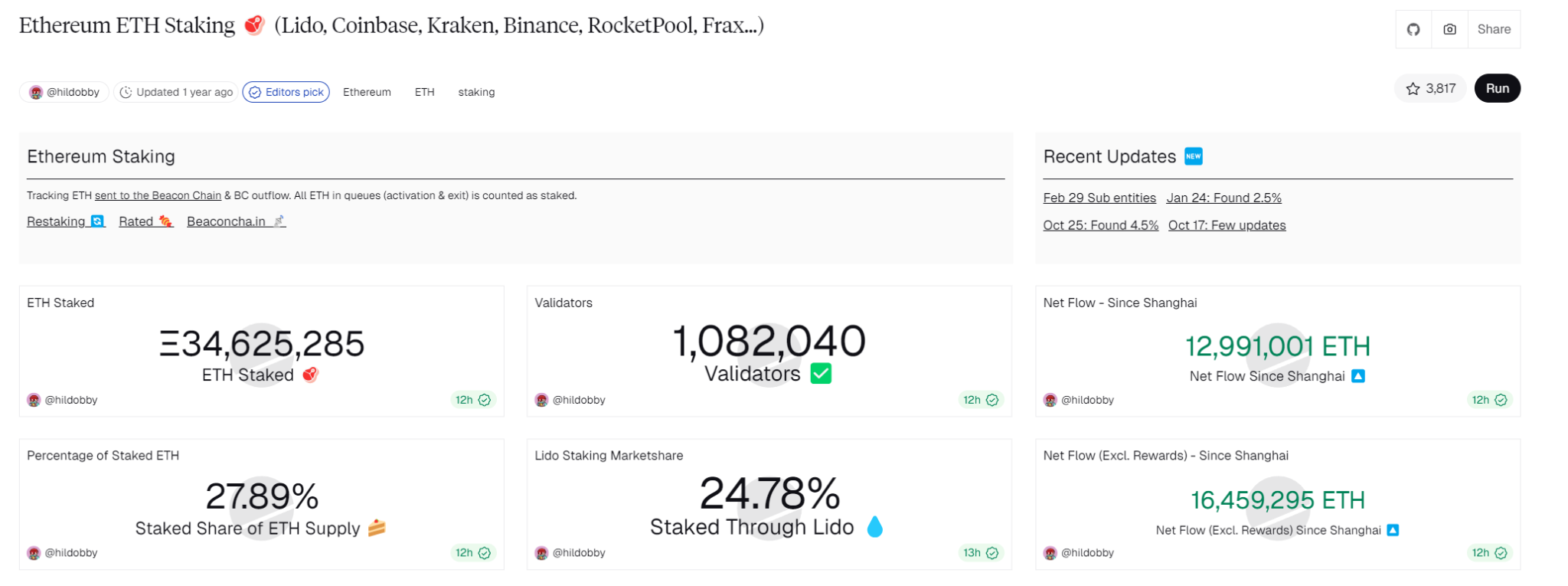

The current total amount staked on the Ethereum Beacon Chain accounts for 27.89% of the circulating supply. These stakers earn stable returns from the protocol daily. However, with fee revenue at only $418,000 (less than a third of Tron's), whether the Ethereum network can sustainably support such massive staking rewards is indeed worth pondering.

More seriously, when the Ethereum price falls, stakers may face a situation where "rewards are insufficient to cover the currency's depreciation," potentially triggering a negative feedback loop of unstaking and selling.

This does share similarities with Ponzi structures in traditional finance: any system reliant on new funds to maintain old returns exposes its fragility during liquidity contractions.


A Philosophical Question: After the Crypto "Red Pill" Takes Effect

"When people say Bitcoin is a Ponzi scheme, it's also the first time they realize the essence of any form of property rights in the real world is a Ponzi." This view touches the essence of the problem.

All value systems are built on consensus, whether fiat currency, gold, or cryptocurrency.

When people say the crypto space is a casino, it might be the first time they truly recognize the nature of the global financial system.

In traditional financial markets, central banks can print money indefinitely, governments can change rules arbitrarily, and insider trading and market manipulation are commonplace. Compared to these traditional financial markets hidden behind opaque rules, the crypto space at least presents the brutality of finance in an extremely transparent, real-time manner to all participants.

In today's market, the Bitcoin Fear & Greed Index is only 11, and on-chain data shows most blockchains are nearly "brain dead." Investors are not disappointed with crypto itself but are unable to accept the real world seen after swallowing the "red pill."

The cryptocurrency market is like a mirror, reflecting the nature of the global financial system: all asset prices are ultimately driven by liquidity, not intrinsic value. When the Fed "turns off the tap," everything from stocks and crypto to gold faces selling pressure.


Historical Perspective: Value Return After Extreme Fear

Looking back at cryptocurrency history, every period of extreme market fear has ultimately proven to be an excellent opportunity for long-term investment.

During the COVID-19 crash in March 2020, the Fear & Greed Index plummeted to 10-15, but Bitcoin subsequently embarked on a bull market that lasted over a year.

In June 2022, following the Terra/Luna collapse and macro-economic tightening, the index remained in "Extreme Fear" territory (8-15) for weeks. Although prices fell across the board, sustained panic actually marked the market bottom. Currently, although market sentiment is extremely pessimistic, on-chain data reveals another picture: behind the panic "surrender," a great "asset transfer" is quietly taking place. Medium-sized whales and panicked retail investors are selling, while large strategic entities and steadfast retail investors are actively accumulating.

Data shows that the largest strategic entities (holding >10,000 BTC) continued to accumulate throughout November, with a net increase of 10,700 BTC. Even Bitcoin's most famous evangelist, Michael Saylor's company, announced buying another $50 million worth of Bitcoin amidst the market panic.

Periods of extreme fear are the perfect time to "be greedy when others are fearful." Historically, choosing to sell when the Fear Index drops to single digits has often been the wrong move.


Трендові криптовалюти

Пов'язані питання

QWhat does a Crypto Fear & Greed Index reading of 10 indicate about the current market sentiment?

AA reading of 10 indicates that the market sentiment has officially fallen into the 'Extreme Fear' zone, marking the lowest level of investor confidence since the global market crash triggered by the COVID-19 pandemic in March 2020.

QAccording to the article, which three blockchains lead in 24-hour fee generation, and what does this indicate?

ATron leads with $1.24 million, followed by Solana with $589,088, and BNB Chain with $435,075. This indicates a highly differentiated landscape where these few chains capture the vast majority of actual usage and economic activity, while many others are struggling.

QWhat two core internal narratives in the cryptocurrency market are being severely tested, according to the analysis?

AThe two core narratives being tested are: 1) Bitcoin spot ETFs, which have turned from an 'engine' of growth into a 'pump' draining liquidity, with a net outflow of over $2.3 billion since November. 2) The 'long-term holding' narrative, as long-term holders have been selling on a large scale, with approximately 815,000 BTC sold in early November.

QWhat economic paradox does the article highlight regarding Ethereum's staking model, especially in a bear market?

AThe paradox is that large stakeholders staking ETH earn yields (approx. 3.5% APY) that are paid through block rewards (new token issuance, diluting all holders) and transaction fees. In a bear market with reduced on-chain activity, the rewards rely more on inflation, meaning later participants are effectively 'transferring blood' to early stakers through dilution, creating a potentially unsustainable model.

QWhat historical pattern does the article suggest often follows periods when the Fear & Greed Index reaches extreme lows like 10?

AHistorically, periods of extreme fear, such as the index dropping to 10-15, have often proven to be excellent long-term investment opportunities. For example, the crash in March 2020 was followed by a bull market that lasted over a year, and the panic in June 2022 marked a market bottom.

Пов'язані матеріали

In Conversation with Ray Dalio: We Are Currently in an AI Bubble, with 1% of My Portfolio in Bitcoin

Ray Dalio, founder of Bridgewater Associates, warns in an interview that the current AI boom shows classic bubble characteristics, which could lead to significant economic downturns as seen in past cycles like 1929 or 2000. He explains that speculative enthusiasm, fueled by debt and overvaluation, often precedes a crash when rising rates or taxation force asset sales, causing widespread losses and recession. Dalio also outlines his "Big Cycle" theory, describing an approximate 80-year pattern where widening wealth gaps, massive government deficits, and shifting geopolitical power (like China's rise) create internal conflict and global instability. He emphasizes that we are in a late-cycle, transitional phase where traditional powers like the US and UK face decline. For personal wealth protection, Dalio advises diversification beyond cash into assets like stocks, bonds, real estate, and particularly gold, which he prefers over Bitcoin. While he holds about 1% of his portfolio in Bitcoin as a non-printable hard asset, he views gold as more secure from technological or governmental threats. Regarding AI's impact, Dalio believes it will disproportionately benefit capital owners, worsening inequality by replacing both physical and cognitive labor. He suggests that human intuition and emotional intelligence, combined with AI, will be key for future workers. On taxation, Dalio argues that wealth taxes are impractical and risk triggering asset sell-offs, reducing productive investment. He points to the UK as a cautionary example of debt, low productivity, and political strife. Geopolitically, Dalio foresees a more regionalized world, with the US showing weakness in prolonged conflicts like with Iran, akin to past imperial declines. The ideal outcome, he suggests, is coexisting powerful blocs (e.g., Americas, China-Asia Pacific) without major war.

marsbit3 год тому

In Conversation with Ray Dalio: We Are Currently in an AI Bubble, with 1% of My Portfolio in Bitcoin

marsbit3 год тому

Daily 7.2 Trillion KRW: Foreign Capital's Record Net Buying on Friday! Wall Street Says Headwinds for Korean Stock Fund Flows Have Subsided

South Korean stock market sees a dramatic shift in fund flows. On July 31, foreign investors made a record net purchase of approximately KRW 7.2 trillion in KOSPI stocks, marking a fundamental reversal from the persistent large-scale net outflows seen in previous months. This contributed to a significant narrowing of foreign net selling in July to KRW 9.8 trillion, down sharply from KRW 48.4 trillion in June and KRW 44.5 trillion in May. Simultaneously, domestic institutional pressure eased. South Korean pension funds and asset managers turned to a net buying position in July, purchasing KRW 1.0 trillion worth of KOSPI shares, contrasting with net sales in May and June. Market volatility is expected to be dampened by new financial regulations. Effective July 31, the Financial Services Commission tightened access for retail investors to single-stock leveraged ETFs by raising the minimum cash deposit requirement. Trading volumes for these products subsequently dropped to about 50% of their monthly average. Citigroup Research maintains its year-end KOSPI target of 10,000 points. The firm cites several supportive factors: the substantial easing of headwinds from capital outflows, a robust fundamental outlook for the semiconductor sector, historically low market valuations, strong economic fundamentals, and the potential for policy support from financial authorities if needed.

marsbit3 год тому

Daily 7.2 Trillion KRW: Foreign Capital's Record Net Buying on Friday! Wall Street Says Headwinds for Korean Stock Fund Flows Have Subsided

marsbit3 год тому

Thanks to Dice Rolls, Bitcoin Keys Are Stored Offline, But Not Everyone Will Do It

The article discusses using dice rolls to generate secure Bitcoin wallet seeds, providing entropy independent of potentially flawed hardware random number generators. It explains that each fair dice roll offers about 2.585 bits of entropy, with around 50 rolls needed for a standard 12-word seed phrase and 99+ recommended for higher security. This method gained attention after a vulnerability was revealed in some Coldcard hardware wallets, where a faulty firmware RNG (dating back to 2021) compromised generated keys. The analysis notes that while a dice-generated main seed was safe from this specific flaw, other Coldcard functions (like creating paper wallets, backup keys, or passwords) could still be vulnerable if they used the defective RNG. The piece argues that while dice-based entropy is technically robust, the manual process is error-prone, tedious, and unrealistic for most new users, who might make mistakes in recording or inputting rolls. It concludes that while manual entropy generation should remain an option for advanced users, the long-term goal is to develop reliable, user-friendly hardware and software that securely generates randomness without requiring specialized knowledge. Coldcard users are advised to check their firmware version and replace any secondary secrets (like paper wallet keys) created with vulnerable devices, while also considering multi-signature setups with devices from different manufacturers for added security.

cryptonews.ru8 год тому

Thanks to Dice Rolls, Bitcoin Keys Are Stored Offline, But Not Everyone Will Do It

cryptonews.ru8 год тому

Торгівля

Спот

Популярні статті

Що таке BITCOIN

Розуміння HarryPotterObamaSonic10Inu (ERC-20) та його позиції у крипто-просторі Останніми роками ринок криптовалют спостерігав за зростанням популярності мем-коінів, які привертають інтерес не тільки трейдерів, але й тих, хто шукає спілкування та розважальну цінність. Серед цих унікальних токенів є HarryPotterObamaSonic10Inu (ERC-20), інтригуючий проект, що поєднує культурні посилання з тканинами криптовалюти. Ця стаття досліджує ключові аспекти HarryPotterObamaSonic10Inu, вивчаючи його механізми, спільноту та його взаємодію з ширшим крипто-ландшафтом. Що таке HarryPotterObamaSonic10Inu (ERC-20)? Як випливає з його назви, HarryPotterObamaSonic10Inu є мем-коіном, побудованим на блокчейні Ethereum, класифікованим за стандартом ERC-20. На відміну від традиційних криптовалют, які можуть підкреслювати практичну корисність або інвестиційний потенціал, цей токен процвітає завдяки розважальній цінності та силі своєї спільноти. Проект спрямований на створення середовища, де зацікавлені користувачі можуть об'єднуватися, ділитися ідеями та брати участь у заходах, натхненних різноманітними культурними явищами. Однією з примітних особливостей HarryPotterObamaSonic10Inu є нульовий податок на транзакції. Цей привабливий елемент має на меті заохочувати торгівлю та участь у спільноті, позбавлену додаткових витрат, які можуть відлякувати дрібних трейдерів. Загальна пропозиція монет становить один мільярд токенів, що позначає намір підтримувати суттєву циркуляцію в межах спільноти. Творець HarryPotterObamaSonic10Inu (ERC-20) Походження HarryPotterObamaSonic10Inu дещо окутане таємницею; деталі про творця залишаються невідомими. Розвиток цього токена позбавлений впізнаваної команди або чіткої стратегії, що не є рідкістю в секторі мем-коінів. Натомість проект виник органічно, а його розвиток значною мірою залежить від ентузіазму та участі його спільноти. Інвестори HarryPotterObamaSonic10Inu (ERC-20) Щодо зовнішніх інвестицій та підтримки, HarryPotterObamaSonic10Inu також залишається невизначеним. Токен не зазначає жодних відомих інвестиційних фондів або значної організаційної підтримки. Натомість життєва сила проекту полягає в його базовій спільноті, яка інформує про його зростання та стійкість через колективні дії та залученість у крипто-просторі. Як працює HarryPotterObamaSonic10Inu (ERC-20)? Як мем-коін, HarryPotterObamaSonic10Inu функціонує передусім поза традиційними рамками, що часто регулюють вартість активів. Є кілька відмінних аспектів, що визначають, як працює проект: Транзакції без податку: Завдяки відсутності податкових зборів на транзакції, користувачі можуть вільно купувати та продавати токен, не турбуючись про приховані витрати. Залучення спільноти: Проект процвітає завдяки взаємодії спільноти, використовуючи соціальні медіа для створення шуму та сприяння залученню. Обговорення, обмін контентом та залученість є ключовими елементами, що допомагають розширити його охоплення та зміцнити лояльність серед прихильників. Відсутність практичної корисності: Слід зазначити, що HarryPotterObamaSonic10Inu не пропонує конкретної корисності в рамках фінансової екосистеми. Натомість він класифікується як токен, що призначений в основному для розваги та спільнотних активностей. Культурне посилання: Токен кмітливо вплітає елементи популярної культури, щоб привернути інтерес, зв'язуючи з ентузіастами мемів та крипто-стежками. HarryPotterObamaSonic10Inu ілюструє, як мем-коіни функціонують інакше, ніж традиційні криптовалютні проекти, увійшовши на ринок як інноваційні соціальні конструкти, а не утилітарні активи. Хронологія HarryPotterObamaSonic10Inu (ERC-20) Історія HarryPotterObamaSonic10Inu відзначена кількома значними етапами: Створення: Токен виник з вірусного мему, захопивши уяву багатьох крипто-ентузіастів. Конкретні дати створення недоступні, що підкреслює його органічний розвиток. Лістинг на біржах: HarryPotterObamaSonic10Inu з'явився на різних біржах, дозволяючи зручніший доступ і торгівлю спільноти. Ініціативи залучення спільноти: Ведення діяльності, спрямованої на покращення взаємодії спільноти, включаючи конкурси, кампанії в соціальних мережах та створення контенту від фанатів та прихильників. Плани на майбутнє: Дорожня карта проекту включає запуск колекції NFT, мерчандайзинг та електронну комерцію, пов'язану з його культурними темами, що далі залучає спільноту та намагається додати більше вимірів до його екосистеми. Ключові моменти про HarryPotterObamaSonic10Inu (ERC-20) Спільнотний підхід: Проект надає пріоритет колективному внеску та креативності, забезпечуючи, щоб участь користувачів була в центрі його розвитку. Класифікація як мем-коін: Це є його епігенез розважальної криптовалюти, що відрізняється від традиційних інвестиційних інструментів. Жодного прямого відношення до Bitcoin: Незважаючи на схожість у назві, HarryPotterObamaSonic10Inu є відмінним і не має жодного зв’язку з Bitcoin або іншими усталеними криптовалютами. Зосередженість на співпраці: HarryPotterObamaSonic10Inu створено для того, щоб надати простір для співпраці та обміну історіями серед його власників, забезпечуючи шлях для творчості та спільного зв'язку. Перспективи на майбутнє: Амбіція розширитися за межі початкової концепції в NFT та мерчандайз відкриває шлях для проекту потенційно потрапити в більш мейнстрімні сфери цифрової культури. Оскільки мем-коіни продовжують захоплювати уяву спільноти криптовалют, HarryPotterObamaSonic10Inu (ERC-20) вирізняється своїми культурними зв'язками та орієнтованим на спільноту підходом. Хоча він може не відповідати типовій моделі утилітарного токена, його суть полягає в радощах і товариськості, що підтримуються серед його прихильників, підкреслюючи еволюційну природу криптовалют в усе більш цифрову епоху. Оскільки проект продовжує розвиватися, важливо спостерігати за тим, як динаміка спільноти вплине на його траєкторію в постійно змінюваному ландшафті технології блокчейн.

2.4k переглядів усьогоОпубліковано 2024.04.01Оновлено 2024.12.03

Що таке BITCOIN

Як купити BTC

Ласкаво просимо до HTX.com! Ми зробили покупку Bitcoin (BTC) простою та зручною. Дотримуйтесь нашої покрокової інструкції, щоб розпочати свою криптовалютну подорож.Крок 1: Створіть обліковий запис на HTXВикористовуйте свою електронну пошту або номер телефону, щоб зареєструвати обліковий запис на HTX безплатно. Пройдіть безпроблемну реєстрацію й отримайте доступ до всіх функцій.ЗареєструватисьКрок 2: Перейдіть до розділу Купити крипту і виберіть спосіб оплатиКредитна/дебетова картка: використовуйте вашу картку Visa або Mastercard, щоб миттєво купити Bitcoin (BTC).Баланс: використовуйте кошти з балансу вашого рахунку HTX для безперешкодної торгівлі.Треті особи: ми додали популярні способи оплати, такі як Google Pay та Apple Pay, щоб підвищити зручність.P2P: Торгуйте безпосередньо з іншими користувачами на HTX.Позабіржова торгівля (OTC): ми пропонуємо індивідуальні послуги та конкурентні обмінні курси для трейдерів.Крок 3: Зберігайте свої Bitcoin (BTC)Після придбання Bitcoin (BTC) збережіть його у своєму обліковому записі на HTX. Крім того, ви можете відправити його в інше місце за допомогою блокчейн-переказу або використовувати його для торгівлі іншими криптовалютами.Крок 4: Торгівля Bitcoin (BTC)Легко торгуйте Bitcoin (BTC) на спотовому ринку HTX. Просто увійдіть до свого облікового запису, виберіть торгову пару, укладайте угоди та спостерігайте за ними в режимі реального часу. Ми пропонуємо зручний досвід як для початківців, так і для досвідчених трейдерів.

5.3k переглядів усьогоОпубліковано 2024.12.12Оновлено 2026.06.02

Як купити BTC

Що таке $BITCOIN

ЦИФРОВЕ ЗОЛОТО ($BITCOIN): Комплексний аналіз Вступ до ЦИФРОВОГО ЗОЛОТА ($BITCOIN) ЦИФРОВЕ ЗОЛОТО ($BITCOIN) — це проект на основі блокчейну, що працює в мережі Solana, який має на меті поєднати характеристики традиційних дорогоцінних металів з інноваціями децентралізованих технологій. Хоча він має таку ж назву, як і Bitcoin, який часто називають “цифровим золотом” через його сприйняття як засобу збереження вартості, ЦИФРОВЕ ЗОЛОТО є окремим токеном, розробленим для створення унікальної екосистеми в ландшафті Web3. Його мета — позиціонувати себе як життєздатний альтернативний цифровий актив, хоча деталі щодо його застосувань і функціональностей все ще розробляються. Що таке ЦИФРОВЕ ЗОЛОТО ($BITCOIN)? ЦИФРОВЕ ЗОЛОТО ($BITCOIN) — це токен криптовалюти, спеціально розроблений для використання в блокчейні Solana. На відміну від Bitcoin, який виконує широко визнану роль зберігання вартості, цей токен, здається, зосереджується на більш широких застосуваннях і характеристиках. Помітні аспекти включають: Інфраструктура блокчейну: Токен побудований на блокчейні Solana, відомому своєю здатністю обробляти швидкі та низьковартісні транзакції. Динаміка постачання: ЦИФРОВЕ ЗОЛОТО має максимальне постачання, обмежене 100 квадрильйонами токенів (100P $BITCOIN), хоча деталі щодо його обігового постачання наразі не розголошуються. Утиліта: Хоча точні функціональності не викладені, є вказівки на те, що токен може бути використаний для різних застосувань, потенційно пов'язаних з децентралізованими додатками (dApps) або стратегіями токенізації активів. Хто є творцем ЦИФРОВОГО ЗОЛОТА ($BITCOIN)? На даний момент особа творців і команди розробників, що стоять за ЦИФРОВИМ ЗОЛОТОМ ($BITCOIN), залишається невідомою. Ця ситуація є типовою для багатьох інноваційних проектів у сфері блокчейну, особливо тих, що пов'язані з децентралізованими фінансами та феноменом мем-коінів. Хоча така анонімність може сприяти культурі, орієнтованій на спільноту, вона посилює занепокоєння щодо управління та підзвітності. Хто є інвесторами ЦИФРОВОГО ЗОЛОТА ($BITCOIN)? Доступна інформація вказує на те, що ЦИФРОВЕ ЗОЛОТО ($BITCOIN) не має жодних відомих інституційних спонсорів або помітних венчурних капіталовкладень. Проект, здається, працює за моделлю “рівний до рівного”, зосереджуючись на підтримці та прийнятті спільноти, а не на традиційних шляхах фінансування. Його активність і ліквідність переважно розташовані на децентралізованих біржах (DEX), таких як PumpSwap, а не на встановлених централізованих торгових платформах, що ще більше підкреслює його підхід знизу вгору. Як працює ЦИФРОВЕ ЗОЛОТО ($BITCOIN) Операційні механізми ЦИФРОВОГО ЗОЛОТА ($BITCOIN) можна детальніше розглянути на основі його дизайну блокчейну та характеристик мережі: Механізм консенсусу: Використовуючи унікальний proof-of-history (PoH) Solana в поєднанні з моделлю proof-of-stake (PoS), проект забезпечує ефективну валідацію транзакцій, що сприяє високій продуктивності мережі. Токеноміка: Хоча конкретні дефляційні механізми не були детально описані, велике максимальне постачання токенів вказує на те, що воно може задовольняти мікротранзакції або нішеві випадки використання, які ще потрібно визначити. Інтероперабельність: Існує потенціал для інтеграції з більш широкою екосистемою Solana, включаючи різні платформи децентралізованих фінансів (DeFi). Однак деталі щодо конкретних інтеграцій залишаються невизначеними. Хронологія ключових подій Ось хронологія, яка підкреслює значні віхи, пов'язані з ЦИФРОВИМ ЗОЛОТОМ ($BITCOIN): 2023: Початкове розгортання токена відбувається на блокчейні Solana, позначене його адресою контракту. 2024: ЦИФРОВЕ ЗОЛОТО набуває видимості, оскільки стає доступним для торгівлі на децентралізованих біржах, таких як PumpSwap, що дозволяє користувачам торгувати ним проти SOL. 2025: Проект спостерігає спорадичну торгову активність і потенційний інтерес до ініціатив, очолюваних спільнотою, хоча на даний момент не зафіксовано жодних значних партнерств або технічних досягнень. Критичний аналіз Сильні сторони Масштабованість: Основна інфраструктура Solana підтримує високі обсяги транзакцій, що може підвищити утиліту $BITCOIN у різних сценаріях транзакцій. Доступність: Потенційно низька торгова ціна за токен може привабити роздрібних інвесторів, сприяючи більш широкій участі завдяки можливостям дробового володіння. Ризики Відсутність прозорості: Відсутність публічно відомих спонсорів, розробників або процесу аудиту може викликати скептицизм щодо стійкості та надійності проекту. Волатильність ринку: Торгова активність сильно залежить від спекулятивної поведінки, що може призвести до значної волатильності цін і невизначеності для інвесторів. Висновок ЦИФРОВЕ ЗОЛОТО ($BITCOIN) постає як цікавій, але неоднозначний проект у швидко розвиваючійся екосистемі Solana. Хоча він намагається використати наратив “цифрового золота”, його відхід від встановленої ролі Bitcoin як засобу збереження вартості підкреслює необхідність чіткішого розмежування його передбачуваної утиліти та структури управління. Майбутнє прийняття та адаптація, ймовірно, залежатиме від вирішення поточної непрозорості та більш чіткого визначення його операційних та економічних стратегій. Примітка: Цей звіт охоплює синтезовану інформацію, доступну станом на жовтень 2023 року, і можуть відбутися події, що виходять за межі дослідницького періоду.

244 переглядів усьогоОпубліковано 2025.05.13Оновлено 2025.05.13

Що таке $BITCOIN

Обговорення

Ласкаво просимо до спільноти HTX. Тут ви можете бути в курсі останніх подій розвитку платформи та отримати доступ до професійної ринкової інформації. Нижче представлені думки користувачів щодо ціни BTC (BTC).

活动图片













