Farewell to Buying Houses and Stocks: The Younger Generation Embraces Cryptocurrency as the Main Battlefield for Wealth

marsbitОпубліковано о 2025-12-17Востаннє оновлено о 2025-12-17

Анотація

For decades, the traditional American wealth-building playbook—securing a good job, buying a home, and investing in stocks—has remained largely unchanged. However, a new report reveals that younger generations are increasingly skeptical of this path and are shifting their investment strategies accordingly. A survey of U.S. adults shows that younger investors, particularly Gen Z and millennials, are more proactive, open to non-traditional assets, and more likely to view cryptocurrency as a core component of their financial future. Nearly three-quarters (73%) believe it is harder to build wealth through conventional means compared to their parents' generation. This sentiment is reflected in their portfolios: younger investors allocate 25% of their investments to non-traditional assets like cryptocurrency, derivatives, and NFTs—three times the allocation of older investors. Almost half (45%) of young investors already hold crypto, compared to only 18% of older investors. Younger investors see crypto not as a speculative side investment but as a vital tool for wealth accumulation. Eighty percent believe it offers financial opportunities outside the traditional system and that it will play a significantly larger role in the future of finance. They are also more eager to explore emerging crypto-related products like derivatives, prediction markets, and DeFi. This generational shift is driving demand for more dynamic, internet-native financial platforms that operate around the c...

For decades, the path to wealth accumulation for Americans has remained almost unchanged: find a good job, buy property, invest in stocks, and wait for the power of compounding to work its magic. However, our latest "Cryptocurrency Industry Report" reveals that the younger generation of investors no longer believes in this traditional path and is adjusting their investment behavior accordingly.

To understand the market strategies of different generations and the role cryptocurrency plays in their investment portfolios, Coinbase partnered with Ipsos to conduct a specialized survey. The study interviewed 4,350 American adults, including 2,005 investors with investment accounts. The core findings are as follows: Younger investors, such as Gen Z and Millennials, are more inclined to actively manage their investments, more open to non-traditional assets, and more likely to view cryptocurrency as a core component of their financial future than any previous generation.
A Generation Shut Out of the Traditional Wealth Ladder

Younger investors are far more optimistic about the economy than older generations, but they believe the existing financial system is not designed for them. Survey data shows that nearly seven out of ten (73%) young people say it is more difficult for their generation to accumulate wealth through traditional means compared to their parents' generation; only 57% of older generations share this view.

They have witnessed soaring housing costs, overwhelming student debt, and sluggish wage growth. In this context, more and more young people are seeking alternative ways to accumulate wealth beyond the traditional model of "home equity + stock portfolio."

Non-Traditional Asset Allocation Three Times Higher Than Older Generations

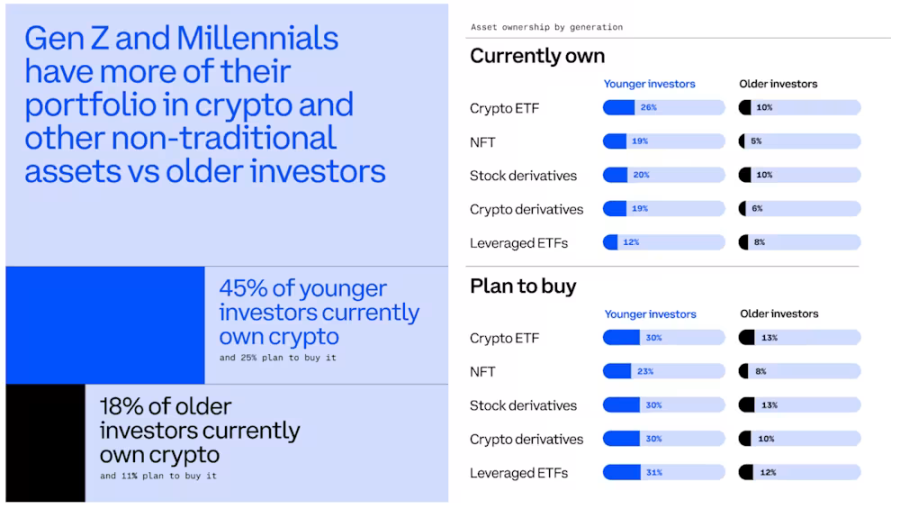
This anxiety is directly reflected in their asset allocation strategies. The survey shows that younger investors allocate 25% of their investment portfolios to non-traditional asset classes such as cryptocurrencies, financial derivatives, non-fungible tokens (NFTs), and other emerging products. This is three times the proportion allocated by older investors, who only allocate 8% to non-traditional assets.

The proportion of stock holdings is roughly similar across generations, but the key difference is that younger investors diversify their portfolios beyond stocks. They are more actively seeking returns beyond traditional stock dividends and are more willing to experiment with new investment tools and emerging markets to narrow the wealth gap.

Cryptocurrency Is Not a Side Hustle but a Core Allocation

This generational shift in investment philosophy is most evident in the acceptance of cryptocurrency. The report shows that 45% of young investors already hold cryptocurrency, compared to only 18% of older investors. Additionally, nearly half (47%) of young investors want to gain exposure to new crypto assets ahead of the general market, while only 16% of older investors share this desire.

In the eyes of the younger generation, cryptocurrency is not merely a speculative trade but an important tool to help them catch up in wealth accumulation. Eighty percent of young people believe that cryptocurrency provides their generation with more financial opportunities outside the traditional financial system. At the same time, another 80% are convinced that cryptocurrency will play a significantly larger role in the future financial system. Among older investors, only about 60% share this view.

The younger generation's enthusiasm for exploring emerging markets extends beyond spot cryptocurrencies; they are eager to engage with more non-traditional assets. Data shows that 80% of young investors are willing to try new investment opportunities ahead of others, while less than half of older generations share this attitude. Young investors consistently show strong interest in emerging non-traditional products such as cryptocurrency derivatives, prediction markets, 24/7 stock trading, early token offerings, altcoins, and decentralized finance (DeFi) lending.

The Impact of This Trend on Future Markets

The younger generation of investors has already demonstrated distinct characteristics: they trade more frequently, are willing to take greater risks for higher returns, and are shifting a significant portion of their investment portfolios to non-traditional assets centered around cryptocurrency. At the same time, they are driving the entire financial industry toward a transformation that meets the needs of the internet-native generation, creating platforms that operate around the clock and support diverse asset trading.

Пов'язані питання

QWhat is the main finding of the Coinbase and Ipsos survey regarding young investors' approach to wealth accumulation?

AThe survey found that young investors, particularly Gen Z and millennials, are more likely to actively manage their investments, are more open to non-traditional assets, and are more inclined to view cryptocurrency as a core component of their financial future, moving away from the traditional path of buying a home and investing in stocks.

QWhy do young investors feel the traditional financial system is not designed for them?

AYoung investors feel this way because they have witnessed rising housing costs, high student debt burdens, and stagnant wage growth, making it more difficult for them to accumulate wealth through traditional means like their parents did.

QHow does the allocation to non-traditional assets differ between younger and older investors?

AYounger investors allocate 25% of their portfolio to non-traditional assets like cryptocurrency, derivatives, and NFTs, which is three times the allocation of older investors, who only allocate 8% to such assets.

QWhat percentage of young investors hold cryptocurrency, and how do their views on its role differ from older investors?

A45% of young investors hold cryptocurrency, compared to only 18% of older investors. Additionally, 80% of young investors believe crypto provides more financial opportunities outside the traditional system and that its role in the future financial system will be significantly greater, a view shared by about 60% of older investors.

QWhat broader impact are young investors having on the financial industry according to the report?

AYoung investors are driving the financial industry to transform towards platforms that are better suited for the internet-native generation, featuring 24/7 operation and support for trading a diverse range of assets, due to their higher trading frequency, greater risk tolerance, and significant allocation to non-traditional assets like crypto.

Пов'язані матеріали

Can Generative Models Finally Be Trained End-to-End? The Core Is a For Loop

This article introduces a novel training paradigm for generative models called Explorative Modeling (XM), which enables true end-to-end training. Traditionally, powerful generative models like autoregressive and diffusion models are not trained end-to-end. They are trained to predict a single small step but require iterative multi-step sampling for inference. This "exposure bias" leads to error accumulation and limits performance. The core challenge XM addresses is "mode blurring." In generative tasks, a single input (e.g., "generate a dog") corresponds to many valid outputs (multiple modes). Standard training objectives like reconstruction loss force the model to average these modes, producing unrealistic, blurry outputs. To avoid this, existing models break generation into many small, almost deterministic steps, sacrificing end-to-end training. XM tackles this by restructuring the training loop itself. Its key insight is to amplify "generative expressivity." For each training input, instead of generating one sample, the model generates K candidate outputs. Only the candidate closest to the real data is used for computing the loss and updating the model via backpropagation. This simple "best-of-K" mechanism is implemented as a short for-loop. By exploring multiple possibilities, the model learns to distribute its guesses across different modes rather than collapsing to their uninformative average. The paper demonstrates that "exploration" acts as a new, powerful scaling axis. Gains from XM increase with model size, data scale, and compute. Experiments show improvements in FID scores for image generation and significant efficiency gains, sometimes outperforming larger models without exploration. When pushed to the limit, XM enables fully single-step, end-to-end generative models. In robotics tasks, an "Explorative Policy" matched the performance of a 100-step Diffusion Policy with a single forward pass, drastically improving inference speed. While the best-of-K concept is not entirely new, the authors' contribution lies in formally understanding it as a direct method to boost generative expressivity without fragmenting the generation process. This work suggests that as models scale, enhancing exploration during training may become crucial for overcoming fundamental performance bottlenecks.

marsbit50 хв тому

Can Generative Models Finally Be Trained End-to-End? The Core Is a For Loop

marsbit50 хв тому

Annual Salary of Millions Competing for Electricians, Meta Rushes to Open Its Own Technical School

The AI boom is facing an unexpected bottleneck: a severe shortage of skilled construction workers and electricians. As tech giants like Meta, OpenAI, and Alphabet race to build massive data centers—such as OpenAI's $16 billion "Stargate" project—they are hitting a critical labor wall. The U.S. needs an estimated 130,000 more electricians, 240,000 construction workers, and 150,000 supervisors by 2030 for AI infrastructure alone, but tens of thousands of electrician jobs go unfilled each year. While AI companies offer high premiums, with electricians earning up to $280,000 annually, worker scarcity still causes massive losses—delays on a single project can cost $14.2 million per month. The complexity of building AI data centers, which require immense power (equivalent to powering hundreds of thousands of homes), sophisticated electrical systems, and advanced liquid cooling solutions, demands highly skilled technicians who are in short supply. To combat this, companies are investing heavily in training. Meta has committed $115 million to a free training school offering tuition, housing, and stipends, targeting 5,000 new workers. OpenAI is partnering with unions to secure skilled labor. These efforts are paying off, with a significant rise in Gen Z interest in trade schools over college. However, the power demands are staggering. AI data centers are driving a rapid surge in electricity consumption, projected to account for up to 12% of U.S. power use by 2028 and raising costs for consumers. Furthermore, the construction boom is project-based, leading to a potential future glut of trained workers once building peaks, which could depress wages industry-wide. The race for AI supremacy now depends as much on skilled hands as on advanced chips.

marsbit2 год тому

Annual Salary of Millions Competing for Electricians, Meta Rushes to Open Its Own Technical School

marsbit2 год тому

Торгівля

Спот
活动图片