Explaining 'Liquidation Cascades': How $19 Billion in Cryptocurrency Vanished in One Day

cryptonews.ruОпубліковано о 2026-08-15Востаннє оновлено о 2026-08-15

Анотація

This article explains how "liquidation cascades" led to a $19 billion wipeout in cryptocurrency markets in a single day. It details that most speculation occurs in perpetual futures, leveraged derivative contracts. When prices move against a trader's position, triggering a margin call and automatic sale, it can start a chain reaction. Each forced sale pushes the price down further, liquidating the next over-leveraged position like dominoes, especially when open interest is concentrated at similar price levels. The piece highlights the October 10, 2025 event, where a major geopolitical announcement triggered a massive sell-off. Over 24 hours, leveraged positions worth over $19 billion were liquidated, affecting 1.6 million traders, with long positions making up the vast majority. Total open interest on major exchanges plummeted by 43%. The phenomenon repeated in 2026, with several other "cascade" events causing billions more in liquidations. The article concludes that these cascades are not rare accidents but the market's standard mechanism for shedding excess leverage. The same conditions—high leverage, crowded positions, and clustered stop-loss levels—repeatedly set the stage for these events, with fuel accumulating again after each crash.

Most cryptocurrency speculation does not occur on the spot market, where buyers own the actual coins, but in perpetual futures—derivative contracts that allow a trader to control, for example, a $100,000 Bitcoin position with a margin of $10,000. When the price moves against the position to an extent that the collateral can no longer cover potential losses, the position is automatically sold on the open market.

It is with this automatic sale that cascade crashes begin, as each forced sale lowers the price a bit more, which in turn pushes the next trader's position below their margin maintenance threshold, triggering another forced sale. In a market where open interest (the total value of outstanding derivative contracts) worth billions is concentrated at similar price levels, one sharp move can knock down positions like dominoes within hours.
And although exchanges have "cushions," they have their own sharp edges. To elaborate, each major derivatives trading platform manages an insurance fund designed to cover positions that become unprofitable faster than they can be closed. When the fund is insufficient, platforms resort to automatic deleveraging, forcibly closing profitable traders' positions on the opposite side of the trade to balance the books.

Simply put, during the strongest cascade crashes, even the winners incur losses. And since liquidations are executed at whatever price is available in the order book, low liquidity during nighttime and weekends leads to sharp "wicks" (instantaneous price spikes far below fair value), causing the lows of cascade crashes to be much lower than what would be justified by spot selling alone.

The Day the Dominoes Fell

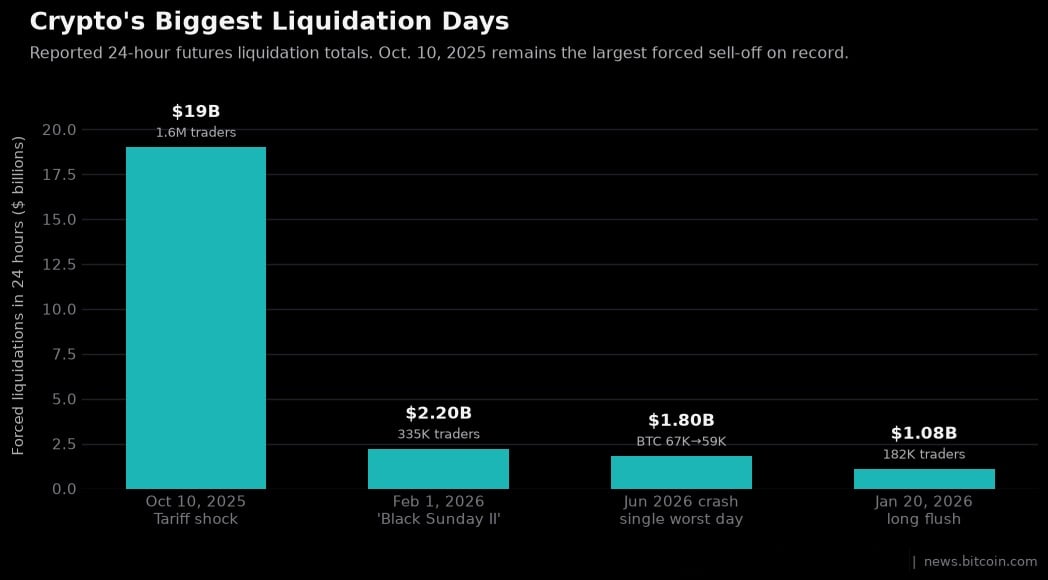
On October 10, 2025, President Trump announced a 100% tariff on imports from China. This triggered a sell-off in stocks and commodities, and cryptocurrencies (which were at levels close to record-high open interest with over-saturated long positions) became the pressure point. Over approximately 24 hours from October 10 to 11, leveraged positions worth over $19 billion were wiped out, affecting more than 1.6 million traders. About $16.7 billion of this amount came from long positions.

The aftermath revealed how overheated the market was: the total open interest in perpetual futures on major exchanges plummeted by 43% in a day—from $217 billion to $123 billion. On the decentralized derivatives exchange Hyperliquid, open interest fell by 57%—from $14 billion to $6 billion.
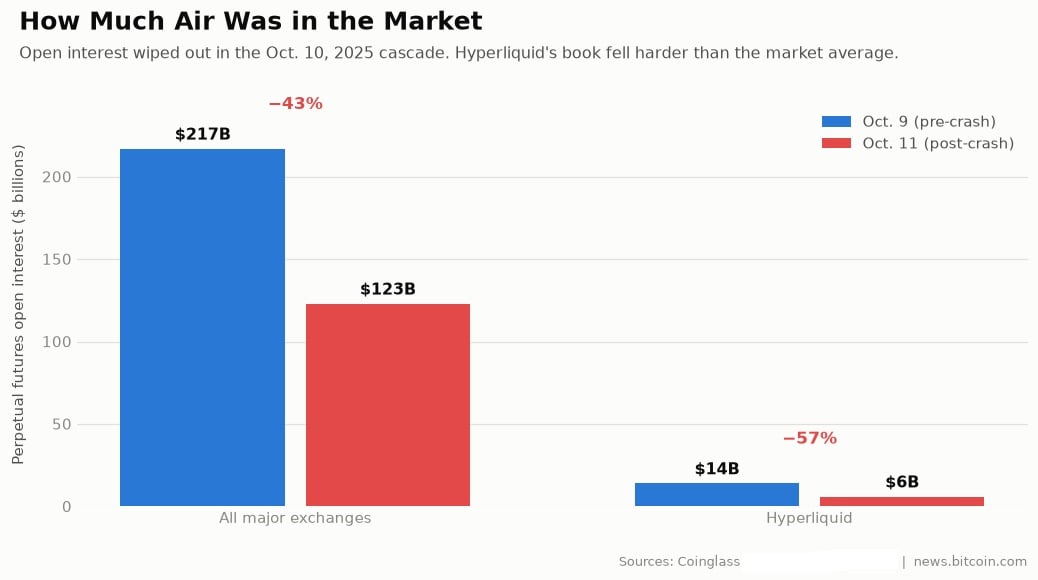
And because some platforms limit the amount of information they disclose or delay its publication, market makers estimated that the actual volume of liquidations may have approached $30–40 billion. For the entirety of 2025, analysts calculated that liquidation volumes exceeded $150 billion.

The Recidivists of 2026

Traders rebuilt their leveraged positions, and 2026 continued to gather them, but on January 20, over 182,000 traders again lost more than $1.08 billion in a single day, with almost all of this amount coming from long positions in Bitcoin and Ethereum futures.

Twelve days later came the day traders dubbed "Black Sunday II" (February 1), when positions worth approximately $2.2 billion were forcibly closed within 24 hours, affecting over 335,000 traders. Ethereum led the losses with $961 million in liquidations, followed by Bitcoin at $679 million, and Solana added $168 million; long positions accounted for roughly 80–85% of the losses as Bitcoin briefly dipped below the $76,000 mark.
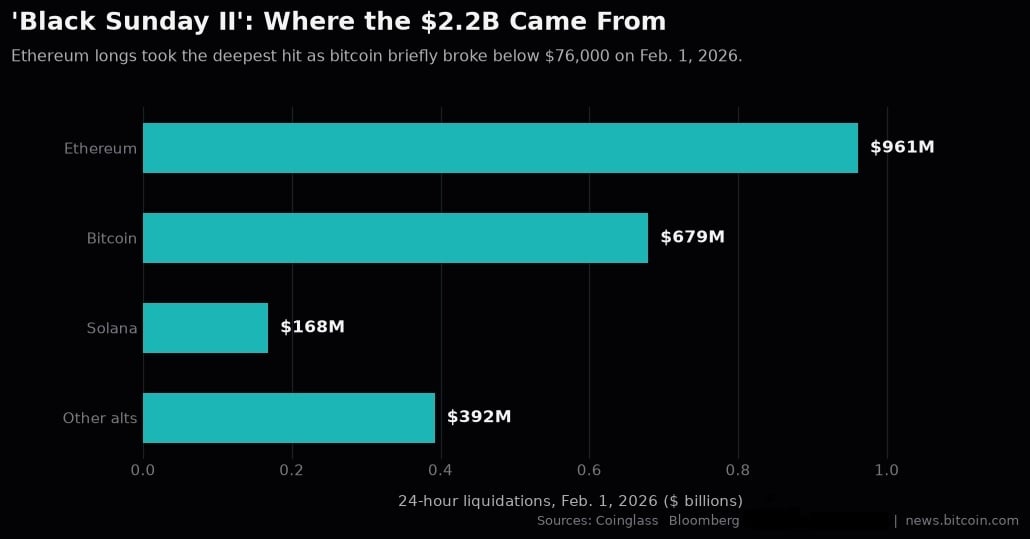
June brought the most significant spot market losses of the year: Bitcoin fell from around $67,000 to $59,100 over 48 hours, triggering forced liquidations totaling over $3 billion during that period (including one single most unprofitable day with losses of about $1.8 billion), as each wave of selling gave rise to the next.

How Traders Get Trapped

Market mechanisms punish the same behavior every time, namely: high leverage, over-saturation of positions, and the clustering of stop-loss levels where everyone else has set theirs. Funding rates (periodic payments traders with long and short positions make to each other) are the first alarm signal, and when long participants are forced to pay significant amounts to stay in the trade, positions become over-saturated, and even a small drop can set off a chain reaction.

The unpleasant lesson to draw from all this is that liquidation cascades are not rare accidents; they are the market's standard way of shedding excess leverage. Open interest recovered after each crash this year, which means the "fuel" for the next crash has already been accumulated.
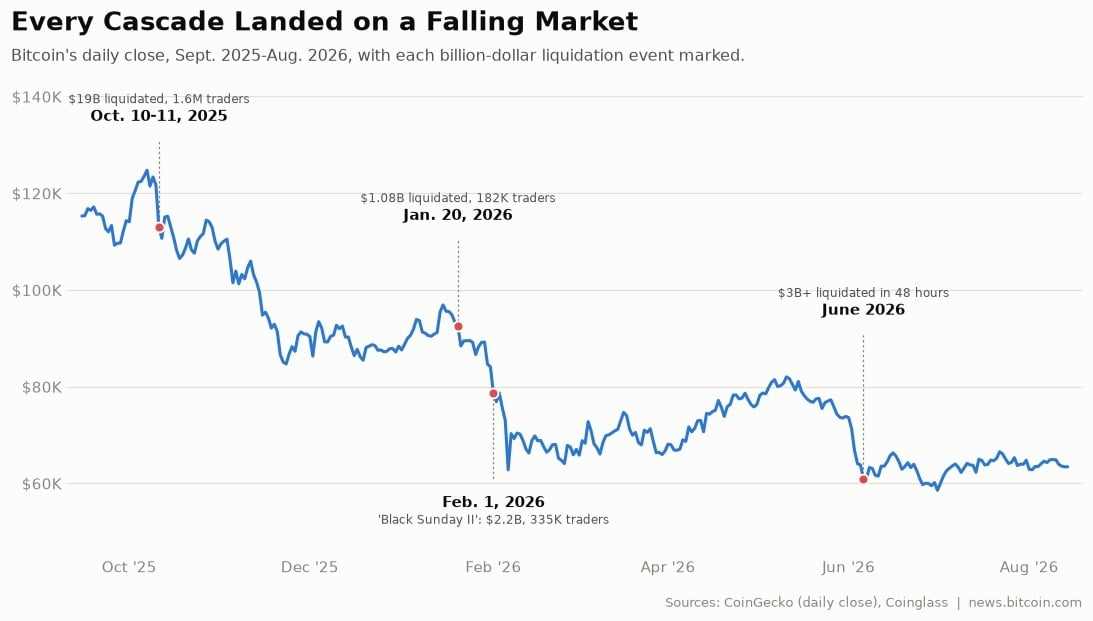
The spark (be it tariff news, an exchange vulnerability, or panic over a fork) is never planned in advance, and liquidation cascades do not wait for bear markets, as some of the largest in history occurred within weeks of reaching all-time highs—precisely when confidence and leverage peaked.


Трендові криптовалюти

Пов'язані питання

QWhat are 'liquidation cascades' and how do they begin in cryptocurrency markets?

ALiquidation cascades, or 'каскады ликвидации,' are chain reactions of forced sell-offs in leveraged cryptocurrency trading. They begin when the price moves against a trader's position to the point where their margin (collateral) can no longer cover potential losses, triggering an automatic sale. Each forced sale pushes the price down further, which can trigger the next trader's margin call, creating a domino effect.

QAccording to the article, what triggered the major liquidation event on October 10-11, 2025?

AThe major liquidation event on October 10-11, 2025, was triggered by an announcement from President Trump about imposing a 100% tariff on imports from China. This caused a broad sell-off in stocks and commodities. Cryptocurrencies, which were at near-record high open interest levels with overcrowded long positions, became a point of pressure, leading to the cascading liquidations.

QWhat is the role of a 'страховой фонд' (insurance fund) on derivatives trading platforms during volatility?

AA 'страховой фонд' (insurance fund) on derivatives trading platforms is designed to cover positions that become unprofitable faster than they can be closed. If this fund is insufficient, platforms resort to 'автоматическое снижение левериджа' (automatic deleveraging), forcibly closing profitable positions on the opposite side of trades to balance their books, meaning even winning traders can suffer losses during extreme cascades.

QWhat common trading behaviors does the article say are repeatedly punished by market mechanisms during cascades?

AThe market mechanisms repeatedly punish common trading behaviors such as: using high leverage, having overcrowded (one-sided) positions, and clustering stop-loss orders at similar price levels where everyone else has placed them.

QWhy does the article suggest that 'the fuel for the next crash is already accumulated' after each major liquidation event?

AThe article suggests this because after each major liquidation event, the total open interest (the value of outstanding derivative contracts) recovers. This means traders rebuild their leveraged positions, recreating the conditions of high leverage and crowded trades that make the market vulnerable to the next spark, whether it's a news event, exchange issue, or panic sell-off.

Пов'язані матеріали

Robert Kiyosaki Shares His Mentor's Predictions About the Emergence of Bitcoin and AI

American entrepreneur and author of "Rich Dad Poor Dad," Robert Kiyosaki, discussed the influence of futurist R. Buckminster Fuller on his worldview, linking Fuller's past technological predictions to the emergence of Bitcoin and the development of artificial intelligence. In an X post, Kiyosaki also reflected on personal purpose, sharing his journey from the music business—where he worked with bands like The Police and Iron Maiden—to creating the "Cashflow" board game and writing his famous book. He described feeling an inner emptiness despite his success, a turning point that came after meeting Fuller, whom he studied with for three summers. Kiyosaki described Fuller as a "friendly genius" who foresaw world-changing developments like Bitcoin and AI. However, the core of his post focused on Fuller's philosophical impact, particularly a quote about belonging to the universe and finding purpose by dedicating one's life to the maximum benefit of others. The entrepreneur remains a vocal advocate for cryptocurrencies. He regularly advises buying Bitcoin during market panics, viewing it and assets like Ethereum, gold, and silver as hedges against traditional financial system failures. Kiyosaki has predicted a major market crash by 2026, seeing it as an opportunity for prepared investors, with long-term price targets including $750,000 for Bitcoin and $95,000 for Ethereum.

cryptonews.ru43 хв тому

Robert Kiyosaki Shares His Mentor's Predictions About the Emergence of Bitcoin and AI

cryptonews.ru43 хв тому

Etherealize CEO Calls Wall Street's Private Blockchains a 'Race to the Bottom'

Etherealize co-founder and CEO Vivek Raman criticized Wall Street's growing interest in private, permissioned blockchains, calling them a "race to the bottom." In an interview with CoinDesk, Raman argued that consortium networks fragment liquidity and return the industry to the siloed systems that blockchain technology was meant to overcome. He stated that closed networks do not interoperate, undermining two key advantages of the technology: system compatibility and liquidity concentration. Etherealize promotes Ethereum as an open, foundational layer for institutional players. Raman insists that privacy and access restrictions should be built on top of public infrastructure—at the application or L2 level—rather than creating separate, closed networks. He compared Ethereum to HTTP as a base layer, with additional permissioned and private layers akin to HTTPS. Examples of this new wave of "closed" solutions mentioned include Canton Network from Digital Asset, Circle's Arc project, and Stripe's Tempo. Raman termed this trend "consortium chains 2.0," recalling earlier initiatives like the R3 interbank consortium and the Hyperledger corporate ecosystem from 2016 that failed to gain significant traction. He reiterated his firm belief that a global, open, permissionless infrastructure is necessary as a foundational base layer. Raman previously noted in June that traditional financial institutions had begun implementing Ethereum-based solutions into real business processes.

cryptonews.ru45 хв тому

Etherealize CEO Calls Wall Street's Private Blockchains a 'Race to the Bottom'

cryptonews.ru45 хв тому

Торгівля

Спот

Популярні статті

Як купити ONE

Ласкаво просимо до HTX.com! Ми зробили покупку Harmony (ONE) простою та зручною. Дотримуйтесь нашої покрокової інструкції, щоб розпочати свою криптовалютну подорож.Крок 1: Створіть обліковий запис на HTXВикористовуйте свою електронну пошту або номер телефону, щоб зареєструвати обліковий запис на HTX безплатно. Пройдіть безпроблемну реєстрацію й отримайте доступ до всіх функцій.ЗареєструватисьКрок 2: Перейдіть до розділу Купити крипту і виберіть спосіб оплатиКредитна/дебетова картка: використовуйте вашу картку Visa або Mastercard, щоб миттєво купити Harmony (ONE).Баланс: використовуйте кошти з балансу вашого рахунку HTX для безперешкодної торгівлі.Треті особи: ми додали популярні способи оплати, такі як Google Pay та Apple Pay, щоб підвищити зручність.P2P: Торгуйте безпосередньо з іншими користувачами на HTX.Позабіржова торгівля (OTC): ми пропонуємо індивідуальні послуги та конкурентні обмінні курси для трейдерів.Крок 3: Зберігайте свої Harmony (ONE)Після придбання Harmony (ONE) збережіть його у своєму обліковому записі на HTX. Крім того, ви можете відправити його в інше місце за допомогою блокчейн-переказу або використовувати його для торгівлі іншими криптовалютами.Крок 4: Торгівля Harmony (ONE)Легко торгуйте Harmony (ONE) на спотовому ринку HTX. Просто увійдіть до свого облікового запису, виберіть торгову пару, укладайте угоди та спостерігайте за ними в режимі реального часу. Ми пропонуємо зручний досвід як для початківців, так і для досвідчених трейдерів.

588 переглядів усьогоОпубліковано 2024.12.12Оновлено 2026.06.02

Як купити ONE

Обговорення

Ласкаво просимо до спільноти HTX. Тут ви можете бути в курсі останніх подій розвитку платформи та отримати доступ до професійної ринкової інформації. Нижче представлені думки користувачів щодо ціни ONE (ONE).

活动图片