Everyone Is Waiting for the War to End, But Does the Oil Price Suggest a Long-Term Conflict?

marsbitОпубліковано о 2026-04-07Востаннє оновлено о 2026-04-07

Анотація

This article argues that the market views oil price volatility as a consequence of the ongoing conflict, but the real insight is understanding how the war itself is being priced through oil. With the Strait of Hormuz blocked, global crude supply is being restructured, with Asian buyers shifting to US oil, causing WTI to surpass Brent—a sign of structural changes in pricing and trade flows. While short-term price differences can be explained by contract timing, the deeper issue is a fundamental shift in who can supply oil. The market's key misjudgment is not on price, but on time. Futures curves still imply the conflict will end soon and supply will recover. However, the more likely path is a prolonged war of attrition. This means high oil prices are not a temporary shock but a new structural reality, with a range of $120-$150. In this framework, oil is no longer just a commodity but the "upstream variable" for all assets. Its repricing will ripple through interest rates, currencies, equity, and credit markets. The market has priced in the war's occurrence, but not its persistence. The analysis concludes that a prolonged conflict is the base case scenario, and any pullbacks in oil prices present an opportunity as the market has yet to fully price in a long-term disruption.

Editor's Note: While the market still views oil price fluctuations as an "outcome variable" of the war, this article argues that what truly needs to be understood is how the war itself is being priced through oil.

As the Strait of Hormuz remains blocked, the global crude oil supply system is being forcibly restructured—Asian buyers are turning to U.S. crude oil on a large scale, and WTI surpassing Brent marks a structural shift in pricing mechanisms and trade flows. Short-term price differentials can be explained by contracts, but at a deeper level, it's a question of "who can still supply."

The author further points out that the market's key misjudgment lies not in price but in time. The futures curve still implies one premise: the conflict will end in the short term, and supply will recover. But the more likely path is a prolonged war of attrition. This means that high oil prices are no longer a temporary shock but will evolve into a more persistent structural state, with the range potentially shifting upward to $120–150.

Under this framework, crude oil is no longer just a commodity but becomes the "upstream variable" for all assets. Its repricing will transmit layer by layer through interest rates, exchange rates, stock markets, and credit markets.

The market has priced in the occurrence of the war but has not yet priced in its persistence.

Below is the original text:

Trump gave Iran a 10-day deadline. That was a week ago. Yesterday, he reminded everyone again: the countdown has only 48 hours left. Tehran's response: no.

Five weeks ago, on February 28, when U.S. and Israeli warplanes launched airstrikes on Iran, the market's pricing logic was still that of a "surgical" air strike: two weeks, three at most; the Strait of Hormuz would reopen; oil prices would spike and then fall back, and everything would return to normal.

But our judgment at the time was: it won't.

From day one, our core view has been that this war would first escalate and only later possibly de-escalate. The most likely path is the involvement of ground forces, evolving into a long and draining conflict. The duration of the Strait of Hormuz's closure would far exceed the assumptions the market is willing to model. We have provided the full logic in our duration framework, Hormuz pricing model, and war variable analysis.

The core judgment is simple: Iran doesn't need to win; it only needs to raise the cost of the war high enough to force Washington to seek an exit path. And this "exit" will not come with the smooth reopening of the strait.

Five weeks later, every key part of this judgment is being gradually validated. The Strait of Hormuz remains closed. Brent crude settled around $110. The Pentagon is preparing for weeks of ground operations. Trump's war goals have also shifted from "denuclearization" to "bombing them back to the Stone Age," but he still cannot clearly define what "victory" means.

The deployment of ground forces is the escalation inflection point we have been tracking. Marine and airborne troops are already assembling in the theater; this moment is approaching.

But more critical than the next round of airstrikes or the next ultimatum is oil.

Oil is not a byproduct of this war; oil is the core of the war itself. Stock markets, bond markets, crypto markets, the Fed, even your daily food expenses—everything is a downstream variable. As long as you judge oil prices correctly, everything else will unfold accordingly; once you misjudge, all other decisions will lose meaning.

WTI crude prices have just surpassed Brent for the first time since 2022, a change that has already drawn market attention.

Good. It should.

WTI Above Brent: What Everyone Is Asking

On April 2, WTI crude settled at $111.54, while Brent settled at $109.03. WTI's premium over Brent was $2.51, the largest spread since 2009. Just two weeks ago, WTI was still at a significant discount to Brent.

Everyone is asking: What happened? Below is the brief version, and the version closer to reality.
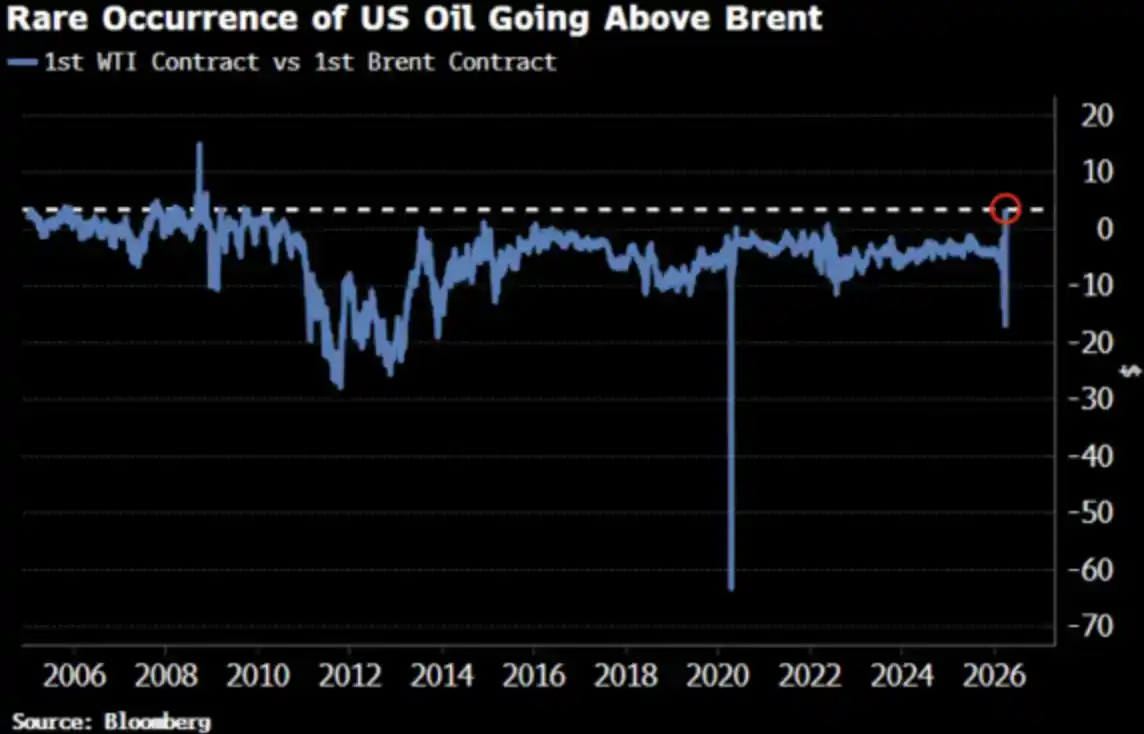
Brief Version: Mismatch in Contract Expiries

WTI's front-month contract is for May delivery, while Brent's front-month contract has rolled to June. In such a tight supply situation, "delivery one month earlier" means a higher price—WTI just happens to have an earlier delivery date.

Adi Imsirovic, an oil trader with 35 years of experience now at Oxford, stated that on top of historically high freight and insurance costs, buyers are willing to pay nearly $30/barrel more for Brent crude delivered one month earlier. In his 35-year career, he has never seen anything like this.

This is a "mechanism-level" explanation—it is correct but incomplete.

Real Version: The Entire Price Curve Is Shifting

The convergence of WTI and Brent is not just a sporadic mismatch in front-month contracts. Bloomberg points out that this phenomenon is clearly visible across multiple contract months, running through the entire forward curve. In other words, the entire price curve is being repriced.

Why? A shift in Asian demand. In late March, Asian refineries locked in about 10 million barrels of U.S. crude for May shipment; the previous week, they also purchased about 8 million barrels. Kpler expects U.S. crude exports to Asia to reach 1.7 million barrels per day in April, up from 1.3 million in March. China, South Korea, Japan, and ExxonMobil's refinery in Singapore are all buying U.S. crude—because it is "the only available supply right now."

The Strait of Hormuz remains closed. Abu Dhabi's benchmark crude Murban—the closest substitute for WTI—has disappeared from the global market. WTI is becoming the world's "marginal pricing oil."

This is not panic buying but a change in flow structure.
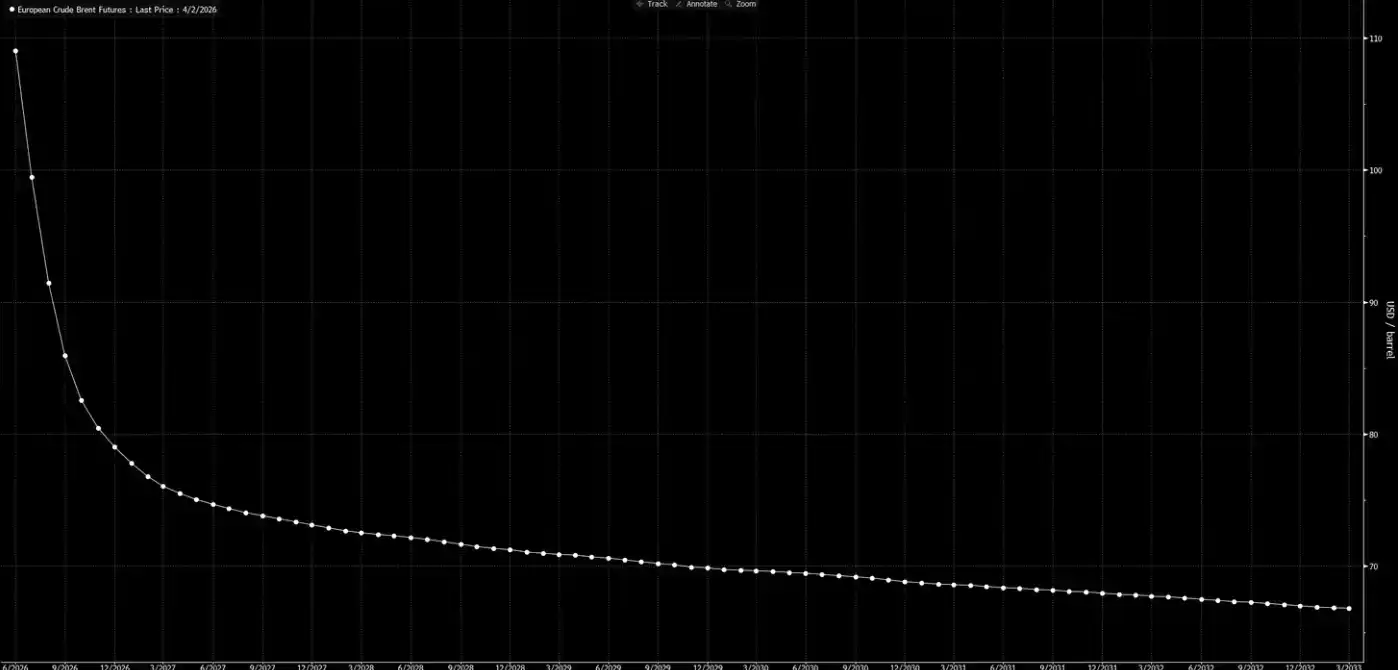
Now look at the forward price curve.

This curve is sending a signal: this is just a temporary shock; by Christmas, everything will be back to normal.

Our judgment: This curve is "dreaming."

Three Endings, One Baseline Path

We have already proposed this analytical framework in the "Weekly Signal Playbook." So far, nothing has changed; if anything, the probability of the baseline scenario has only strengthened.

This war will ultimately end in only three ways:
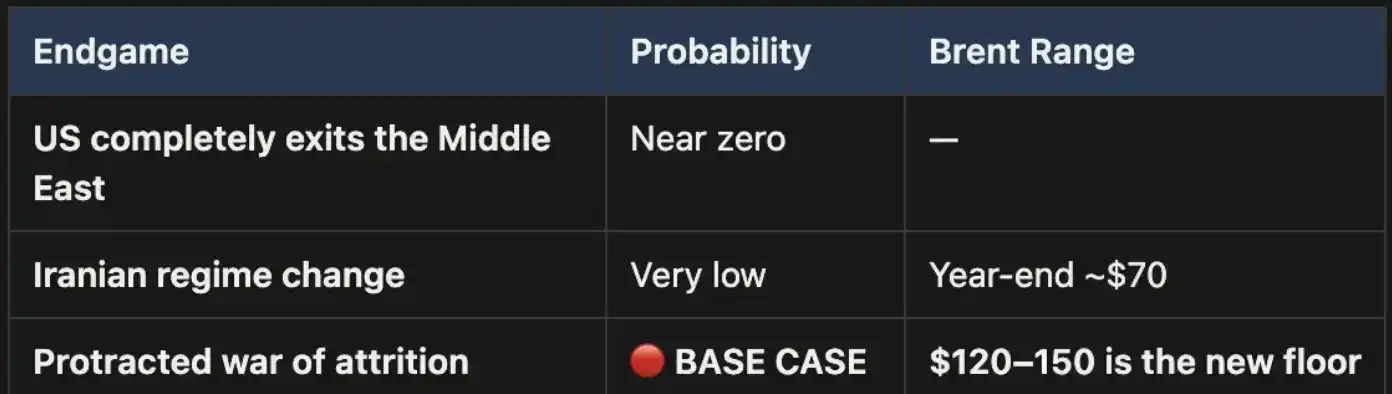
Ending one is almost politically impossible.


Ending two is equally untenable: terrain conditions, troop requirements, and the logic of guerrilla warfare all indicate that this path would be costly and difficult to conclude. Iran's land area is three times that of Iraq, with nearly twice the population, not to mention mountainous terrain that leaves no room for invaders. This is not 2003.

Ending three is the baseline scenario, and its probability is far ahead. If the conflict evolves into a long-term war of attrition, the closure of the Strait of Hormuz will persist, and oil prices will remain high. This high level will be structural, not temporary. The current forward price curve clearly underprices this.

What most people overlook is this: from the perspective of the oil industry itself, a long-term war might actually align with U.S. strategic interests. Middle Eastern crude production capacity would be damaged in the conflict, forcing global buyers to turn to North American energy because other alternative sources are scarce. Higher oil prices would also stimulate U.S. producers to expand output—increasing rigs and investing more in shale oil. Look at the chart below: historically, almost every major oil price spike has been followed by an uptick in U.S. production within 12 to 18 months.
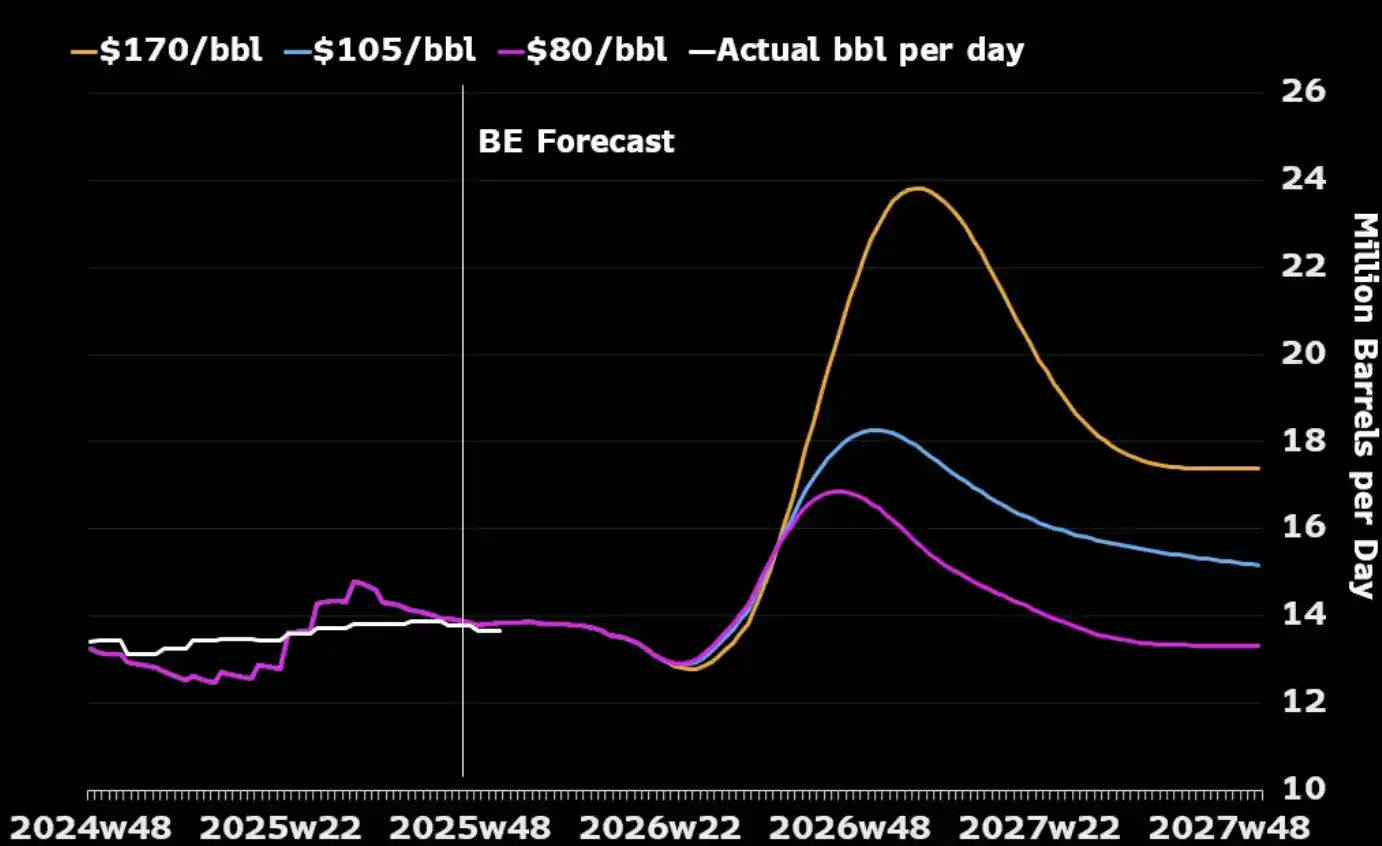
The only cost the U.S. truly needs to manage is domestic: how to avoid gasoline prices staying above $4 per gallon for too long, triggering political backlash. This is a "pain threshold," not a condition for ending the war.

The "Arithmetic" of Price

With the Strait of Hormuz closed, $110 for Brent is not the ceiling but the starting point. Under our baseline scenario, as long as the strait remains closed, oil prices will sustain in the $120 to $150 range.

With each passing week, inventories are being drawn down. UBS data shows global inventories had fallen to the five-year average by the end of March—and that was before the latest round of escalation. Macquarie estimates: if the war drags past June and the strait remains closed, there is a 40% probability oil prices will surge to $200.

The front-month spread (the difference between Brent's two nearest contracts) has widened to $8.59/barrel. The market is paying about an 8% premium for "delivery one month earlier"—this is tension at the 2008 level.

But in 2008, 15% of global supply wasn't physically blocked.

Now, almost every model, every price curve, every year-end prediction on Wall Street is built on the same premise: this conflict will end, the Strait of Hormuz will reopen, oil prices will return to normal, and the world will go back to the way it was.

Our judgment: It won't.

The back end of the forward curve hasn't caught up with reality. The market has priced in the "occurrence of the war" but has not priced in the "persistence of the war." Before Hormuz reopens, every pullback in crude is an opportunity. This is our core position, and we will not hedge it.

Oil is the first node. When "ground forces enter" and there is no quick victory—when the conflict evolves into the long-term war of attrition we judged from day one—repricing will not stop at crude itself but will transmit sequentially to interest rates, exchange rates, stock markets, and credit markets. This is what will happen next.


Пов'язані питання

QWhat is the main argument of the article regarding the oil market and the ongoing conflict?

AThe article argues that the oil market is mispricing the duration of the conflict. While the market prices in a short-term disruption, the more likely path is a prolonged war of attrition, which would make high oil prices a structural, not a transitory, state. Oil is not just a commodity but the core of the war and the upstream variable for all other assets.

QWhat significant change occurred between WTI and Brent crude oil prices, and what does it signify?

AWTI crude oil price traded at a premium to Brent for the first time since 2022, with a spread of $2.51. This signifies a structural shift in global oil trade flows, driven by Asian buyers turning to US crude after the closure of the Strait of Hormuz, making WTI the marginal pricing oil for the world.

QAccording to the article, what are the three possible outcomes of the conflict, and which is the most probable?

AThe three outcomes are: 1) A swift, decisive US victory forcing Iran surrender (politically impossible), 2) A full-scale US invasion and occupation of Iran (unviable due to terrain and cost), and 3) A prolonged war of attrition. The article states that Outcome 3 is the base case with the highest probability.

QWhat is the expected price range for oil in the article's base case scenario, and why?

AIn the base case scenario of a prolonged conflict with the Strait of Hormuz closed, the expected oil price range is $120 to $150 per barrel. This is because the disruption is structural, global inventories are being drawn down, and 15% of global supply is physically blockaded.

QHow does the article suggest the market's current pricing is flawed?

AThe market's current pricing, as seen in the futures curve, is flawed because it is predicated on the assumption that the conflict will end soon and the Strait of Hormuz will reopen. The article contends the market has priced in the 'occurrence' of the war but has not priced in its 'persistence,' leading to a significant mispricing of long-term oil price structure.

Пов'язані матеріали

The King of Blind Date Attire in Korea: How SK Hynix Made a Comeback Against Samsung?

In South Korea's dating scene, SK Hynix employees are now highly sought after, a status shift fueled by the company's astronomical profits and employee bonuses, projected to reach up to 6.1 million RMB per person by 2027. This marks a dramatic reversal for the long-time second-place player in memory semiconductors, which has now surpassed its rival Samsung in annual operating profit. The turnaround story began in 2008 when a struggling Hynix, emerging from bankruptcy restructuring, took a risky bet by agreeing to develop High Bandwidth Memory (HBM) with AMD. At the time, HBM had no clear market beyond high-end graphics cards and was a costly, complex technology. Major players like Samsung, pursuing its own HMC technology, declined. For Hynix, with only memory as its core business, it was a gamble born of necessity. The pivotal moment came in 2012 when SK Group Chairman Chey Tae-won acquired Hynix. Defying industry downturns, he invested heavily in R&D and fabrication, sustaining the HBM project through over a decade of commercial uncertainty and internal challenges. A key break occurred around 2016-2017 when Samsung faced production issues supplying HBM2 for Google's TPU, allowing SK Hynix to gain a crucial foothold in the data center market. The AI explosion post-ChatGPT in 2022 was the catalyst, turning HBM into a critical bottleneck for AI accelerators like NVIDIA's GPUs. By 2025, SK Hynix captured 62% of the global HBM market, leaving Samsung at 17%. For the first time, its annual operating profit exceeded Samsung's. Analysts point to the "innovator's dilemma" to explain Samsung's miss: its vast, successful business portfolio made it risk-averse, preventing an all-in bet on the initially niche HBM technology. In contrast, SK Hynix, as a challenger with its back against the wall, had no choice but to commit fully. The story highlights how Korea's chaebol system allows for ultra-long-term bets beyond quarterly pressures. However, SK Hynix's lead isn't guaranteed. Samsung is aggressively catching up on HBM4, and challenges like customer concentration (heavy reliance on NVIDIA) and technical hurdles in advanced packaging remain. The narrative underscores a market truth: the greatest alpha often comes from betting on uncertain, long-term directions others dismiss, much like HBM in 2008.

marsbit6 хв тому

The King of Blind Date Attire in Korea: How SK Hynix Made a Comeback Against Samsung?

marsbit6 хв тому

Understanding Hash in One Article: The "Browser Miner" on Ethereum

Hash is an Ethereum-based ERC-20 token described as a "browser-minable post-quantum token." Its key features include enabling browser-based GPU mining without specialized hardware, a fixed supply cap of 21 million tokens, immutable and permissionless smart contracts with no team allocation or pre-mining, and an emphasis on post-quantum security using Keccak256 hashing. The mining mechanism is a simplified on-chain proof-of-work where miners solve unique challenges tied to their wallet address. Key design elements prevent answer theft, with epochs resetting every 100 blocks (~20 minutes) and a per-block minting limit. Emission follows a Bitcoin-like halving schedule every 100,000 mints, starting at 100 tokens per mint. Projections suggest all tokens could be mined within approximately 294 days if a target rate of one mint per minute is sustained. Hash emphasizes "post-quantum" security by leveraging hash-based primitives like Keccak256, which are considered more resistant to quantum attacks compared to elliptic-curve cryptography. While not a fully post-quantum asset, it aligns with Ethereum's broader post-quantum research narrative. The project completed its Genesis sale at $0.03 and began trading on Uniswap, with its price reaching around $0.19. The initial circulating supply is small, with 5% sold in Genesis and 5% allocated to liquidity. The majority (47.6% of total supply) is allocated to early-stage mining, leading to a front-loaded emission schedule. This structure, combined with low initial liquidity, makes Hash a high-volatility, high-risk project dependent on sustained miner participation and market demand to absorb new supply.

marsbit20 хв тому

Understanding Hash in One Article: The "Browser Miner" on Ethereum

marsbit20 хв тому

OpenAI's Largest Internal Wealth Creation: 600 People Cash Out a Total of $6.6 Billion, 75 Take Home the Maximum $30 Million Each

A Wall Street Journal report reveals OpenAI's unprecedented pre-IPO wealth creation. In a single employee stock sale last October, over 600 current and former employees sold shares, collectively cashing out approximately $6.6 billion. Due to high investor demand, the company tripled the individual sale cap to $30 million, with about 75 employees selling the maximum amount. This event represents the largest such transaction in tech industry history for a private company. OpenAI's valuation was $500 billion for this tender offer. Employees with over two years of tenure were eligible, allowing many post-ChatGPT hires their first liquidity event. The company's stock has reportedly grown over 100-fold in seven years. Following a restructuring, employees collectively hold about 26% of OpenAI. The scale of executive wealth is also staggering. In court testimony related to Elon Musk's lawsuit, President and co-founder Greg Brockman confirmed his OpenAI stake is worth around $30 billion. Analysis indicates about 165 current and former employees hold a combined ~$164.9 billion in equity, averaging nearly $1 billion per person in paper wealth. OpenAI's per-employee stock-based compensation is estimated to be 34 times the average of major tech firms before their IPOs. OpenAI continues its rapid ascent, closing a $122 billion funding round at an $852 billion valuation in March. With monthly revenue hitting $2 billion, over 900 million weekly ChatGPT users, and plans for a potential trillion-dollar IPO in late 2026, this wealth-creation engine shows no signs of stopping.

链捕手42 хв тому

OpenAI's Largest Internal Wealth Creation: 600 People Cash Out a Total of $6.6 Billion, 75 Take Home the Maximum $30 Million Each

链捕手42 хв тому

Торгівля

Спот
Ф'ючерси

Популярні статті

Як купити WAR

Ласкаво просимо до HTX.com! Ми зробили покупку WAR (WAR) простою та зручною. Дотримуйтесь нашої покрокової інструкції, щоб розпочати свою криптовалютну подорож.Крок 1: Створіть обліковий запис на HTXВикористовуйте свою електронну пошту або номер телефону, щоб зареєструвати обліковий запис на HTX безплатно. Пройдіть безпроблемну реєстрацію й отримайте доступ до всіх функцій.ЗареєструватисьКрок 2: Перейдіть до розділу Купити крипту і виберіть спосіб оплатиКредитна/дебетова картка: використовуйте вашу картку Visa або Mastercard, щоб миттєво купити WAR (WAR).Баланс: використовуйте кошти з балансу вашого рахунку HTX для безперешкодної торгівлі.Треті особи: ми додали популярні способи оплати, такі як Google Pay та Apple Pay, щоб підвищити зручність.P2P: Торгуйте безпосередньо з іншими користувачами на HTX.Позабіржова торгівля (OTC): ми пропонуємо індивідуальні послуги та конкурентні обмінні курси для трейдерів.Крок 3: Зберігайте свої WAR (WAR)Після придбання WAR (WAR) збережіть його у своєму обліковому записі на HTX. Крім того, ви можете відправити його в інше місце за допомогою блокчейн-переказу або використовувати його для торгівлі іншими криптовалютами.Крок 4: Торгівля WAR (WAR)Легко торгуйте WAR (WAR) на спотовому ринку HTX. Просто увійдіть до свого облікового запису, виберіть торгову пару, укладайте угоди та спостерігайте за ними в режимі реального часу. Ми пропонуємо зручний досвід як для початківців, так і для досвідчених трейдерів.

186 переглядів усьогоОпубліковано 2024.12.11Оновлено 2026.04.28

Як купити WAR

Обговорення

Ласкаво просимо до спільноти HTX. Тут ви можете бути в курсі останніх подій розвитку платформи та отримати доступ до професійної ринкової інформації. Нижче представлені думки користувачів щодо ціни WAR (WAR).

活动图片












