Even Satoshi Nakamoto Would Kowtow to the God of Wealth

深潮Опубліковано о 2025-12-25Востаннє оновлено о 2025-12-25

Анотація

On the fifth day of the Lunar New Year, the author visits a temple in Hangzhou and observes a surprising number of cryptocurrency insiders—KOLs, community builders, and tech elites—praying for wealth, abandoning algorithmic consensus for incense and devotion. The piece notes the rising influence of metaphysics in crypto circles, where traditional analysis is increasingly supplanted by astrology, face-reading, and feng shui. A trader’s astrological prediction warns of Bitcoin’s “darkest hour” in 2026, while a VC partner admits that assessing founders’ facial traits is now part of due diligence. Anecdotes illustrate this trend: a listed company CEO’s devotion to feng shui reportedly led to massive Bitcoin gains, while a frog-avatar KOL ignored his advisor’s warning and lost everything trading futures. The author frames this not as mere superstition but as a psychological response to extreme volatility. Just as maritime cultures turned to deities like Mazu for safety in uncertain seas, crypto participants seek spiritual anchors amid market chaos. When tweets from figures like Musk or Trump can swing prices 50% in a day, belief systems—whether in code or cosmology—become a necessary comfort. The question isn’t whether the God of Wealth understands blockchain, but whether faith helps traders sleep at night.

Author: Xiaobing, Deep Tide TechFlow

Every year on the fifth day of the Lunar New Year, Xiaobing wakes up early to visit the Number One Temple of Wealth at Beigao Peak in Hangzhou.

I thought I would be jostling with aunties and uncles, but when I arrived, the scene was filled with familiar faces amidst the swirling incense smoke.

To the left was a well-known爆料KOL, to the right someone involved in community schemes, and a few tech elites who usually preach "decentralization" were devoutly kowtowing with loud thuds. In that moment, algorithmic consensus and Federal Reserve moves were no match for the three sticks of incense in their hands.

Over the past two years, mysticism has become the "mainstream study" in the crypto world. If you’re still looking at K-line charts, you’re a classical rookie; the real OGs are now reading birth charts.

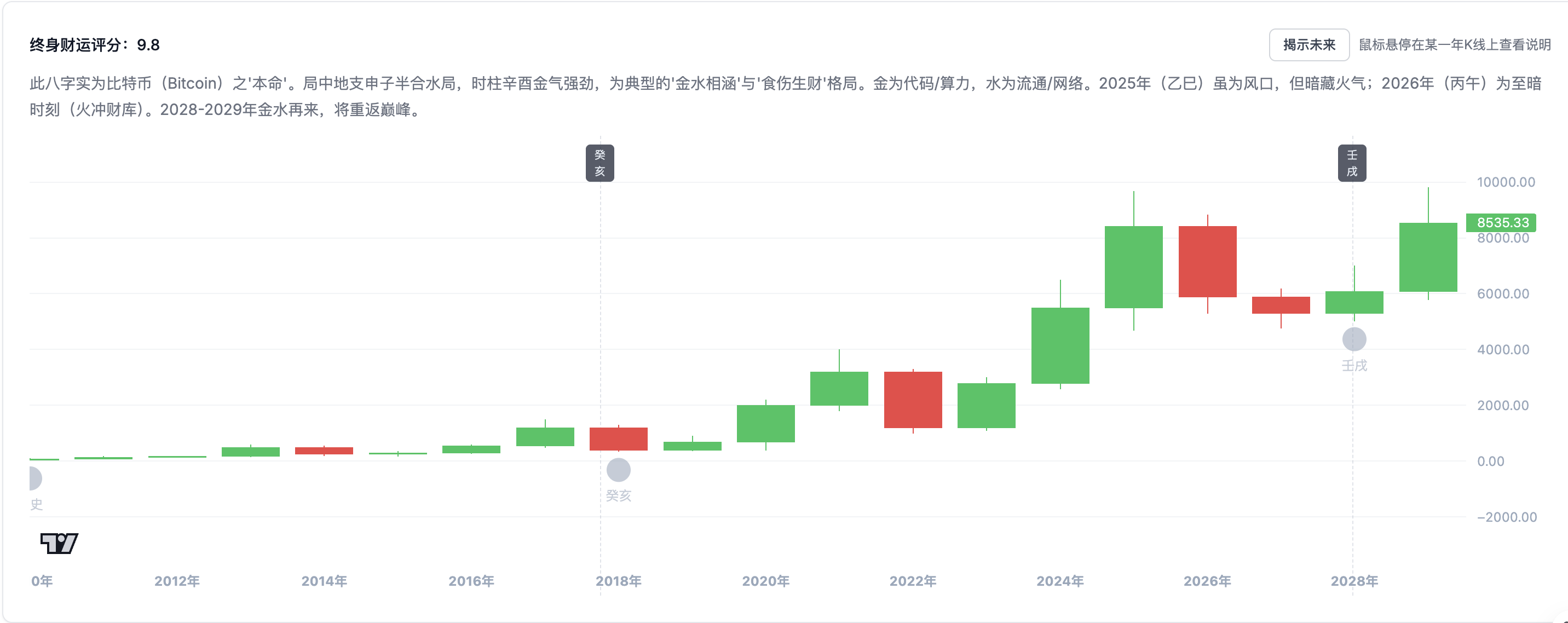
A crypto trader familiar with various macro indicators eventually turned to mysticism, recently calculating Bitcoin’s八字 (Bazi). The result was alarming: Fire clashes with the wealth vault, making 2026 (Bingwu Year) Bitcoin’s darkest hour. I quickly checked my wallet—good thing there were no coins in it anyway.
Remember when Alen, a crypto VC at y2z Ventures, bluntly stated that one of their fund’s core competitive edges was "reading面相" (face reading)? Due diligence (DD) used to involve code audits and business models, but now it’s different. First, check if the founder has a "wealth-draining face," then see if the project’s name clashes with风水 (Feng Shui).

On a recent trip to Shenzhen, I noticed that traders and KOLs’ standard setup isn’t data terminals—they all have a "Feng Shui consultant" backing them.

Don’t laugh; this actually works in the crypto world. Xiaobing knows a listed company boss in Hong Kong who is a devout believer in Feng Shui, donating real money to temples—possibly more than the company’s R&D budget.

And the result? Call it Feng Shui bringing noble help, but starting in 2023, he began buying Bitcoin, made hundreds of millions from hoarding, and later caught the wave of the DAT (Crypto Treasury Reserve) narrative, doubling the company’s stock price... Although everyone knows this is "survivorship bias," you can’t argue with the fact that he really made a fortune.

There are counterexamples too. A frog-avatar爆料KOL also had a Feng Shui consultant who advised him not to trade recently, but he couldn’t resist playing with contracts and ended up getting liquidated.

This isn’t entirely superstition.

Our traditional land-based civilization emphasizes farming—sow one seed in spring, reap ten thousand in autumn—focusing on certainty. But what does maritime civilization face? Storms and unknown waters.

Why do people in the southeastern coastal areas worship Mazu? Not out of ignorance, but because on the vast, unpredictable ocean, besides experience and technology, you need something else.

The crypto world is essentially a modern version of the "Age of Exploration." It faces deep, unfathomable waters and sudden storms. Humans are like this: the greater the randomness and volatility, the more we seek supernatural spiritual anchors.

When K-line charts fail, and a single tweet from Musk, Trump, or CZ can sway the market, Feng Shui becomes the last psychological defense. This isn’t ignorance; it’s an instinctive stress response to massive wealth fluctuations.

After all, when your assets can swing 50% in a day, you have to believe in something to sleep at night. As for whether the God of Wealth understands blockchain—does it really matter?


Пов'язані питання

QWhat is the main theme of the article regarding the crypto community's behavior?

AThe article highlights that mysticism and fortune-seeking practices, like worshipping the God of Wealth and using feng shui, have become prevalent in the crypto community as a psychological anchor amidst extreme market volatility and uncertainty.

QHow does the article describe the crypto space in comparison to historical contexts?

AIt compares the crypto space to the 'Age of Exploration' or maritime civilizations, where people face vast unknowns and storms, leading them to seek supernatural beliefs for stability and mental comfort.

QWhat example does the article give to show the effectiveness of feng shui in crypto success?

AIt mentions a Hong Kong-listed company boss who devoutly donated to temples and followed feng shui, leading to massive profits from Bitcoin investments and a surge in his company's stock price during the DAT narrative wave.

QWhat counterexample is provided about ignoring mystical advice in the crypto world?

AA frog-avatar KOL ignored his feng shui advisor's warning to avoid trading, engaged in contracts, and ended up getting liquidated.

QWhy does the article suggest crypto traders turn to mysticism instead of traditional analysis?

ABecause extreme market randomness, influenced by factors like tweets from figures such as Musk or Trump, makes traditional analysis like K-line charts less reliable, leading traders to seek psychological comfort through superstition.

Пов'язані матеріали

Misjudged A-Shares: Resilience, Expectations, and Confidence

China's A-share market recently faced selling pressure, especially in tech sectors, initially triggered by a global tech sell-off that began in South Korea. However, the article argues this is a case of "mistaken injury" and highlights the market's underlying resilience. This resilience stems from three main pillars: **1) Tech Sector Fundamentals:** Unlike Korea's market dominated by a few memory chip stocks, China's tech sector is diversified across computing, communications, electronics, and semiconductors, supported by dual narratives of global AI supply chains and domestic substitution. Core areas like optical modules and fiber optics continue to show strong earnings growth. **2) "National Team" Support:** State-backed institutions and large corporations have made significant market purchases and announced buybacks, providing liquidity and signaling confidence. This is seen as a stabilizing policy signal, often associated with market bottoms. **3) Broader Market Pillars:** Other major sectors are showing endogenous recovery momentum. Consumer stocks benefit from stabilizing CPI and signs of sector recovery (e.g., liquor price hikes). Cyclical sectors like aluminum have high earnings, potential price increases due to tight supply, and low valuations. The financial sector offers stable dividends and low valuations. The conclusion is that the sell-off was driven by external contagion, not a collapse in fundamentals. With strong policy support and recovering momentum across key sectors, the A-share market possesses the toughness to regain stability.

marsbit12 хв тому

Misjudged A-Shares: Resilience, Expectations, and Confidence

marsbit12 хв тому

The Clarity Act's Journey Through Congress: The Thorny Path of Bipartisan Compromise in the U.S.

The U.S. Congress is struggling to advance the crypto market structure bill known as the Clarity Act, with bipartisan compromise proving difficult. Key hurdles include unresolved disputes over "yield" products and, more critically, the inclusion of strong ethics provisions for elected officials—a non-negotiable demand for many Democrats. While a compromise on yield was reached in May, securing only limited Democratic support in committee, the separate Senate Agriculture Committee version later passed with no Democratic votes due to the ethics impasse. As Republicans push for a full Senate vote in July, demands for ethics rules have expanded, and other contentious issues like developer protections and concerns from law enforcement and large banks further complicate negotiations. Despite consensus on the need for legislation, the path forward is unclear. Recent discussions between senators and White House officials aim to find acceptable ethics language. Some lawmakers question whether a compromise text can garner enough bipartisan support, with one Democrat stating the current proposal lacks the strong ethics provisions required for their vote. Potential short-term goals for the crypto community include symbolic Senate action before the August recess, a longer-term aim for passage by 2026, or establishing a detailed framework that addresses ethics and other compromises. The process remains arduous, relying on the traditional, vote-by-vote effort to build bipartisan support.

marsbit31 хв тому

The Clarity Act's Journey Through Congress: The Thorny Path of Bipartisan Compromise in the U.S.

marsbit31 хв тому

Are Kalshi and Polymarket Founders at Odds? This Business Rivalry Is More Brutal Than You Think

"The Rivalry Between Kalshi and Polymarket Founders Turns Bitter and Litigious" The intense feud between Tarek Mansour, CEO of Kalshi, and Shayne Coplan, founder of Polymarket, has escalated far beyond typical business competition into personal animosity and regulatory battles. Both lead billion-dollar prediction market platforms, but their approaches differ sharply. Kalshi positions itself as the compliant operator, securing U.S. regulatory approval before launching. In contrast, Polymarket initially operated offshore, allowing U.S. users to access its platform via VPN, which drew regulatory scrutiny. The conflict reached a peak in November 2024 when FBI agents raided Coplan's New York apartment. While Coplan publicly blamed political motives, his team privately suspected Kalshi was involved. According to sources, Kalshi's lawyers had previously reported Polymarket's operations to federal prosecutors, highlighting its accessibility to U.S. users despite a ban. This incident fueled mutual accusations and underhanded tactics, including social media smear campaigns and attempts to sabotage each other's major business deals. Their rivalry also played out in Washington, influencing regulatory debates. Kalshi actively lobbied against Polymarket's practices, framing them as illegal and unethical. Polymarket, after facing a CFTC fine and investigation, later acquired a licensed U.S. firm to launch a domestic app, regaining a foothold. Despite the hostility, both companies have seen massive growth, with combined trading volumes soaring. However, increased regulatory scrutiny, particularly around insider trading on Polymarket's platform, continues to pose challenges. The founders' deep-seated mutual disdain ensures their battle for market dominance remains as much a personal vendetta as a commercial one.

marsbit40 хв тому

Are Kalshi and Polymarket Founders at Odds? This Business Rivalry Is More Brutal Than You Think

marsbit40 хв тому

Торгівля

Спот
活动图片




