Ethereum Foundation Backs SEAL Initiative as LiquidChain L3 Protocol Gains Traction

bitcoinistОпубліковано о 2026-02-10Востаннє оновлено о 2026-02-10

Анотація

The Ethereum Foundation has officially backed the Security Alliance (SEAL), a coalition of white-hat hackers and researchers, to strengthen the crypto industry’s coordinated defense against drainer attacks. SEAL’s "SEAL 911" initiative enables real-time reporting of exploits, helping intercept stolen funds before they are laundered. This move signals a shift from reactive security measures to more structural solutions that reduce complexity and risk. LiquidChain ($LIQUID), a Layer 3 protocol, is gaining traction as a architectural solution to cross-chain vulnerabilities. By unifying liquidity across Bitcoin, Ethereum, and Solana into a single execution layer, it eliminates the need for risky bridging operations—a common attack vector. The project has raised over $533K in its presale, reflecting growing institutional interest in infrastructure that abstracts away cross-chain complexity and enhances security through design rather than intervention.

Trusted Editorial content, reviewed by leading industry experts and seasoned editors. Ad Disclosure

Quick Facts:

  • ➡️ The Ethereum Foundation has officially backed the Security Alliance (SEAL), strengthening the industry’s coordinated response against crypto drainers.
  • ➡️ Market focus is shifting from reactive security measures to architectural solutions that reduce complexity.
  • ➡️ LiquidChain is capitalizing on this trend by unifying Bitcoin, Ethereum, and Solana liquidity into a single, secure L3 execution layer.
  • ➡️ Institutional support for white-hat initiatives signals a maturing market where security is treated as a public good rather than a luxury.

The decentralized finance security landscape just shifted.

By formally backing the Security Alliance (SEAL), the Ethereum Foundation is acknowledging a hard truth: code audits alone aren’t enough to stop the rising tide of sophisticated crypto drainers.

SEAL, a coalition of white-hat hackers and researchers, has quietly become the industry’s emergency response team. Their ‘SEAL 911’ initiative lets victims and protocols report active exploits in real-time, often intercepting funds before they hit mixers.

The Foundation’s backing isn’t just financial; it’s an institutional nod to coordinated defense. Previously, protocols fought threats in silos. Now, the centralization of threat intelligence creates a “herd immunity” effect that makes drainer-as-a-service operations significantly harder to scale.

But let’s be honest: while SEAL treats the symptoms (exploits), the market is hunting for a cure to the root cause: complexity. Most losses happen during the intricate dance of bridging assets and signing obscure permissions.

Ironically, for an industry built on trustless code, our security still relies heavily on human intervention. Recognizing this, investors are rotating toward architectural solutions that remove the need for risky bridging entirely.

This thesis is driving capital into LiquidChain ($LIQUID), a Layer 3 infrastructure project designed to unify liquidity across Bitcoin, Ethereum, and Solana.

Learn more about LiquidChain here.

LiquidChain Unifies Liquidity To Remove Bridge Risk

Fragmentation is the enemy of security. Every time you wrap an asset or use a third-party bridge, you introduce a new point of failure, a vector that drainers exploit with ruthless efficiency. LiquidChain ($LIQUID) positions itself as the structural antidote, fusing the liquidity of the three largest ecosystems into a single execution environment.

By operating as a Layer 3 (L3) protocol, LiquidChain allows developers to deploy applications once that access Bitcoin, Ethereum, and Solana simultaneously.

For the end-user, this means ‘single-step execution.’ Instead of the perilous multi-step process of bridging $ETH to $SOL, swapping, and then staking, actions that often require signing multiple blind approvals, LiquidChain handles the cross-chain complexity at the protocol level.

This creates a verifiable settlement layer where the friction (and risk) of interoperability is abstracted away. The project’s unique proposition isn’t building a better bridge; it’s creating an environment where bridges are rendered invisible. Developers gain access to a Cross-Chain VM, allowing them to tap into Bitcoin’s capital base while using Solana’s speed.

No more navigating the dark forest of cross-chain transfers.

$LIQUID is available here.

Smart Money Rotates Into L3 Infrastructure As Presale Crosses $533K

While the broader market reacts to security headlines, astute capital is quietly positioning itself in infrastructure plays that streamline the user experience. The data tells the story: LiquidChain ($LIQUID) has raised over $533K to date.

Currently priced at $0.0136, the token represents a bet on the ‘abstraction narrative’, the idea that the next billion users won’t care (or know) which chain they’re using.
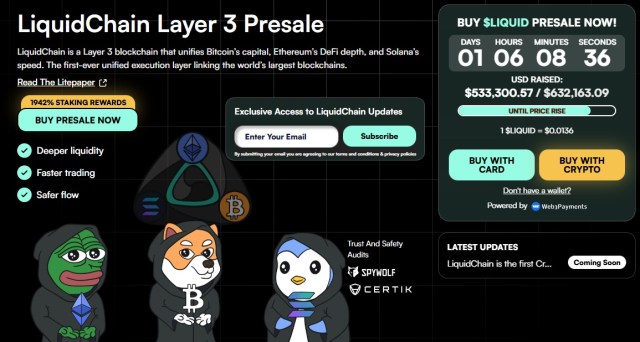
The capital inflow suggests investors are looking beyond commoditized Layer 2 scaling solutions toward Layer 3 protocols with specific interoperability use cases.

The utility of the $LIQUID token extends beyond simple governance. It functions as the transaction fuel for this cross-chain environment and facilitates liquidity staking. In a market where yield is often chased at the expense of safety, LiquidChain’s model offers a compelling alternative: rewards derived from the friction of unifying the world’s disparate blockchains.

With the presale gaining momentum, the window for early entry at these valuations is narrowing as the project approaches mainnet deployment.

Buy $LIQUID here.

Disclaimer: The content provided in this article is for informational purposes only and does not constitute financial advice. Cryptocurrency investments carry inherent risks, including high volatility and potential loss of principal. Always conduct your own research.

Editorial Process for bitcoinist is centered on delivering thoroughly researched, accurate, and unbiased content. We uphold strict sourcing standards, and each page undergoes diligent review by our team of top technology experts and seasoned editors. This process ensures the integrity, relevance, and value of our content for our readers.

patrubogdan

Follow

Full Profile

Related Posts

Crypto Exchange Backpack Targets Token Launch Soon, as BMIC Fires Up Quantum Defense

Vitalik Buterin Outlines Ethereum’s AI Future, While SUBBD Token Targets the Creator Economy

Binance Dominates Trump’s USD1 Supply as Bitcoin Hyper Breaks Records

Cathie Wood’s Ark Invest Buys More Bullish Assets Just Days After Last Purchase, While LiquidChain Turns Heads

Polymarket Sues Massachusetts Over Prediction Market Regulation – SUBBD Token Takes Advantage

Bitcoin Hyper Could Conquer 2026 if Bitcoin Regains Lost Ground

Трендові криптовалюти

Пов'язані питання

QWhat is the SEAL initiative and why is the Ethereum Foundation backing it?

AThe SEAL (Security Alliance) initiative is a coalition of white-hat hackers and researchers that serves as the industry's emergency response team against crypto drainers. The Ethereum Foundation is backing it to strengthen the coordinated defense against exploits, providing both financial support and institutional validation for centralized threat intelligence to create a 'herd immunity' effect.

QHow does LiquidChain's L3 protocol address security concerns in DeFi?

ALiquidChain's Layer 3 protocol unifies liquidity from Bitcoin, Ethereum, and Solana into a single execution layer, eliminating the need for risky cross-chain bridges. It reduces complexity by allowing 'single-step execution' and abstracting away interoperability friction, thereby removing common attack vectors used by drainers.

QWhat is the current presale status and token price of LiquidChain ($LIQUID)?

ALiquidChain's presale has raised over $533,000 to date, with the $LIQUID token currently priced at $0.0136.

QHow does SEAL's 'SEAL 911' initiative work?

ASEAL's 'SEAL 911' initiative allows victims and protocols to report active exploits in real-time, enabling white-hat hackers to intercept funds before they reach mixers or are laundered.

QWhat is the core investment thesis behind capital flowing into L3 infrastructure like LiquidChain?

AThe investment thesis centers on the 'abstraction narrative' - that next-generation users won't care about underlying blockchain complexity. Investors are betting on infrastructure that streamlines user experience by unifying liquidity across chains and eliminating bridging risks, treating security as a fundamental architectural feature rather than an add-on.

Пов'язані матеріали

Will the Fed Definitely Raise Interest Rates in September? How Will Crypto and U.S. Stocks Withstand the Pressure?

The market's expectation for a September Fed rate hike surged dramatically in early August, jumping from under 50% to over 80% within a week. This shift followed a contentious July FOMC meeting, where a 9-3 vote to hold rates revealed growing dissent from hawkish members advocating for an immediate hike to combat persistent inflation. The primary catalyst for this repricing is rising oil prices, driven by renewed geopolitical tensions around the Strait of Hormuz, which threaten global supply. Energy costs directly influence inflation metrics, making the upcoming July CPI report (due August 12th) a critical data point. If it shows inflation reaccelerating, the probability of a September hike will solidify. For Bitcoin and crypto assets, this is typically bearish news. Bitcoin continues to behave as a high-beta, liquidity-sensitive risk asset. A rate hike raises the opportunity cost of holding non-yielding assets and could drive capital toward money markets, pressuring crypto prices in the short term. However, historical patterns suggest that if a hike is perceived as the end of a tightening cycle rather than the start, any negative price impact may be brief. U.S. stocks, particularly crypto-linked equities like Coinbase and growth-oriented tech stocks, are also vulnerable. Higher rates increase discount rates in valuation models, putting pressure on high-multiple companies. This coincides with a pivotal tech earnings season where investor focus has shifted from massive AI capital expenditure to tangible revenue and cash flow generation. Companies with negative cash flow and weak growth narratives could face heightened volatility if borrowing costs rise in September. In summary, a September Fed hike has evolved into a mainstream market scenario. Key factors to watch are oil prices, the July CPI report, and Fed communications, which will determine the final decision and its impact on volatile crypto and equity markets.

marsbit7 хв тому

Will the Fed Definitely Raise Interest Rates in September? How Will Crypto and U.S. Stocks Withstand the Pressure?

marsbit7 хв тому

A 'Overlooked' Market Event: Joint US-Japan-South Korea Intervention, Rare US Treasury Involvement, and Bessent's Quiet 'Market Rescue'?

Summary: The United States, Japan, and South Korea executed their largest coordinated foreign exchange intervention in nearly 30 years. The action targeted depreciation pressure on the Japanese yen and South Korean won. This move is seen as a significant effort by the US to stabilize the financial markets of its key allies and prevent the spillover of risks. Key details: * Japan reportedly intervened on July 30 using approximately 8.45 trillion yen (about $52.8 billion). South Korean authorities also intervened that day, selling dollars to support the won. * Notably, the US Treasury Department intervened directly in yen markets for the first time in roughly 30 years. The New York Fed, reportedly acting on behalf of the Treasury, sold euros to buy yen via Goldman Sachs and Morgan Stanley on July 31. Analysts view the use of the euro-yen pair as a way to alleviate yen pressure without adding selling pressure to the US dollar. * Prior to the action, the New York Fed conducted "rate checks" on both USD/JPY and EUR/JPY, a newer signaling tool that falls between verbal and physical intervention. The intervention is interpreted as going beyond traditional currency stabilization. Analysts, such as Michael Hartnett of Bank of America, suggest it resembles a "Price Keeping Operation" for the AI era. The core US objectives are perceived to be: 1. Preventing rapid yen depreciation from triggering a sharp rise in Japanese government bond yields. 2. Containing financial stress from spreading across Asian markets like South Korea and Japan. 3. Reducing the risk of disorderly capital flows impacting the US bond market. This coordinated action underscores the importance of Japan and South Korea as critical partners in the US semiconductor and AI supply chain. Stabilizing their financial markets is seen as vital to mitigating risks to the broader tech industry and the US market itself. The intervention coincides with market pressures, including the KOSDAQ index hitting a low since October 2022. While seen as a move to control volatility, some analysts caution it may not fundamentally reverse existing market trends.

marsbit11 хв тому

A 'Overlooked' Market Event: Joint US-Japan-South Korea Intervention, Rare US Treasury Involvement, and Bessent's Quiet 'Market Rescue'?

marsbit11 хв тому

Will the Federal Reserve Definitely Raise Interest Rates in September? How Will Cryptocurrencies and US Stocks Bear the Pressure?

In early August 2024, market expectations for a September Federal Reserve rate hike surged dramatically, from below 50% to over 80%, driven by renewed inflation concerns. This shift followed a contentious July FOMC meeting where a 9-3 vote to hold rates revealed a growing hawkish faction advocating for an immediate hike, citing prolonged above-target inflation. The key catalyst is escalating conflict near the Strait of Hormuz, which has pushed oil prices up approximately 20% in July, threatening to reignite inflation. The next critical data point is the July CPI report on August 12th; a hot reading could solidify hike expectations. For crypto assets, particularly Bitcoin, this represents near-term pressure. Bitcoin continues to exhibit high-beta, risk-on characteristics, making it sensitive to tightening liquidity and higher opportunity costs. However, historical precedent suggests that if a hike is perceived as the cycle's end rather than its start, the negative impact may be brief, with markets quickly pivoting to anticipate future rate cuts. U.S. stocks, especially crypto-linked equities like Coinbase and high-valuation tech stocks, face amplified volatility. Higher rates increase discount rates in valuation models, pressuring growth stocks. This coincides with a pivotal tech earnings season where investor focus has shifted from massive AI capital expenditures to demonstrable revenue and cash flow generation. Companies with negative cash flows and weak growth narratives could see severe pressure if a September hike materializes, as financing costs would rise. Key indicators to watch include oil prices, upcoming inflation data, and Fed commentary at events like the Jackson Hole symposium.

Odaily星球日报11 хв тому

Will the Federal Reserve Definitely Raise Interest Rates in September? How Will Cryptocurrencies and US Stocks Bear the Pressure?

Odaily星球日报11 хв тому

Торгівля

Спот

Популярні статті

Як купити L3

Ласкаво просимо до HTX.com! Ми зробили покупку Layer3 (L3) простою та зручною. Дотримуйтесь нашої покрокової інструкції, щоб розпочати свою криптовалютну подорож.Крок 1: Створіть обліковий запис на HTXВикористовуйте свою електронну пошту або номер телефону, щоб зареєструвати обліковий запис на HTX безплатно. Пройдіть безпроблемну реєстрацію й отримайте доступ до всіх функцій.ЗареєструватисьКрок 2: Перейдіть до розділу Купити крипту і виберіть спосіб оплатиКредитна/дебетова картка: використовуйте вашу картку Visa або Mastercard, щоб миттєво купити Layer3 (L3).Баланс: використовуйте кошти з балансу вашого рахунку HTX для безперешкодної торгівлі.Треті особи: ми додали популярні способи оплати, такі як Google Pay та Apple Pay, щоб підвищити зручність.P2P: Торгуйте безпосередньо з іншими користувачами на HTX.Позабіржова торгівля (OTC): ми пропонуємо індивідуальні послуги та конкурентні обмінні курси для трейдерів.Крок 3: Зберігайте свої Layer3 (L3)Після придбання Layer3 (L3) збережіть його у своєму обліковому записі на HTX. Крім того, ви можете відправити його в інше місце за допомогою блокчейн-переказу або використовувати його для торгівлі іншими криптовалютами.Крок 4: Торгівля Layer3 (L3)Легко торгуйте Layer3 (L3) на спотовому ринку HTX. Просто увійдіть до свого облікового запису, виберіть торгову пару, укладайте угоди та спостерігайте за ними в режимі реального часу. Ми пропонуємо зручний досвід як для початківців, так і для досвідчених трейдерів.

227 переглядів усьогоОпубліковано 2024.12.06Оновлено 2026.06.02

Як купити L3

Обговорення

Ласкаво просимо до спільноти HTX. Тут ви можете бути в курсі останніх подій розвитку платформи та отримати доступ до професійної ринкової інформації. Нижче представлені думки користувачів щодо ціни L3 (L3).

活动图片