Ethereum Foundation Backs SEAL Initiative as LiquidChain L3 Protocol Gains Traction

bitcoinistОпубліковано о 2026-02-10Востаннє оновлено о 2026-02-10

Анотація

The Ethereum Foundation has officially backed the Security Alliance (SEAL), a coalition of white-hat hackers and researchers, to strengthen the crypto industry’s coordinated defense against drainer attacks. SEAL’s "SEAL 911" initiative enables real-time reporting of exploits, helping intercept stolen funds before they are laundered. This move signals a shift from reactive security measures to more structural solutions that reduce complexity and risk. LiquidChain ($LIQUID), a Layer 3 protocol, is gaining traction as a architectural solution to cross-chain vulnerabilities. By unifying liquidity across Bitcoin, Ethereum, and Solana into a single execution layer, it eliminates the need for risky bridging operations—a common attack vector. The project has raised over $533K in its presale, reflecting growing institutional interest in infrastructure that abstracts away cross-chain complexity and enhances security through design rather than intervention.

Trusted Editorial content, reviewed by leading industry experts and seasoned editors. Ad Disclosure

Quick Facts:

  • ➡️ The Ethereum Foundation has officially backed the Security Alliance (SEAL), strengthening the industry’s coordinated response against crypto drainers.
  • ➡️ Market focus is shifting from reactive security measures to architectural solutions that reduce complexity.
  • ➡️ LiquidChain is capitalizing on this trend by unifying Bitcoin, Ethereum, and Solana liquidity into a single, secure L3 execution layer.
  • ➡️ Institutional support for white-hat initiatives signals a maturing market where security is treated as a public good rather than a luxury.

The decentralized finance security landscape just shifted.

By formally backing the Security Alliance (SEAL), the Ethereum Foundation is acknowledging a hard truth: code audits alone aren’t enough to stop the rising tide of sophisticated crypto drainers.

SEAL, a coalition of white-hat hackers and researchers, has quietly become the industry’s emergency response team. Their ‘SEAL 911’ initiative lets victims and protocols report active exploits in real-time, often intercepting funds before they hit mixers.

The Foundation’s backing isn’t just financial; it’s an institutional nod to coordinated defense. Previously, protocols fought threats in silos. Now, the centralization of threat intelligence creates a “herd immunity” effect that makes drainer-as-a-service operations significantly harder to scale.

But let’s be honest: while SEAL treats the symptoms (exploits), the market is hunting for a cure to the root cause: complexity. Most losses happen during the intricate dance of bridging assets and signing obscure permissions.

Ironically, for an industry built on trustless code, our security still relies heavily on human intervention. Recognizing this, investors are rotating toward architectural solutions that remove the need for risky bridging entirely.

This thesis is driving capital into LiquidChain ($LIQUID), a Layer 3 infrastructure project designed to unify liquidity across Bitcoin, Ethereum, and Solana.

Learn more about LiquidChain here.

LiquidChain Unifies Liquidity To Remove Bridge Risk

Fragmentation is the enemy of security. Every time you wrap an asset or use a third-party bridge, you introduce a new point of failure, a vector that drainers exploit with ruthless efficiency. LiquidChain ($LIQUID) positions itself as the structural antidote, fusing the liquidity of the three largest ecosystems into a single execution environment.

By operating as a Layer 3 (L3) protocol, LiquidChain allows developers to deploy applications once that access Bitcoin, Ethereum, and Solana simultaneously.

For the end-user, this means ‘single-step execution.’ Instead of the perilous multi-step process of bridging $ETH to $SOL, swapping, and then staking, actions that often require signing multiple blind approvals, LiquidChain handles the cross-chain complexity at the protocol level.

This creates a verifiable settlement layer where the friction (and risk) of interoperability is abstracted away. The project’s unique proposition isn’t building a better bridge; it’s creating an environment where bridges are rendered invisible. Developers gain access to a Cross-Chain VM, allowing them to tap into Bitcoin’s capital base while using Solana’s speed.

No more navigating the dark forest of cross-chain transfers.

$LIQUID is available here.

Smart Money Rotates Into L3 Infrastructure As Presale Crosses $533K

While the broader market reacts to security headlines, astute capital is quietly positioning itself in infrastructure plays that streamline the user experience. The data tells the story: LiquidChain ($LIQUID) has raised over $533K to date.

Currently priced at $0.0136, the token represents a bet on the ‘abstraction narrative’, the idea that the next billion users won’t care (or know) which chain they’re using.
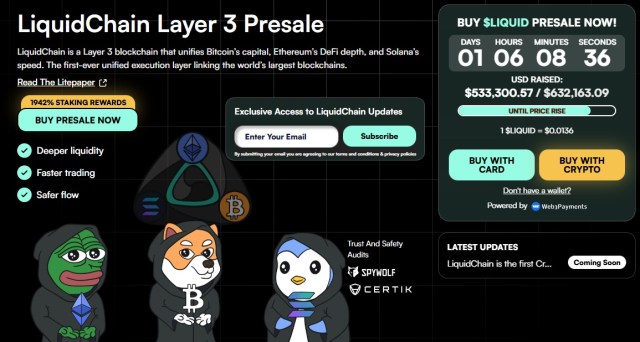
The capital inflow suggests investors are looking beyond commoditized Layer 2 scaling solutions toward Layer 3 protocols with specific interoperability use cases.

The utility of the $LIQUID token extends beyond simple governance. It functions as the transaction fuel for this cross-chain environment and facilitates liquidity staking. In a market where yield is often chased at the expense of safety, LiquidChain’s model offers a compelling alternative: rewards derived from the friction of unifying the world’s disparate blockchains.

With the presale gaining momentum, the window for early entry at these valuations is narrowing as the project approaches mainnet deployment.

Buy $LIQUID here.

Disclaimer: The content provided in this article is for informational purposes only and does not constitute financial advice. Cryptocurrency investments carry inherent risks, including high volatility and potential loss of principal. Always conduct your own research.

Editorial Process for bitcoinist is centered on delivering thoroughly researched, accurate, and unbiased content. We uphold strict sourcing standards, and each page undergoes diligent review by our team of top technology experts and seasoned editors. This process ensures the integrity, relevance, and value of our content for our readers.

patrubogdan

Follow

Full Profile

Related Posts

Crypto Exchange Backpack Targets Token Launch Soon, as BMIC Fires Up Quantum Defense

Vitalik Buterin Outlines Ethereum’s AI Future, While SUBBD Token Targets the Creator Economy

Binance Dominates Trump’s USD1 Supply as Bitcoin Hyper Breaks Records

Cathie Wood’s Ark Invest Buys More Bullish Assets Just Days After Last Purchase, While LiquidChain Turns Heads

Polymarket Sues Massachusetts Over Prediction Market Regulation – SUBBD Token Takes Advantage

Bitcoin Hyper Could Conquer 2026 if Bitcoin Regains Lost Ground

Пов'язані питання

QWhat is the SEAL initiative and why is the Ethereum Foundation backing it?

AThe SEAL (Security Alliance) initiative is a coalition of white-hat hackers and researchers that serves as the industry's emergency response team against crypto drainers. The Ethereum Foundation is backing it to strengthen the coordinated defense against exploits, providing both financial support and institutional validation for centralized threat intelligence to create a 'herd immunity' effect.

QHow does LiquidChain's L3 protocol address security concerns in DeFi?

ALiquidChain's Layer 3 protocol unifies liquidity from Bitcoin, Ethereum, and Solana into a single execution layer, eliminating the need for risky cross-chain bridges. It reduces complexity by allowing 'single-step execution' and abstracting away interoperability friction, thereby removing common attack vectors used by drainers.

QWhat is the current presale status and token price of LiquidChain ($LIQUID)?

ALiquidChain's presale has raised over $533,000 to date, with the $LIQUID token currently priced at $0.0136.

QHow does SEAL's 'SEAL 911' initiative work?

ASEAL's 'SEAL 911' initiative allows victims and protocols to report active exploits in real-time, enabling white-hat hackers to intercept funds before they reach mixers or are laundered.

QWhat is the core investment thesis behind capital flowing into L3 infrastructure like LiquidChain?

AThe investment thesis centers on the 'abstraction narrative' - that next-generation users won't care about underlying blockchain complexity. Investors are betting on infrastructure that streamlines user experience by unifying liquidity across chains and eliminating bridging risks, treating security as a fundamental architectural feature rather than an add-on.

Пов'язані матеріали

In-Depth Report on the On-Chain Lending Market: When Off-Chain Credit Meets On-Chain Liquidation

The on-chain lending market has evolved from a peripheral DeFi niche into core financial infrastructure. As of early 2026, total value locked (TVL) in on-chain lending protocols has reached $64.3 billion, accounting for 53.54% of total DeFi TVL, making it the largest and most mature vertical within decentralized finance. Aave dominates the sector with approximately $32.9 billion in TVL, commanding nearly half of the market—a leadership position that is unlikely to be challenged in the foreseeable future. However, the path of on-chain lending forward is not without risk. Liquidation cascades, credit defaults, and cross-chain vulnerabilities remain systemic threats hanging over the industry. At the same time, a deeper structural transformation is underway: on-chain lending is shifting from a “leverage tool for crypto-native users” to a “compliant gateway for institutional capital”. The scale of RWA (Real World Asset) lending has surpassed $18.5 billion, with U.S. Treasuries and government securities increasingly serving as core collateral. Institutional capital inflows are reshaping both the user base and risk appetite of the sector. This report systematically analyzes the evolution of on-chain lending definitions, competitive dynamics, core risks, and future trends, providing a comprehensive industry outlook for investors and trade practitioners. Key findings suggest that the “one dominant player with several strong challengers” structure will persist in the short term, while fixed-rate lending, compliant collateral, and institutional credit underwriting will define the next phase of competition. For investors focused on DeFi infrastructure, three key opportunity tracks stand out, namely, the Aave ecosystem (Morpho, Spark), RWA lending protocols (Ondo, Maple) and fixed-rate innovation (Notional, Pendle).

HTX Learn40 хв тому

In-Depth Report on the On-Chain Lending Market: When Off-Chain Credit Meets On-Chain Liquidation

HTX Learn40 хв тому

Fu Peng's First Public Speech in 2026: What Exactly Are Crypto Assets? Why Did I Join the Crypto Asset Industry?

Fu Peng, a renowned macroeconomist and now Chief Economist at New火 Group, delivered his first public speech of 2026 at the Hong Kong Web3 Festival. He explained his perspective on crypto assets and why he joined the industry, framing it within the context of macroeconomic trends and financial evolution. Fu emphasized that crypto assets are transitioning from an early, belief-driven phase to a mature, institutionally integrated asset class. He drew parallels to the 1970s-80s, when technological advances (like computing) revolutionized traditional finance, leading to the rise of FICC (Fixed Income, Currencies, and Commodities). Similarly, current advancements in AI, data, and blockchain are reshaping finance, with crypto assets becoming part of a new "FICC + C" (C for Crypto) framework. He noted that institutional capital, including traditional hedge funds, avoided early crypto due to its speculative nature but are now engaging as regulatory clarity emerges (e.g., stablecoin laws, CFTC classifying crypto as a commodity). Fu predicted that 2025-2026 marks a turning point where crypto becomes a standardized, financially viable asset for diversified portfolios, akin to commodities or derivatives in traditional finance. Fu defined Bitcoin not as "digital gold" in a simplistic sense but as a value-preserving, financially tradable asset. He highlighted that crypto's future lies in regulated, institutional adoption, moving away from retail-dominated trading. His entry into crypto signals this maturation, where traditional finance integrates crypto into mainstream asset management.

marsbit1 год тому

Fu Peng's First Public Speech in 2026: What Exactly Are Crypto Assets? Why Did I Join the Crypto Asset Industry?

marsbit1 год тому

Justin Sun Sues Trump Family: What $75 Million Bought Was Only a Blacklist

Justin Sun, founder of Tron, has filed a lawsuit in federal court against World Liberty Financial (WLF), alleging he was made the "primary target of a fraudulent scheme" after investing $75 million. Sun claims the investment secured him an advisor title and WLFI tokens, which were later frozen by WLF, causing "hundreds of millions in losses." The dispute began in late 2024 when Sun's investment helped revive WLF's struggling token sale, which ultimately raised $550 million. Shortly after, the SEC dropped its lawsuit against Sun following Donald Trump's inauguration. However, relations soured when Sun refused WLF's demands for additional funding. In August 2025, WLF added a "blacklist" function to its smart contract, allowing it to unilaterally freeze tokens. Sun's holdings, worth approximately $107 million, were frozen, and he was threatened with token destruction. The lawsuit highlights WLF's structure, which directs 75% of token sale profits to the Trump family, who had earned $1 billion by December 2025. WLF's CEO is Zach Witkoff, son of U.S. Middle East envoy Steve Witkoff. The project faces scrutiny for opaque operations, including a controversial loan arrangement on the Dolomite platform, co-founded by a WLF advisor. Despite Sun's history with the SEC, the case underscores centralization risks within DeFi, as WLF controls governance and holds powers to freeze assets arbitrarily. Sun's tokens remain frozen as legal proceedings begin.

marsbit1 год тому

Justin Sun Sues Trump Family: What $75 Million Bought Was Only a Blacklist

marsbit1 год тому

Торгівля

Спот
Ф'ючерси

Популярні статті

Як купити L3

Ласкаво просимо до HTX.com! Ми зробили покупку Layer3 (L3) простою та зручною. Дотримуйтесь нашої покрокової інструкції, щоб розпочати свою криптовалютну подорож.Крок 1: Створіть обліковий запис на HTXВикористовуйте свою електронну пошту або номер телефону, щоб зареєструвати обліковий запис на HTX безплатно. Пройдіть безпроблемну реєстрацію й отримайте доступ до всіх функцій.ЗареєструватисьКрок 2: Перейдіть до розділу Купити крипту і виберіть спосіб оплатиКредитна/дебетова картка: використовуйте вашу картку Visa або Mastercard, щоб миттєво купити Layer3 (L3).Баланс: використовуйте кошти з балансу вашого рахунку HTX для безперешкодної торгівлі.Треті особи: ми додали популярні способи оплати, такі як Google Pay та Apple Pay, щоб підвищити зручність.P2P: Торгуйте безпосередньо з іншими користувачами на HTX.Позабіржова торгівля (OTC): ми пропонуємо індивідуальні послуги та конкурентні обмінні курси для трейдерів.Крок 3: Зберігайте свої Layer3 (L3)Після придбання Layer3 (L3) збережіть його у своєму обліковому записі на HTX. Крім того, ви можете відправити його в інше місце за допомогою блокчейн-переказу або використовувати його для торгівлі іншими криптовалютами.Крок 4: Торгівля Layer3 (L3)Легко торгуйте Layer3 (L3) на спотовому ринку HTX. Просто увійдіть до свого облікового запису, виберіть торгову пару, укладайте угоди та спостерігайте за ними в режимі реального часу. Ми пропонуємо зручний досвід як для початківців, так і для досвідчених трейдерів.

175 переглядів усьогоОпубліковано 2024.12.06Оновлено 2025.03.21

Як купити L3

Обговорення

Ласкаво просимо до спільноти HTX. Тут ви можете бути в курсі останніх подій розвитку платформи та отримати доступ до професійної ринкової інформації. Нижче представлені думки користувачів щодо ціни L3 (L3).

活动图片