Ethereum Finally 'Bounces Back'! ETH Returns to the Golden Line, What's Different About This Rally?

marsbitОпубліковано о 2026-08-21Востаннє оновлено о 2026-08-21

Анотація

Ethereum has surged above $2,300, a level not seen in over three months, marking a significant recovery and technical breakthrough by reclaiming key resistance levels, including the weekly EMA50 for the first time in the current bear market. The rally has been fueled by a combination of factors: improved market risk appetite, positive regulatory sentiment, and a major short squeeze where over 88% of recent ETH liquidations were short positions. The ETH/BTC ratio has also broken its long-term downtrend, indicating renewed strength for Ethereum relative to Bitcoin. Fundamentally, Ethereum spot ETFs have shown strong inflows, outperforming their Bitcoin counterparts in recent months. Wall Street institutions like Morgan Stanley and JPMorgan have notably increased their ETH exposure, while several banks have added or expanded positions in ETH ETFs. On-chain fundamentals remain robust, with the proportion of staked ETH reaching a new all-time high of nearly 33.7%. Data indicates long-term holding sentiment, as small wallet holdings increased while large outflows were often directed towards staking or contracts, not selling. However, potential headwinds include declining staking yields and community debate over proposals to adjust staking rewards at high participation levels. The upcoming Glamsterdam upgrade, featuring improvements to validator exit efficiency, could enhance liquidity and further attract institutional stakers. While the rebound is supported by sentiment, capit...

Author: Nancy, PANews

After more than three months, the price of Ethereum has finally broken above the $2,300 mark.

Externally, the recovery in macro risk appetite, improved regulatory expectations, and a short squeeze have provided direct impetus for ETH's rise. Internally, the continuous influx of funds into spot ETFs, accelerated institutional allocations, and the ever-increasing scale of ETH staking are also persistently improving the market's medium- to long-term expectations for Ethereum.

Ethereum Strongly 'Bounces Back', First Time Standing Above the Golden Line Since This Bear Market Began

E-army, the long wait for Ethereum's strong 'bounce back' is finally over.

CoinGecko data shows that as of August 21, the ETH price has risen to around $2,354, returning to levels seen in early May of this year.
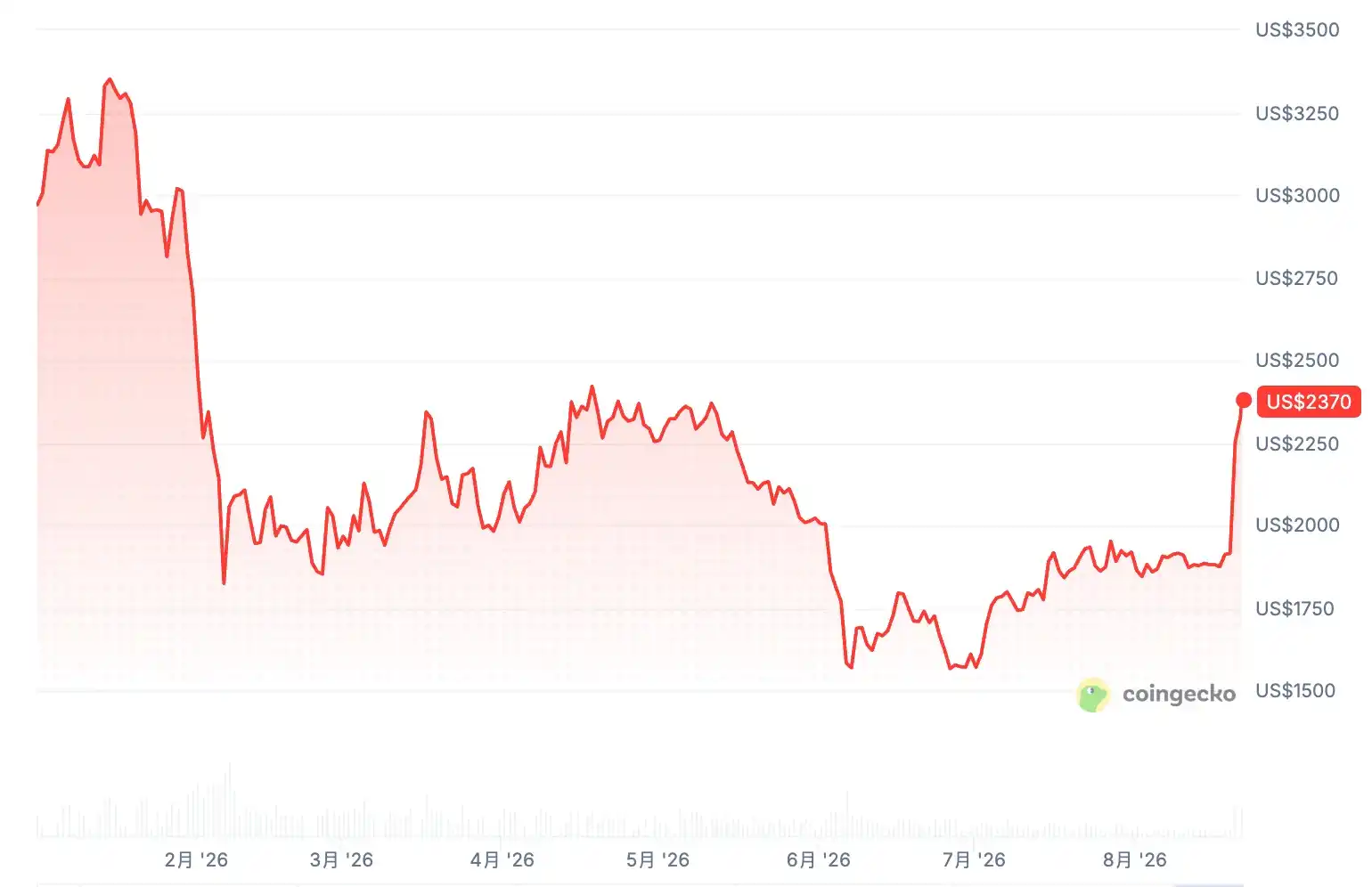
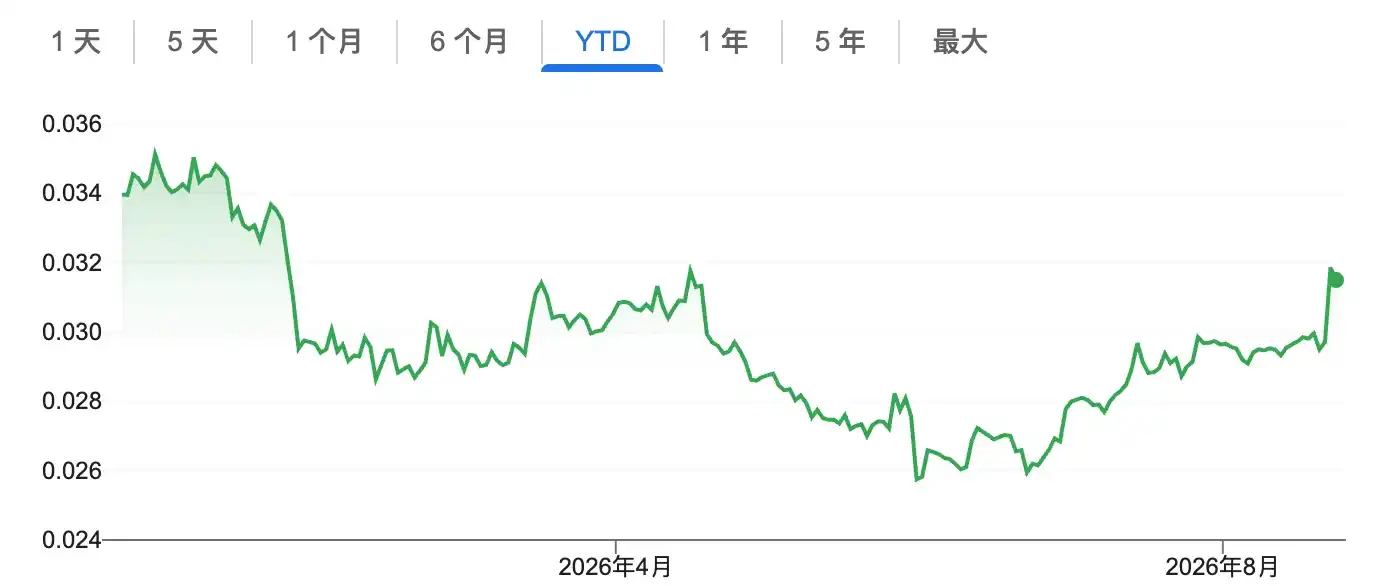
In just one week, ETH rose about 25%, ranking among the top ten gainers in the top 100 crypto assets by market cap, significantly outperforming Bitcoin over the same period. The ETH/BTC exchange rate is also continuing to break its long-term downtrend, currently rebounding to around 0.031, returning to April levels.
With Ethereum's price surging, its market capitalization has also re-entered the forefront of global mainstream assets. Data from 8 Market shows that Ethereum's total market cap has now risen to approximately $284.3 billion, surpassing Dell and ranking 72nd among global assets by market cap. Several months ago, dragged down by continuous price declines, Ethereum's market cap once fell out of the top 100 global assets.

In this rapid rebound, short sellers have been forced to become the biggest 'payers'. CoinGlass data shows that since August 19, the cumulative liquidation amount for Ethereum contracts has exceeded $1.33 billion, with short liquidations accounting for a staggering 88.4%. Of course, the large-scale short covering has further amplified ETH's upward momentum, leading to a significant short squeeze.

Noted trader Doctor Profit pointed out that Ethereum has now thoroughly broken through key resistance zones of the bear market phase and has, for the first time since the start of this bear market, re-crossed above what he calls the 'Golden Line (Weekly EMA50)'. In his view, this breakthrough is an important technical signal for ETH, and he bluntly advised to 'buckle up', while warning that short sellers might face further pressure.

BitMine Chairman Tom Lee noted that the rise in the ETH/BTC exchange rate indicates the market is starting to focus on the actual implementation of tokenization and AI agent applications, which will benefit Ethereum. Historically, the ETH/BTC exchange rate tends to rise during crypto bull markets as Ethereum's usage relative to Bitcoin increases, with previous drivers being the ICO boom of 2017-2018, the NFT wave of 2020-2021, and the stablecoin wave of 2025. The driving force for this cycle will be Wall Street's on-chain tokenization business and the large-scale use of blockchains by AI agents. Easing financial conditions will also provide a tailwind for the crypto market.

As a major Ethereum bull, BitMine has also ushered in a long-awaited 'bounce-back moment'. As of August 16, Ethereum's largest institutional holder, BitMine, holds 5.815164 million ETH with an average cost basis of $3,366. With Ethereum's recovery, BitMine's floating losses have narrowed from over $8.5 billion to $5.8 billion.

Ethereum ETF Inflows Outperform Bitcoin's, Multiple Institutions Buck the Trend to Increase Holdings

On the capital front, Ethereum spot ETFs continue to send positive signals.
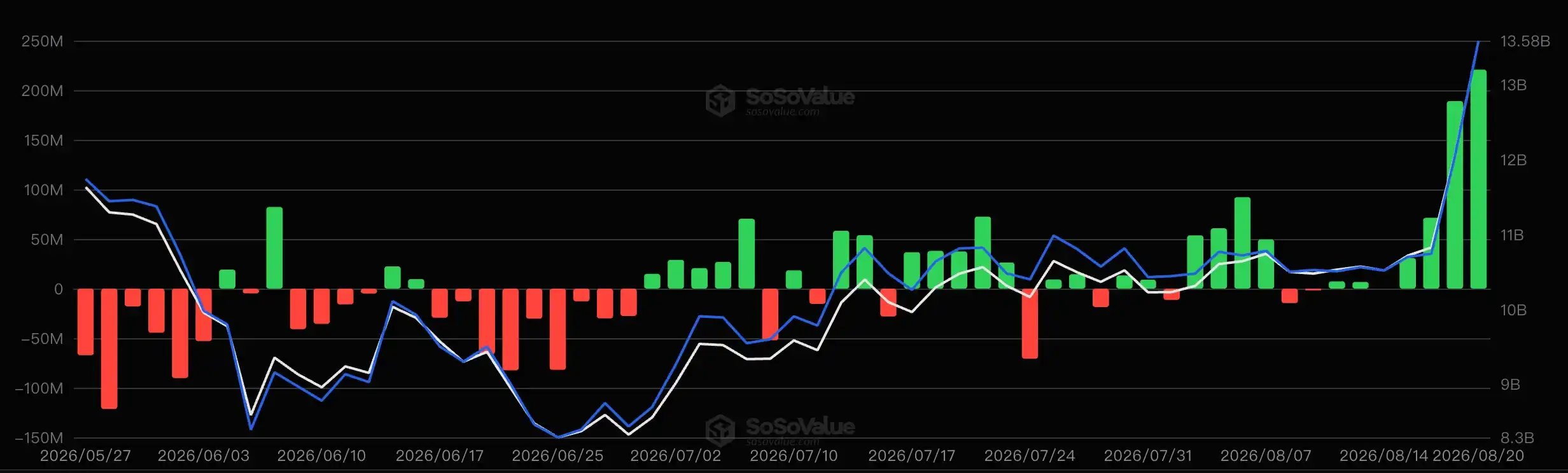
Sosovalue data shows that Ethereum spot ETFs have seen net inflows for four consecutive trading days, with cumulative net inflows exceeding $510 million this week. Among them, the net inflow on August 20 alone exceeded $220 million, the highest level since October last year. BlackRock's ETHA remains the primary source of funds, with the latest single-day net inflow reaching $173 million.

In recent times, the capital performance of Ethereum spot ETFs has also begun to significantly outperform that of Bitcoin spot ETFs. A recent report from DWF Labs shows that in June, ETH ETF net outflows accounted for 4.65% of fund size, significantly lower than BTC ETF's 8.09%. By July, ETH ETFs turned to net inflows, accounting for 3.19% of fund size, while BTC ETFs were only 0.34%, with the former being about 9.4 times the latter.

Institutional allocations are also changing. DWF Labs points out that Wall Street banks significantly increased their exposure to ETH in Q2, with growth rates noticeably higher than for BTC. For example, Morgan Stanley's BTC exposure grew 3.7% quarter-over-quarter, while its ETH exposure grew 18.6%; JPMorgan's BTC exposure grew 12.2%, while its ETH exposure grew 67.3%.

In addition, several other institutions have also increased their holdings of Ethereum ETFs against the trend. According to 13F filings, Bank of America's holdings of ETHA increased from about 67,500 shares to about 1.98 million shares, an expansion of about 29 times, with a reported value of about $23.6 million at the end of Q2; Italy's largest bank significantly reduced its holdings of BlackRock's Bitcoin ETF IBIT while nearly doubling its holdings of BlackRock's Staked Ethereum Trust; Spain's Santander Bank also disclosed holdings of BlackRock's Bitcoin and Ethereum ETFs for the first time in Q2.

Compared to the short-term price rebound, this shift in capital structure is perhaps more noteworthy.

Recently, several ETF issuers have also continued to enhance the appeal of their products. For instance, BlackRock's Ethereum ETF ETHA plans to implement a 1-for-3 reverse stock split on October 6, while Fidelity has applied to add a staking function to its Ethereum ETF FETH.

Over One-Third of ETH Staked, Declining Yields May Weaken Attractiveness

Unlike the recent persistent downtrend in Ethereum's price, its staking scale has maintained a growth trajectory.
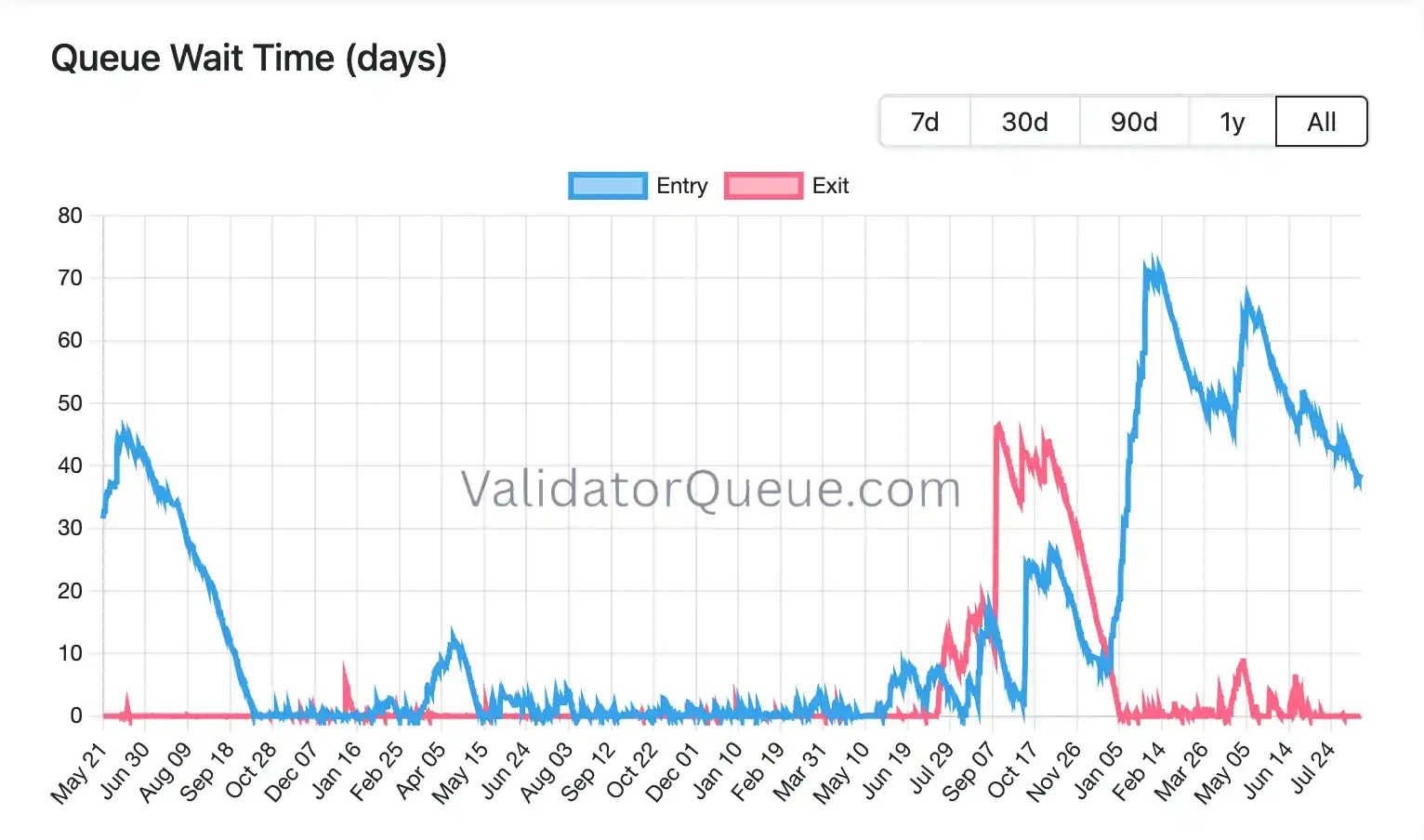
ValidatorQueue data shows that Ethereum's current staking ratio has climbed to a new all-time high, with over 41.1 million ETH in staking, accounting for nearly 33.7% of the total supply. Meanwhile, the validator exit queue is nearly zero, while the entry queue for staking still has about 2.21 million ETH waiting, with an estimated wait time exceeding 38 days.

On-chain data also confirms the market's long-term holding intent. Santiment data shows that from May 20 to August 20, large wallets holding over 1,000 ETH collectively reduced their holdings by about 1.7 million ETH, accounting for 2.9% of holdings in this tier. During the same period, the share of holdings in small wallets holding 1 to 10 ETH increased from 4.38% to 4.52%, with increases on 65 trading days and decreases on only 27.

However, the decline in large holder balances does not entirely mean ETH was sold. Santiment notes that of this outflowing ETH, only about 300,000 can be traced to smaller wallets, with most of the remainder likely entering staking or contract addresses. Concurrently, exchange ETH balances also fell from about 7.07 million to 6.54 million during this period.

The continuous rise in staking scale has also raised market concerns. Recently, Ethereum researchers Justin Drake and Jerome de Tychey proposed a new EIP-8363, suggesting that when Ethereum's staking rate reaches 50% of the total supply, a progressive burn mechanism would gradually reduce and eventually zero out the new issuance rewards for consensus layer validators. However, this proposal has faced opposition from the community.
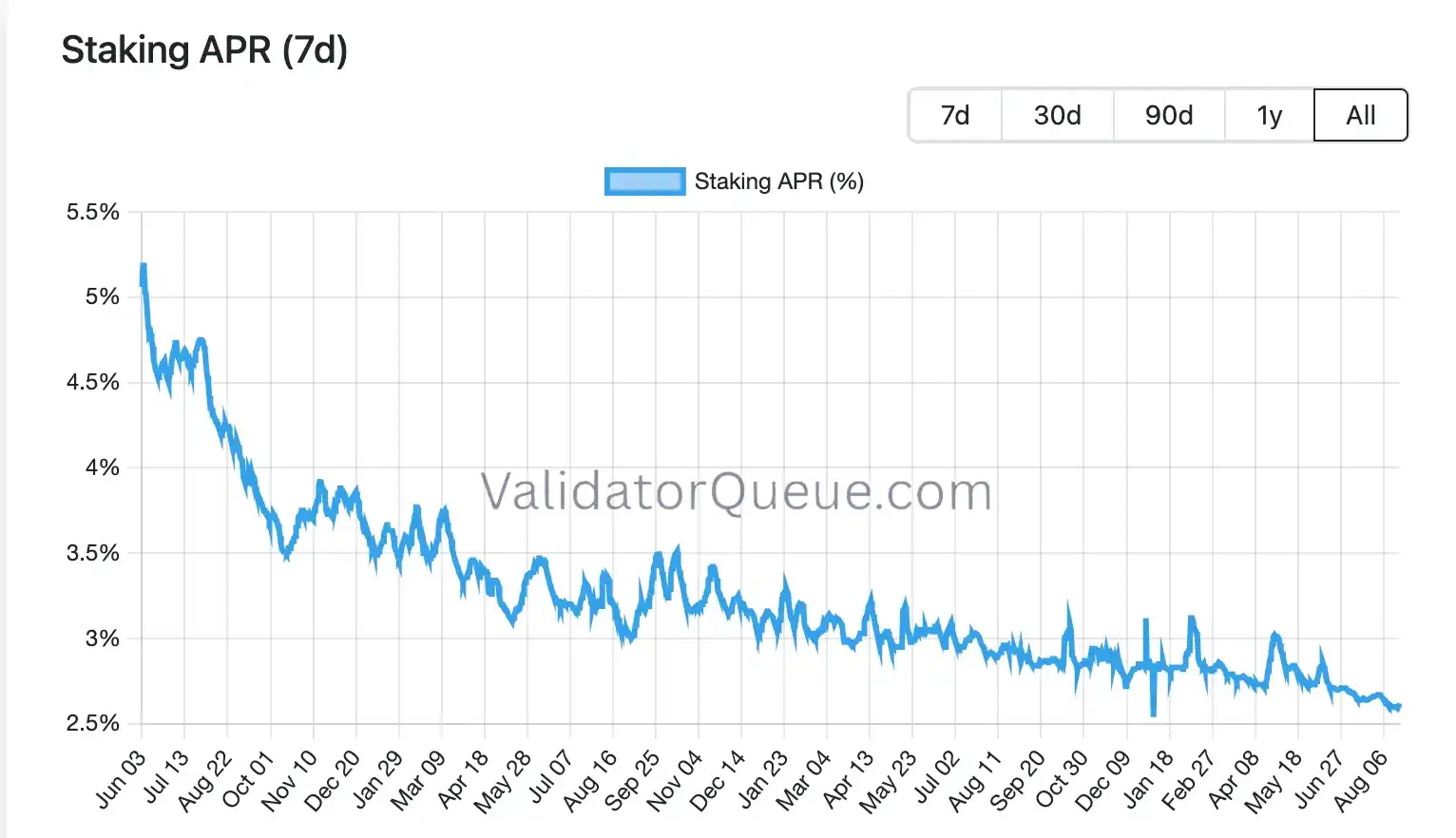
Meanwhile, as the amount of ETH and the number of validators participating in staking continue to increase, staking yields have also begun to decline. Data shows that over the past three months, ETH staking yields have fallen from a high of 2.86% to 2.59%, significantly lower than the peak of around 5.2% three years ago. If staking yields fall further, their attractiveness to new capital could be somewhat impacted.

Notably, Ethereum's next major upgrade, Glamsterdam, is scheduled for Q4 2026, and EIP-8061 is being considered for inclusion. This proposal aims to eliminate the validator exit queue limit and increase exit processing speed to about 4 times the current rate, thereby improving the efficiency and flexibility of ETH unstaking. If relevant proposals are finalized, stakers could manage capital liquidity more flexibly while earning yields. For institutional investors, higher unstaking efficiency means lower liquidity risk, potentially further boosting willingness to participate in staking.

Overall, this Ethereum rally has gained support from sentiment, capital, and fundamentals. However, whether it can truly mark a return to form will require time and more fundamental developments to provide the answer.


Трендові криптовалюти

Пов'язані питання

QAccording to the article, what are the key internal and external factors driving Ethereum's recent price surge?

AExternally, the surge is driven by improved macro risk appetite, better regulatory expectations, and short squeezes. Internally, it's supported by continuous capital inflows into spot ETFs, accelerated institutional allocation, and the increasing scale of ETH staking.

QWhat significant technical milestone did Ethereum achieve recently, as mentioned by trader Doctor Profit?

AEthereum has broken through a key resistance area from the bear market phase and, for the first time since the start of this bear market, has climbed back above the 'Golden Line' (weekly EMA50), which is considered an important technical signal.

QHow has the performance of Ethereum spot ETFs compared to Bitcoin spot ETFs in recent months, according to DWF Labs' report?

AIn June, ETH ETF net outflows accounted for 4.65% of fund size, significantly lower than BTC ETF's 8.09%. By July, ETH ETFs turned to net inflows at 3.19% of fund size, while BTC ETFs were only at 0.34%, making ETH ETF inflows approximately 9.4 times that of BTC ETFs.

QWhat is the current proportion of Ethereum's total supply that is staked, and what potential issue is highlighted regarding staking rewards?

AOver 41.1 million ETH is currently staked, representing nearly 33.7% of the total supply. A highlighted issue is that the staking yield has declined from a high of 2.86% to 2.59% over the past three months, which could potentially reduce its attractiveness to new capital if yields fall further.

QWhat major future upgrade is mentioned for Ethereum, and which specific proposal is noted for potentially improving the staking experience?

AThe next major Ethereum upgrade, 'Glamsterdam,' is planned for Q4 2026. The proposal EIP-8061 is being considered for inclusion, which aims to remove the validator exit queue limit and increase exit processing speed by about 4 times, thereby improving exit efficiency and flexibility for stakers.

Пов'язані матеріали

Is RWA Still Meaningful Without DeFi?

The article "Would RWA Still Matter Without DeFi?" argues that tokenizing real-world assets (RWA) alone, like putting a barcode on a container, is not transformative. True value emerges when these tokenized assets are integrated into decentralized finance (DeFi) ecosystems, enabling valuation, financing, hedging, trading, and loss management in a programmable, automated manner. Tokenization provides digital representation, but DeFi provides utility through leverage, liquidity, and composability. The core challenge lies in aligning the different "time clocks" of blockchain (fast, 24/7), traditional markets (limited hours), and asset redemption (slow processes), which creates liquidation risks and gaps. Effective RWA integration requires more than a token; it needs a full stack: legally enforceable rights, reliable data oracles, clear transfer rules, executable secondary liquidity, appropriate collateral parameters, and credible loss resolution paths. Liquidity is defined not by total value locked (TVL) but by the ability to exit a position under stress within a required timeframe. Risk management for RWAs must be modeled as a dependency graph, monitoring interconnected nodes like issuers, custodians, oracles, and liquidity pools for early warning signs beyond just price data. While tokenized government bonds serve as an initial "ping test," the future lies in more complex assets like computing power and energy, which require bespoke risk models. Tokenized stocks paired with perpetual futures present a major test, combining global equity ownership with crypto-native leverage, necessitating robust architectural safeguards like isolation and dynamic collateral rules. The conclusion is that without DeFi, RWA tokenization offers limited value—improving distribution and transparency. The significant opportunity arises when tokenized assets become functional components within open, programmable capital markets, where they can be used as collateral and facilitate complex financial strategies. The token is merely the barcode; the market operating system is the real machine.

marsbit23 хв тому

Is RWA Still Meaningful Without DeFi?

marsbit23 хв тому

Government Intervention in the Bond Market: What Does It Mean?

On August 19, 2026, the U.S. Treasury unexpectedly announced it would at least double the size of its long-term Treasury buyback operations, starting September 9. The move triggered an immediate market reaction, with the 30-year yield falling 9 basis points. This intervention came against a backdrop of the 30-year yield hitting a 19-year high of 5.34% the previous day, driven by persistent inflation, high oil prices, deteriorating U.S. fiscal health with public debt surpassing $40 trillion, and a global "buyers' strike" for long-dated bonds. Treasury buybacks involve the government repurchasing older, less liquid bonds from the market via reverse auctions to improve market functioning, not to reduce overall debt. While the action provided tactical relief and signaled the Treasury's willingness to intervene, analysts caution it does not address core structural issues: massive fiscal deficits, high borrowing needs, and fading demand from traditional buyers like foreign central banks. For investors, the announcement offered short-term support for long-duration bond ETFs and boosted assets like gold, which rose 2.7%. However, it's unlikely to significantly lower mortgage rates or alter the challenging environment for long-term bonds. The key takeaway is the distinction between a tactical market operation and the unresolved structural pressures that continue to push yields higher, requiring close monitoring of upcoming economic data, Treasury auctions, and potential signals of more aggressive policy measures.

marsbit27 хв тому

Government Intervention in the Bond Market: What Does It Mean?

marsbit27 хв тому

After 'Bessent Put', How Far Is the U.S. from Restarting QE?

Following an unscheduled announcement from the U.S. Treasury Department on August 19th, investor discussions have intensified regarding the potential for future policy interventions in long-term bond markets. The Treasury increased the maximum size of its regular buyback operations for 10-to-30 year bonds from $2 billion to $4 billion, citing a desire to improve liquidity. This move came shortly after a surge in long-term yields, with the 30-year Treasury yield briefly touching 5.34%. Market analysts, rather than focusing on the modest operational size, have interpreted the timing—outside the normal quarterly communication window—as a significant signal. The move has been dubbed the "Bessent Put," implying the market's growing expectation that Treasury officials, led by Deputy Secretary Josh Bessent, may act to prevent a disorderly rise in long-term borrowing costs. This perception represents a potential shift in the market's view of the government's "policy reaction function." The underlying pressures on long-term bonds are multifaceted, including large fiscal deficits, increased Treasury supply, a rise in corporate debt issuance for AI infrastructure (creating a "crowding out" effect), and uncertainty around foreign holdings, particularly from Japan. Geopolitical risks in the Middle East further complicate the policy landscape, potentially creating conflicting pressures between fighting inflation and managing financing costs. However, the article clarifies that this Treasury buyback program is distinct from Quantitative Easing (QE). It is a debt management operation, not a Federal Reserve balance sheet expansion. While the announcement opens the door for market speculation about more forceful tools like Yield Curve Control (YCC) or a return to QE, analysts note that conditions would need to deteriorate significantly for such measures to be implemented. For now, the "Bessent Put" reflects a change in market expectations about possible policy boundaries, not an imminent launch of new monetary stimulus.

marsbit27 хв тому

After 'Bessent Put', How Far Is the U.S. from Restarting QE?

marsbit27 хв тому

Is Stablecoin Really Necessary for Cross-border Payments?

"Is Stablecoin Truly Necessary for Cross-Border Payments? While stablecoins are often praised as superior for cross-border transfers—especially if the recipient desires crypto—their advantage is less clear in traditional cross-currency scenarios (e.g., USD to Mexican Peso). The existing correspondent banking system is slow and costly (≈15% fees) due to multiple intermediaries. Modern fintech solutions like Wise have dramatically improved this by using a netting model: they hold local currency pools and settle payments domestically, avoiding actual cross-border fund movement. This offers near-instant transfers with low, transparent fees (averaging ~0.52%). The 'stablecoin sandwich' model (convert fiat to stablecoin, transfer on-chain, convert to local fiat) offers similar user experience but doesn't inherently provide major cost or speed advantages over fintech. Its on-chain transfer is cheap, but fiat conversion spreads remain. Stablecoin's real innovation is 'unbundling' the cross-border payment stack. Instead of requiring a proprietary global network like Wise, businesses only need reliable on- and off-ramps in specific corridors. This lowers market entry barriers, fosters competition among local providers, and can drive down costs, particularly for niche or underserved corridors (e.g., US to Africa). While vertical integration may reoccur, the open, permissionless nature of the underlying blockchain layer makes monopolistic pricing difficult. The long-term benefit is the potential redistribution of value—previously captured as intermediary rents—to consumers through lower costs."

marsbit31 хв тому

Is Stablecoin Really Necessary for Cross-border Payments?

marsbit31 хв тому

Торгівля

Спот

Популярні статті

Що таке ETH 2.0

ETH 2.0: Нова ера для Ethereum Вступ ETH 2.0, широко відомий як Ethereum 2.0, є величезним оновленням для блокчейну Ethereum. Ця трансформація не є лише косметичною зміною; вона має на меті фундаментально покращити масштабованість, безпеку та сталий розвиток мережі. З переходом від енергомісткого механізму консенсусу Proof of Work (PoW) до більш ефективного Proof of Stake (PoS), ETH 2.0 обіцяє трансформаційний підхід до екосистеми блокчейнів. Що таке ETH 2.0? ETH 2.0 — це збірка особливих, взаємопов’язаних оновлень, спрямованих на оптимізацію можливостей та продуктивності Ethereum. Це перетворення розроблене для вирішення критичних викликів, з якими стикалося існуюче механізм Ethereum, зокрема щодо швидкості транзакцій та заторів у мережі. Мета ETH 2.0 Основні цілі ETH 2.0 зосереджені на покращенні трьох ключових аспектів: Масштабованість: Мета — значно підвищити кількість транзакцій, які мережа може обробити за секунду; ETH 2.0 прагне вийти за межі поточного обмеження приблизно в 15 транзакцій на секунду, потенційно досягнувши тисяч. Безпека: Підвищені заходи безпеки є невід’ємною частиною ETH 2.0, зокрема через покращену стійкість до кібератак і збереження децентралізованої етики Ethereum. Сталий розвиток: Новий механізм PoS розроблений не тільки для підвищення ефективності, але й для різкого зменшення споживання енергії, що узгоджує операційну структуру Ethereum з екологічними міркуваннями. Хто є творцем ETH 2.0? Створення ETH 2.0 можна віднести до Ethereum Foundation. Ця неприбуткова організація, яка відіграє важливу роль у підтримці розвитку Ethereum, очолюється відомим співавтором Віталіком Бутеріним. Його бачення більш масштабованого та стійкого Ethereum стало рушійною силою цього оновлення, залучаючи внески зі всього світу від розробників і ентузіастів, які прагнуть покращити протокол. Хто є інвесторами ETH 2.0? Хоча подробиці про інвесторів ETH 2.0 не були оприлюднені, відомо, що Ethereum Foundation отримує підтримку від різних організацій та осіб у сфері блокчейну та технологій. Ці партнери включають венчурні капітальні компанії, технологічні компанії та філантропічні організації, які мають спільний інтерес у підтримці розвитку децентралізованих технологій та інфраструктури блокчейну. Як працює ETH 2.0? ETH 2.0 відзначається введенням низки ключових функцій, які відрізняють його від попередника. Proof of Stake (PoS) Перехід до механізму консенсусу PoS є одним із знакових змін ETH 2.0. На відміну від PoW, який покладається на енергомісткий видобуток для перевірки транзакцій, PoS дозволяє користувачам підтверджувати транзакції та створювати нові блоки відповідно до кількості ETH, яку вони ставлять у мережі. Це призводить до підвищення енергоефективності, зменшуючи споживання приблизно на 99,95%, завдяки чому Ethereum 2.0 стає значно більш екологічною альтернативою. Шардові ланцюги Шардові ланцюги є ще одним ключовим нововведенням ETH 2.0. Ці менші ланцюги працюють паралельно з основним ланцюгом Ethereum, що дозволяє обробляти кілька транзакцій одночасно. Це підходи покращує загальну ємність мережі, усуваючи проблеми масштабованості, які переслідували Ethereum. Beacon Chain У центрі ETH 2.0 знаходиться Beacon Chain, яка координує мережу і управляє протоколом PoS. Вона виконує роль організатора: контролює валідаторів, забезпечує з’єднання шард з мережею і моніторить загальний стан екосистеми блокчейнів. Хронологія ETH 2.0 Шлях ETH 2.0 характеризується кількома ключовими етапами, які відображають еволюцію цього значного оновлення: Грудень 2020: Запуск Beacon Chain ознаменував введення PoS, проклавши шлях до міграції на ETH 2.0. Вересень 2022: Завершення "Злиття" є знаковим моментом, коли мережа Ethereum успішно перейшла з PoW на PoS, відкриваючи нову еру для Ethereum. 2023: Очікуване розгортання шардових ланцюгів має на меті подальше покращення масштабованості мережі Ethereum, закріплюючи ETH 2.0 як надійну платформу для децентралізованих додатків і послуг. Ключові особливості та переваги Покращена масштабованість Однією з найзначніших переваг ETH 2.0 є його покращена масштабованість. Поєднання PoS та шардових ланцюгів дозволяє мережі розширити свою ємність, що дозволяє їй обробляти набагато більший обсяг транзакцій в порівнянні з класичною системою. Енергоефективність Запровадження PoS є величезним кроком до енергоефективності в технології блокчейн. Значно зменшуючи споживання енергії, ETH 2.0 не тільки знижує операційні витрати, але також ближче узгоджується з глобальними цілями сталого розвитку. Підвищена безпека Оновлені механізми ETH 2.0 сприяють підвищенню безпеки по всій мережі. Впровадження PoS, поряд з інноваційними контрольними заходами, встановленими через шардові ланцюги та Beacon Chain, забезпечує вищий рівень захисту від потенційних загроз. Зниження витрат для користувачів З покращенням масштабованості вплив на витрати на транзакції також стане очевидним. Збільшена ємність і зменшені затори, як очікується, призведуть до зниження зборів для користувачів, що зробить Ethereum більш доступним для повсякденних транзакцій. Висновок ETH 2.0 є значною еволюцією в екосистемі блокчейну Ethereum. Оскільки він вирішує важливі питання, такі як масштабованість, споживання енергії, ефективність транзакцій і загальна безпека, важливість цього оновлення не можна недооцінювати. Перехід до Proof of Stake, введення шардових ланцюгів і фундаментальна робота Beacon Chain свідчать про майбутнє, в якому Ethereum може задовольнити зростаючі вимоги децентралізованого ринку. В індустрії, що рухається вперед завдяки інноваціям та прогресу, ETH 2.0 є підтвердженням можливостей технології блокчейн у прокладенні шляху до більш сталого та ефективного цифрового економіки.

327 переглядів усьогоОпубліковано 2024.04.04Оновлено 2024.12.03

Що таке ETH 2.0

Що таке ETH 3.0

ETH3.0 та $eth 3.0: Глибоке дослідження майбутнього Ethereum Вступ У швидко змінюваному світі криптовалют та технології блокчейн, ETH3.0, часто позначуваний як $eth 3.0, став темою значного інтересу та спекуляцій. Цей термін охоплює два основні концепти, які потребують уточнення: Ethereum 3.0: Це потенційне майбутнє оновлення, яке має на меті покращення можливостей існуючого блокчейну Ethereum, зокрема, фокусуючись на поліпшенні масштабованості та продуктивності. ETH3.0 Мем Токен: Цей окремий криптовалютний проект прагне використовувати блокчейн Ethereum для створення екосистеми, орієнтованої на меми, сприяючи залученню до криптовалютної громади. Розуміння цих аспектів ETH3.0 є важливим не лише для криптоентузіастів, але й для тих, хто спостерігає за широкими технологічними тенденціями у цифровому просторі. Що таке ETH3.0? Ethereum 3.0 Ethereum 3.0 пропонується як оновлення вже існуючої мережі Ethereum, яка стала основою багатьох децентралізованих додатків (dApps) та смарт-контрактів з моменту свого виникнення. Передбачувані удосконалення зосереджені в основному на масштабованості — інтегруючи передові технології, такі як шардінг та нульові знання (zk-докази). Ці технологічні нововведення націлені на забезпечення безпрецедентної кількості транзакцій на секунду (TPS), потенційно досягаючи мільйонів, тим самим вирішуючи одну з найзначніших обмежень, з якими стикається сучасна технологія блокчейн. Покращення є не лише технічним, а й стратегічним; воно спрямоване на підготовку мережі Ethereum до широкого прийняття та корисності в майбутньому, позначеному збільшеним попитом на децентралізовані рішення. ETH3.0 Мем Токен На відміну від Ethereum 3.0, ETH3.0 Мем Токен пропонує легшу та грайливішу домену, поєднуючи культуру інтернет-мемів із динамікою криптовалют. Цей проект дозволяє користувачам купувати, продавати та обмінювати меми на блокчейні Ethereum, надаючи платформу, яка сприяє залученню громади через креативність та спільні інтереси. ETH3.0 Мем Токен має на меті продемонструвати, як технологія блокчейн може перетинатися з цифровою культурою, створюючи випадки використання, які є водночас розважальними та фінансово життєздатними. Хто є творцем ETH3.0? Ethereum 3.0 Ініціатива щодо Ethereum 3.0 переважно підтримується консорціумом розробників та дослідників у межах громади Ethereum, зокрема, до складу якого входить Джастін Дрейк. Відомий своїми думками та внеском у розвиток Ethereum, Дрейк є помітною особистістю в обговореннях щодо переходу Ethereum на новий рівень консенсусу, який називається «Beam Chain». Цей колабораційний підхід до розробки свідчить про те, що Ethereum 3.0 не є продуктом єдиного творця, а скоріше втіленням колективної винахідливості, спрямованої на просування технології блокчейн. ETH3.0 Мем Токен Деталі про творця ETH3.0 Мем Токена наразі не відстежуються. Природа мем-токенів часто призводить до більш децентралізованої та громартової структури, що може пояснити відсутність специфічної атрибуції. Це узгоджується з етикою ширшої крипто-спільноти, де інновації часто виникають з колективних, а не індивідуальних зусиль. Хто є інвесторами ETH3.0? Ethereum 3.0 Підтримка Ethereum 3.0 переважно надходить від Фонду Ethereum поряд з ентузіастичною спільнотою розробників та інвесторів. Це базове співробітництво надає значний градус легітимності та підвищує ймовірність успішної реалізації, оскільки воно використовує довіру та авторитет, накопичені за роки роботи мережі. У швидко змінюваному кліматі криптовалют підтримка громади займає важливу роль у розвитку та прийнятті, позиціонуючи Ethereum 3.0 як серйозного конкурента для майбутніх блокчейн-інновацій. ETH3.0 Мем Токен Хоча наразі доступні джерела не надають явної інформації щодо інвестиційних фондів або організацій, що підтримують ETH3.0 Мем Токен, це свідчить про типову модель фінансування для мем-токенів, яка часто спирається на підтримку знизу та залучення громади. Інвестори в такі проекти зазвичай складаються з осіб, які мотивовані потенціалом інновацій, що керуються спільнотою, та духом співпраці, притаманним крипто-спільноті. Як працює ETH3.0? Ethereum 3.0 Відмінні риси Ethereum 3.0 полягають у його запропонованій реалізації технології шардінгу та zk-proof. Шардінг — це метод розподілу блокчейну на менші, керовані частини чи «шарди», які можуть обробляти транзакції одночасно, а не послідовно. Це децентралізоване оброблення допомагає запобігти заторам та забезпечити оперативність мережі навіть під великим навантаженням. Технологія нульових доказів (zk-proof) надає ще один рівень складності, дозволяючи валідацію транзакцій без розкриття підпорядкованих даних. Цей аспект не лише підвищує конфіденційність, а й збільшує загальну ефективність мережі. Також обговорюється включення нульової Ефірної віртуальної машини (zkEVM) в це оновлення, що ще більше підвищить можливості та корисність мережі. ETH3.0 Мем Токен ETH3.0 Мем Токен виділяється завдяки використанню популярності культури мемів. Він створює ринок, на якому користувачі можуть брати участь у торгівлі мемами не лише для розваги, але й для потенційного економічного вигоди. Інтегруючи функції, такі як стейкінг, забезпечення ліквідності та механізми управління, проект сприяє створенню середовища, яке заохочує взаємодію та участь громади. Пропонуючи унікальне поєднання розваг та економічних можливостей, ETH3.0 Мем Токен прагне залучити різну аудиторію, яка охоплює від криптоентузіастів до casual-консумерів мемів. Хронологія ETH3.0 Ethereum 3.0 11 листопада 2024: Джастін Дрейк натякає на майбутнє оновлення ETH 3.0, яке зосереджене на поліпшеннях масштабованості. Це оголошення означає початок формальних обговорень щодо майбутньої архітектури Ethereum. 12 листопада 2024: Очікується, що запропоновану пропозицію для Ethereum 3.0 буде представлено на Devcon у Бангкоку, що готує ґрунт для більш широкого зворотного зв'язку від громади та потенційних наступних кроків у розвитку. ETH3.0 Мем Токен 21 березня 2024: ETH3.0 Мем Токен офіційно потрапляє у список на CoinMarketCap, що означає його дебют у публічному крипто-просторі та підвищує видимість для його меморієнтованої екосистеми. Ключові моменти На завершення, Ethereum 3.0 представляє значну еволюцію в межах мережі Ethereum, зосереджуючись на подоланні обмежень щодо масштабованості та продуктивності через передові технології. Його запропоновані оновлення відображають проактивний підхід до майбутніх вимог і корисності. Натомість ETH3.0 Мем Токен втілює суть культури, керованої громадою, у сфері криптовалют, використовуючи культуру мемів для створення привабливих платформ, які заохочують творчість і участь користувачів. Розуміння окремих цілей і функцій ETH3.0 та $eth 3.0 є надзвичайно важливим для кожного, хто цікавиться поточними подіями в крипто-просторі. З обома ініціативами, які прокладають унікальні шляхи, вони разом підкреслюють динамічну та багатогранну природу інновацій у блокчейн-технологіях.

336 переглядів усьогоОпубліковано 2024.04.04Оновлено 2024.12.03

Що таке ETH 3.0

Як купити ETH

Ласкаво просимо до HTX.com! Ми зробили покупку Ethereum (ETH) простою та зручною. Дотримуйтесь нашої покрокової інструкції, щоб розпочати свою криптовалютну подорож.Крок 1: Створіть обліковий запис на HTXВикористовуйте свою електронну пошту або номер телефону, щоб зареєструвати обліковий запис на HTX безплатно. Пройдіть безпроблемну реєстрацію й отримайте доступ до всіх функцій.ЗареєструватисьКрок 2: Перейдіть до розділу Купити крипту і виберіть спосіб оплатиКредитна/дебетова картка: використовуйте вашу картку Visa або Mastercard, щоб миттєво купити Ethereum (ETH).Баланс: використовуйте кошти з балансу вашого рахунку HTX для безперешкодної торгівлі.Треті особи: ми додали популярні способи оплати, такі як Google Pay та Apple Pay, щоб підвищити зручність.P2P: Торгуйте безпосередньо з іншими користувачами на HTX.Позабіржова торгівля (OTC): ми пропонуємо індивідуальні послуги та конкурентні обмінні курси для трейдерів.Крок 3: Зберігайте свої Ethereum (ETH)Після придбання Ethereum (ETH) збережіть його у своєму обліковому записі на HTX. Крім того, ви можете відправити його в інше місце за допомогою блокчейн-переказу або використовувати його для торгівлі іншими криптовалютами.Крок 4: Торгівля Ethereum (ETH)Легко торгуйте Ethereum (ETH) на спотовому ринку HTX. Просто увійдіть до свого облікового запису, виберіть торгову пару, укладайте угоди та спостерігайте за ними в режимі реального часу. Ми пропонуємо зручний досвід як для початківців, так і для досвідчених трейдерів.

3.6k переглядів усьогоОпубліковано 2024.12.10Оновлено 2026.06.02

Як купити ETH

Обговорення

Ласкаво просимо до спільноти HTX. Тут ви можете бути в курсі останніх подій розвитку платформи та отримати доступ до професійної ринкової інформації. Нижче представлені думки користувачів щодо ціни ETH (ETH).

活动图片