Emirates Airlines Begins Accepting Cryptocurrency for Flight Tickets

cryptonews.ruОпубліковано о 2026-07-28Востаннє оновлено о 2026-07-28

Анотація

Emirates airline has launched a service for purchasing flight tickets using cryptocurrency via Crypto.com Pay. The new payment method is available to residents of the United Arab Emirates through Emirates' official website and mobile app. Transactions are settled in UAE dirhams (AED). This initiative, stemming from a July 2025 memorandum of understanding, offers two payment methods: via the Emirates app, which redirects users to their crypto wallet for confirmation, or by scanning a QR code on the Emirates website with the Crypto.com app. The integration is facilitated through Crypto.com's Dubai unit, which holds a license from the UAE Central Bank. Emirates leadership stated the move expands customer payment options and caters to digitally savvy, younger generations. It also aligns with Dubai's Cashless Strategy, aiming to digitize 90% of all financial transactions by year-end as part of the D33 economic program. The article further notes regulatory context, referencing a framework issued in April by Dubai's Virtual Assets Regulatory Authority (VARA) that categorizes token issuance, requiring full licensing and 100% reserves for fiat-backed stablecoins.

Emirates Airlines has launched the Crypto.com Pay service for purchasing flight tickets with cryptocurrency. According to a statement from Emirates management, the new payment method is now available to residents of the United Arab Emirates on the company's official website and mobile app.

Transactions are processed in UAE dirhams (AED). This step is the practical implementation of a memorandum of understanding signed by the partners in July 2025.

Transaction Mechanics

The integration operates through the Dubai subsidiary of Crypto.com, as the first structure among Virtual Asset Service Providers (VASP) to receive a Stored Value Facilities (SVF) license from the Central Bank of the UAE.
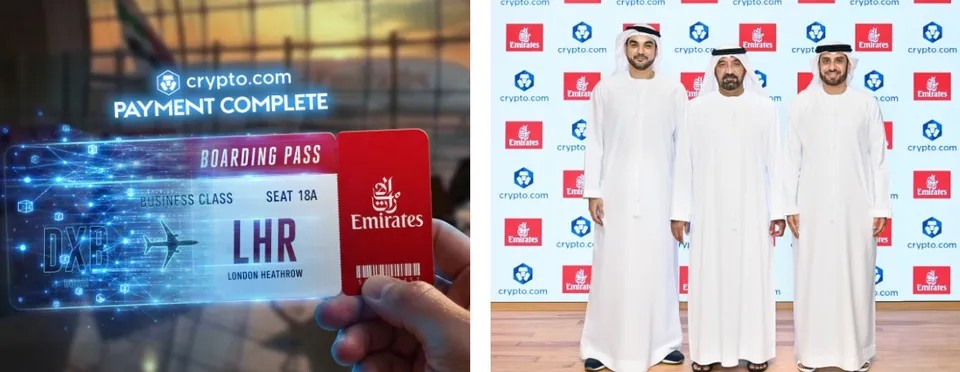
Source: Emirates.

The payment process depends on the device used:

  • Mobile devices: When booking through the Emirates app, the user selects Crypto.com Pay, is automatically redirected to the wallet app for confirmation of the debit, and returns to receive the receipt;
  • Desktop computers: The customer scans a QR code on emirates.com using the Crypto.com mobile app, confirms the transfer, and receives an e-ticket.
"The implementation of this initiative fulfills our commitment to expanding payment options for our customers' travel. It also reflects the rapidly changing preferences of a younger, digitally-savvy generation that manages their money from their phones," emphasized Adnan Kazim, Deputy President and Chief Commercial Officer of Emirates.

The introduction of the service supports the Dubai Cashless Strategy within the D33 economic program, which aims to shift 90% of all financial transactions to a digital format by the end of the year.

Related: UAE telecom giant launches pilot for integrating regulated dirham stablecoin

Regulation of Issuance

In April, the Dubai Virtual Assets Regulatory Authority (VARA) issued a roadmap regulating asset issuance.

According to VARA's guidelines, all tokens issued are divided into three categories:

  • Category 1: Fiat-referenced stablecoins (FRVA) and assets backed by physical resources or revenue (ARVA/RWA). Issuers must obtain a full VARA license and hold 100% reserves;
  • Category 2: Other virtual assets not falling into the first group. A license for issuance is not required, but sales must go through licensed distributors;
  • Excluded Assets (Exempt VAs): Non-transferable tokens and closed-loop loyalty points without a secondary market.

Related: Dubai regulator penalizes 19 crypto companies for operating without licenses

end-content

Пов'язані питання

QWhich airline has started accepting cryptocurrency for ticket payments?

AEmirates has started accepting cryptocurrency for ticket payments.

QWhat payment service did Emirates launch to enable cryptocurrency payments?

AEmirates launched the Crypto.com Pay service to enable cryptocurrency payments.

QThrough which entities is the Crypto.com Pay transaction processing facilitated in the UAE?

ATransactions are processed through Crypto.com's Dubai subsidiary, which is licensed as a Virtual Asset Service Provider (VASP) and holds a Store of Value Funds (SVF) license from the UAE Central Bank.

QWhat is the strategic goal of Dubai's Cashless Strategy mentioned in the article?

AThe strategic goal of Dubai's Cashless Strategy, part of the D33 economic program, is to convert 90% of all financial transactions into digital format by the end of the year.

QHow did Dubai's Virtual Assets Regulatory Authority (VARA) categorize tokens in its issued roadmap?

AVARA categorized tokens into three groups: Category 1 (Fiat-Referenced Virtual Assets and Asset-Referenced Virtual Assets), Category 2 (other virtual assets not in Category 1), and Exempt Virtual Assets (non-transferable tokens and closed-loop loyalty points).

Пов'язані матеріали

Bank of Korea Reveals Results of Tokenized Deposit Testing

The Bank of Korea has announced the results of its pilot test for tokenized deposits. Involving 28 central banks and international financial organizations, the project saw participation from major South Korean banks including KB Kookmin Bank, NH NongHyup Bank, Shinhan Bank, Woori Bank, and Hana Bank. Transactions, from payment orders to final settlement, were completed in real time, averaging just 80 seconds. The test involved 30 transactions across 17 different scenarios—such as corporate and interbank transfers—and was conducted in six currencies, including the Korean won, US dollar, and euro, with a total transaction value reaching approximately $995,000. The central bank reported that the platform operated stably throughout, despite being only partially connected to the existing banking infrastructure. Settlements using tokenized deposits were executed seamlessly, quickly, and transparently. An internal transfer of 20 million won (about $13,890) between NH NongHyup Bank and Shinhan Bank was also successfully processed via the Project Agora platform, which involved connecting to the Bank of Korea's CBDC test platform, Project Hangang. Additionally, KB Kookmin Bank and Japan's MUFG Bank tested cross-border payments using these deposit tokens—digital certificates issued by commercial banks within the pilot, not directly by the central bank. The Bank of Korea plans to continue testing payments with tokenized deposits. This follows last year's pledge by South Korean authorities to tighten regulations for won-based stablecoins, which will require approval from both the central bank and the Financial Services Commission.

cryptonews.ru1 год тому

Bank of Korea Reveals Results of Tokenized Deposit Testing

cryptonews.ru1 год тому

Торгівля

Спот
活动图片