Dogecoin Tries to Hold $0.09370 – Is 2026 the Doge Year or Will $MAXI Take Over?

bitcoinistОпубліковано о 2026-02-10Востаннє оновлено о 2026-02-10

Анотація

Dogecoin is currently testing a critical support level at $0.09370, which is seen as a key determinant of its near-term price direction. If this level holds, analysts project a potential rally toward $0.20 by 2026, supported by oversold technical indicators and historical accumulation patterns. However, a breakdown below $0.088 could trigger a decline toward $0.060. Meanwhile, liquidity is shifting toward newer, high-risk meme tokens like Maxi Doge ($MAXI), which has raised $4.58M in its presale. $MAXI targets a high-leverage trading culture with features like holder-exclusive competitions and a dedicated treasury fund. Whale activity indicates growing interest, though the token remains a speculative play. The broader meme coin market remains sensitive to macroeconomic liquidity conditions, with Dogecoin’s performance tied to Bitcoin’s movements and central bank policies. The article highlights both the technical outlook for DOGE and the emerging appeal of narrative-driven altcoins like $MAXI for risk-seeking investors.

Trusted Editorial content, reviewed by leading industry experts and seasoned editors. Ad Disclosure

Quick Facts:

  • ➡️ Dogecoin must hold the $0.09370 support level to maintain its bullish structure and target $0.20 by 2026.
  • ➡️ A breakdown below $0.088 would invalidate the current reversal thesis, risking a drop to $0.060.
  • ➡️ Market liquidity is rotating toward thematic projects like Maxi Doge, which integrates trading competitions and leverage culture for high-risk ROI hunters.
  • ➡️ Macroeconomic shifts in global liquidity remain the primary catalyst for the next leg of the meme coin supercycle.

Dogecoin is fighting a critical battle at $0.09370.

That price point, once just a blip on the technical chart, has hardened into a psychological line in the sand for the entire meme sector. With Bitcoin stuck in consolidation, high-beta assets like DOGE are being forced to test their liquidity floors. The real question for traders isn’t just about surviving the current dip. It’s about whether this retest can trigger a parabolic run deep into 2026.

Why does this specific level matter? It aligns perfectly with historical accumulation zones where retail panic usually meets institutional buying. While volume indicators suggest ‘weak hands’ are folding, on-chain metrics reveal a quiet divergence in wallet growth.

Someone is accumulating. The market is currently trying to price in macro uncertainty alongside the hope for a ‘meme supercycle.’ If support holds, the structure points toward a reversal that could challenge year-to-date highs.

But the liquidity landscape is shifting. Legacy giants like Dogecoin are battling the law of large numbers, it takes massive capital just to move the needle 5%. Consequently, speculative cash is beginning to fragment. Traders chasing asymmetric returns are increasingly hedging major positions with newer, narrative-driven projects.

This rotation explains why assets like Maxi Doge ($MAXI) are gaining traction. They offer a totally different risk-reward profile for anyone betting on the next wave of retail euphoria.

Learn more about Maxi Doge.

Analysts Eye $0.20 Reversal if Key Support Holds

The technical case for Dogecoin hinges entirely on holding the $0.09000–$0.09370 zone. A breakdown here would be ugly—, likely triggering a cascade of long liquidations down to the $0.075 region. But a successful defense?

That confirms a ‘higher low’ macro structure (a classic reversal signal). Plus, the daily RSI is hovering in oversold territory. Historically, that’s exactly where impulsive bounces in the meme sector start.

Fundamentally, DOGE remains tied to payment narratives. Yet, what most analysts miss is the link between global liquidity cycles and meme performance. As central banks signal rate adjustments, risk-on assets react first. Liquidity usually flows into Bitcoin, then rotates into heavyweights like DOGE.

If the $0.09370 support holds through this volatility, charts point to immediate resistance at $0.12, with a medium-term target of $0.20 by early 2026.

Scenario Analysis:

  • Bull Case: DOGE reclaims the 50-day EMA, confirming $0.09370 as a cycle bottom. Buying pressure targets $0.14 initially, with a breakout to $0.22 imminent if volume holds up.
  • Base Case: The asset chops sideways between $0.090 and $0.105 for 3-5 weeks, shaking out leverage before making a decisive move.
  • Bear Case (Invalidation): A daily candle close below $0.088 invalidates the bullish thesis, exposing the asset to a retest of 2023 lows around $0.060.

$MAXI is available here.

Smart Money Rotates: $MAXI Targets High-Leverage Culture

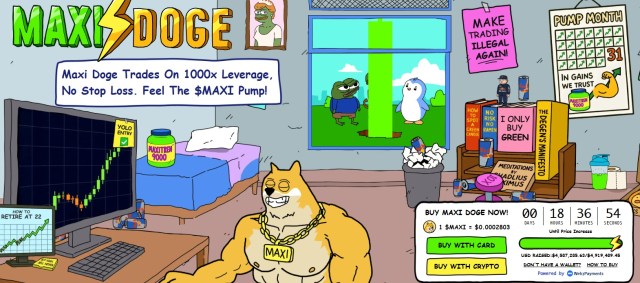
While Dogecoin relies on broad sentiment, Maxi Doge ($MAXI) is carving out a niche by targeting the aggressive trading culture defining this cycle.

Early adopters call it the ‘Left-Curve’ play. It positions itself not just as a currency, but as the embodiment of the 1000x leverage mentality. That distinction is key. While DOGE wants mass adoption, Maxi Doge targets the high-frequency trader and the ‘gym-bro’ aesthetic dominating crypto Twitter.

The project stands out with a ‘Leverage King’ ecosystem, featuring holder-only trading competitions and a ‘Maxi Fund’ treasury. The numbers seem to back the hype.

According to the presale page, Maxi Doge has raised exactly $4.58M, with tokens currently priced at $0.0002803. This influx suggests retail investors are hunting for volatility and outsized returns, gains that mature assets like $DOGE struggle to deliver these days due to their massive caps.
Smart money is watching this rotation. On-chain data from Etherscan reveals that 2 whale wallets scooped up $628K ($314K, $314K) in recent transactions.

That signals high-net-worth players are positioning themselves before the project moves to open markets. View whale activity on Etherscan.

Still, caution is required. As an ERC-20 token focused on high-octane culture, Maxi Doge carries early-stage volatility risks. The ‘never skip leg-day’ branding and competitive staking APY are attractive, sure, but this remains a high-risk allocation. It’s for those looking to diversify into speculative narratives, not safe havens.

Watch the liquidity rotation, Maxi Doge ($MAXI) presale is live here. It represents the aggressive edge of the current meme market.

Buy your $MAXI here.

The information provided in this article is for educational purposes only and does not constitute financial advice. Crypto assets, including Dogecoin and presale tokens like Maxi Doge, are highly volatile and unregulated. Always conduct your own independent research and consult a professional advisor before making investment decisions.

Editorial Process for bitcoinist is centered on delivering thoroughly researched, accurate, and unbiased content. We uphold strict sourcing standards, and each page undergoes diligent review by our team of top technology experts and seasoned editors. This process ensures the integrity, relevance, and value of our content for our readers.

patrubogdan

Follow

Full Profile

Related Posts

Government Shutdown Fears Trigger 2% Crypto Dip, But Bitcoin Hyper Remains Unshaken

US Debt Spiral Eyes $39T: Why Bitcoin Hyper ($HYPER) Is The Hedge to Watch

Crypto Exchange Backpack Targets Token Launch Soon, as BMIC Fires Up Quantum Defense

Ethereum Foundation Backs SEAL Initiative as LiquidChain L3 Protocol Gains Traction

Vitalik Buterin Outlines Ethereum’s AI Future, While SUBBD Token Targets the Creator Economy

Binance Dominates Trump’s USD1 Supply as Bitcoin Hyper Breaks Records

Пов'язані питання

QWhat is the critical support level for Dogecoin mentioned in the article, and why is it important?

AThe critical support level for Dogecoin is $0.09370. It is important because it aligns with historical accumulation zones where retail panic often coincides with institutional buying. Holding this level is crucial for maintaining its bullish structure and targeting a price of $0.20 by 2026.

QWhat are the potential price targets for Dogecoin if the $0.09370 support holds?

AIf the $0.09370 support holds, the immediate resistance target is $0.12, with a medium-term target of $0.20 by early 2026.

QWhat is Maxi Doge ($MAXI), and how does it differentiate itself from Dogecoin?

AMaxi Doge ($MAXI) is a newer, narrative-driven project that targets high-leverage trading culture. It differentiates itself by integrating trading competitions and a 'Maxi Fund' treasury, focusing on high-risk ROI hunters and the aggressive trading mentality, unlike Dogecoin, which aims for broader mass adoption.

QWhat on-chain activity suggests smart money is interested in Maxi Doge?

AOn-chain data from Etherscan reveals that two whale wallets purchased $628K (split as $314K each) in $MAXI tokens, indicating high-net-worth players are positioning themselves before the project moves to open markets.

QWhat is the bear case scenario for Dogecoin if it fails to hold the key support level?

AThe bear case scenario involves a daily candle close below $0.088, which would invalidate the bullish thesis and expose Dogecoin to a retest of its 2023 lows around $0.060.

Пов'язані матеріали

Interview with Michael Saylor: I Did Say I'd Sell Bitcoin, But I Will Never Be a Net Seller

**Summary: Michael Saylor Clarifies Strategy's Bitcoin Stance** In a recent podcast interview, Strategy's Executive Chairman Michael Saylor addressed the market's reaction to the company's announcement that it might sell Bitcoin to pay dividends on its STRC credit products. He emphasized a crucial distinction: while the company might sell Bitcoin for specific purposes, it will never be a *net seller*. Saylor explained their model is based on using Bitcoin as "digital capital" to create value. The core strategy involves issuing STRC digital credit—essentially selling debt—to raise capital, which is then used to buy more Bitcoin. He estimates Bitcoin appreciates at roughly 40% annually. A small portion of these capital gains (e.g., ~2.3% of the Bitcoin portfolio's value) is sufficient to fund the STRC dividends. Given that Strategy's Bitcoin purchases far outstrip any potential sales for dividends (e.g., buying $3.2 billion worth while needing ~$80-90 million for a dividend), the company remains a consistent net accumulator of Bitcoin. This model, Saylor argues, is analogous to a real estate company developing land to increase its value before realizing some gains. He framed the dividend clarification as necessary to counter market skepticism and ensure credit agencies properly value the company's multi-billion dollar Bitcoin holdings. Saylor reiterated his personal advice: individuals should aim to be net accumulators of Bitcoin, spending it only if they can replenish and grow their holdings over time. Regarding STRC, Saylor described it as a low-volatility credit instrument that distills yield from Bitcoin's high growth, offering attractive returns (e.g., ~11-12% yield) for risk-averse investors. He noted that Strategy's STRC issuance now constitutes about 60% of the U.S. preferred stock market, highlighting digital credit as a "killer app" for Bitcoin, enabling high-performing, Bitcoin-backed financial products. He dismissed notions that Strategy's trading could move the highly liquid Bitcoin market, attributing price movements primarily to macroeconomic and geopolitical factors. Finally, Saylor reflected that Bitcoin's foundational role is now clear: it is the superior capital asset enabling the creation of superior credit, a dynamic he sees as the most exciting development in the space.

marsbit6 хв тому

Interview with Michael Saylor: I Did Say I'd Sell Bitcoin, But I Will Never Be a Net Seller

marsbit6 хв тому

380,000 Apps Exposed, 2,000+ Apps Leaked Secrets: AI Programming Turns 'Intranet' into Public Internet

Israeli cybersecurity firm RedAccess uncovered a severe data exposure trend linked to "vibe coding" or AI-powered software development tools. Their research found approximately 38,000 publicly accessible web applications built with platforms like Lovable, Base44, Netlify, and Replit. Of these, an estimated 2,000 apps exposed sensitive corporate and personal data, including medical records, financial information, internal strategic documents, and customer chat logs. In some cases, access even granted administrative privileges. The core issue stems from default privacy settings that make applications public by default, combined with a lack of built-in security controls (like authentication) in the AI-generated code. This allows employees without security expertise—"citizen developers"—to easily create and deploy applications that bypass standard corporate security reviews. The exposed apps, often indexed by search engines, are trivially discoverable. While some platform providers (Replit, Lovable, Wix/Base44) argue that security configuration is the user's responsibility and question the validity of some findings, security researchers confirm the widespread reality of such exposures. This pattern, also noted in prior studies, highlights a critical security gap as AI democratizes app creation, potentially leading to massive, unintentional data leaks.

marsbit1 год тому

380,000 Apps Exposed, 2,000+ Apps Leaked Secrets: AI Programming Turns 'Intranet' into Public Internet

marsbit1 год тому

Attracting Global Capital, Asia's New 'Super Cycle' Is Unfolding

Investors are turning to Asia as the next frontier for global equity growth, with a new "super cycle" unfolding across the region. Driven by the AI revolution, Asian markets, particularly South Korea, have seen significant rallies. According to Morgan Stanley analysis, the underlying drivers of Asia's industrial cycle are shifting from traditional sectors like real estate and manufacturing to massive investments in AI infrastructure, energy security and transition, and supply chain resilience. Fixed asset investment in Asia is projected to grow from around $11 trillion in 2025 to $16 trillion by 2030, with a 7% annual growth rate from 2026-2030. The AI wave is a primary catalyst, driving immense capital expenditure for chips, servers, data centers, and power systems. Asia is central to this hardware supply chain. In China, AI investment is focused on building a full-system domestic capability, with the local AI chip market potentially reaching $86 billion by 2030. Beyond AI, China's export story is expanding from EVs and batteries to robotics. The country already captures about half of new global industrial robot demand and over 90% of humanoid robot shipments. This growth phase mirrors the early stages of China's EV export boom. Simultaneously, energy security investments, spurred by AI's massive power needs, are rising, with China benefiting from its leadership in solar, batteries, and EVs. Regional defense spending is also increasing structurally, supporting demand for advanced manufacturing. The main beneficiaries are China, South Korea, and Japan, positioned in core supply chain areas. However, risks remain, including potential overcapacity, profit margin pressures from competition, persistent technological restrictions, geopolitical friction, and workforce displacement due to AI-driven automation. Market volatility is also expected to increase as investor expectations diverge on the realization of these capital investment and export themes.

marsbit1 год тому

Attracting Global Capital, Asia's New 'Super Cycle' Is Unfolding

marsbit1 год тому

Торгівля

Спот
Ф'ючерси
活动图片