Did Maduro Really Hide $60 Billion in BTC?

marsbitОпубліковано о 2026-01-06Востаннє оновлено о 2026-01-06

Анотація

The article investigates the unverified claim that former Venezuelan President Nicolás Maduro's regime secretly amassed a "shadow reserve" of 600,000 to 660,000 Bitcoins, valued at $60-67 billion, prior to his arrest by US forces in January 2026. This amount would rival the holdings of the largest corporate Bitcoin buyer, MicroStrategy. The report outlines three potential, yet unconfirmed, methods for accumulation: 1. **The failed Petro scheme:** The state-backed cryptocurrency, Petro, was likely a facade but established a regulatory body (Sunacrip) that potentially facilitated money laundering and a strategic pivot to holding Bitcoin. 2. **The PDVSA-Crypto scandal:** An estimated $21 billion in oil export receivables from the state oil company went missing between 2020-2023. Intelligence suggests funds may have been laundered through USDT and converted to Bitcoin via a complex, automated system. 3. **Military mining:** The regime's military commercial arm allegedly confiscated thousands of private mining rigs and operated mining facilities with heavily subsidized electricity, potentially generating tens of thousands of BTC. The article heavily emphasizes that the 600k BTC figure is based on human intelligence (HUMINT) and lacks verifiable on-chain evidence. If the reserve exists, access would likely be controlled via a multi-signature wallet by key figures like financier Alex Saab or Maduro's family. The potential market impact is significant, ranging from neutral (if t...

Author: Cathy, Baihua Blockchain

In the early hours of January 3, 2026, U.S. special forces arrested Venezuelan President Nicolás Maduro in Caracas during a military operation codenamed "Absolute Resolve."

This event sparked a major question in the crypto community: Did the Maduro regime really possess the rumored "shadow reserves"?

According to a report from the investigative agency Whale Hunting and multiple intelligence sources, a staggering rumor has been circulating in the market: the Maduro regime may hold 600,000 to 660,000 Bitcoin. If true, this would be worth a staggering $60-67 billion at market prices in early 2026.

What does this mean?

MicroStrategy (now renamed Strategy), the company known as the "Bitcoin whale," held over 670,000 BTC as of January 2026, worth approximately $61.3 billion. If the Venezuelan rumors are true, its holdings would be comparable to the world's largest corporate buyer, representing about 3% of Bitcoin's total supply (21 million coins).

But the question is: Does this fortune actually exist? And if it does, where is it hidden?

In the crypto world, there is an ironclad rule: "Not your keys, not your coins."

01 How Did the Rumor Originate?

To understand where the rumor of "600,000 BTC" came from, we first need to understand the theoretical avenues through which the Maduro regime could have accumulated Bitcoin. It must be emphasized that the following analysis is based on public reports and intelligence estimates, not proven facts.

Avenue One: The Petro Scam — Paving the Way for Crypto-fication

In February 2018, under heavy pressure from U.S. sanctions, Maduro announced the launch of the world's first "national cryptocurrency" — the Petro. The government claimed to raise $735 million on the first day, with a total fundraising target of $6 billion.

But multiple investigations showed that this ICO had serious problems from the start.

The Petro was first claimed to be based on Ethereum, then on NEM, and finally seemed to run on a private chain that didn't exist. The government claimed the Petro was backed by 5.3 billion barrels of crude oil in the Ayacucho block, but field investigations revealed dilapidated infrastructure with no mining activity whatsoever.

The so-called "financing" was likely just an internal shuffling of regime assets.

But while the Petro failed, it left a crucial byproduct: Sunacrip (National Superintendency of Crypto Assets). This agency was given the power to regulate all crypto activities, issue mining licenses, and even directly operate national mining pools. It wasn't a regulator; it was a national money laundering center.

In January 2024, Maduro officially shut down the Petro. This wasn't a failure, but a strategic pivot — from "issuer" to "holder," fully transitioning to Bitcoin and USDT, which have genuine global liquidity.

Avenue Two: The PDVSA-Crypto Scandal — $21 Billion Unaccounted For

Market rumors suggest the core source of the Maduro regime's Bitcoin reserves may have been the diversion of oil export revenues from the state-owned oil company PDVSA.

In 2019, the U.S. imposed comprehensive sanctions on PDVSA, cutting off its access to the global banking system. To survive, PDVSA initiated an "anti-blockade" strategy:

Dark Fleet: Using tankers with transponders turned off to ship crude oil to "teapot refineries" (small, non-state-owned refineries) in Asia.

Intermediary Network: Masking the origin of crude through shell companies registered in the UAE, Russia, and elsewhere. These intermediaries often had no oil trading experience; their only qualification was personal connections to the regime's core figures.

Crypto Settlements: Unable to receive dollar wire transfers, intermediaries were instructed to pay for oil in USDT (Tether).

In March 2023, Venezuela was rocked by the shocking "PDVSA-Crypto" scandal. An internal government audit revealed that approximately $21 billion in accounts receivable from oil exports between 2020 and 2023 was unaccounted for.

Where did this money go? It remains a mystery to this day.

Some intelligence analysts speculate that a portion of it may have found its way back to regime-controlled wallets via cryptocurrency. Reportedly, Sunacrip established an automated "springboard" mechanism:

  • Receive: Intermediaries send USDT to intermediate wallets controlled by Sunacrip
  • Launder: Obfuscate fund trails through mixers like Tornado Cash
  • Exchange: Convert USDT to Bitcoin at OTC desks in Russia or Eastern Europe
  • Store: Bitcoin transferred to offline-generated cold wallets, with private keys held by the highest echelons of the regime

The architects of this system were Tareck El Aissami (former Oil Minister) and Alex Saab (the regime's "financial diplomat"). El Aissami resigned in March 2023 and was arrested in April 2024 on corruption charges, facing counts of treason, money laundering, and more. The assets he controlled were likely confiscated by the Maduro family.

Saab returned to Venezuela in a prisoner swap with the U.S. in December 2023, with Maduro exchanging 10 American prisoners for this financial architect, highlighting his perceived indispensability — an importance likely stemming from his control over financial lifelines.

Avenue Three: Military Mining — "National Hashrate" from Confiscated Rigs

Beyond oil revenues, another theory suggests the Venezuelan regime may have directly produced Bitcoin by controlling the "means of production."

Venezuela has some of the world's cheapest electricity, primarily from the Guri Dam. This makes Bitcoin mining highly profitable. The Maduro government monopolized this advantage through a military commercial entity — CAMIMPEG (Military Company for Mining, Oil, and Gas).

CAMIMPEG established "Bolivarian Army Digital Asset Production Centers." These military mining farms enjoyed privileges:

  • Guaranteed Power: Priority access to electricity amid nationwide frequent blackouts
  • Security: Heavily guarded by the National Guard
  • Near-Zero Operating Costs: As electricity was effectively free (state-subsidized), marginal costs were near zero

But where did the equipment for these military farms come from? Largely from the confiscation of private miners.

Starting in 2020, Sunacrip, in conjunction with the military, launched a series of raids on private mining operations:

  • 2020: National Guard seizes 315 Antminer S9 units in Bolívar state
  • 2023: Raid on the headquarters of the "Tren de Aragua" gang in Tocorón Prison, seizing numerous miners and weapons
  • 2024: Over 2,300 Antminer S19J Pro units seized in a single operation in Maracay

According to intelligence sources, between 2020 and 2025, the government may have acquired tens of thousands of mining machines through confiscations from private farms and gang facilities. These devices were not destroyed but redeployed to CAMIMPEG-controlled facilities.

Based on the known thousands of high-performance miners, plus output from state-owned farms, this "zombie army" could have produced tens of thousands of Bitcoin over the past several years.

02 Data Sources and Skepticism Regarding the "600,000 BTC" Rumor

Key Question: Is this number credible?

Based on intelligence reports from Chainalysis, TRM Labs, and the investigative agency "Whale Hunting," the estimated figure circulating in the market is 600,000 to 660,000 BTC. But it must be emphasized:

This figure comes solely from intelligence sources, not verifiable on-chain hard data

No public on-chain evidence supports this number

The Whale Hunting report explicitly states: "This estimate is from HUMINT (Human Intelligence), unconfirmed by blockchain analysis"

Nonetheless, the report still provided a hypothetical breakdown:
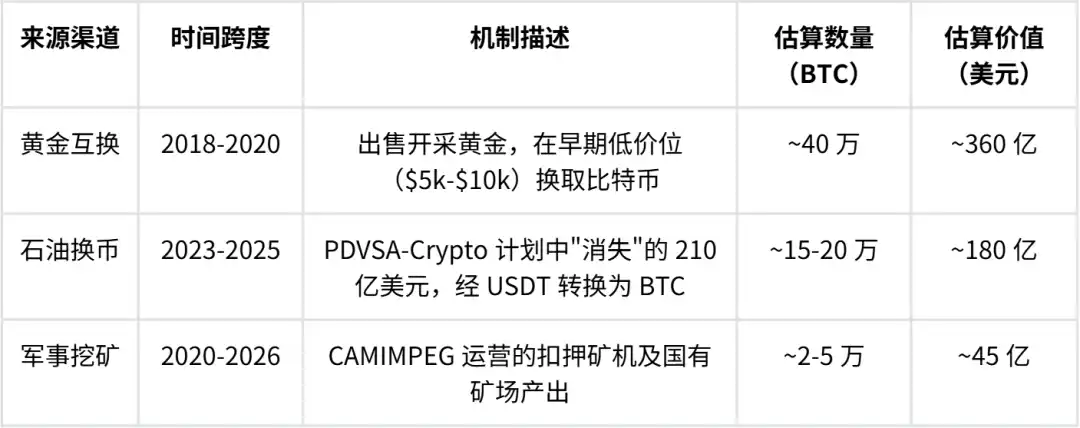
Is this rumor logically plausible?

Supporters' View:

MicroStrategy Comparison: MicroStrategy (now Strategy) held over 670,000 BTC as of January 2026. A sovereign nation theoretically has the capacity to reach a similar scale.

Funding Basis: PDVSA had $21 billion unaccounted for in 2020-2023. If 50% of that was converted to Bitcoin, it could have purchased 300,000-400,000 BTC at average prices of the time.

Skeptics' View:

  • Lack of On-Chain Evidence: If 600,000 BTC truly existed, traces should be found on the blockchain, but no one has been able to point to specific addresses.
  • Suspiciously Round Number: The figure 600,000 seems more like an estimate than an actual count and may be significantly overestimated.
  • Questionable Motive: This rumor might be used for political purposes or market manipulation.

Conclusion: In the absence of concrete blockchain evidence, this remains an unverified rumor.

03 If the Rumor is True: Who Would Hold the Private Keys?

Assuming this "shadow reserve" does exist, even Maduro's arrest does not mean the U.S. can control it.

The FBI's primary challenge would be: How to prove the existence of these Bitcoins, and how to find the private keys?

Who might hold the private keys?

If this asset exists, intelligence analysts speculate it is unlikely managed by a single account. It's more likely to use a multi-signature (Multisig) or private key sharding scheme.

Theoretical key holders might include:

  • Alex Saab: As the regime's financial architect, Saab not only understands the full picture of fund flows but likely holds the crucial seed phrases or knows the physical location of hardware wallets needed to recover the wallets. His return to Venezuela in the December 2023 prisoner swap — 10 American prisoners exchanged for this financial brain — demonstrates his irreplaceability to the regime.
  • Nicolasito (Maduro's Son): Named in indictments, Maduro's son was deeply involved in illegal gold mining and the regime's daily operations, potentially holding a backup of the family's portion of the private keys.
  • Cilia Flores (First Lady): Known as the "First Combatant," she holds a high position within the regime's inner circle. She might control physical access to some cold wallets.
  • Technocrat Layer: Former Sunacrip technicians might be responsible for maintaining the multi-signature technical infrastructure. While they might not know the full keys, their cooperation could be crucial for reconstructing wallet access.

Speculated Crypto Architecture

The most likely architecture is an M-of-N signature scheme (e.g., 3/5 or 5/7). This means signatures from 3 out of 5 core individuals would be required to move the funds.

If Maduro, Flores, and Saab were all under U.S. control, theoretically, the U.S. could compel them to cooperate in unlocking the funds. But reality is far more complex:

  • Geographic Dispersion: Cold wallets could be stored分散ly in bunkers in Caracas, safety deposit boxes in Russia, or safe houses in Cuba.
  • Dead Man's Switch: The system might include an automatic trigger mechanism. If specific actions aren't performed for a prolonged period (e.g., Maduro goes missing), funds could automatically transfer to irrecoverable addresses or be sent to allies.
  • Ideological Resistance: Even facing life imprisonment, key holders might refuse to cooperate. For them, this is not just wealth but the final weapon against "American imperialism."

04 Market Impact: The Rumor Itself is Uncertainty

Even if unverified, this rumor has become a "Sword of Damocles" hanging over the crypto market. 600,000 Bitcoin represents 3% of BTC's total supply. If real, the impact would be massive.

Three Possible Scenarios

Scenario One: Rumor is False

If thorough investigation by the FBI and blockchain analysis firms ultimately proves this "shadow reserve" does not exist or is severely overestimated, the market might breathe a sigh of relief. This means no potential selling pressure, neutral or slightly bullish for price.

Scenario Two: Rumor is True and FBI Gains Control

If the asset exists and the U.S. successfully seizes it, following procedure, these Bitcoin would enter judicial freezing, potentially locked for years. This effectively removes a huge supply from circulation, reducing market float, which is bullish for price.

This is similar to the FBI's seizure of Silk Road Bitcoin in 2013. Around 170,000 BTC were frozen and eventually auctioned in batches. But during the freeze, these coins were effectively out of circulation, objectively reducing selling pressure.

Scenario Three: Rumor is True but Keys are Lost

This is the most dangerous scenario. If the asset exists but the private keys are not controlled by the U.S., remnants of the fleeing regime might attempt to sell Bitcoin on OTC markets for escape funds, triggering panic selling.

The German government's sale of just 50,000 BTC in 2024 caused short-term market volatility. 600,000 would be catastrophic.

05 Summary

Maduro's arrest has revealed a glimpse of the Venezuelan regime's use of cryptocurrency to evade sanctions.

From the failed Petro experiment to the $21 billion PDVSA-Crypto scandal, to militarized mining facilities — these are all confirmed facts. But the rumor of a "600,000 BTC shadow reserve" still lacks concrete evidence.

What we can confirm: Venezuela did use crypto to evade sanctions, PDVSA did have $21 billion unaccounted for, and the regime did confiscate大量 mining equipment.

What we cannot confirm includes: Whether 600,000 BTC were actually accumulated, who holds the private keys (if they exist), and whether these Bitcoin will enter the market.

It does raise a尖锐 question: When decentralized technology is used to evade sanctions, how do we find the balance between freedom and order?

But until more evidence surfaces, the "$60 billion shadow reserve" remains just an unverified rumor.


Пов'язані питання

QWhat is the core rumor surrounding Nicolás Maduro's regime and Bitcoin, as discussed in the article?

AThe core rumor is that Nicolás Maduro's regime may have secretly accumulated a 'shadow reserve' of 600,000 to 660,000 Bitcoin, valued at approximately $60-67 billion at early 2026 prices.

QAccording to the article, what were the three main theoretical pathways through which the Maduro regime could have accumulated Bitcoin?

AThe three main theoretical pathways were: 1) Profits and infrastructure from the failed 'Petro' cryptocurrency scheme. 2) Diversion of oil export revenues from the state oil company PDVSA, specifically the $21 billion in unaccounted receivables. 3) Confiscation and operation of mining equipment through military-controlled mining facilities (CAMIMPEG).

QWhat key piece of evidence casts doubt on the credibility of the '600,000 BTC' rumor?

AThe key doubt is the lack of any verifiable on-chain evidence. The number is based on human intelligence (HUMINT) estimates from sources like Whale Hunting and has not been confirmed by blockchain analysis. No specific wallet addresses have been identified to support such a large holding.

QIf the Bitcoin reserve is real, who are the speculated key holders of the private keys, and why?

AThe speculated key holders are: Alex Saab (the regime's financial architect, likely holding critical seed phrases), Nicolasito (Maduro's son, involved in illicit operations), Cilia Flores (the First Lady, with high status), and a layer of technocrats from Sunacrip (who maintained the multisig technical architecture). This suggests a distributed, multisignature wallet structure.

QWhat are the three potential market impact scenarios described if the rumor is true?

A1) The rumor is false: No impact or slightly positive as fear of a massive sell-off is removed. 2) The BTC is real and seized by the FBI: Bullish, as the coins would be frozen, reducing circulating supply. 3) The BTC is real but the private keys are lost/controlled by regime remnants: Bearish, as they could attempt a massive OTC sell-off, causing panic and a price crash.

Пов'язані матеріали

You Bet on the News, the Pros Read the Rules: The True Cognitive Gap in Losing Money on Polymarket

The article explains that the key to profiting on Polymarket, a prediction market platform, lies not just predicting real-world events correctly, but in meticulously understanding the specific rules that govern how each market will be resolved. It illustrates this with examples, such as a market on Venezuela's 2026 leader, where the official rules defining "officially holds" the office overruled the intuitive answer of who was in practical control. Other examples include debates over the definition of a "token" or what constitutes an "agreement." The core argument is that a "reality vs. rules" gap creates pricing discrepancies that savvy traders ("车头" or "whales") exploit. The platform has a formal dispute resolution process managed by UMA token holders to settle ambiguous outcomes. This process involves proposal submission, a challenge window, a discussion period, and a final vote. However, the article highlights a critical flaw in this system compared to a traditional court: the lack of separation between the arbiters (UMA voters) and the interested parties (traders with financial stakes in the outcome). This conflict of interest undermines the discussion phase, leads to herd mentality, and results in opaque final decisions without explanatory rulings. Consequently, the system lacks a body of precedent, making it difficult for users to learn from past disputes. The ultimate takeaway is that success on Polymarket requires a lawyer-like scrutiny of the rules to identify and capitalize on the cognitive gap between how events appear and how they are contractually defined for settlement.

marsbit15 хв тому

You Bet on the News, the Pros Read the Rules: The True Cognitive Gap in Losing Money on Polymarket

marsbit15 хв тому

Will the Fed Still Cut Interest Rates? Tonight's Data Is Crucial

The core debate surrounding the Federal Reserve's potential interest rate cuts is intensifying amid geopolitical conflict and rebounding inflation. The key question is whether high energy prices will cause persistent inflation or weaken consumer demand enough to force the Fed to cut rates. Citigroup presents a bullish case for cuts, arguing that oil supply disruptions from the Strait of Hormuz are temporary and will not lead to lasting inflationary pressure. They point to receding bond yields and oil prices as evidence the market is pricing in a short-lived shock. Citi's data also shows tightening financial conditions, a stabilizing labor market, and healthy tax returns, supporting their view that the path to lower rates remains open. Conversely, Deutsche Bank offers a starkly contrasting, more hawkish outlook. They argue the Fed's current policy is already neutral and expect rates to remain unchanged indefinitely. Their view is based on stalled disinflation progress and a shift toward more hawkish rhetoric from key Fed officials like Waller, who cited risks from prolonged Middle East conflict and tariffs. Other officials, including Williams and Hammack, signaled rates would likely stay on hold for a "considerable time." The market pricing has shifted dramatically, now forecasting zero cuts in 2026. The imminent release of the March retail sales "control group" data is highlighted as a critical test. This metric, which excludes gas station sales, will reveal if high gasoline prices are eroding consumer spending in other areas. A weak reading could support the case for imminent rate cuts, while a strong one would bolster the argument for the Fed to hold steady. This data is pivotal for determining the near-term policy path.

marsbit35 хв тому

Will the Fed Still Cut Interest Rates? Tonight's Data Is Crucial

marsbit35 хв тому

The Second Half of Macro Influencer Fu Peng's Career

Fu Peng, a prominent Chinese macroeconomist and former chief economist of Northeast Securities, has joined Hong Kong-based digital asset management firm Bitfire Group (formerly New Huo Group) as its chief economist. This move, announced in April 2026, triggered an 11% surge in Bitfire's stock price. Fu, known for his accessible macroeconomic commentary and large social media following, will focus on integrating digital assets into global asset allocation frameworks, particularly combining FICC (fixed income, currencies, and commodities) with cryptocurrencies for institutional clients. His career includes roles at Lehman Brothers and Solomon International, with significant influence gained through public communication. However, in late 2024, Fu faced temporary social media bans after a controversial private speech at HSBC on China's economic challenges, though he denied regulatory sanctions. He later left Northeast Securities citing health reasons. Bitfire, a licensed virtual asset manager serving high-net-worth clients, seeks to build trust and attract traditional capital through Fu’s expertise and credibility. The partnership represents a strategic shift for both: Fu enters the crypto sector after a traditional finance peak, while Bitfire aims to leverage his macro framework for institutional adoption. Outcomes remain uncertain regarding capital inflows and compatibility within corporate structure.

marsbit1 год тому

The Second Half of Macro Influencer Fu Peng's Career

marsbit1 год тому

Торгівля

Спот
Ф'ючерси

Популярні статті

Що таке BITCOIN

Розуміння HarryPotterObamaSonic10Inu (ERC-20) та його позиції у крипто-просторі Останніми роками ринок криптовалют спостерігав за зростанням популярності мем-коінів, які привертають інтерес не тільки трейдерів, але й тих, хто шукає спілкування та розважальну цінність. Серед цих унікальних токенів є HarryPotterObamaSonic10Inu (ERC-20), інтригуючий проект, що поєднує культурні посилання з тканинами криптовалюти. Ця стаття досліджує ключові аспекти HarryPotterObamaSonic10Inu, вивчаючи його механізми, спільноту та його взаємодію з ширшим крипто-ландшафтом. Що таке HarryPotterObamaSonic10Inu (ERC-20)? Як випливає з його назви, HarryPotterObamaSonic10Inu є мем-коіном, побудованим на блокчейні Ethereum, класифікованим за стандартом ERC-20. На відміну від традиційних криптовалют, які можуть підкреслювати практичну корисність або інвестиційний потенціал, цей токен процвітає завдяки розважальній цінності та силі своєї спільноти. Проект спрямований на створення середовища, де зацікавлені користувачі можуть об'єднуватися, ділитися ідеями та брати участь у заходах, натхненних різноманітними культурними явищами. Однією з примітних особливостей HarryPotterObamaSonic10Inu є нульовий податок на транзакції. Цей привабливий елемент має на меті заохочувати торгівлю та участь у спільноті, позбавлену додаткових витрат, які можуть відлякувати дрібних трейдерів. Загальна пропозиція монет становить один мільярд токенів, що позначає намір підтримувати суттєву циркуляцію в межах спільноти. Творець HarryPotterObamaSonic10Inu (ERC-20) Походження HarryPotterObamaSonic10Inu дещо окутане таємницею; деталі про творця залишаються невідомими. Розвиток цього токена позбавлений впізнаваної команди або чіткої стратегії, що не є рідкістю в секторі мем-коінів. Натомість проект виник органічно, а його розвиток значною мірою залежить від ентузіазму та участі його спільноти. Інвестори HarryPotterObamaSonic10Inu (ERC-20) Щодо зовнішніх інвестицій та підтримки, HarryPotterObamaSonic10Inu також залишається невизначеним. Токен не зазначає жодних відомих інвестиційних фондів або значної організаційної підтримки. Натомість життєва сила проекту полягає в його базовій спільноті, яка інформує про його зростання та стійкість через колективні дії та залученість у крипто-просторі. Як працює HarryPotterObamaSonic10Inu (ERC-20)? Як мем-коін, HarryPotterObamaSonic10Inu функціонує передусім поза традиційними рамками, що часто регулюють вартість активів. Є кілька відмінних аспектів, що визначають, як працює проект: Транзакції без податку: Завдяки відсутності податкових зборів на транзакції, користувачі можуть вільно купувати та продавати токен, не турбуючись про приховані витрати. Залучення спільноти: Проект процвітає завдяки взаємодії спільноти, використовуючи соціальні медіа для створення шуму та сприяння залученню. Обговорення, обмін контентом та залученість є ключовими елементами, що допомагають розширити його охоплення та зміцнити лояльність серед прихильників. Відсутність практичної корисності: Слід зазначити, що HarryPotterObamaSonic10Inu не пропонує конкретної корисності в рамках фінансової екосистеми. Натомість він класифікується як токен, що призначений в основному для розваги та спільнотних активностей. Культурне посилання: Токен кмітливо вплітає елементи популярної культури, щоб привернути інтерес, зв'язуючи з ентузіастами мемів та крипто-стежками. HarryPotterObamaSonic10Inu ілюструє, як мем-коіни функціонують інакше, ніж традиційні криптовалютні проекти, увійшовши на ринок як інноваційні соціальні конструкти, а не утилітарні активи. Хронологія HarryPotterObamaSonic10Inu (ERC-20) Історія HarryPotterObamaSonic10Inu відзначена кількома значними етапами: Створення: Токен виник з вірусного мему, захопивши уяву багатьох крипто-ентузіастів. Конкретні дати створення недоступні, що підкреслює його органічний розвиток. Лістинг на біржах: HarryPotterObamaSonic10Inu з'явився на різних біржах, дозволяючи зручніший доступ і торгівлю спільноти. Ініціативи залучення спільноти: Ведення діяльності, спрямованої на покращення взаємодії спільноти, включаючи конкурси, кампанії в соціальних мережах та створення контенту від фанатів та прихильників. Плани на майбутнє: Дорожня карта проекту включає запуск колекції NFT, мерчандайзинг та електронну комерцію, пов'язану з його культурними темами, що далі залучає спільноту та намагається додати більше вимірів до його екосистеми. Ключові моменти про HarryPotterObamaSonic10Inu (ERC-20) Спільнотний підхід: Проект надає пріоритет колективному внеску та креативності, забезпечуючи, щоб участь користувачів була в центрі його розвитку. Класифікація як мем-коін: Це є його епігенез розважальної криптовалюти, що відрізняється від традиційних інвестиційних інструментів. Жодного прямого відношення до Bitcoin: Незважаючи на схожість у назві, HarryPotterObamaSonic10Inu є відмінним і не має жодного зв’язку з Bitcoin або іншими усталеними криптовалютами. Зосередженість на співпраці: HarryPotterObamaSonic10Inu створено для того, щоб надати простір для співпраці та обміну історіями серед його власників, забезпечуючи шлях для творчості та спільного зв'язку. Перспективи на майбутнє: Амбіція розширитися за межі початкової концепції в NFT та мерчандайз відкриває шлях для проекту потенційно потрапити в більш мейнстрімні сфери цифрової культури. Оскільки мем-коіни продовжують захоплювати уяву спільноти криптовалют, HarryPotterObamaSonic10Inu (ERC-20) вирізняється своїми культурними зв'язками та орієнтованим на спільноту підходом. Хоча він може не відповідати типовій моделі утилітарного токена, його суть полягає в радощах і товариськості, що підтримуються серед його прихильників, підкреслюючи еволюційну природу криптовалют в усе більш цифрову епоху. Оскільки проект продовжує розвиватися, важливо спостерігати за тим, як динаміка спільноти вплине на його траєкторію в постійно змінюваному ландшафті технології блокчейн.

1.7k переглядів усьогоОпубліковано 2024.04.01Оновлено 2024.12.03

Що таке BITCOIN

Як купити BTC

Ласкаво просимо до HTX.com! Ми зробили покупку Bitcoin (BTC) простою та зручною. Дотримуйтесь нашої покрокової інструкції, щоб розпочати свою криптовалютну подорож.Крок 1: Створіть обліковий запис на HTXВикористовуйте свою електронну пошту або номер телефону, щоб зареєструвати обліковий запис на HTX безплатно. Пройдіть безпроблемну реєстрацію й отримайте доступ до всіх функцій.ЗареєструватисьКрок 2: Перейдіть до розділу Купити крипту і виберіть спосіб оплатиКредитна/дебетова картка: використовуйте вашу картку Visa або Mastercard, щоб миттєво купити Bitcoin (BTC).Баланс: використовуйте кошти з балансу вашого рахунку HTX для безперешкодної торгівлі.Треті особи: ми додали популярні способи оплати, такі як Google Pay та Apple Pay, щоб підвищити зручність.P2P: Торгуйте безпосередньо з іншими користувачами на HTX.Позабіржова торгівля (OTC): ми пропонуємо індивідуальні послуги та конкурентні обмінні курси для трейдерів.Крок 3: Зберігайте свої Bitcoin (BTC)Після придбання Bitcoin (BTC) збережіть його у своєму обліковому записі на HTX. Крім того, ви можете відправити його в інше місце за допомогою блокчейн-переказу або використовувати його для торгівлі іншими криптовалютами.Крок 4: Торгівля Bitcoin (BTC)Легко торгуйте Bitcoin (BTC) на спотовому ринку HTX. Просто увійдіть до свого облікового запису, виберіть торгову пару, укладайте угоди та спостерігайте за ними в режимі реального часу. Ми пропонуємо зручний досвід як для початківців, так і для досвідчених трейдерів.

4.2k переглядів усьогоОпубліковано 2024.12.12Оновлено 2025.03.21

Як купити BTC

Що таке $BITCOIN

ЦИФРОВЕ ЗОЛОТО ($BITCOIN): Комплексний аналіз Вступ до ЦИФРОВОГО ЗОЛОТА ($BITCOIN) ЦИФРОВЕ ЗОЛОТО ($BITCOIN) — це проект на основі блокчейну, що працює в мережі Solana, який має на меті поєднати характеристики традиційних дорогоцінних металів з інноваціями децентралізованих технологій. Хоча він має таку ж назву, як і Bitcoin, який часто називають “цифровим золотом” через його сприйняття як засобу збереження вартості, ЦИФРОВЕ ЗОЛОТО є окремим токеном, розробленим для створення унікальної екосистеми в ландшафті Web3. Його мета — позиціонувати себе як життєздатний альтернативний цифровий актив, хоча деталі щодо його застосувань і функціональностей все ще розробляються. Що таке ЦИФРОВЕ ЗОЛОТО ($BITCOIN)? ЦИФРОВЕ ЗОЛОТО ($BITCOIN) — це токен криптовалюти, спеціально розроблений для використання в блокчейні Solana. На відміну від Bitcoin, який виконує широко визнану роль зберігання вартості, цей токен, здається, зосереджується на більш широких застосуваннях і характеристиках. Помітні аспекти включають: Інфраструктура блокчейну: Токен побудований на блокчейні Solana, відомому своєю здатністю обробляти швидкі та низьковартісні транзакції. Динаміка постачання: ЦИФРОВЕ ЗОЛОТО має максимальне постачання, обмежене 100 квадрильйонами токенів (100P $BITCOIN), хоча деталі щодо його обігового постачання наразі не розголошуються. Утиліта: Хоча точні функціональності не викладені, є вказівки на те, що токен може бути використаний для різних застосувань, потенційно пов'язаних з децентралізованими додатками (dApps) або стратегіями токенізації активів. Хто є творцем ЦИФРОВОГО ЗОЛОТА ($BITCOIN)? На даний момент особа творців і команди розробників, що стоять за ЦИФРОВИМ ЗОЛОТОМ ($BITCOIN), залишається невідомою. Ця ситуація є типовою для багатьох інноваційних проектів у сфері блокчейну, особливо тих, що пов'язані з децентралізованими фінансами та феноменом мем-коінів. Хоча така анонімність може сприяти культурі, орієнтованій на спільноту, вона посилює занепокоєння щодо управління та підзвітності. Хто є інвесторами ЦИФРОВОГО ЗОЛОТА ($BITCOIN)? Доступна інформація вказує на те, що ЦИФРОВЕ ЗОЛОТО ($BITCOIN) не має жодних відомих інституційних спонсорів або помітних венчурних капіталовкладень. Проект, здається, працює за моделлю “рівний до рівного”, зосереджуючись на підтримці та прийнятті спільноти, а не на традиційних шляхах фінансування. Його активність і ліквідність переважно розташовані на децентралізованих біржах (DEX), таких як PumpSwap, а не на встановлених централізованих торгових платформах, що ще більше підкреслює його підхід знизу вгору. Як працює ЦИФРОВЕ ЗОЛОТО ($BITCOIN) Операційні механізми ЦИФРОВОГО ЗОЛОТА ($BITCOIN) можна детальніше розглянути на основі його дизайну блокчейну та характеристик мережі: Механізм консенсусу: Використовуючи унікальний proof-of-history (PoH) Solana в поєднанні з моделлю proof-of-stake (PoS), проект забезпечує ефективну валідацію транзакцій, що сприяє високій продуктивності мережі. Токеноміка: Хоча конкретні дефляційні механізми не були детально описані, велике максимальне постачання токенів вказує на те, що воно може задовольняти мікротранзакції або нішеві випадки використання, які ще потрібно визначити. Інтероперабельність: Існує потенціал для інтеграції з більш широкою екосистемою Solana, включаючи різні платформи децентралізованих фінансів (DeFi). Однак деталі щодо конкретних інтеграцій залишаються невизначеними. Хронологія ключових подій Ось хронологія, яка підкреслює значні віхи, пов'язані з ЦИФРОВИМ ЗОЛОТОМ ($BITCOIN): 2023: Початкове розгортання токена відбувається на блокчейні Solana, позначене його адресою контракту. 2024: ЦИФРОВЕ ЗОЛОТО набуває видимості, оскільки стає доступним для торгівлі на децентралізованих біржах, таких як PumpSwap, що дозволяє користувачам торгувати ним проти SOL. 2025: Проект спостерігає спорадичну торгову активність і потенційний інтерес до ініціатив, очолюваних спільнотою, хоча на даний момент не зафіксовано жодних значних партнерств або технічних досягнень. Критичний аналіз Сильні сторони Масштабованість: Основна інфраструктура Solana підтримує високі обсяги транзакцій, що може підвищити утиліту $BITCOIN у різних сценаріях транзакцій. Доступність: Потенційно низька торгова ціна за токен може привабити роздрібних інвесторів, сприяючи більш широкій участі завдяки можливостям дробового володіння. Ризики Відсутність прозорості: Відсутність публічно відомих спонсорів, розробників або процесу аудиту може викликати скептицизм щодо стійкості та надійності проекту. Волатильність ринку: Торгова активність сильно залежить від спекулятивної поведінки, що може призвести до значної волатильності цін і невизначеності для інвесторів. Висновок ЦИФРОВЕ ЗОЛОТО ($BITCOIN) постає як цікавій, але неоднозначний проект у швидко розвиваючійся екосистемі Solana. Хоча він намагається використати наратив “цифрового золота”, його відхід від встановленої ролі Bitcoin як засобу збереження вартості підкреслює необхідність чіткішого розмежування його передбачуваної утиліти та структури управління. Майбутнє прийняття та адаптація, ймовірно, залежатиме від вирішення поточної непрозорості та більш чіткого визначення його операційних та економічних стратегій. Примітка: Цей звіт охоплює синтезовану інформацію, доступну станом на жовтень 2023 року, і можуть відбутися події, що виходять за межі дослідницького періоду.

75 переглядів усьогоОпубліковано 2025.05.13Оновлено 2025.05.13

Що таке $BITCOIN

Обговорення

Ласкаво просимо до спільноти HTX. Тут ви можете бути в курсі останніх подій розвитку платформи та отримати доступ до професійної ринкової інформації. Нижче представлені думки користувачів щодо ціни BTC (BTC).

活动图片