Dialogue with IOTA Foundation's Jens: From Kenya to the UK, TWIN Propels Global Trade into the '5-Minute' Era

marsbitОпубліковано о 2026-06-30Востаннє оновлено о 2026-06-30

Анотація

**Summary: IOTA's TWIN Project is Speeding Up Global Trade** Jens Munch Lund-Nielsen, Head of Global Trade & Supply Chain at the IOTA Foundation, discusses how the TWIN (Trade and Logistics Information Network) project is addressing long-standing inefficiencies in global trade. Traditionally, cross-border trade involves numerous parties, extensive paperwork, and delays spanning weeks. TWIN, built on IOTA's decentralized, scalable, and low-cost infrastructure, aims to replace this fragmented, paper-based system with a real-time, trusted, and interconnected digital collaboration layer. As a neutral digital public infrastructure, TWIN allows governments, businesses, and ports to exchange verifiable data and documents without ceding control to a single entity. This solves a core coordination problem that previous, proprietary platforms failed to address due to a lack of trust and neutrality. Key real-world implementations include: * **TLIP in East Africa:** Reduced document retrieval times for flower, coffee, and tea exports from 6-7 hours to ~30 minutes, cutting administrative work by 50-60%. * **UK Ecosystem of Trust Trials:** Provided border agencies with much earlier visibility (up to 20+ hours) of incoming chilled poultry shipments from Poland, enabling better resource planning. * Other pilots focus on supply chain traceability for fruits/vegetables, port efficiency, and critical mineral sourcing. TWIN ensures interoperability across jurisdictions by adopting globa...

Author: Deep Tide TechFlow

As early as 2015, institutions including the World Economic Forum (WEF) and Barclays predicted:

Blockchain holds immense transformative potential within the high-friction global trade system.

Previously, a cross-border trade transaction typically involved 30 stakeholders, 36 documents, and 240 paper copies circulating over weeks; now, flowers exported from Kenya to Europe can have their trade documents obtained in less than 5 minutes.

This is the efficiency being progressively achieved by the blockchain protocol project IOTA through TWIN, a global trade digital collaboration infrastructure.

Since its launch in May 2025, TWIN has made breakthrough progress across three continents: in Africa, processing over 184,000 invoices through TLIP; piloting within UK border infrastructure; and currently negotiating pilot projects with government and enterprise in Asia.

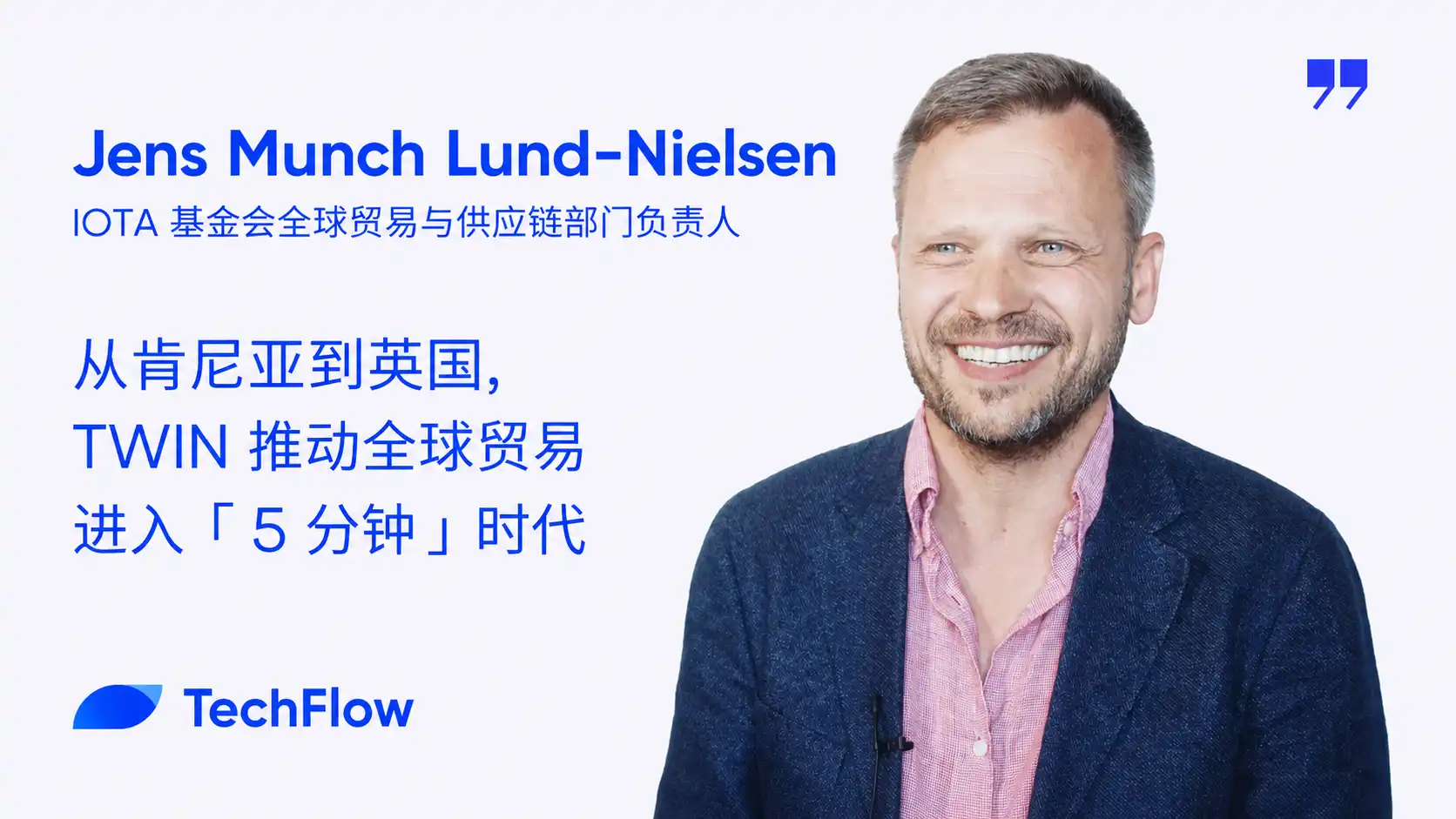
On the occasion of TWIN's first anniversary, we had an in-depth conversation with Jens Munch Lund-Nielsen, Head of Global Trade & Supply Chain at the IOTA Foundation.

Before joining the IOTA Foundation, Jens worked in the strategy office of Maersk, one of the world's largest shipping companies, focusing on digital trade and public-private partnerships. There, he witnessed firsthand how the global trade system truly operates: vast but inefficient, high-friction and fragmented, with no single party able to truly coordinate everyone.

This experience gave Jens a clearer realization: global trade needs an open, neutral, decentralized infrastructure that supports multiple participants—governments, enterprises, ports—to exchange trusted data in real-time within the same system. This also became the core reason Jens chose to join the IOTA Foundation:

To drive TWIN's development, to move global trade from paper-based, siloed processes towards truly real-time, trusted, and interconnected digital collaboration workflows.

In this content, let's follow Jens's insights to see what, in the eyes of this seasoned trade professional, the real answer has been for the over-decade-long stagnation of global trade digitalization.
From Paper to Chain: Building a Global Trade Digital Collaboration Infrastructure

Deep Tide TechFlow: Before delving into TWIN, could you first briefly introduce yourself, including your background in global trade, and what was the opportunity that led you to join the TWIN project?

Jens:

Hello everyone, I am Jens Munch Lund-Nielsen, currently serving as Head of Global Trade & Supply Chain at the IOTA Foundation.

My background is primarily focused on technology, trade facilitation, and digital trade, with a particular emphasis on building digital products and supporting their global rollout and implementation.

Before joining IOTA, I served as Head of Digital Trade within Maersk's strategy office, focusing on integrating trade facilitation, public-private partnerships, and digital solutions into global supply chains.

The opportunity to work on TWIN appealed to me because I saw it as a unique chance to address long-standing structural inefficiencies in global trade through trusted digital systems and interoperable technology.

Deep Tide TechFlow: For those unfamiliar with the project, how would you describe TWIN? What is its core essence?

Jens:

At its essence, TWIN is a neutral digital infrastructure for global trade.

Today's trade system operates on fragmented systems and paper-based processes because no single party can coordinate all participants.

TWIN changes this: it provides a common foundational layer where businesses, governments, and various organizations can exchange data, documents, and assets in real-time and securely.

TWIN is an open, interoperable network that connects existing systems, reinforces trust through verifiable data, and enables cross-jurisdictional compliance without relying on a centralized owner.

Built on IOTA, TWIN combines distributed ledger technology with decentralized identity systems, ensuring each participant always retains control over their own data while enabling global collaboration.

Simply put:

TWIN is the infrastructure that moves global trade from paper-based, siloed operations towards real-time, trusted, and interconnected digital collaboration workflows.

Deep Tide TechFlow: What specific problem in global trade is TWIN dedicated to solving? Why has this problem remained unsolved for so long?

Jens:

Fundamentally, TWIN addresses a core coordination problem in global trade: the lack of a common, trusted infrastructure that all participants can use to seamlessly exchange data.

Today, trade still heavily relies on paper documents and fragmented systems. Information is repeatedly entered, delayed, and often inconsistent as it moves between exporters, importers, banks, ports, and customs authorities. This creates inefficiencies, increases risks, and limits supply chain transparency.

This problem has persisted, not due to a lack of technology, but due to a lack of 'neutrality'.

Most previous attempts at trade digitalization have essentially involved building permissioned platforms, often driven by specific companies, regions, or interest groups. While these solutions may be technically viable, they face a structural issue:

Other participants are often reluctant to adopt infrastructure perceived as 'controlled by others.' Without widespread trust and adoption, these systems fail to achieve the network effect scale required for global trade.

TWIN takes a different path. It offers an open, neutral, decentralized infrastructure where no single party owns or controls the entire system. This allows all participants to share data while retaining their sovereignty and meeting their respective regulatory requirements.

Scalable, Low-Cost, Decentralized: IOTA Underpins the TWIN Architecture

Deep Tide TechFlow: Why was IOTA chosen as the underlying infrastructure for TWIN?

Jens:

IOTA was chosen as the underlying infrastructure for TWIN because it meets the core requirements of a global trade system: scalability, cost-efficiency, and neutrality.

Built on a DAG architecture, IOTA offers high scalability, capable of processing a massive volume of transactions and data exchanges in parallel, which is crucial for global trade where millions of events, documents, and updates occur continuously across supply chains.

It also provides extremely low transaction costs, which is vital in trade scenarios due to the high-frequency interactions involved. If every document update, verification, or data exchange incurred a significant fee, costs would quickly become prohibitive at scale.

Beyond the technology itself, IOTA brings over a decade of experience building real-world infrastructure and a solid track record of delivery through collaboration with governments, enterprises, and standardization bodies.

Furthermore, and importantly, IOTA is designed as an open, neutral infrastructure, not controlled by a single corporate entity. This aligns perfectly with the fundamental needs of global trade, where trust and sovereignty are key prerequisites for adoption by diverse stakeholders.

Deep Tide TechFlow: How should we understand the relationship between TWIN and IOTA? Is TWIN an application layer, an ecosystem, or something more macro?

Jens:

The most appropriate way to understand TWIN is as a digital public infrastructure for global trade—a shared data and coordination layer connecting governments, businesses, and existing platforms.

Simply put, TWIN enables parties to exchange verified, immutable data across borders in real-time without relinquishing control.

IOTA sits underneath as the underlying infrastructure layer. It provides the decentralized trust layer, ensuring data integrity, auditability, and interoperability at scale.

From African Flowers to European Poultry: TWIN's Real-World Trade Scenario Implementations

Deep Tide TechFlow: What are the most concrete, real-world application scenarios currently being explored or implemented through TWIN?

Jens:

TWIN is already deployed in multiple real-world trade scenarios, effectively demonstrating how shared digital infrastructure reduces friction, increases transparency, and enhances efficiency in global supply chains.

The Trade and Logistics Information Pipeline (TLIP) project connects East African exporters, logistics service providers, and government agencies to a shared data pipeline. In pilot projects covering flower, coffee, and tea exports, document retrieval time for inspection purposes reduced from 6-7 hours to about 30 minutes, administrative workload decreased by 50%-60%, and exporters saved approximately $400 monthly on document processing costs.

TWIN was also tested in the UK government's 'Ecosystem of Trust Trials', involving around 2000 consignments of chilled poultry meat shipped from Poland to the UK. Border agencies gained earlier visibility of arriving goods (port health officials received data up to 20+ hours earlier than standard processes), enabling more effective resource allocation.

The UK's 'Digital Trade Testbed' will also trial TWIN to support the exchange of digital international trade information between UK ports and key border agencies.

Other implementation scenarios include:

The RESULD (Responsible Supply Chain and Logistics Due Diligence) project integrates TWIN for tracing fruit and vegetable supply chains between Kenya, the Netherlands, and the UK;

The MISSION (Maritime Instantaneous Optimisation) project is trialing TWIN to improve port operational efficiency;

Salus leverages TWIN to bring traceability to critical mineral supply chains, turning shipping and trade documents into verifiable digital assets for financial institutions to use in risk assessment and issuing trade finance;

Furthermore, the ADAPT project, led by the African Continental Free Trade Area Secretariat in collaboration with the IOTA Foundation, the Tony Blair Institute for Global Change, and the World Economic Forum, is advancing the development of a digital trade backbone for Africa, drawing on IOTA's architecture and TWIN's experience.

Deep Tide TechFlow: What are the typical reactions from governments and enterprises when they first encounter TWIN? Which areas currently show the highest acceptance?

Jens:

Upon encountering TWIN, governments and enterprises generally recognize its significant value.

On the government side, departments most directly involved in trade, such as Trade Ministries and Customs authorities under Finance Ministries, clearly perceive TWIN's immense potential to improve internal clearance processes, strengthen border control, and obtain better access to trusted data to prevent unauthorized or non-compliant goods from entering.

Within the private sector, the highest participation currently comes from transport service providers and freight forwarders, as they already handle a large volume of border and documentation processes on behalf of producers and growers. The broader industry also shows a similar level of anticipation and interest in the value TWIN can create.

At the same time, a crucial point to emphasize is: TWIN's true value derives from the network itself. The more participants connected to TWIN, the greater the value created by the entire system for all involved.

Deep Tide TechFlow: Trade is highly fragmented across different jurisdictions. How does TWIN handle interoperability between different systems, standards, and regulatory environments?

Jens:

International interoperability is one of TWIN's most critical value drivers, operating on multiple levels, a significant part of which involves ensuring systems 'speak the same language'.

To this end, we adopt globally recognized standards, such as data models from the United Nations Centre for Trade Facilitation and Electronic Business (UN/CEFACT) and the World Customs Organization (WCO), further supported and refined through the International Chamber of Commerce's Digital Standards Initiative (ICC DSI).

In terms of identity, interoperability is primarily driven by national identity registries. Through TWIN ID, we can connect a company's national-level digital identity with international standards, such as the Legal Entity Identifier (LEI) issued by the Global Legal Entity Identifier Foundation (GLEIF), which is also a partner in this initiative.

From a technical perspective, we also observe increasing convergence around standards like Decentralized Identifiers (DIDs) and Verifiable Credentials as defined by the World Wide Web Consortium (W3C).

Finally, legal interoperability is equally important. The United Nations Commission on International Trade Law (UNCITRAL) Model Law on Electronic Transferable Records (MLETR) framework is driving the legal recognition of digital trade documents, though its adoption depends on government ratification in each country.

Our experience is that work can begin even in countries that have not yet ratified MLETR; in such cases, we also assist governments in advancing this process, especially given the growing importance of this framework for trade finance scenarios.

Bridging Digital Silos, Filling the $2.5 Trillion Trade Finance Gap

Deep Tide TechFlow: How do you see global trade evolving over the next 5 to 10 years? What role will decentralized infrastructure play in this transformation?

Jens:

The international trade industry is vast and has been undergoing digital transformation over the past 10 to 15 years, with governments and enterprises upgrading their systems around standardized data models and the use of REST APIs. The missing piece today is connecting these 'digital silos' in a way that respects data sovereignty, data integrity, and controlled data sharing.

We are currently advancing projects in over eight countries, working closely with governments, and continue to see strong interest in this area. Therefore, I am optimistic:

In the coming years, a trusted 'connective layer' linking these systems will truly materialize and scale. Its potential impact on global trade, finance, and international trade agreements could be profound, making it an area especially worthy of attention.

Deep Tide TechFlow: If TWIN achieves large-scale success, what do you imagine its 'end state' would look like? Compared to today, how would global trade operate differently?

Jens:

Simply put, as global trade moves towards fully digital collaboration, many outdated processes will be replaced. Key areas like discovering new business partners or accessing financing will look fundamentally different from today.

Currently, there is an estimated $2.5 trillion trade finance gap globally, preventing many businesses from accessing the capital they need to participate efficiently in global trade.

With digital infrastructure solutions like TWIN, trusted data and verifiable digitalized processes could help unlock access to capital at scale, potentially reshaping the entire industry landscape and improving conditions for traders worldwide.


Трендові криптовалюти

Пов'язані питання

QWhat is TWIN, and what core problem in global trade does it aim to solve?

ATWIN is a neutral, open digital infrastructure for global trade built on IOTA. Its core essence is to provide a common foundational layer where businesses, governments, and ports can exchange real-time, secure, and verifiable data and assets. It aims to solve the long-standing coordination problem in global trade: the reliance on fragmented systems and paper-based processes. This fragmentation arises because no single party can coordinate all participants. TWIN offers a decentralized solution, allowing seamless data exchange without a centralized controller, bridging the 'digital silos' and moving trade towards real-time, trusted, and interconnected digital collaboration.

QWhy was IOTA chosen as the underlying infrastructure for TWIN?

AIOTA was chosen for TWIN due to its scalability, cost-efficiency, and neutrality, which are critical for global trade. IOTA's Directed Acyclic Graph (DAG) architecture enables high scalability for handling massive volumes of concurrent transactions and data exchanges typical in supply chains. It offers extremely low transaction costs, essential for frequent trade interactions. Furthermore, IOTA's decade of experience in building real-world infrastructure and its status as an open, neutral protocol not controlled by any single entity aligns perfectly with the need for trust and sovereignty among diverse global trade stakeholders.

QCan you provide specific examples of real-world applications where TWIN is currently being deployed or tested?

AYes. TWIN is deployed in several real-world scenarios: 1) The Trade & Logistics Information Pipeline (TLIP) in East Africa connects exporters, logistics providers, and governments. In pilot projects for flowers, coffee, and tea, it reduced document retrieval time from 6-7 hours to ~30 minutes, cut administrative work by 50-60%, and saved exporters about $400 monthly. 2) It was tested in the UK's 'Ecosystem of Trust Trials' for chilled poultry shipments from Poland, giving border agencies visibility up to 20 hours earlier. 3) It's part of the UK's 'Digital Trade Testbed' for exchanging digital trade information between ports and border agencies. Other applications include the RESULD project for fruit/veg traceability, MISSION for port efficiency, Salus for critical mineral supply chain traceability and trade finance, and ADAPT for building a digital trade backbone in Africa.

QHow does TWIN handle interoperability between different jurisdictions, systems, and regulatory environments?

ATWIN ensures international interoperability on multiple levels. It adopts globally recognized data standards from bodies like UN/CEFACT and the World Customs Organization (WCO). For identity, it leverages national digital identity registries and aligns them with international standards like the Legal Entity Identifier (LEI) through its TWIN ID system. Technically, it converges around standards like W3C's Decentralized Identifiers (DIDs) and Verifiable Credentials. Legally, it supports frameworks like the UNCITRAL Model Law on Electronic Transferable Records (MLETR) to give digital trade documents legal recognition, while also assisting governments in adopting such laws where they are not yet in place.

QWhat potential impact could a successful, large-scale adoption of TWIN have on the future of global trade, particularly regarding trade finance?

ASuccessful large-scale adoption of TWIN could fundamentally transform global trade into a fully digitized, collaborative process. A key impact would be in addressing the global trade finance gap, estimated at $2.5 trillion. By providing trusted, verifiable data and digital processes, TWIN could unlock access to capital for businesses currently excluded. This would enable more efficient participation in global trade, reshape industry dynamics, and improve conditions for traders worldwide. Ultimately, the 'end state' would see outdated processes replaced, facilitating easier discovery of new business partners and revolutionizing access to financing.

Пов'язані матеріали

The Strategy That Would Never Sell Bitcoin Opened a Permanent Sales Channel

MicroStrategy, a company long known for its "never sell Bitcoin" mantra, announced a "Digital Credit Capital Framework" allowing it to sell up to $1.25 billion worth of Bitcoin. Surprisingly, its stock (MSTR) rose nearly 7% pre-market. This shift, coming just a month after a small, "ad-hoc" sale of 32 BTC for dividends, transitions from a temporary action to a formal, institutional tool. The framework outlines four clear purposes for potential sales: bolstering USD reserves, paying preferred stock dividends/interest, and repurchasing its own preferred and common stock. The key driver for this change is the immense financial pressure from MicroStrategy's complex capital structure, specifically its massive $8.5 billion perpetual preferred stock (STRC). STRC features a variable interest rate that has been reset upward eight times in a year to 12% in an attempt to stabilize its price. However, the stock has fallen over 25% below its face value. Combined with other preferred stocks and convertible notes, MicroStrategy's total annual fixed obligations now stand at $1.76 billion, equating to a daily burn of roughly $4.8 million. While its $2.55 billion in USD reserves and the new $1.25 billion BTC sales framework provide a two-year+ runway, a dangerous feedback loop exists. Falling Bitcoin prices would force the sale of more BTC to meet fixed obligations, potentially creating further sell-side pressure and lowering MSTR's asset valuation multiple. This, in turn, limits its ability to raise cash through stock issuance. The market's positive reaction likely stems from relief; the framework replaces fears of a forced, disorderly sell-off with a structured plan. However, it does not resolve the underlying high-cost capital structure, leaving the company's long-term health heavily dependent on Bitcoin's price performance.

marsbit29 хв тому

The Strategy That Would Never Sell Bitcoin Opened a Permanent Sales Channel

marsbit29 хв тому

OpenClaw and Cursor Just Invaded Phones! Agents Are Now in Your Pocket

AI Agents have officially arrived on mobile. In a landmark move, both OpenClaw and Cursor launched native mobile apps on the same day, fundamentally shifting how AI assistants are accessed and controlled. OpenClaw has released full-featured native apps for iOS and Android. Its "local-first" architecture, developed by the OpenClaw Foundation, keeps user data private by running the agent on a user's private Gateway. The mobile app now allows seamless remote control and approval of the agent's actions directly from a smartphone, with access to device capabilities like the camera, GPS, and contacts. Simultaneously, Cursor, the AI-powered coding tool, launched a public beta of its native iOS app. It enables developers to start and manage cloud-based AI coding agents from their phones. These agents can work asynchronously for extended periods—debugging, writing code, and creating pull requests—while developers are away from their computers. The app sends notifications for key decisions, allowing users to review and merge PRs from anywhere. Together, these releases signal a major shift: AI agents are no longer confined to desktop browsers or terminals. They are becoming persistent, autonomous assistants that work independently in the cloud, with humans transitioning from constant operators to mobile supervisors who approve key steps. The era of pocket-sized, on-demand AI is now here.

marsbit42 хв тому

OpenClaw and Cursor Just Invaded Phones! Agents Are Now in Your Pocket

marsbit42 хв тому

Торгівля

Спот

Популярні статті

Що таке $S$

Розуміння SPERO: Комплексний огляд Вступ до SPERO Оскільки ландшафт інновацій продовжує еволюціонувати, виникнення технологій web3 та криптовалютних проектів відіграє ключову роль у формуванні цифрового майбутнього. Один з проектів, який привернув увагу в цій динамічній сфері, — це SPERO, позначений як SPERO,$$s$. Ця стаття має на меті зібрати та представити детальну інформацію про SPERO, щоб допомогти ентузіастам та інвесторам зрозуміти його основи, цілі та інновації в рамках web3 та крипто-сектору. Що таке SPERO,$$s$? SPERO,$$s$ — це унікальний проект у криптопросторі, який прагне використати принципи децентралізації та технології блокчейн для створення екосистеми, що сприяє залученню, корисності та фінансовій інклюзії. Проект розроблений для полегшення взаємодії між користувачами новими способами, надаючи їм інноваційні фінансові рішення та послуги. У своїй основі SPERO,$$s$ прагне надати можливості індивідам, забезпечуючи інструменти та платформи, які покращують користувацький досвід у криптовалютному просторі. Це включає в себе можливість більш гнучких методів транзакцій, сприяння ініціативам, що підтримуються спільнотою, та створення шляхів для фінансових можливостей через децентралізовані додатки (dApps). Основна концепція SPERO,$$s$ обертається навколо інклюзивності, прагнучи зменшити розриви в традиційній фінансовій системі, використовуючи переваги технології блокчейн. Хто є творцем SPERO,$$s$? Особистість творця SPERO,$$s$ залишається дещо невідомою, оскільки є обмежені публічно доступні ресурси, що надають детальну інформацію про його засновників. Ця відсутність прозорості може бути наслідком зобов'язання проекту до децентралізації — етики, яку багато проектів web3 поділяють, ставлячи колективні внески вище за індивідуальне визнання. Зосереджуючи обговорення навколо спільноти та її колективних цілей, SPERO,$$s$ втілює суть наділення без виділення конкретних осіб. Таким чином, розуміння етики та місії SPERO є більш важливим, ніж ідентифікація єдиного творця. Хто є інвесторами SPERO,$$s$? SPERO,$$s$ підтримується різноманітними інвесторами, починаючи від венчурних капіталістів до ангельських інвесторів, які прагнуть сприяти інноваціям у крипто-секторі. Зосередження цих інвесторів зазвичай узгоджується з місією SPERO — пріоритет надається проектам, які обіцяють технологічний прогрес у суспільстві, фінансову інклюзію та децентралізоване управління. Ці інвесторські фонди зазвичай зацікавлені в проектах, які не лише пропонують інноваційні продукти, але й позитивно впливають на спільноту блокчейн та її екосистеми. Підтримка з боку цих інвесторів підкріплює SPERO,$$s$ як значного конкурента в швидко змінюваній сфері крипто-проектів. Як працює SPERO,$$s$? SPERO,$$s$ використовує багатогранну структуру, яка відрізняє його від традиційних криптовалютних проектів. Ось деякі ключові особливості, які підкреслюють його унікальність та інноваційність: Децентралізоване управління: SPERO,$$s$ інтегрує моделі децентралізованого управління, надаючи користувачам можливість активно брати участь у процесах прийняття рішень щодо майбутнього проекту. Цей підхід сприяє відчуттю власності та відповідальності серед членів спільноти. Корисність токена: SPERO,$$s$ використовує свій власний криптовалютний токен, розроблений для виконання різних функцій в екосистемі. Ці токени дозволяють здійснювати транзакції, отримувати винагороди та полегшувати послуги, що пропонуються на платформі, підвищуючи загальну залученість та корисність. Шарова архітектура: Технічна архітектура SPERO,$$s$ підтримує модульність та масштабованість, що дозволяє безперешкодно інтегрувати додаткові функції та додатки в міру розвитку проекту. Ця адаптивність є надзвичайно важливою для збереження актуальності в постійно змінюваному крипто-ландшафті. Залучення спільноти: Проект підкреслює ініціативи, що підтримуються спільнотою, використовуючи механізми, які стимулюють співпрацю та зворотний зв'язок. Підтримуючи сильну спільноту, SPERO,$$s$ може краще задовольняти потреби користувачів та адаптуватися до ринкових тенденцій. Фокус на інклюзію: Пропонуючи низькі комісії за транзакції та зручні інтерфейси, SPERO,$$s$ прагне залучити різноманітну базу користувачів, включаючи осіб, які раніше не брали участі в крипто-просторі. Це зобов'язання до інклюзії узгоджується з його загальною місією наділення через доступність. Хронологія SPERO,$$s$ Розуміння історії проекту надає важливі уявлення про його розвиток та етапи. Нижче наведено пропоновану хронологію, що відображає значні події в еволюції SPERO,$$s$: Етап концептуалізації та ідеації: Початкові ідеї, що стали основою SPERO,$$s$, були сформовані, тісно пов'язані з принципами децентралізації та фокусом на спільноті в індустрії блокчейн. Запуск білого паперу проекту: Після концептуального етапу був випущений комплексний білий папір, що детально описує бачення, цілі та технологічну інфраструктуру SPERO,$$s$, щоб залучити інтерес та зворотний зв'язок від спільноти. Створення спільноти та ранні залучення: Активні зусилля були спрямовані на створення спільноти ранніх прихильників та потенційних інвесторів, що полегшило обговорення цілей проекту та отримання підтримки. Подія генерації токенів: SPERO,$$s$ провів подію генерації токенів (TGE) для розподілу своїх рідних токенів серед ранніх прихильників та встановлення початкової ліквідності в екосистемі. Запуск початкового dApp: Перший децентралізований додаток (dApp), пов'язаний з SPERO,$$s$, став доступним, дозволяючи користувачам взаємодіяти з основними функціями платформи. Постійний розвиток та партнерства: Безперервні оновлення та вдосконалення пропозицій проекту, включаючи стратегічні партнерства з іншими учасниками блокчейн-простору, сформували SPERO,$$s$ у конкурентоспроможного та еволюціонуючого гравця на крипто-ринку. Висновок SPERO,$$s$ є свідченням потенціалу web3 та криптовалют для революціонізації фінансових систем та наділення індивідів. Завдяки зобов'язанню до децентралізованого управління, залучення спільноти та інноваційно спроектованих функцій, він прокладає шлях до більш інклюзивного фінансового ландшафту. Як і з будь-якими інвестиціями в швидко змінюваному крипто-просторі, потенційним інвесторам та користувачам рекомендується ретельно досліджувати та обдумано взаємодіяти з поточними подіями в SPERO,$$s$. Проект демонструє інноваційний дух крипто-індустрії, запрошуючи до подальшого дослідження його численних можливостей. Хоча подорож SPERO,$$s$ ще триває, його основні принципи можуть справді вплинути на майбутнє того, як ми взаємодіємо з технологією, фінансами та один з одним у взаємопов'язаних цифрових екосистемах.

112 переглядів усьогоОпубліковано 2024.12.17Оновлено 2024.12.17

Що таке $S$

Що таке AGENT S

Агент S: Майбутнє автономної взаємодії в Web3 Вступ У постійно змінюваному ландшафті Web3 та криптовалюти інновації постійно переосмислюють, як люди взаємодіють з цифровими платформами. Один з таких новаторських проектів, Агент S, обіцяє революціонізувати взаємодію людини з комп'ютером через свою відкриту агентну структуру. Прокладаючи шлях для автономних взаємодій, Агент S прагне спростити складні завдання, пропонуючи трансформаційні застосування в штучному інтелекті (ШІ). Це детальне дослідження заглиблюється в складності проекту, його унікальні особливості та наслідки для сфери криптовалюти. Що таке Агент S? Агент S є революційною відкритою агентною структурою, спеціально розробленою для вирішення трьох основних викликів в автоматизації комп'ютерних завдань: Набуття специфічних знань у галузі: Структура інтелектуально навчається з різних зовнішніх джерел знань та внутрішнього досвіду. Цей подвійний підхід дозволяє їй створити багатий репозиторій специфічних знань у галузі, покращуючи її продуктивність у виконанні завдань. Планування на довгих горизонтах завдань: Агент S використовує планування з підкріпленням досвіду, стратегічний підхід, який полегшує ефективний розподіл та виконання складних завдань. Ця функція значно підвищує її здатність ефективно та результативно управляти кількома підзавданнями. Обробка динамічних, неоднорідних інтерфейсів: Проект представляє Інтерфейс Агент-Комп'ютер (ACI), інноваційне рішення, яке покращує взаємодію між агентами та користувачами. Використовуючи багатомодальні великі мовні моделі (MLLMs), Агент S може безперешкодно орієнтуватися та маніпулювати різноманітними графічними інтерфейсами користувача. Завдяки цим новаторським функціям Агент S надає надійну структуру, яка вирішує складнощі, пов'язані з автоматизацією людської взаємодії з машинами, прокладаючи шлях для численних застосувань у ШІ та за його межами. Хто є творцем Агент S? Хоча концепція Агент S є фундаментально новаторською, конкретна інформація про його творця залишається невідомою. Творець наразі невідомий, що підкреслює або початкову стадію проекту, або стратегічний вибір зберегти засновників у таємниці. Незважаючи на анонімність, акцент залишається на можливостях та потенціалі структури. Хто є інвесторами Агент S? Оскільки Агент S є відносно новим у криптографічній екосистемі, детальна інформація про його інвесторів та фінансових спонсорів не задокументована. Відсутність публічно доступних відомостей про інвестиційні фонди або організації, що підтримують проект, викликає питання щодо його фінансової структури та дорожньої карти розвитку. Розуміння підтримки є критично важливим для оцінки стійкості проекту та потенційного впливу на ринок. Як працює Агент S? В основі Агент S лежить передова технологія, яка дозволяє йому ефективно функціонувати в різних умовах. Його операційна модель побудована навколо кількох ключових функцій: Взаємодія з комп'ютером, подібна до людської: Структура пропонує розширене планування ШІ, прагнучи зробити взаємодії з комп'ютерами більш інтуїтивними. Імітуючи людську поведінку при виконанні завдань, вона обіцяє підвищити досвід користувачів. Наративна пам'ять: Використовується для використання високорівневого досвіду, Агент S використовує наративну пам'ять для відстеження історій завдань, тим самим покращуючи свої процеси прийняття рішень. Епізодична пам'ять: Ця функція надає користувачам покрокові інструкції, дозволяючи структурі пропонувати контекстуальну підтримку в міру виконання завдань. Підтримка OpenACI: Завдяки можливості працювати локально, Агент S дозволяє користувачам зберігати контроль над своїми взаємодіями та робочими процесами, узгоджуючи з децентралізованою етикою Web3. Легка інтеграція з зовнішніми API: Його універсальність і сумісність з різними платформами ШІ забезпечують те, що Агент S може безперешкодно вписатися в існуючі технологічні екосистеми, роблячи його привабливим вибором для розробників та організацій. Ці функціональні можливості колективно сприяють унікальному положенню Агент S у крипто-просторі, оскільки він автоматизує складні, багатоступеневі завдання з мінімальним втручанням людини. У міру розвитку проекту його потенційні застосування в Web3 можуть переосмислити, як відбуваються цифрові взаємодії. Хронологія Агент S Розробка та етапи Агент S можуть бути узагальнені в хронології, яка підкреслює його значні події: 27 вересня 2024 року: Концепція Агент S була представлена в комплексній науковій статті під назвою “Відкрита агентна структура, яка використовує комп'ютери як людина”, що демонструє основи проекту. 10 жовтня 2024 року: Наукова стаття була опублікована на arXiv, пропонуючи детальне дослідження структури та її оцінки продуктивності на основі бенчмарку OSWorld. 12 жовтня 2024 року: Було випущено відеопрезентацію, що надає візуальне уявлення про можливості та особливості Агент S, ще більше залучаючи потенційних користувачів та інвесторів. Ці маркери в хронології не лише ілюструють прогрес Агент S, але й вказують на його прихильність до прозорості та залучення громади. Ключові моменти про Агент S У міру розвитку структури Агент S кілька ключових характеристик виділяються, підкреслюючи її новаторський характер та потенціал: Інноваційна структура: Розроблена для забезпечення інтуїтивного використання комп'ютерів, подібного до людської взаємодії, Агент S пропонує новий підхід до автоматизації завдань. Автономна взаємодія: Здатність автономно взаємодіяти з комп'ютерами через GUI означає стрибок до більш інтелектуальних та ефективних обчислювальних рішень. Автоматизація складних завдань: Завдяки своїй надійній методології він може автоматизувати складні, багатоступеневі завдання, роблячи процеси швидшими та менш схильними до помилок. Безперервне вдосконалення: Механізми навчання дозволяють Агенту S покращуватися на основі минулого досвіду, постійно підвищуючи свою продуктивність та ефективність. Універсальність: Його адаптивність до різних операційних середовищ, таких як OSWorld та WindowsAgentArena, забезпечує його здатність служити широкому спектру застосувань. Оскільки Агент S займає своє місце в ландшафті Web3 та криптовалюти, його потенціал покращити можливості взаємодії та автоматизувати процеси означає значний прогрес у технологіях ШІ. Завдяки своїй інноваційній структурі Агент S є прикладом майбутнього цифрових взаємодій, обіцяючи більш безперешкодний та ефективний досвід для користувачів у різних галузях. Висновок Агент S представляє собою сміливий крок вперед у поєднанні ШІ та Web3, з можливістю переосмислити, як ми взаємодіємо з технологією. Хоча проект все ще на ранніх стадіях, можливості для його застосування є величезними та переконливими. Завдяки своїй комплексній структурі, що вирішує критичні виклики, Агент S прагне вивести автономні взаємодії на передній план цифрового досвіду. У міру того, як ми заглиблюємося в сфери криптовалюти та децентралізації, проекти, подібні до Агент S, безсумнівно, відіграватимуть ключову роль у формуванні майбутнього технологій та співпраці людини з комп'ютером.

740 переглядів усьогоОпубліковано 2025.01.14Оновлено 2025.01.14

Що таке AGENT S

Як купити S

Ласкаво просимо до HTX.com! Ми зробили покупку Sonic (S) простою та зручною. Дотримуйтесь нашої покрокової інструкції, щоб розпочати свою криптовалютну подорож.Крок 1: Створіть обліковий запис на HTXВикористовуйте свою електронну пошту або номер телефону, щоб зареєструвати обліковий запис на HTX безплатно. Пройдіть безпроблемну реєстрацію й отримайте доступ до всіх функцій.ЗареєструватисьКрок 2: Перейдіть до розділу Купити крипту і виберіть спосіб оплатиКредитна/дебетова картка: використовуйте вашу картку Visa або Mastercard, щоб миттєво купити Sonic (S).Баланс: використовуйте кошти з балансу вашого рахунку HTX для безперешкодної торгівлі.Треті особи: ми додали популярні способи оплати, такі як Google Pay та Apple Pay, щоб підвищити зручність.P2P: Торгуйте безпосередньо з іншими користувачами на HTX.Позабіржова торгівля (OTC): ми пропонуємо індивідуальні послуги та конкурентні обмінні курси для трейдерів.Крок 3: Зберігайте свої Sonic (S)Після придбання Sonic (S) збережіть його у своєму обліковому записі на HTX. Крім того, ви можете відправити його в інше місце за допомогою блокчейн-переказу або використовувати його для торгівлі іншими криптовалютами.Крок 4: Торгівля Sonic (S)Легко торгуйте Sonic (S) на спотовому ринку HTX. Просто увійдіть до свого облікового запису, виберіть торгову пару, укладайте угоди та спостерігайте за ними в режимі реального часу. Ми пропонуємо зручний досвід як для початківців, так і для досвідчених трейдерів.

1.6k переглядів усьогоОпубліковано 2025.01.15Оновлено 2026.06.02

Як купити S

Обговорення

Ласкаво просимо до спільноти HTX. Тут ви можете бути в курсі останніх подій розвитку платформи та отримати доступ до професійної ринкової інформації. Нижче представлені думки користувачів щодо ціни S (S).

活动图片