Data Modeling: How to Improve the Quality of Interaction on Polymarket?

Odaily星球日报Опубліковано о 2026-02-22Востаннє оновлено о 2026-02-22

Анотація

Polymarket, a leading prediction market platform, is anticipated to have one of the largest airdrops in the sector. This analysis provides a data-driven strategy to optimize user interactions for potential rewards. A critical finding is that public dashboards often double-count trading volume by including both sides of a trade. The true, single-sided figure is likely half of what is displayed, which will be the metric Polymarket uses internally. User distribution data reveals extreme concentration: only 0.51% of addresses profited over $1,000, and a mere 1.74% traded over $50,000. Crucially, 79% of traders have never earned even $1 in liquidity provider (LP) rewards, making LP activity a currently undervalued and highly capital-efficient interaction. Historical airdrop precedents suggest rewards will be based on active behavior—not profitability—to avoid favoring insiders. A multi-dimensional model is predicted, likely featuring: * 40% weight on trade volume (using a square root compression formula to limit whale dominance). * 35% weight on LP rewards. * 15% weight on market diversity (number of distinct markets traded in). * 10% weight on longevity (months active). The analysis advises users to accumulate genuine, on-chain provable volume across diverse markets, hold positions for 1-24 hours, and, most importantly, begin providing liquidity to accumulate LP rewards, which are a strong anti-Sybil signal. A hard cap per address is also expected to prevent excessive...

This article is from:arise

Compiled by | Odaily Planet Daily (@OdailyChina); Translator | Azuma (@azuma_eth)

The core content of this article is only one — how to prepare for the potential largest airdrop in the prediction market track.

Data Issues That Must Be Declared

Before building each model, we need real and reliable data. The trading volume data of Polymarket has been widely misreported.
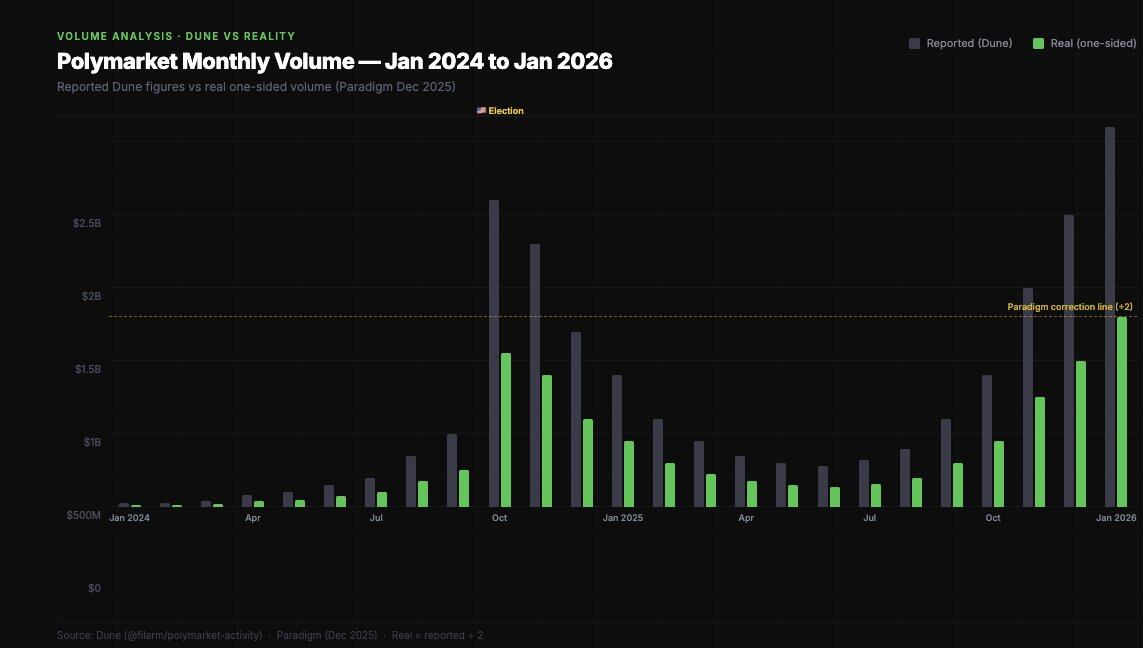
Paradigm published a key finding in a study in December 2025: Most Polymarket data dashboards count trading volume by summing all "OrderFilled" events, but this event is triggered on both the maker and taker sides of the same transaction, resulting in double counting. The actual trading volume is only about half of the number presented on the dashboards.

Dashboard volume vs. one-sided volume — the latter is the number that truly matters in airdrop modeling.
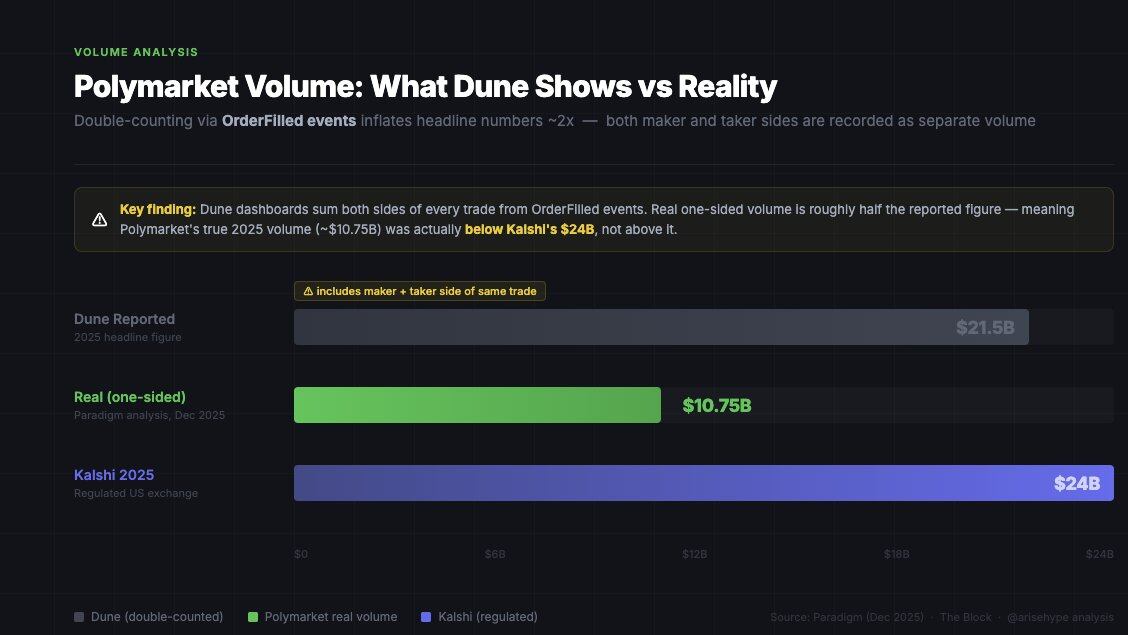
This is crucial for airdrop modeling. If Polymarket considers trading volume as a metric, they will only use internal data, not the various statistics on Dune. Your actual volume "score" is likely only half of what tools like Polycool show.

User Distribution

Regarding airdrop speculation, the most important dataset comes from a study by IMDEA Networks Institute, which covered over 86 million transactions (April 2024 – April 2025).

  • Only 0.51% of addresses achieved profits exceeding $1,000;
  • Only 1.74% of addresses (estimated) had a trading volume exceeding $50,000;
  • The top 3 arbitrage addresses alone extracted $4.2 million in "risk-free profits";
  • The top traders could profit over ten million dollars.
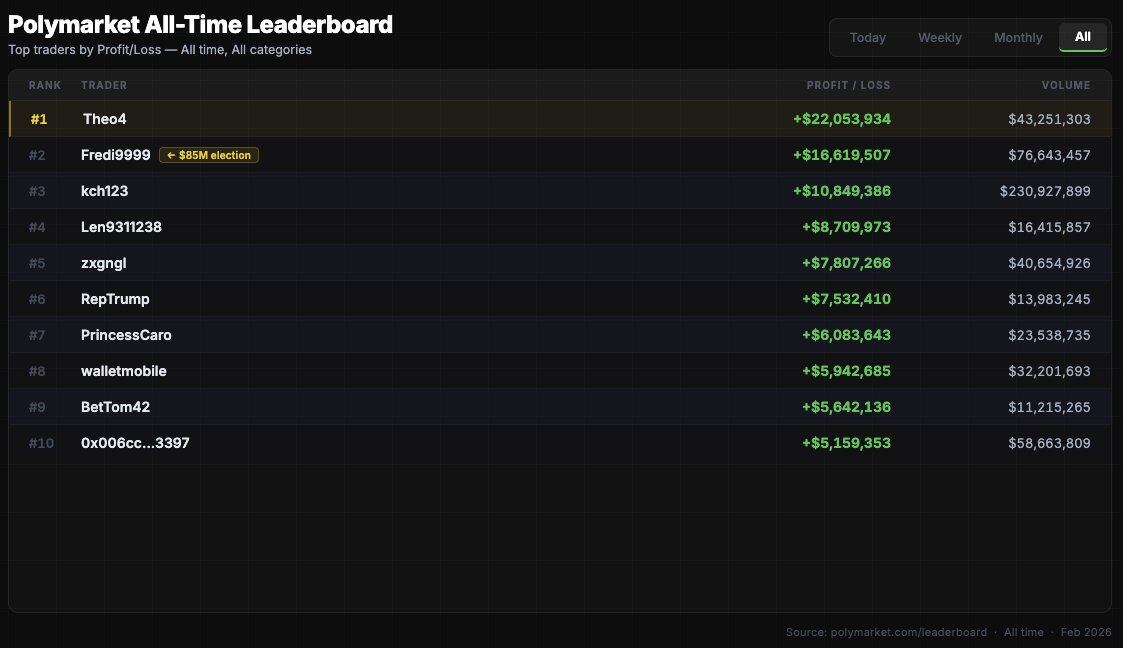
In terms of LP rewards, the stratification is even more pronounced.
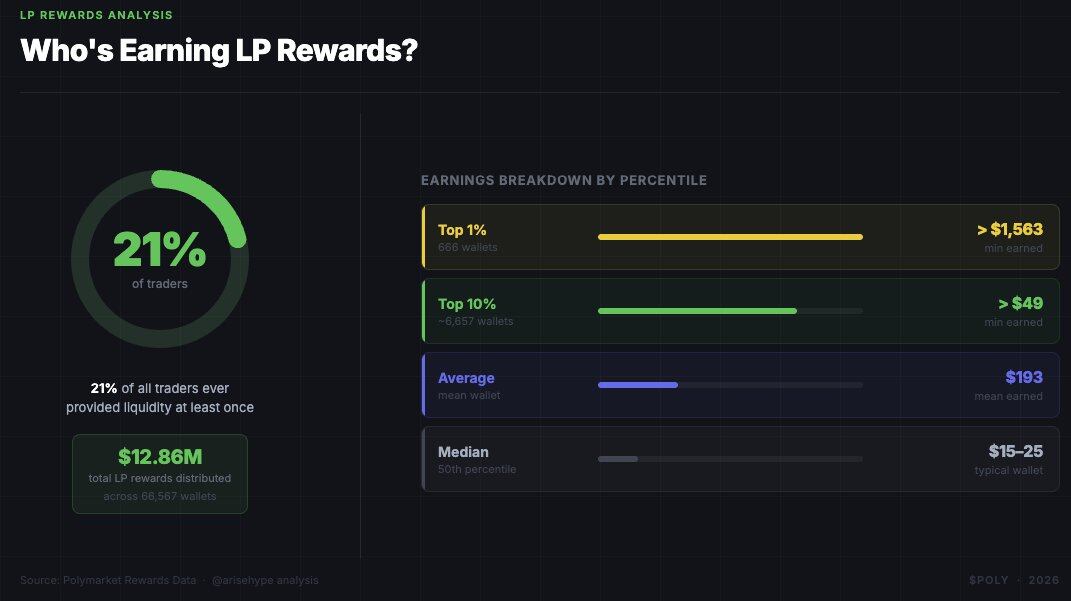
79% of traders have never earned even $1 in LP rewards — this is currently the most overlooked interactive behavior. Among 314,000 traders, only 66,567 wallets have ever received LP rewards. This means only 21% of traders have ever provided liquidity. Compared to overall participation, this reward mechanism is clearly neglected.

Lower usage is generally seen as a signal of being "undervalued" in airdrop models.

Airdrop Precedents: What Has History Told Us?
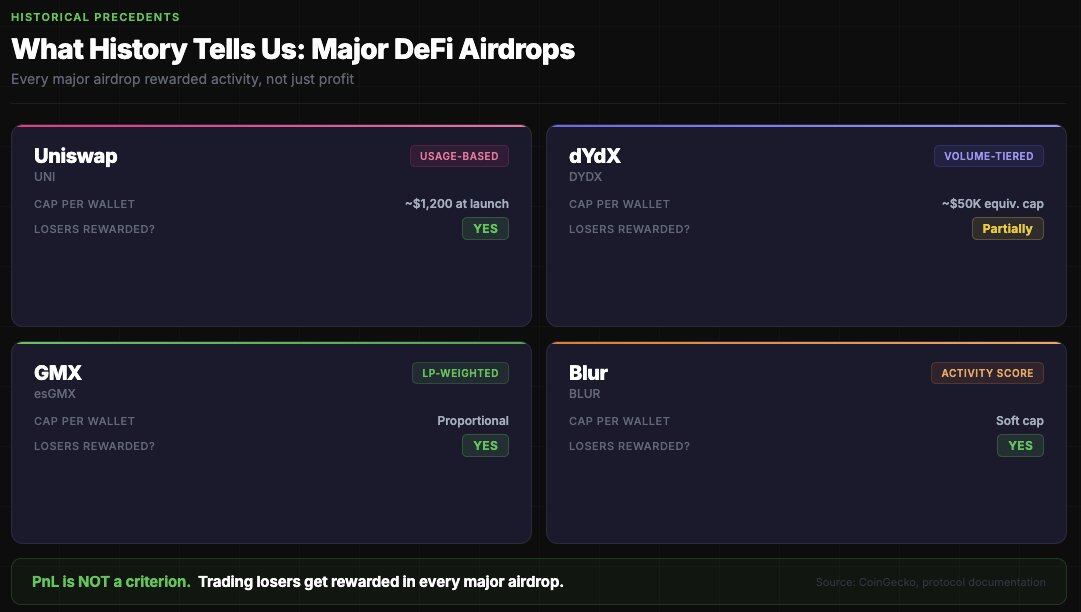
All major DeFi airdrops reward "active behavior," not "profitability." Polymarket will follow the same logic.

Commonalities of all large-scale airdrops include:

  • Purely equal distribution would be abused by Sybil attacks (Polymarket will certainly not distribute equally);
  • Purely distributing based on trading volume would overly concentrate the airdrop on whales (PR risk + SEC risk);
  • Best strategy: tiered hierarchy + reward caps + multiple dimensions (volume + LP + diversity + active duration);
  • In all major airdrops, losers are also rewarded — PnL is not a criterion.

The last point is crucial: If you traded $100,000 and lost $20,000, you are more likely to be rewarded than someone who traded $1,000 and made $500. The platform does not want to only incentivize profitable trading — that would more easily screen for insiders.

Reverse Thinking: How to Limit Whales?

Some airdrop calculators on the market use the simplest volume ratio model: Airdrop share = Individual volume / Total volume × Airdrop amount.

This is wrong because mainstream airdrops consistently use a "diminishing curve."
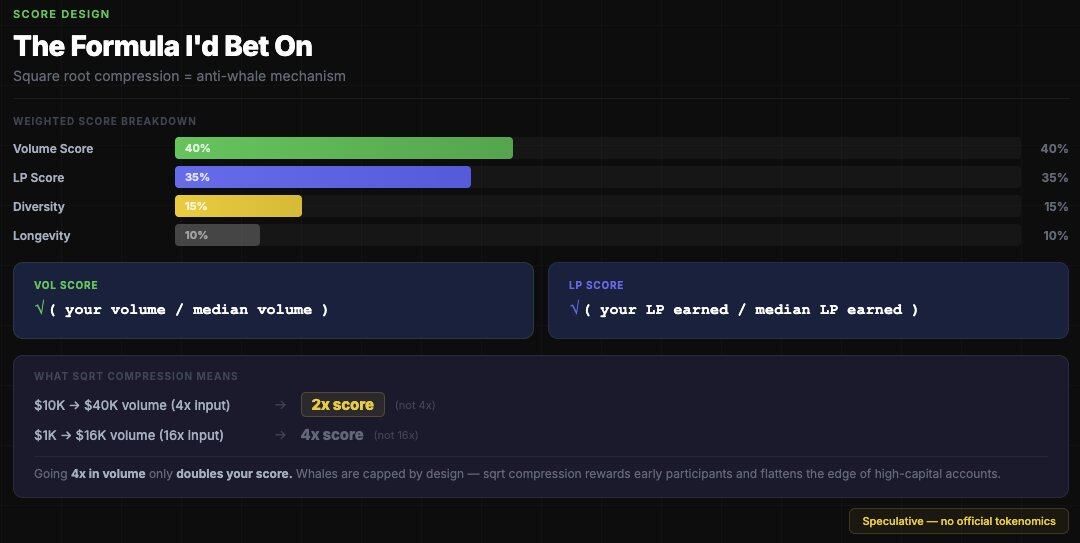
The model I'm more inclined to bet on is that Polymarket will use square root compression to limit the airdrop size for whales — for example, every 4x increase in volume only yields a 2x increase in score, which would completely change the airdrop results for the whale group.
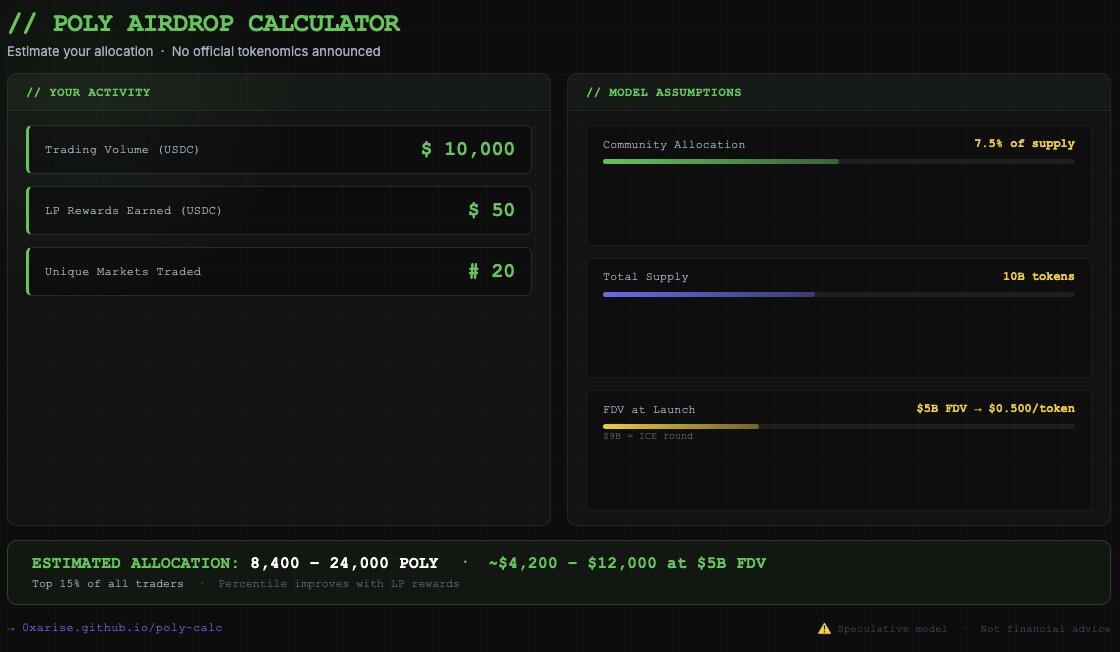
So how much would top wallets get? Assuming a total POLY supply of 10 billion, with 7.5% allocated for community airdrop (750 million POLY), and an FDV at TGE of $30–90 billion.

Without a cap on airdrop amount per address, for a volume of $85 million (taking top trader fredi999 as an example), the model estimates about 3–5 million POLY. At a $90 billion FDV, this is equivalent to $3–4.5 million. Theoretically possible, but the PR effect would be terrible.

A more realistic scenario is to cap the airdrop per address, e.g., the cap might be 500,000–2 million POLY. At a $5 billion FDV, top addresses could get about $450,000–$1 million.

"LP" vs. "Volume": Where is the Opportunity Now?

If you start interacting with Polymarket in February 2026 with a principal of $5,000, mathematically, deploying LP is a more favorable option for new participants.
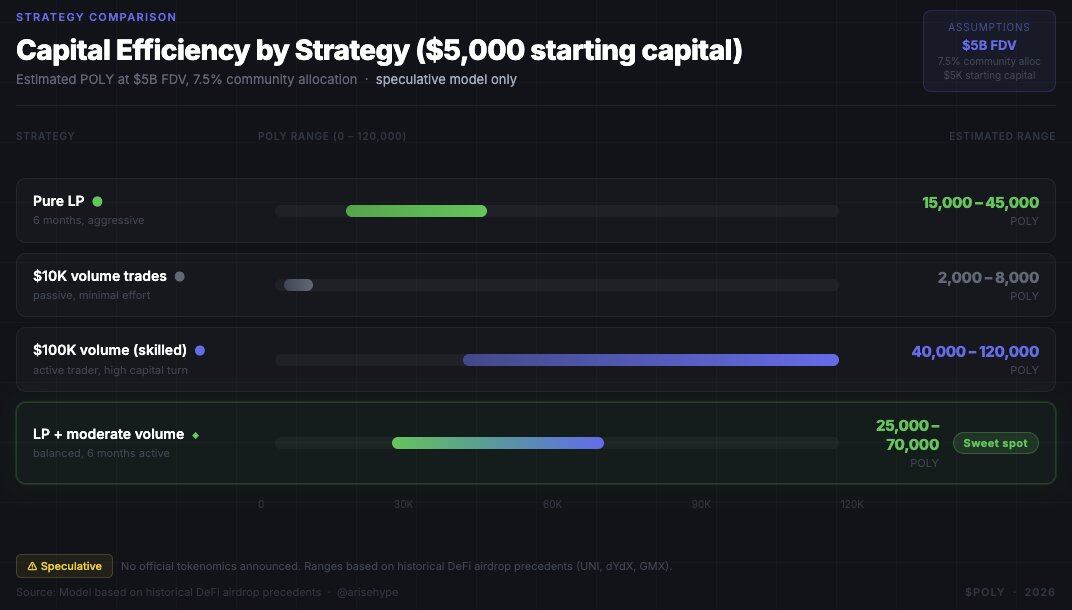
  • To earn $49 in LP rewards (top 10%), you need to consistently place limit orders in high-reward markets. This is achievable in 30–60 days using $500–$1,000 in capital.
  • To earn $1,563 in LP rewards (top 1%), higher capital or sustained high-frequency participation is required.
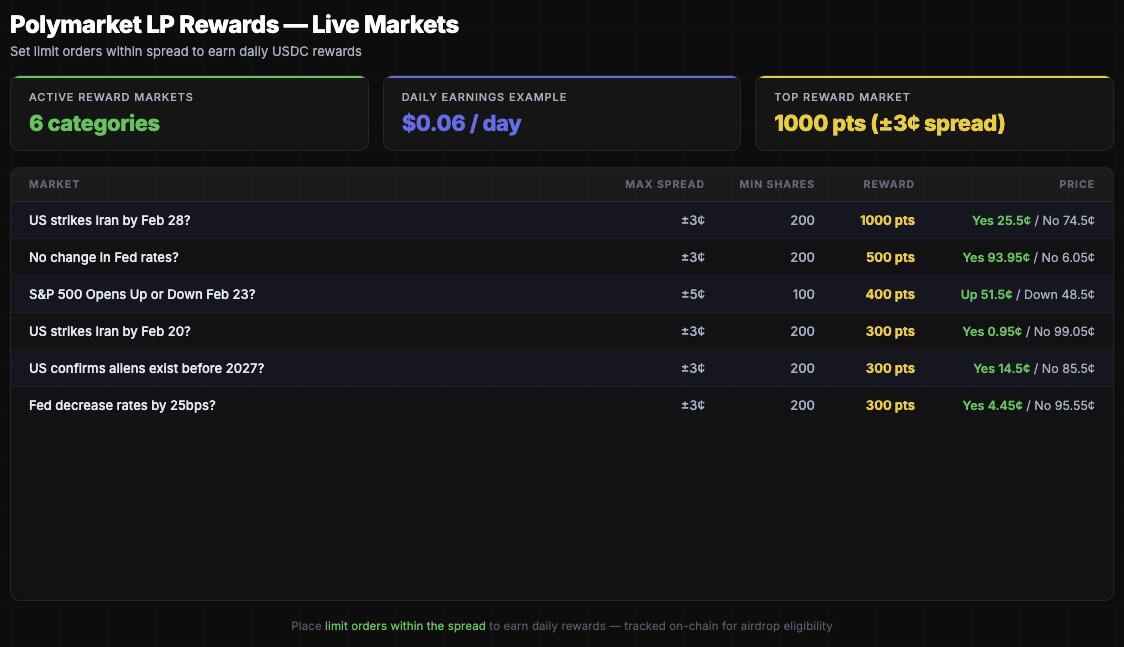
As for volume, you need to accumulate real volume without wash trading:

  1. Trade in 5 or more different categories of markets (politics, crypto, sports, science, culture);
  2. Hold positions for at least 1–24 hours before closing;
  3. Do not engage in wash trading the same market across different addresses;
  4. Lose money moderately — this is proof of "real participation";
  5. Target markets with volume > $500,000 (Polymarket might filter out micro markets);
  6. Single bet size: $50–$500.

Airdrop Model Speculation

The airdrop will not be as most people expect.

Most airdrop guesses are based on the simplest volume-weighted distribution, but Polymarket will do it smarter and more interestingly. They have on-chain LP data, which is clean, verifiable, and all measured in USD. They also have volume data that can filter out Sybil patterns. They also have wallet age, market diversity, and geographic distribution data.

This is my model — Polymarket has not confirmed anything, so this is just my speculation.

  • Volume weight: 40% — will use a square root compression formula, minimum threshold around $500;
  • LP reward weight: 35% — on-chain verifiable, Sybil-resistant;
  • Market diversity weight: 15% — number of unique markets participated in;
  • Active duration weight: 10% — number of active months before the snapshot.

Additionally, Polymarket will cap rewards per address (likely $500,000), otherwise the top 50 addresses would get too large a share, damaging the community narrative. Losers will receive the same reward as profiteers with equivalent volume; profitability is not a criterion — this cannot be philosophically justified and would create perverse incentives.

79% of traders have never received $1 in LP rewards. If LP weight accounts for 35% of the airdrop formula, the most capital-efficient behavior currently is to provide limit orders in high-volume markets and start accumulating on-chain verifiable proof of contribution.

In short, POLY could become the largest airdrop in the history of prediction markets. Calculated at a $9 billion FDV, the total value of the community airdrop could reach $450–$900 million. Even capturing just 0.1% of that is $450,000. This is why optimizing LP data now is more important than most people realize.


Пов'язані питання

QWhat is the key data issue highlighted in the article regarding Polymarket's volume reporting?

AThe key data issue is that most Polymarket data dashboards double-count volume by summing all 'OrderFilled' events, which fire on both the maker and taker sides of a trade. The true volume is approximately half of what is displayed on these dashboards.

QAccording to the research from IMDEA Networks Institute, what percentage of Polymarket traders have never earned even $1 in LP rewards?

AAccording to the research, 79% of Polymarket traders have never earned even $1 in LP rewards.

QWhat is a common characteristic of all major DeFi airdrops mentioned in the article?

AA common characteristic is that all major DeFi airdrops reward 'active behavior' rather than 'profitability'. Loss-making traders are also rewarded, as profitability is not a criterion.

QWhat is the proposed model for how the airdrop might be weighted across different user actions?

AThe proposed model suggests the airdrop might be weighted as follows: 40% for volume (using a square root compression formula), 35% for LP rewards, 15% for market diversity, and 10% for longevity (active months before the snapshot).

QWhy does the article suggest that providing liquidity (LP) is currently a more capital-efficient action for new participants seeking the airdrop?

AProviding liquidity is suggested as more capital-efficient because LP data is clean, on-chain, verifiable, and resistant to sybils. Furthermore, 79% of traders have never earned LP rewards, making it an underutilized activity that could carry significant weight in the airdrop formula.

Пов'язані матеріали

Gate Research Institute: The 'Wall Street-ization' Wave of Crypto Financial Products – Competition or Integration?

The article titled "Gate Research Institute: Are Crypto Financial Products Sparking a 'Wall Street' Wave—Competition or Convergence?" explores the evolving relationship between the crypto ecosystem and traditional finance (TradFi). The piece begins by reflecting on Bitcoin's original 2009 vision of decentralization, disintermediation, and moving away from banks. It then contrasts this with the 2024 landscape, where key crypto assets like Bitcoin are increasingly held through Wall Street products like ETFs issued by giants like BlackRock. The article questions whether this signifies that TradFi is systematically taking over the rights to issue, price, custody, and distribute crypto financial assets. The core argument is that this is not a zero-sum takeover but rather a bidirectional convergence where each side addresses the other's weaknesses. Crypto offers 24/7 global markets, programmable settlement, and open access but lacks compliant channels, institutional-grade custody, deep fiat liquidity, and mainstream distribution. TradFi possesses these but is constrained by legacy systems, limited operating hours, and slow settlement. Two primary convergence paths are highlighted: * **Path A (CEX to TradFi):** Exemplified by Gate, which has progressed from offering tokenized stocks and CFDs to providing direct, real stock trading (US, Hong Kong, South Korea) within its platform, using USDT. * **Path B (TradFi to Crypto):** Exemplified by Robinhood, which has integrated crypto trading, acquired exchanges like Bitstamp, and is moving traditional assets like stocks onto the blockchain via tokenization and its own Layer 2. Both paths are ultimately competing to become the next-generation, unified financial account—a "super account" where users can seamlessly trade cryptocurrencies, stocks, ETFs, RWA (Real World Assets), and tokenized treasury products in one interface. The growth of RWA and tokenized treasuries (e.g., BlackRock's BUIDL) is presented as the asset-layer fusion, providing stable, yield-bearing assets on-chain and acting as a bridge between the two worlds. In conclusion, the "Wall Street-ization" of crypto is framed as a mutual transformation. Decentralized ideals persist in the protocol layer, while at the application layer, a more efficient, global, and accessible unified capital market is emerging from this convergence. The future competition lies not between crypto exchanges and stockbrokers, but between platforms vying to offer the most comprehensive asset coverage, liquidity, and user experience within a single account.

marsbit4 хв тому

Gate Research Institute: The 'Wall Street-ization' Wave of Crypto Financial Products – Competition or Integration?

marsbit4 хв тому

Claude's Major New Feature: Screen Recording + Voice, Distilling Your Skills into AI Tasks in One Click

Claude has introduced a major new feature called "Record a Skill," available for Pro, Max, and Team users. This function, found in the Claude desktop app's CoWork menu, allows users to create reusable AI skills simply by recording their screen and providing voice narration while performing a task. Claude then automatically analyzes the recording and generates a functional Skill. A hands-on test confirmed the feature works seamlessly. Users start recording via the Skills manager, perform their workflow while verbally explaining the steps and logic, and avoid including sensitive information. After recording, Claude processes the content and creates the Skill, which can be saved and later invoked with a slash command (/). This eliminates the need for manual adjustments or writing complex instruction files. The innovation goes beyond mere efficiency. Previously, creating a Skill required writing a detailed SKILL.md file in Markdown—a significant barrier for non-technical users. "Record a Skill" bypasses this by directly capturing both actions and the implicit reasoning shared in the narration. This lowers the barrier to knowledge transfer and automation, addressing a core challenge in corporate knowledge management: the difficulty of getting experts to write and maintain documentation. However, the feature also highlights a shift in the nature of work. A case study from March 2026 showed a freelancer whose five-year client relationship was effectively replaced by a hand-coded Claude Skill automating their content workflow. With the even lower barrier of screen recording, the ability to distill personal expertise into automatable skills accelerates this trend. The "moat" for work is moving from simply knowing how to do a task to mastering tasks that are difficult or impossible to automate.

marsbit8 хв тому

Claude's Major New Feature: Screen Recording + Voice, Distilling Your Skills into AI Tasks in One Click

marsbit8 хв тому

Feeding AI "Noise" Can Also Boost Scores, This Work Enables Positive Transfer with Noise

Feeding "Noise" to AI Can Improve Performance: A Method Enables Positive Transfer from Noise This work, Semi-Supervised Noise Adaptation (SSNA), introduces a Noise Adaptation Framework (NAF) that challenges traditional transfer learning. Instead of requiring a labeled source domain of real data (e.g., images, text), NAF uses randomly generated Gaussian noise as the source. For a target task with C classes, it constructs C noise clusters by sampling from Gaussian distributions. Although this synthetic noise contains no semantic meaning, NAF trains it to form a discriminative class structure in a shared representation space—clustering same-class noise and separating different classes. The key is aligning this learned structure from the noise domain to the real, sparsely labeled target domain. A small number of target labels are still essential to establish the correspondence between noise clusters and actual classes. The training objective combines: 1) supervised loss on the few labeled target samples, 2) classification loss for the noise to build its structure, and 3) a distribution alignment loss (using Negative Domain Similarity) to minimize the gap between the noise and target domains in the shared space. Experiments show significant gains in few-label settings. With just 4 labels per class, NAF with a ResNet-18 backbone improves accuracy over a standard supervised baseline (ERM) by +12.35% on CIFAR-10, +7.61% on CIFAR-100, +4.38% on DTD-47, and +2.74% on Caltech-101. It also benefits fine-grained datasets and scales to ImageNet-1K (with 100 labels/class) and text classification (AG News). NAF can be integrated into existing semi-supervised methods like FixMatch for further gains. Ablation studies confirm the transferred benefit comes from the discriminative structure of the noise, not randomness itself. Collapsing all noise into a single point causes negative transfer, while increasing separation between noise cluster centers improves performance. The amount of noise per class is less critical once a basic structure forms. In conclusion, this work demonstrates that for positive transfer, the semantic content of source data may not be necessary. What can be effectively transferred is the *organizational structure* of categories within a representation space. This offers a promising alternative for scenarios where real source data is unavailable due to privacy, copyright, or procurement constraints.

marsbit10 хв тому

Feeding AI "Noise" Can Also Boost Scores, This Work Enables Positive Transfer with Noise

marsbit10 хв тому

Торгівля

Спот
活动图片