Data: 75% of Traders on Hyperliquid Are Losing Money. What Are the Profitable Ones Using?

marsbitОпубліковано о 2026-05-20Востаннє оновлено о 2026-05-20

Анотація

On Hyperliquid, approximately 75% of addresses are losing money, indicating that manual traders are increasingly competing against automated systems. Profitable traders primarily employ one of three approaches: 1) Running systematic, high-frequency strategies (e.g., one address executed 261k trades with a 64.75% win rate), 2) Placing high-conviction, asymmetric bets with large positions (e.g., 50 trades yielding $4.48M at a 28% win rate), or 3) Using algorithms for execution while making manual macro judgments. The article argues that traditional methods like chart patterns or reacting to social media news are often already priced in by bots, making such traders the "exit liquidity" for systematic players. Success now depends on unique narrative timing, structural insights, or conviction during market capitulation.

Author: Stacy Muur

Compiled by: Deep Tide TechFlow

Deep Tide Guide: Three-quarters of addresses on Hyperliquid are losing money. It's not bad luck; the rules of the game have changed. While you're still looking at candlestick patterns for formations, arbitrage bots have already made their profit. Data shows that truly profitable traders either use algorithmic systematic execution or place large bets on asymmetric opportunities with high conviction. Manual retail traders watching screens are becoming the exit liquidity for others.
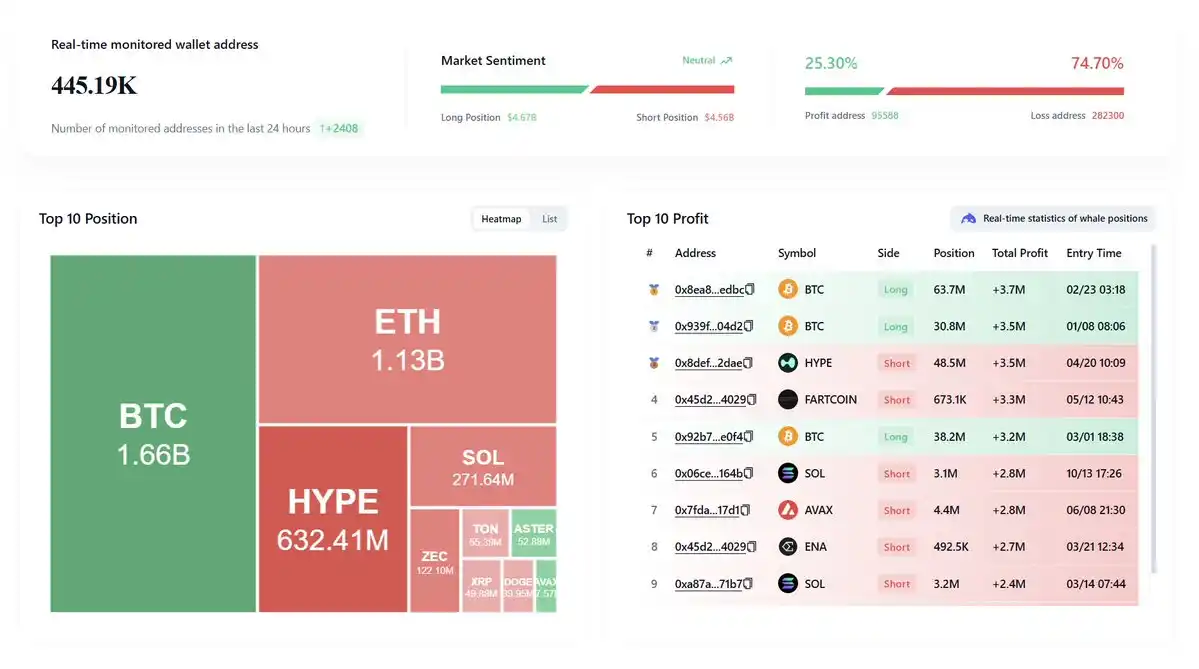
About 75% of addresses on Hyperliquid are in a loss-making position.

The reality is that people trading manually on Hyperliquid are competing against systems that never rest. The trading opportunity you just discovered has likely already been priced in by the system.

When you see a certain pattern, chances are it has already been arbitraged.

Extreme funding rates are balanced in an instant.

Technical patterns have already appeared across more than 50 order books.

News headlines are priced in as soon as they appear.

What the most profitable traders are doing:

→1. Running systematic strategies (the second most profitable address executed 261,000 trades this month with a 64.75% win rate)

→ 2. Holding high-conviction positions, betting on asymmetric returns (a wallet made $4.48 million with just 50 trades and a 28% win rate)

→ 3. Using algorithms as execution tools while making macro judgments manually

If you have timing in narratives, structural insight, or conviction when everyone else capitulates, you can still make profitable trades.

But if your trades are based on chart patterns or news you saw on X, you are likely just exit liquidity.


Пов'язані питання

QAccording to the article, what percentage of addresses on Hyperliquid are losing money, and what is presented as the primary reason?

AApproximately 75% of addresses on Hyperliquid are losing money. The primary reason is that manual traders are competing against automated, systemized strategies that execute trades faster and more efficiently, often pricing in opportunities before a human trader can act.

QWhat are the two main strategies used by the most profitable traders on Hyperliquid, as described in the article?

AThe two main strategies are: 1. Running systematic, automated strategies (one example executed 261,000 trades with a 64.75% win rate). 2. Holding high-conviction positions to bet on asymmetric opportunities (one wallet made $4.48M with only 50 trades, despite a 28% win rate).

QThe article suggests that several common trading signals are often ineffective. Name at least three of these signals.

AThree common but often ineffective signals mentioned are: 1. Technical chart patterns (which appear across many order books). 2. Extreme funding rates (which get arbitraged instantly). 3. News headlines (which are priced in immediately upon release).

QWhat role does the article suggest algorithms can play for a trader who still wants to make manual, high-level decisions?

AThe article suggests using algorithms as an execution tool. A trader can make macro or high-level directional judgments manually, and then use an algorithm to handle the rapid, systematic execution of trades based on that judgment.

QAccording to the article's conclusion, what kind of manual trader is most likely to succeed, and what kind is most likely to fail?

AA manual trader who succeeds is likely one acting on deep narrative timing, unique structural insights, or having strong conviction when others are capitulating. A manual trader who fails is likely one whose decisions are based on commonly seen chart patterns or news headlines found on social media (like X), as they become 'exit liquidity' for others.

Пов'язані матеріали

Valuation $1 Billion, Nvidia Doubles Down! Is Prime Intellect Washing Off Its Web3 Label?

Prime Intellect, a decentralized AI infrastructure company founded in 2024, recently announced a $130 million Series A funding round at a $1 billion valuation, with investments from NVIDIA, Intel, and Dell's venture arms. The company claims its annualized recurring revenue (ARR) has exceeded $100 million within a year, serving over 6,000 enterprise clients. Initially rooted in Web3 and decentralized science (DeSci), Prime Intellect has evolved into a full-stack AI training and deployment platform. Its core technology enables distributed training of large language models across globally dispersed, heterogeneous GPU clusters. Key milestones include releasing open-source models like INTELLECT-1 and INTELLECT-3, and launching Prime Intellect Lab, a platform allowing users to train and optimize agentic models without managing their own GPU infrastructure. The company's deep collaboration with hardware giants, particularly NVIDIA, extends beyond investment to joint optimization of software (e.g., integrating NVIDIA Dynamo) and hardware systems. A notable commercial case involves fintech company Ramp using Prime Lab to train a specialized agent, demonstrating the platform's applied value. While achieving rapid commercial growth, Prime Intellect has systematically downplayed its earlier Web3 and token-based incentives from its official documentation, repositioning itself as a mainstream AI infrastructure provider focused on enterprise adoption and potential IPO.

Foresight News17 хв тому

Valuation $1 Billion, Nvidia Doubles Down! Is Prime Intellect Washing Off Its Web3 Label?

Foresight News17 хв тому

After 13% Daily Distribution, Why Did SATA Still Fall?

Strive Asset Management's BTC-linked preferred stock SATA transitioned from monthly to daily dividend distributions on June 16, with a current annualized yield of 13%. Despite this change, SATA's price fell approximately 9.9% from June 22 to June 26. The analysis highlights that this decline reflects fundamental credit and structural risks, not simply dividend frequency. SATA represents a perpetual, cumulative preferred equity interest in Strive, not a direct Bitcoin-backed bond. Its dividends depend on Strive's corporate credit and access to capital markets. While Strive's Bitcoin holdings grew from 15,009 to 19,864 BTC between May 12 and June 18, SATA's outstanding shares grew faster (from ~4.96 million to ~7.83 million). Coupled with a drop in BTC price, the pure Bitcoin coverage ratio for SATA's stated amount fell from ~2.44x to ~1.52x. A further ~34.3% decline in BTC to ~$39,416 would bring this coverage to 1.0x. Daily dividends smooth cash flow for investors and reduce dividend-capture trading, but do not eliminate price volatility or credit risk. SATA now trades at a ~12.25% discount to its $100 stated amount, implying a market yield of ~14.81% and a credit spread of ~1,117 bps over SOFR. Key risks include a negative feedback loop if SATA trades below par, making new issuance dilutive; reliance on capital markets for dividend funding despite a ~17-month cash buffer; and the perpetual nature of the security, where dividends can be deferred. In summary, SATA innovates by providing daily income from a Bitcoin-focused corporate balance sheet, but its recent price action underscores its exposure to Bitcoin valuation, company-specific financing risks, and perpetual duration. The market is repricing it from a near-par yield product to a deeply discounted high-risk credit instrument.

marsbit45 хв тому

After 13% Daily Distribution, Why Did SATA Still Fall?

marsbit45 хв тому

Unlocking 20%, $125 Million in Pressure, Can PUMP Hold Up?

"Pump.fun Faces Crucial Test with $125M Token Unlock Despite a cooldown in the meme coin market, Pump.fun remains one of Web3's top revenue-generating protocols, earning $28.4 million in the past 30 days. The platform has accumulated approximately $1.05 billion in total revenue from over 12 million tokens created. The protocol now faces its biggest challenge: the first unlock of team and investor tokens. A total of 82.5 billion PUMP tokens (8.25% of total supply, 20.23% of previous circulating supply), valued at around $125 million, have been unlocked. This potential selling pressure is significant compared to the token's 24-hour trading volume of only $28 million. While Pump.fun uses a portion of its revenue to buy back and burn PUMP tokens, creating buy-side pressure, this support has weakened. The buyback rate was reduced from 100% to 50% of net fees in April 2024. In June 2024, monthly buybacks totaled just $9.2 million, an over 80% drop from its peak. At this rate, selling just 7% of the newly unlocked tokens would offset a full month of buybacks. Furthermore, this unlock is only the first batch; team and investors still hold another 247.5 billion locked PUMP tokens, with 240 billion community tokens awaiting a release schedule. Despite these headwinds, PUMP is argued to be a relatively scarce asset in the current market. With a $610 million market cap against $28.4 million in monthly revenue, its valuation is lower than competitors like Hyperliquid. The investment thesis for PUMP is not betting on a single meme coin but on the persistent activity of the meme market and Pump.fun's ability to maintain its position as a key platform. The conclusion suggests that while the unlock tests short-term price resilience, the protocol's underlying revenue strength will determine PUMP's long-term trajectory, potentially making the current dip a viable entry point for long-term accumulation."

Odaily星球日报58 хв тому

Unlocking 20%, $125 Million in Pressure, Can PUMP Hold Up?

Odaily星球日报58 хв тому

Aave Withdrawal, TVL Plunges: Where is MegaETH's Valuation Anchor?

MegaETH, once a highly anticipated new blockchain, has seen a dramatic decline in its Total Value Locked (TVL) and token price. According to DefiLlama data, its TVL plummeted nearly 60% in 24 hours, falling to just over $30 million from a May peak, with the Aave V3 protocol withdrawing 80% of its liquidity. The MEGA token price dropped to around $0.048, with a market cap of ~$54 million and a fully diluted valuation (FDV) of ~$480 million. The analysis identifies three key mismatches between MegaETH's valuation and its fundamentals. First, its high FDV contrasts with minimal real usage: low protocol revenue (~$90k/30 days) and few daily active addresses. Second, its DeFi narrative is contradicted by its revenue structure, where a collectible card game (Monster) generates most income, not major DeFi protocols like Aave. Third, initial hype from VC backing and airdrop farming has faded without sustained user adoption or clear applications. The TVL was heavily concentrated in Aave and largely driven by cyclical arbitrage strategies involving stablecoins like USDm and USDe. As the yield for these strategies diminished, funds rapidly exited. The departure of this speculative capital has exposed a lack of substantial, organic ecosystem activity. While the sharp drop could be seen as a correction from inflated expectations, the article suggests MegaETH's valuation lacks a solid foundation. Future price movements may rely on short-term market sentiment rather than genuine improvement in network fundamentals, such as increased real usage, a diversified application ecosystem, and consistent user growth. The situation reflects a broader market trend of demanding clearer value propositions beyond just high TVL figures.

marsbit1 год тому

Aave Withdrawal, TVL Plunges: Where is MegaETH's Valuation Anchor?

marsbit1 год тому

Торгівля

Спот
活动图片