Crypto xAI Weekly Roundup: TAO Surges 40% in a Week, Decentralized Computing Trains First Competitive-Grade Large Model

marsbitОпубліковано о 2026-03-18Востаннє оновлено о 2026-03-18

Анотація

This week in crypto xAI was dominated by Bittensor subnet Templar's historic achievement: the decentralized pre-training of Covenant-72B, a 720-billion-parameter LLM, reportedly rivaling LLaMA-2-70B. Trained on 1.1 trillion tokens using consumer-grade hardware within Bittensor’s permissionless network, this milestone shifts the narrative from proving subnet viability to delivering outputs competitive with centralized alternatives. TAO surged 40% in response. The broader DeAI market cap rose 12% to $16.2B, with FET (+61%) and RENDER (+31%) also posting significant gains. The robotics sector grew 6% to $811M, led by PEAQ’s 48% rise. Nansen DEX flow data showed net inflows into sUSDAI, WTAO, and VIRTUAL, indicating smart money accumulation. x402 transaction analysis revealed a key trend: while transaction counts fell, the total transaction value spiked, signaling a shift toward higher-value, legitimate commercial use cases over low-value spam. AWS further validated the space by releasing a full technical reference architecture for x402, marking its transition from concept to infrastructure.

Author: 0xSammy

Compiled by: Deep Tide TechFlow

Deep Tide Guide: Bittensor subnet Templar has completed the largest decentralized LLM pre-training in history—Covenant-72B with 72 billion parameters. Its performance is reportedly comparable to LLaMA-2-70B, and the entire training process was based on consumer-grade internet hardware.

This is not a proof of concept but a delivered product. It elevates Bittensor's narrative from "subnets can exist" to "subnets can produce outputs that compete with centralized alternatives."

At the same time, AWS released the complete x402 technical reference architecture. These two events combined drove the DeAI sector up 12% in a single week.

Full Text Below:

Headline of the Week: TAO and Covenant-72B

On March 10, Templar (Bittensor Subnet 3) completed the largest decentralized LLM pre-training in history: Covenant-72B. 72 billion parameters. Approximately 1.1 trillion tokens. Fully trained on consumer-grade internet hardware within Bittensor's permissionless network. Anyone with a GPU can freely join or leave. Performance is reportedly comparable to LLaMA-2-70B.

This upgrades Bittensor's core thesis from "subnets can exist" to "subnets can produce outputs that compete with centralized alternatives."

A permissionless network of consumer-grade GPUs, achieving synergy on a scale previously associated only with hyperscale cloud providers. Before Covenant-72B, decentralized training was just a promise on the roadmap; now, it is a delivered product.

Within 24 hours of the announcement, TAO rose 19%, with a weekly gain of +39.8%. Templar's post on X received 1.7 million views:

Three ecosystem subnets (SN3 Templar, SN4 Targon, SN39 Basilica) ranked among the top eight gainers on CoinGecko that day. The structural dynamics between TAO and subnets amplify buying pressure: investors need TAO to acquire subnet tokens, so concentrated demand for any single subnet cascades into accumulation of the underlying asset.

The price action is now anchored to a verifiable technical milestone. Covenant-72B is a fully trained model. Grayscale's Bittensor Trust SEC filing (December 2025) is still pending approval; xTAO continues to accumulate as the largest corporate holder. Institutional access is being built in parallel.

A) DeAI Total Market Cap Analysis

This week, the total DeAI market cap increased by $1.9 billion (+12%), reaching $16.2 billion:
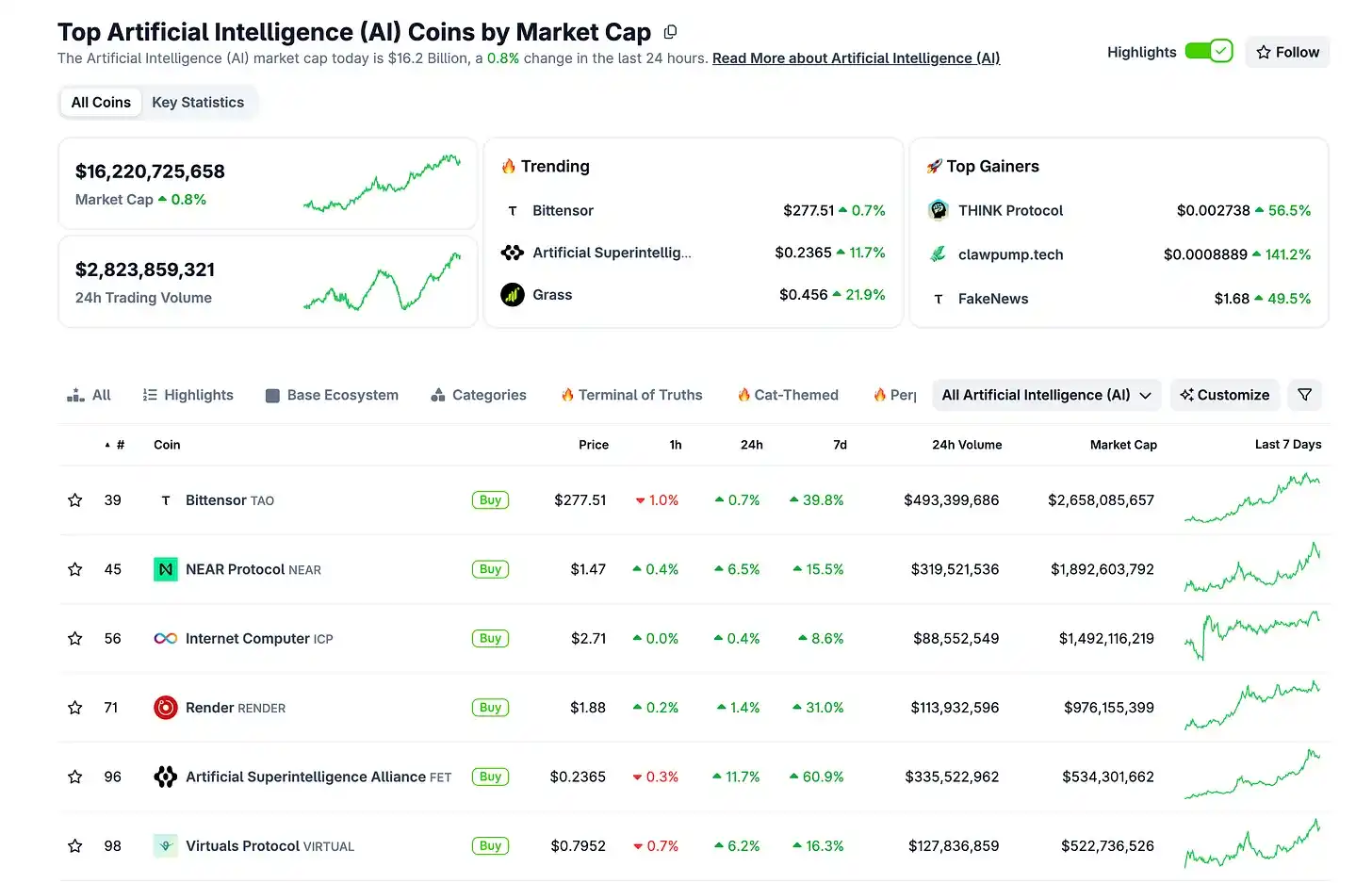
The core news this week was Templar's Covenant-72B (details above). The overall AI sector benefited from Bittensor's catalyst effect and continued institutional narrative momentum around Agent infrastructure.

TAO (7-day +40%): $277.51, market cap $2.66 billion. Catalyst: Covenant-72B; structural dynamics from subnets to TAO amplified gains.

FET (7-day +61%): $0.2365, market cap $534 million. The strongest weekly gainer among top DeAI assets. The Artificial Superintelligence Alliance benefited from sector rotation catalyzed by TAO, with capital broadly flowing into AI tokens.

RENDER (7-day +31%): $1.88, market cap $976 million. Covenant-72B proves distributed GPU networks can train competitive models, providing a tailwind for the decentralized computing narrative.

NEAR (7-day +16%): $1.47, market cap $1.89 billion. IronClaw (a security-hardened rewrite of OpenClaw in Rust, deployed on TEE) and NEARCON 2026 catalysts continue to have an effect. NEAR's positioning as enterprise-grade OpenClaw infrastructure keeps it in AI buying interest.

ICP (7-day +9%): $2.71, market cap $1.49 billion. Caffeine AI, a self-writing application platform on DFINITY's ICP platform, continues to attract developers (reportedly hundreds of thousands of monthly unique visitors according to Dominic Williams). Version V3 is upcoming, featuring Claude Code integration. The "Mission 70" tokenomics proposal aims to reduce annual inflation by 70% by the end of 2026, with Caffeine-driven compute burning as a key mechanism. Over the past 30 days, ICP ranked first in code development activity among AI/Big Data crypto projects.

VIRTUAL (7-day -16%): $0.7952, market cap $523 million. Pullback following AGDP-driven rally. But the more interesting story for VIRTUAL this week is in the x402 facilitator data: Virtuals have already ranked among the top three facilitators by transaction volume on x402 via ACP.

B) Robotics Total Market Cap Analysis

This week, the total Robotics sector market cap increased by $44 million (+6%), reaching $811 million:
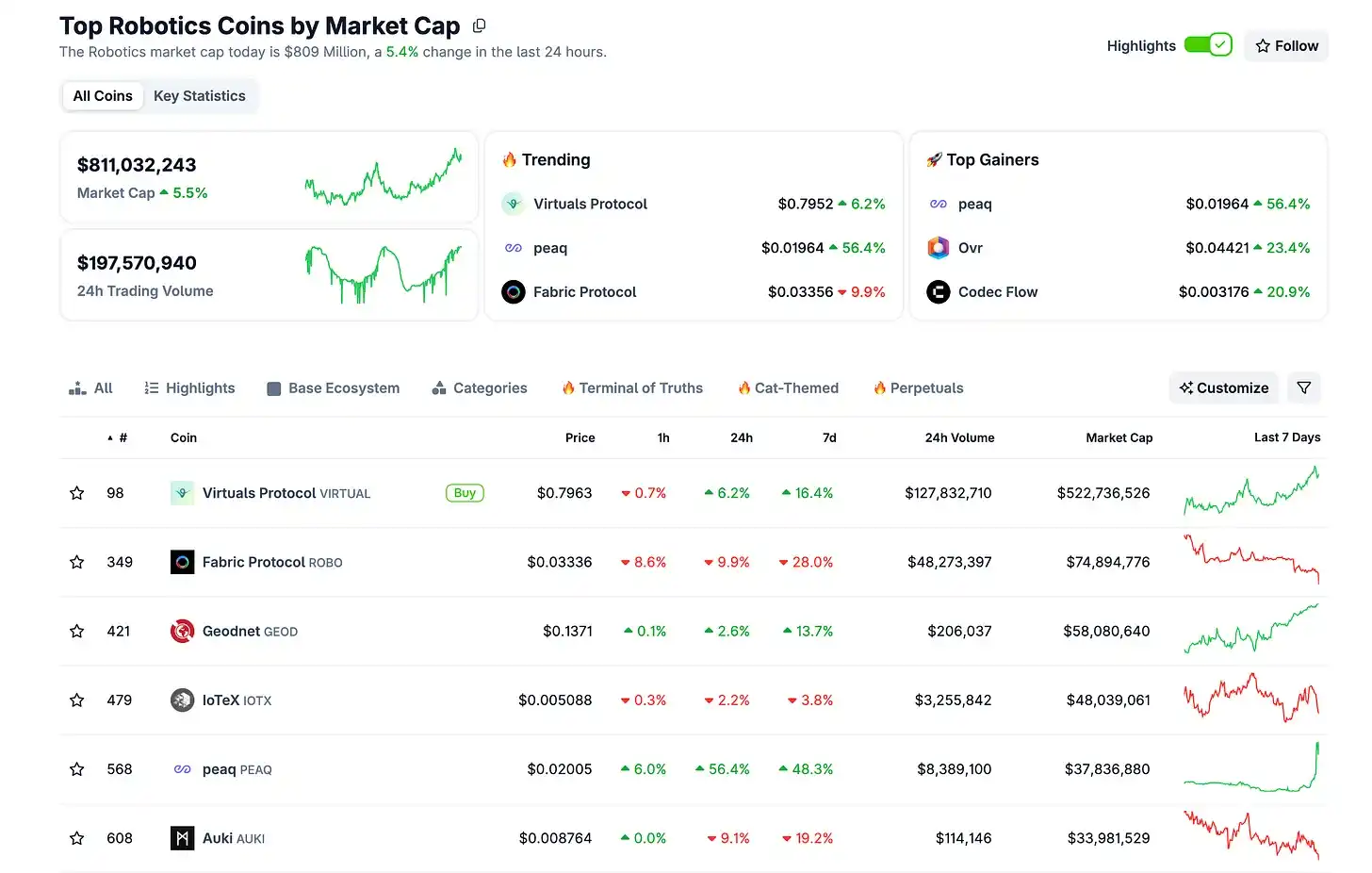
PEAQ (7-day +48%): $0.02005, market cap $37.8 million. The standout performer. peaq released a new video explaining the robotics narrative and its Robotics SDK (compatible with ROS 2, enabling any robot to obtain a peaq ID, perform on-chain payments/receipts, and data verification). Hashkey Capital's "Machine Economy" research report listed peaq as the foundational L1 for machine identity, payments, and governance. Over 60 DePIN projects across 22 industries are operational on the network; the Dubai VARA regulatory sandbox is open for on-chain robotics businesses.

ROBO (7-day -28%): $0.03336, market cap $74.9 million. Fabric Protocol (OpenMind/Fabric Foundation) is finding price equilibrium after initial listing enthusiasm. Still a relatively new player in the robotics category.

GEOD (7-day -14%): $0.1371, market cap $58.1 million. 24-hour trading volume only $206k, despite GEO-SWARM being live on Kickstarter and GEOD coverage added by Solana/Blockworks' Lightspeed institutional platform, which is expected to improve institutional visibility over time.

Crypto AI Agent Sector

a) Nansen DEX Fund Flows (All Traders, 7-Day)
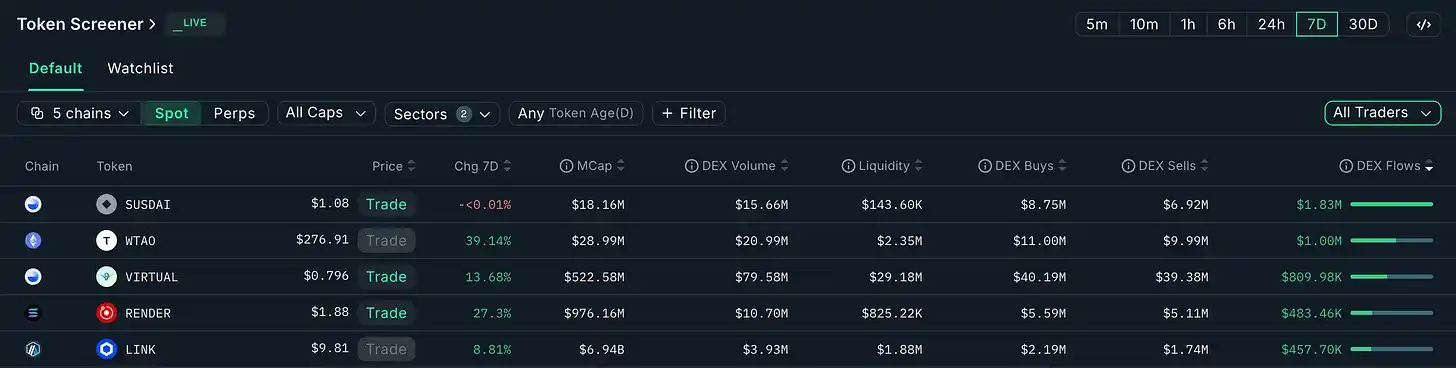
sUSDAI (+$1.83M net inflow): Largest net inflow in the AI sector. The yield layer for USDai, a GPU-collateralized stablecoin protocol (Permian Labs; backed by Dragonfly, Coinbase Ventures, YZi Labs). Lends against physical GPU infrastructure, returning yield via sUSDAI. PayPal/PYUSD integration; peak TVL $658M. CHIP governance token launched via CoinList in late February; capital is rotating into the yield layer. DeFi capital meets physical AI infrastructure financing.

WTAO (+$1.00M net inflow): $11.0M bought vs $10.0M sold. Confirms Covenant-72B drove real DEX accumulation behavior.

VIRTUAL (+$810k net inflow): Net inflow remained positive despite a 16.3% weekly price drop. $40.19M bought vs $39.38M sold. Smart money buying the dip. This group has the deepest liquidity at $29.18M.

RENDER (+$483k net inflow): Slight positive. Sector tailwinds, no specific catalyst. Render Con 2026 is upcoming.

LINK (+$458k net inflow): Noteworthy that Chainlink appears in the AI sector filter. Chainlink Runtime Engine is the connective tissue for Agent infrastructure; explicitly referenced in an AWS blog post this week regarding CRE integration.

b) Nansen Public Figure Fund Flows (7-Day)

DRV (+$264k net inflow, 7 traders): Derive, a decentralized derivatives protocol based on OP Stack. +48.84% in 7 days, market cap $111M. Institutional staking goes live on March 23; 25% of fees used for DRV buybacks.

FAI (+$187k net inflow, 4 traders): Freysa AI, a sovereign Agent stack on Base. Market cap $62M. Uses TEE and zkTLS, enabling Agents to hold their own keys. Similar to OpenClaw but approaches from a cryptographic sovereignty angle.

WTAO (+$105k net inflow, 3 traders): Corroborates the signal around Covenant-72B seen among all traders.

c) x402 Analysis

i) Transaction Count Down, Transaction Value Up
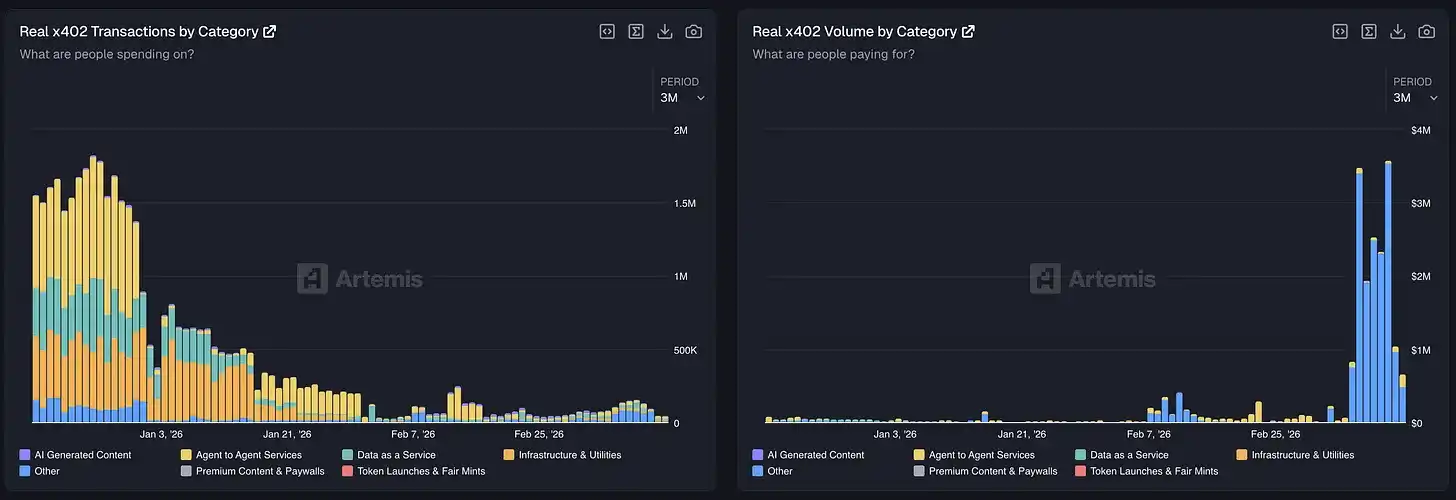
Artemis data tells two stories:

Transaction Count (Left Chart): Significant decline from Dec/Jan peaks. Daily average transactions dropped from over 1.5-2 million to the hundreds of thousands.

Transaction Value (Right Chart): Sharp uptick after a plateau in Jan/Feb, pushing daily average transaction value to $3-4 million. Concentrated in Infrastructure & Utilities and Data-as-a-Service categories, with Agent-to-Agent Services contributing secondarily.

This divergence is the most important signal for x402 currently. Decreasing transaction count with increasing transaction value means the average transaction size is growing. Fake transactions are being washed out; what remains are fewer, higher-value real commercial transactions.

Based on the current merchant landscape, the dominant categories likely represent: Agents paying for compute (cloud GPU, inference nodes, Chutes); API data source access (Firecrawl, StableEnrich, market intelligence data); browser sessions (Browserbase); and content generation (Freepik).

Agent-to-Agent Services is structurally the most interesting: autonomous Agents paying other Agents to complete subtasks.

AI-generated content and token issuance, which dominated early transaction counts, have largely been washed out.

ii) a16z and the Data Measurement Gap

a16z partner Noah Levine pointed out that "real" transaction volume is significantly lower than the inflated numbers caused by fake activity earlier this year. Bloomberg reported x402's 30-day payment volume at $24 million (data from x402.org); Allium Labs' data was around $3 million; Artemis, filtering out wash trading, estimated real volume at about $1.6 million.
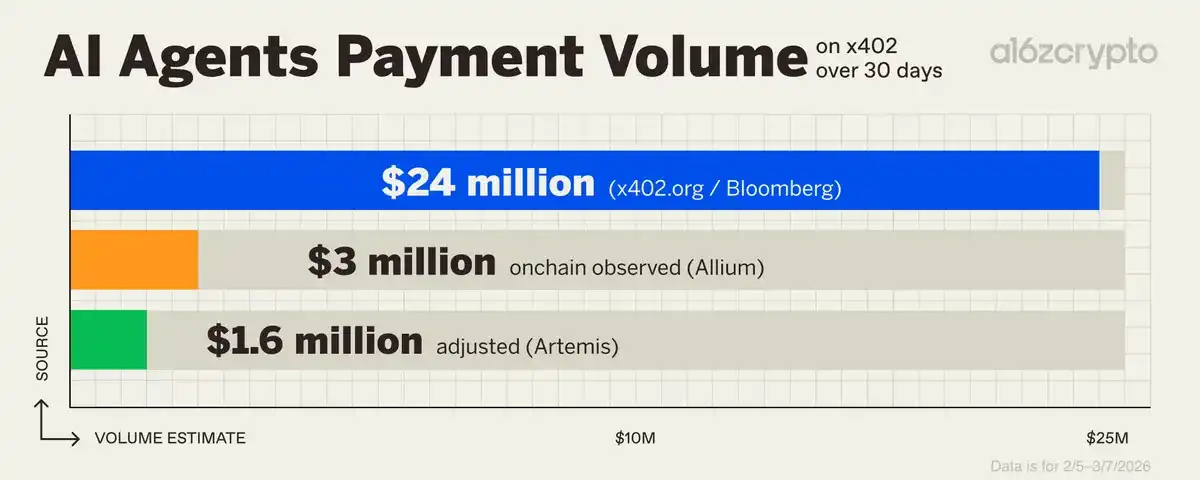
But this gap reveals how early the measurement infrastructure is—especially as more mature institutions begin adopting this open protocol: Stripe, Cloudflare, Vercel, and Google have all integrated x402.

These institutions are betting not on the current $1.6 million per month, but on what that number becomes when Agents become the default buyers.

iii) Top Facilitators Ranking (Past 7 Days)
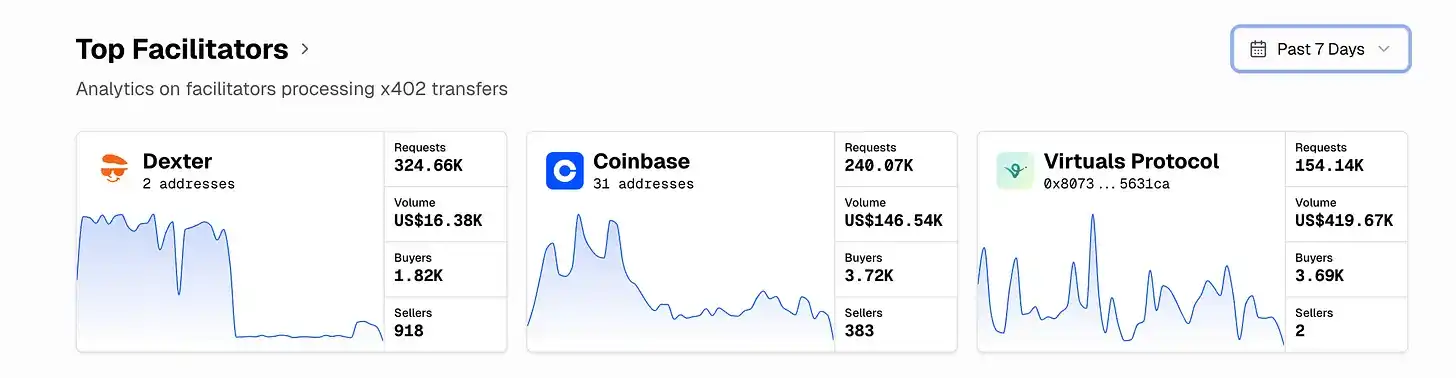
The facilitator ranking is diversifying: high-frequency micro-payments (Dexter), institutional API access (Coinbase), structured Agent commerce (Virtuals/ACP).

Virtuals Protocol (144.14k requests, $419.67k volume): Ranked third by request count, but highest by transaction value. Average price per request ~$2.72 (5x Coinbase's, 54x Dexter's). 3,690 buyers对应仅 2 sellers.

This is ACP settling structured Agent-to-Agent commercial transactions: a few service Agents completing high-value tasks for thousands of buyers.

On March 10, Virtuals and the Ethereum Foundation dAI team jointly submitted ERC-8183, formalizing the trusted Agent commercial transaction lifecycle alongside x402 (payments) and ERC-8004 (identity/reputation).

iv) AWS Releases Full x402 Reference Architecture

On March 15, AWS published "x402 and Agent Commerce: Redefining Autonomous Payments in Financial Services" on its industry blog, including a complete technical reference architecture.

When AWS releases a production-grade reference architecture with open-source code for a native crypto payment standard, the protocol moves from the conceptual stage to the infrastructure stage.

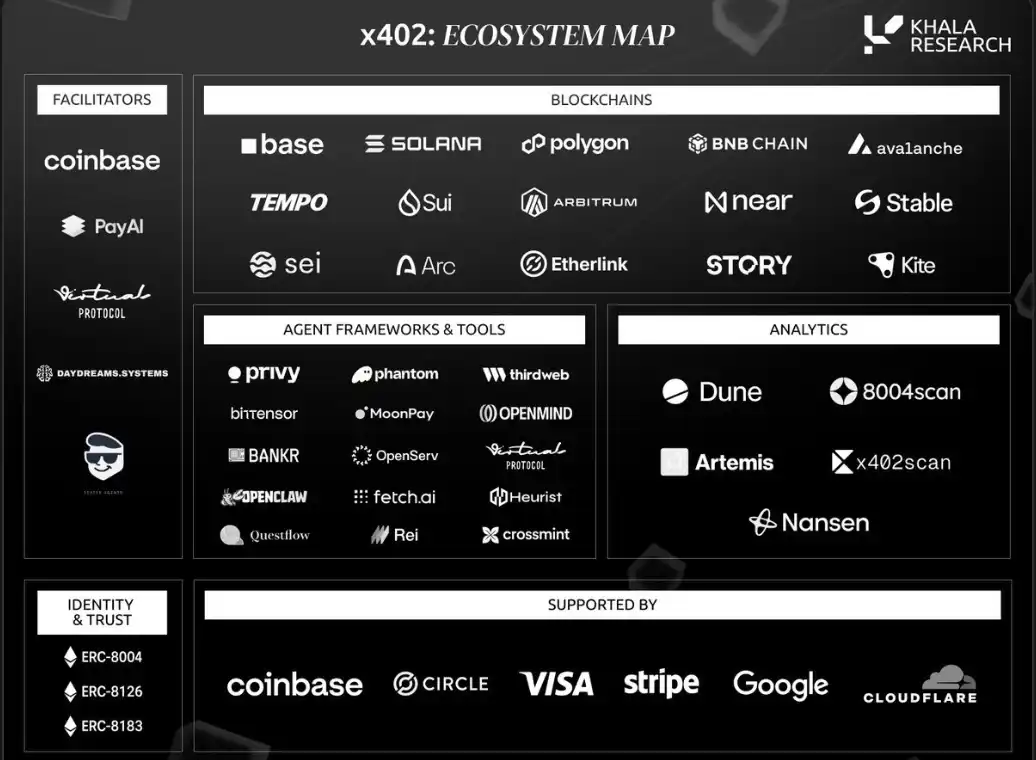
To learn more about x402's trajectory, follow Khala Research, as we will release a full report later this week. Below is the current ecosystem map:
Disclaimer: The content covered in this communication should not be considered investment or financial advice. It is for informational and educational purposes only.

Disclosure: I hold some of these assets and have cooperative relationships with certain projects mentioned in this communication.

Пов'язані питання

QWhat is the significance of the Covenant-72B model trained by Templar on the Bittensor network?

AThe Covenant-72B model is a 72-billion parameter LLM pre-trained on 1.1 trillion tokens, entirely on consumer-grade internet hardware within the Bittensor network. Its significance lies in being the largest decentralized LLM pre-training to date, with performance reportedly comparable to centralized models like LLaMA-2-70B. This upgrades Bittensor's narrative from proving subnets can exist to demonstrating they can produce outputs competitive with centralized alternatives.

QWhat was the price performance of TAO following the announcement of Covenant-72B, and what drove this performance?

AFollowing the announcement of Covenant-72B, the price of TAO increased by 19% within 24 hours and saw a weekly gain of +39.8%. This performance was driven by the technical milestone of the successful training, which validated the decentralized AI narrative. The structural dynamic between TAO and its subnets also amplified buying pressure, as investors need TAO to acquire subnet tokens.

QAccording to the article, what is the x402 protocol data showing about the nature of transactions?

AThe x402 protocol data shows a divergence: the number of transactions has decreased significantly from its peak, but the total transaction volume (in USD) has sharply increased. This indicates that the average transaction size is growing, suggesting that low-value, fake 'wash trading' is being cleaned out and replaced by fewer, but higher-value, genuine commercial transactions.

QWhich company released a full technical reference architecture for the x402 protocol, and why is this important?

AAWS released a full technical reference architecture for the x402 protocol. This is important because when a major cloud provider like AWS publishes a production-ready reference architecture with open-source code for a native crypto payment standard, it signifies the protocol's transition from a conceptual stage to an infrastructure stage, boosting its legitimacy and potential for institutional adoption.

QWhat role did the Virtuals Protocol play in the x402 ecosystem according to the merchant rankings?

AAccording to the 7-day merchant rankings, the Virtuals Protocol ranked third by number of requests but first by total transaction volume. Its high average transaction value (~$2.72 per request) and the structure of its business (3,690 buyers to just 2 sellers) indicate it is settling high-value, structured agent-to-agent commerce transactions through its ACP (Agent Commerce Protocol).

Пов'язані матеріали

Two Legends Lost in Three Days: Is Google's AI Talent Dam Cracking?

In three days, Google lost two AI legends. On June 18, Noam Shazeer, co-author of the seminal "Attention is All You Need" paper and Gemini co-lead, left for OpenAI. Just 48 hours later, John Jumper, 2024 Nobel laureate and AlphaFold lead, departed DeepMind for Anthropic. This follows Andrej Karpathy joining Anthropic in May. These moves highlight a structural trend: top AI talent is concentrating at mission-driven, pre-IPO firms like OpenAI and Anthropic, while Google becomes a primary source. The exodus stems from a core mission mismatch. Google's ad-centric model often subordinates AI research to product and revenue goals, creating friction for pioneers like Shazeer, who returned in 2024 only to leave again. In contrast, OpenAI and Anthropic offer singular focus on pushing AI boundaries, whether towards AGI or safety-aligned models, which deeply appeals to top researchers like Jumper. Financial incentives amplify the pull. With both OpenAI and Anthropic nearing IPO, employees stand to gain immensely from equity, an upside Google's mature stock cannot match. Furthermore, the 2023 merger of Google Brain and DeepMind, intended to consolidate strength, has instead created cultural tension and slowed the path from research to product, as evidenced by Gemini's pace. This talent redistribution is reshaping the AI landscape. While Google retains vast data and compute resources, its true crisis is the quiet, continuous loss of the people who define the field's future. The real moat in AI is not infrastructure, but the concentration of brilliant minds—a battle Google is currently losing.

marsbit1 год тому

Two Legends Lost in Three Days: Is Google's AI Talent Dam Cracking?

marsbit1 год тому

Behind the AI Report Card, Lies a Chinese 'Exam Setter'

Beyond the familiar performance charts like MMLU-Pro and MMMU, which major AI models strive to ace, stands a key "examiner": Chinese-Canadian researcher Wenhu Chen. An assistant professor at the University of Waterloo and founder of TIGERLab, Chen addresses the crucial need for more rigorous AI evaluation. As models like GPT-4 began scoring near-perfect results on older benchmarks like MMLU, it became difficult to distinguish their true capabilities. In response, Chen introduced MMLU-Pro in 2024, featuring harder, more reasoning-focused questions with more answer choices, successfully reintroducing meaningful performance gaps. His work extends to multi-modal evaluation with MMMU and its enhanced version, MMMU-Pro. These benchmarks test a model's ability to understand and reason with complex information from images, charts, and text across diverse academic subjects, exposing the significant challenges even top models face in genuine comprehension. Chen's background in complex QA, table reasoning, and his experience at Google DeepMind on projects like Gemini inform his approach. He understands that effective benchmarks must anticipate how models might "cheat" by memorizing data or avoiding visual analysis. His lab also actively researches video understanding and generation models (e.g., UniVideo, Vamba), ensuring his evaluation work is grounded in practical model-building challenges. Now at Meta's Super Intelligence Lab, Chen continues his focus on multi-modal data and evaluation, representing the deep yet often unseen contributions of Chinese talent in shaping the fundamental tools of the AI industry.

marsbit1 год тому

Behind the AI Report Card, Lies a Chinese 'Exam Setter'

marsbit1 год тому

Alliance Co-founder's Letter to Entrepreneurs: Written at the Moment Cursor Sold for $600 Billion

Alliance Co-founder's Letter to Entrepreneurs: On Cursor's $60 Billion Sale Many aspiring founders see massive exits like Cursor's $60B sale and wonder why they can't achieve the same, often concluding opportunities are exhausted. But great companies aren't built in obvious, crowded spaces. Cursor, like Stripe, Figma, and Shopify before it, started with a non-consensus belief about the future. Before ChatGPT, they believed AI would transform knowledge work. They focused on a genuinely exciting domain, became their own customer, and obsessed over power users. Their journey involved years of "glass-chewing" effort before the market was ready. The pattern is consistent: identify a long-term technological shift, find a missed entry point, and execute for years before the trend becomes obvious. First-generation products (PayPal, Adobe, Amazon) prove a market exists. Second-generation winners (Stripe, Figma, Shopify) rebuild that market around new insights, technology, or changing customer behaviors. Founders must identify their phase in the cycle. Early entrants like Coinbase or Cursor focus on making new technology usable for power users. Later entrants find the "yin" to the established "yang"—the blind spots incumbents miss as they grow distant from individual users. The key is deep market immersion. Use every product in your space. Talk to users. Build an audience. Stop looking for ideas and start *seeing* them everywhere. Then, choose one. The idea must offer a 10x improvement or solve a "hair-on-fire" pain point—something severe enough that users are already crafting workarounds. When building, avoid feature bloat. Ask: why would someone switch? Great startups rarely force new behaviors; they improve familiar workflows with drastically lower friction (e.g., Cursor forked VS Code instead of creating a new editor). Distribution is the underestimated moat. Before product-market fit, achieve distribution-market fit. How do customers discover new tools? Founders like those at Airbnb, Stripe, and Cursor did unscalable, manual work to recruit early users. The final, unteachable ingredient is resilience. Cursor built for years pre-market, faced rejection, and persisted. So did Airbnb, Nvidia, and Rain (which launched post-FTX collapse). The lesson isn't that these founders were smarter, but that they stayed in the game long enough for their insights to compound. Framework: Spot technological cycles. Cultivate unique insight. Obsess over your market. Talk to customers. Find a hair-on-fire problem. Build the simplest wedge. Win your distribution channel. Above all, don't quit when it gets hard. Most people won't do these things consistently. The few who do build the next generation of great companies. Go build.

marsbit1 год тому

Alliance Co-founder's Letter to Entrepreneurs: Written at the Moment Cursor Sold for $600 Billion

marsbit1 год тому

Weekly Editor's Picks (0613-0619)

Weekly Editor's Picks (0613-0619): Market Insights & Analysis This weekly digest curates in-depth analysis often lost in the information flow, focusing on key insights across macro trends, investment, and technology. **Macro & Geopolitics:** With the Strait of Hormuz reopening and military conflict shifting to negotiation, markets are pivoting from "war shock" to "supply restoration." Trades include shorting crude risk premiums, longing airlines/tourism, Asian energy importers, and bond duration, while shorting inflation expectations. LNG, fertilizer, and chemical chains are also being repriced. **Investment & VC:** Ray Dalio advises against betting on concentrated AI giants dominating indices, advocating for diversified portfolios of high-quality, low-correlation assets instead. Analysis covers the 4-year crypto cycle, predicting the core surviving product by 2029 will be asset trading markets. Current BTC metrics suggest a potential bottoming zone, presenting a patient accumulation window. SpaceX's high-profile IPO at a $2.1T valuation faces scrutiny over fundamentals, with key watchpoints being its likely inclusion in the Nasdaq index and Q2 earnings. Concerns are raised about potential "gamma squeeze" and systemic risks if its narrative-driven valuation gets amplified by passive index funds. Robinhood (HOOD) is noted for breaking its high correlation with crypto, bolstered by its stock trading and new underwriting business. **Web3 & AI:** A warning highlights ~$1.8T in off-balance-sheet AI infrastructure commitments (purchase commitments, leases) as a potential systemic risk if AI monetization lags. AI models are being used for World Cup predictions, adding a new layer for betting markets. A cost breakdown of a $20 AI subscription reveals the supply chain from model companies to cloud, GPUs, and power. **Prediction Markets:** The emergence of prediction market "concept stocks" is noted, with Robinhood developing its own platform, Rothera, signaling a shift from market competition to a "channel war" for user access. **CeFi & DeFi:** The SpaceX IPO tested perpetual contract mechanisms for pre-IPO assets, highlighting challenges in handling corporate actions like stock splits on-chain. The de-pegging of STRC (Strategy's preferred share) to ~$89 reflects market concerns over MicroStrategy's capital structure and BTC-backed leverage model. BlackRock's covered-call Bitcoin ETF (BITA) offers yield but caps upside, appealing to yield-seeking institutions. **Ethereum:** An opinion piece argues Ethereum's core strength is its vast developer community and composability, solidifying its role as the default operating system for the financial internet. **Weekly Hot Topics:** Include the US-Iran deal reopening the Strait of Hormuz, Fed's hawkish hold, Anthropic restricting model access, SpaceX acquiring Cursor, and a humorous stock surge for "Liuliumei" due to its "LLM" ticker.

marsbit1 год тому

Weekly Editor's Picks (0613-0619)

marsbit1 год тому

Alliance's Co-Founder's Letter to Entrepreneurs: Written on the Occasion of Cursor's $60 Billion Sale

In this letter to entrepreneurs, Alliance reflects on the success of Cursor's $60 billion sale to Elon Musk, using it as a case study to counter the misconception that opportunities in crowded fields like AI or crypto are exhausted. The piece argues that great companies like Cursor, Stripe, Figma, and Shopify are not built by geniuses with perfect ideas, but by founders who start with a non-consensus belief about the future and build for years before that future becomes obvious to everyone. They identify long-term shifts, find overlooked entry points, and execute relentlessly. The framework for success involves: 1. **Identifying your place in the technology cycle**: Early-stage opportunities focus on making new tech usable for power users (e.g., Coinbase, Cursor). Later-stage opportunities involve finding the "yin" to an existing "yang"—the blind spots of first-generation players (e.g., Stripe vs. PayPal, Figma vs. Adobe). 2. **Cultivating unique insights**: Immerse yourself deeply in the market. Use every product, talk to users, and build an audience. Insights will emerge naturally from deep engagement. 3. **Finding a "hair-on-fire" problem**: Look for a 10x improvement or a severe, urgent pain point. The strongest signal is people already building clumsy workarounds. 4. **Building a focused MVP**: Don't just add features because you can. Ask why users would abandon their current tool for yours. The best startups rarely force new behaviors; they improve familiar workflows with drastically lower friction. 5. **Winning a distribution channel**: Distribution is often the moat. Before product-market fit, achieve channel-market fit. Find where your customers are and build an engine to reach them, even through unscalable, manual efforts initially. 6. **Persistence**: The final, unteachable ingredient is resilience. Success stories like Cursor, Airbnb, and Nvidia involved years of grinding, rejection, and perseverance when the path forward seemed unclear. The conclusion is that there is no secret. Most people fail to consistently execute these steps over the long term. The few who do build the companies that define the next era. The world is yours to create.

链捕手1 год тому

Alliance's Co-Founder's Letter to Entrepreneurs: Written on the Occasion of Cursor's $60 Billion Sale

链捕手1 год тому

Торгівля

Спот
Ф'ючерси
活动图片