Crypto wrench attacks steal more than $30M so far in 2026: Chainalysis

cointelegraphОпубліковано о 2026-08-06Востаннє оновлено о 2026-08-06

Анотація

Criminals stole over $30 million through physical "wrench attacks" on cryptocurrency holders in the first half of 2026, putting the year on track to exceed the record $58 million stolen in 2025. Blockchain analytics firm Chainalysis reported 46 such violent incidents globally by late June, including kidnappings and home invasions, up from 40 in the same period last year. While the attackers' success rate dropped to 26% from 49% in 2025, the report warns the true scale is likely understated due to unreported cases. France remains a major hotspot, with 30 publicly known incidents by mid-2026—a significant increase from 19 in all of 2025. French authorities have counted over 70 cases, with data breaches, including the alleged misuse of tax records and a leak at a crypto tax firm, cited as key drivers. Attack methods vary in sophistication, from directly cashing out stolen funds on exchanges to using complex laundering services, with some cases linked to broader criminal networks.

Criminals stole more than $30 million through physical attacks on crypto holders in the first half of this year, putting the year on pace to surpass the record $58 million stolen in 2025.

In a Chainalysis report released Thursday, the blockchain analytics firm said that 46 violent crypto-related incidents had been documented globally through late June, up from 40 during the same period in 2025. The incidents include kidnappings, home invasions and hostage situations, collectively known as “wrench attacks.”

The findings suggest wrench attacks are increasing, expanding the risks facing crypto holders beyond custody and asset management to their physical safety, homes and families.

According to the report, only 12 of the 46 attempts resulted in payment, giving attackers a 26% success rate, down from 49% in 2025. However, the report acknowledged that known cases likely understate the scale of the problem, as many attacks go unreported.

Chainalysis said the “tradecraft tends to be amateur at the point of violence, but professional at both ends,” with victims often selected through data leaks, social media or insider information before low-skilled crews carry out the attacks.
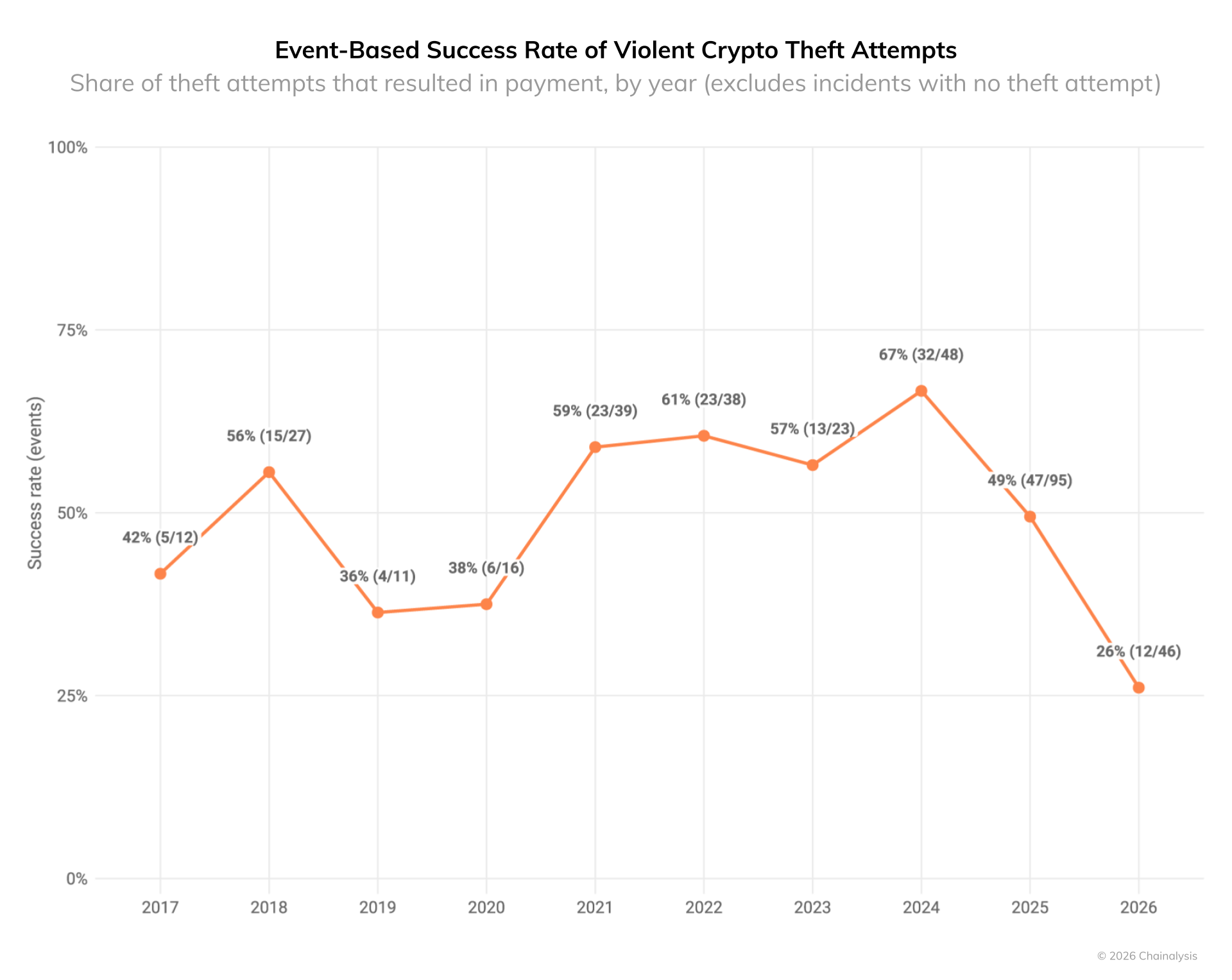
Success rate of crypto wrench attacks by year. Source: Chainalysis

France remains wrench attack hotspot

According to Chainalysis, France recorded 30 publicly known incidents by midyear, compared with 19 throughout 2025. The report noted that French authorities have counted more than 70 incidents, indicating the actual total may be substantially higher.

Related: Spain arrests suspect in 2025 kidnapping of Ledger co-founder

In July, Interior Minister Laurent Nuñez put the first-half count at 77 kidnappings, extortions or attempted extortions, up from 45 in all of 2025. In response, the government has introduced a rapid-alert and protection system and promised greater intelligence-sharing and coordination with the crypto industry.

Chainalysis said in the Thursday report that the alleged misuse of French tax records was the likeliest driver of the surge. A French tax official allegedly accessed and sold information about crypto investors to criminals, while a separate breach at crypto tax-reporting company Waltio reportedly exposed data belonging to about 50,000 users.

Onchain activity also showed varying levels of sophistication. Some attackers sent stolen funds directly to centralized exchanges, while others used bridges, decentralized exchanges and laundering services. Chainalysis said the most advanced cases showed links to broader criminal networks.

Magazine: Do the Coldcard attacks mean all hardware wallets are now insecure?

Пов'язані питання

QAccording to the Chainalysis report, what is the estimated total value stolen through 'wrench attacks' in the first half of 2026, and how does this pace compare to 2025?

ACriminals stole more than $30 million through 'wrench attacks' in the first half of 2026. This pace puts the year on track to surpass the record $58 million stolen in the entirety of 2025.

QWhat does the term 'wrench attack' refer to in the context of cryptocurrency crime, and what is the reported success rate for these attacks in the first half of 2026?

AIn cryptocurrency crime, a 'wrench attack' refers to a physical, violent attack on a crypto holder, such as a kidnapping, home invasion, or hostage situation, aimed at coercing them to surrender their crypto assets. According to the report, only 12 of the 46 documented attempts resulted in payment, giving a success rate of 26% for the first half of 2026.

QWhich country is identified as the primary hotspot for crypto wrench attacks, and what is cited as a key factor driving the surge in incidents there?

AFrance is identified as the primary hotspot for crypto wrench attacks. The report cites the alleged misuse of French tax records as the likeliest driver of the surge, where a tax official reportedly sold information on crypto investors to criminals. A separate data breach at the crypto tax firm Waltio also reportedly exposed user data.

QBeyond the direct violence, how does Chainalysis describe the 'tradecraft' or methods used by attackers in these incidents?

AChainalysis describes the tradecraft as 'amateur at the point of violence, but professional at both ends.' Victims are often identified professionally through data leaks, social media, or insider information. However, the physical attacks themselves are frequently carried out by low-skilled crews. Onchain analysis of the stolen funds also shows varying levels of sophistication in moving and laundering the assets.

QWhat measures have French authorities reportedly taken in response to the increase in wrench attacks?

AIn response to the increase, the French government has introduced a rapid-alert and protection system. They have also promised greater intelligence-sharing and coordination with the cryptocurrency industry to combat these crimes.

Пов'язані матеріали

Home Furnishing Listed Companies Are Trying to Turn Around with AI and Semiconductors

Chinese home furnishing listed companies are increasingly turning to AI and semiconductor cross-border ventures to revive their fortunes amid declining core businesses. A prominent example is PVC flooring giant **Elegant Home Furnishing**, whose stock price skyrocketed with 10 consecutive trading limits after announcing a plan to acquire a majority stake in **Ou Kang Nuo**, a semiconductor storage testing equipment and services company. Despite Elegant Home's own financial struggles—including recent losses and tight cash flow—the acquisition, funded through asset sales and loans, has dramatically boosted its market value. The deal involves a cross-shareholding structure with Ou Kang Nuo's controlling shareholder. This trend is widespread. Over the past year, numerous home furnishing firms with stagnant main operations have seen their stock prices surge after announcing moves into hot sectors like AI, semiconductors, or computing power. Key cases include: * **Markor Home Furnishings** ("high-end home furnishing first share"), after years of heavy losses, acquired an AI server high-speed copper cable company and later introduced AI computing power investors. * **Zhenai Meijia** ("blanket king") became the first A-listed manufacturer controlled by an AI large model company following a takeover. * **Fasilon** (integrated ceiling) saw its stock soar after establishing an AI subsidiary. * **Jinlong Decoration** experienced multiple trading limits after being linked to "commercial aerospace" and "AI computing," despite clarifying these segments contribute less than 1% of its business. Statistics show over 20 A-share companies announced semiconductor crossovers in 2025, with home furnishing and building materials firms being the most active. This shift is largely driven by pressures from the real estate downturn, shrinking overseas demand, and trade tariffs, pushing companies to seek growth through trendy concepts rather than core business improvement. However, the article warns that such speculative frenzies often end when the hype fades, leaving stock prices to eventually reflect the companies' weak fundamentals, as seen in Jinlong Decoration's subsequent sharp price correction. The repeated attempts to "ride the trend" highlight a desperate struggle for survival in a challenging traditional industry.

marsbit46 хв тому

Home Furnishing Listed Companies Are Trying to Turn Around with AI and Semiconductors

marsbit46 хв тому

"Sell America" Trade Resurfaces: Global Funds Reprice Washington Policy Risks, Dollar and Treasuries Bear the Brunt

"Sale of America" Trade Resurges as Global Funds Reprice Washington Policy Risks, Hitting Dollar and Treasuries First Recent policy signals from Washington are prompting global bond and foreign exchange investors to reignite the "Sale of America" debate. Uncertainty stems from Fed Chair Wash's shift towards less policy communication, Treasury Secretary Bessant's approval of joint intervention with Japan to support the Yen (the first such coordinated move in nearly 30 years), expanding fiscal deficits, and trade war fears. These factors are undermining confidence in U.S. assets. The 30-year Treasury yield recently broke above 5%, hitting a high not seen since 2007, while the Bloomberg Dollar Spot Index has fallen about 2% from its June peak. This dollar weakness is unusual given still-high U.S. interest rates. Investors cite policy uncertainty as a key driver, with one manager calling the Fed Chair and Treasury Secretary a "double whammy" creating a "Trump administration premium." While the S&P 500 continues hitting record highs and foreign holdings of U.S. Treasuries remain high, parts of the bond and FX markets are adjusting. A core concern is whether the Fed under Wash can effectively anchor inflation expectations; analysts warn that if the Fed lags the hiking cycle, long-end yields could face further upward pressure. The 30-year term premium has risen sharply. The U.S.-backed Yen intervention has also sparked debate on the dollar's structural outlook. While framed by Bessant as a "reallocation of reserves," market participants caution that if Japan—America's largest foreign creditor—must sell Treasuries to fund interventions, ripple effects could hit the bond market. Strategists predict moderate dollar depreciation ahead. Most experts are not predicting an end to dollar hegemony or the safe-haven status of Treasuries. However, a key underlying risk is highlighted: the pace of foreign buying of U.S. debt may not keep up with the speed of American borrowing, gradually eroding the structural advantages that have long supported "American exceptionalism."

marsbit47 хв тому

"Sell America" Trade Resurfaces: Global Funds Reprice Washington Policy Risks, Dollar and Treasuries Bear the Brunt

marsbit47 хв тому

Торгівля

Спот
活动图片