Home Furnishing Listed Companies Are Trying to Turn Around with AI and Semiconductors

marsbitОпубліковано о 2026-08-06Востаннє оновлено о 2026-08-06

Анотація

Chinese home furnishing listed companies are increasingly turning to AI and semiconductor cross-border ventures to revive their fortunes amid declining core businesses. A prominent example is PVC flooring giant **Elegant Home Furnishing**, whose stock price skyrocketed with 10 consecutive trading limits after announcing a plan to acquire a majority stake in **Ou Kang Nuo**, a semiconductor storage testing equipment and services company. Despite Elegant Home's own financial struggles—including recent losses and tight cash flow—the acquisition, funded through asset sales and loans, has dramatically boosted its market value. The deal involves a cross-shareholding structure with Ou Kang Nuo's controlling shareholder. This trend is widespread. Over the past year, numerous home furnishing firms with stagnant main operations have seen their stock prices surge after announcing moves into hot sectors like AI, semiconductors, or computing power. Key cases include: * **Markor Home Furnishings** ("high-end home furnishing first share"), after years of heavy losses, acquired an AI server high-speed copper cable company and later introduced AI computing power investors. * **Zhenai Meijia** ("blanket king") became the first A-listed manufacturer controlled by an AI large model company following a takeover. * **Fasilon** (integrated ceiling) saw its stock soar after establishing an AI subsidiary. * **Jinlong Decoration** experienced multiple trading limits after being linked to "c...

Another home furnishing listed company's stock price has skyrocketed due to a cross-border venture into semiconductors.

On August 6, PVC flooring giant Elysium Home Furnishings resumed trading with another daily limit-up, marking its 10th consecutive daily limit-up. Wind data shows that from July 21 to August 6, the company's stock price has surged by 159.31% cumulatively.

This struggling flooring company achieved a turnaround solely through a cross-border capital operation.

On the evening of July 20, Elysium Home Furnishings announced that it had signed an "Equity Acquisition Intent Agreement" with shareholders Zhao Ming, Tong Shujuan, Anhui Mingde Zhonghe, and Anhui Zhonghe of OCONOR, intending to acquire no less than 77.08% of OCONOR's equity with cash and make it a controlling subsidiary.

OCONOR is mainly engaged in storage testing equipment and related testing services. Its product series include GA300, SW400, MS200, and ES100, covering test scenarios such as SSD modules, DDR modules, storage chips, and embedded memory. It boasts a complete solution centered on system-level testing (SLT) while also providing professional testing services.
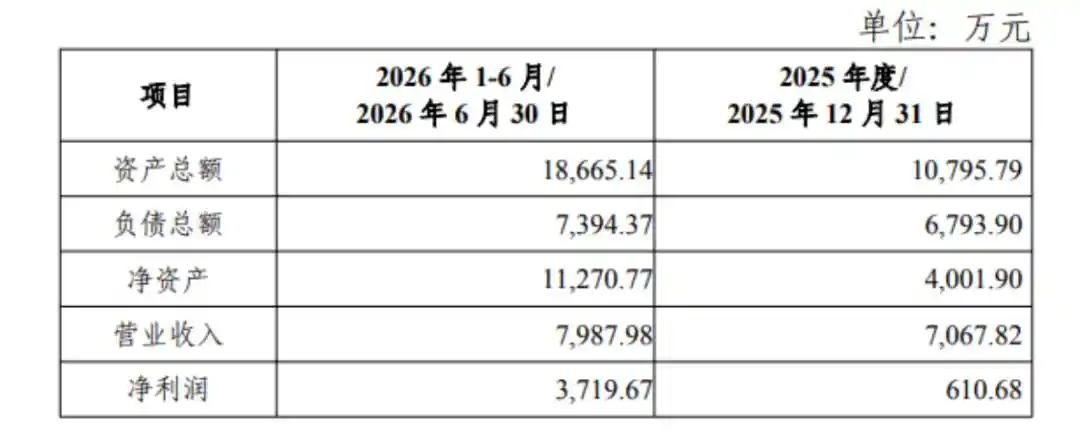
OCONOR Financial Data | Screenshot from the Announcement

This acquisition involves many clever transaction details: Elysium Home Furnishings acquires OCONOR, while OCONOR's actual controller Zhao Ming simultaneously acquires 20% of Elysium Home Furnishings' shares. You buy me, I buy you, a two-way binding. Additionally, OCONOR has made a performance commitment: cumulative non-GAAP net profit over four years shall be no less than 230 million yuan.

The key question is: where does Elysium Home Furnishings' acquisition funding come from?

The announcement shows that the acquisition funds will come from the company's own funds and self-raised funds through methods such as disposing of idle assets (valued at approximately 200 million to 300 million yuan), bank loans, and loans from major shareholders.

Currently, Elysium Home Furnishings does not have much cash on its books.

According to its Q1 2026 report, Elysium Home Furnishings had only 259 million yuan in cash and cash equivalents on its books, while short-term interest-bearing debt reached 277 million yuan. The acquisition requires 500 million yuan.

The reason for the limited cash on hand is that Elysium Home Furnishings' "flooring business" has long been in the red.

In 2025, the company's revenue and net profit attributable to shareholders both declined, with net profit attributable to shareholders plummeting 87.6% year-on-year to 17.17 million yuan. Entering 2026, losses continued to widen, with a loss of 14.82 million yuan in Q1 and a projected loss for the first half of the year increasing to 34.5 million to 40.5 million yuan.
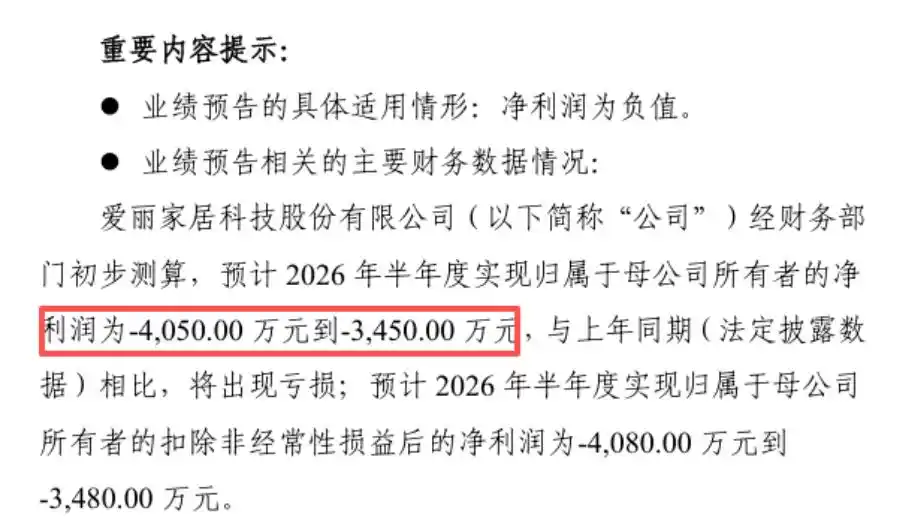
Image Source: Elysium Home Furnishings Announcement

However, Elysium Home Furnishings did not persist in returning to its core business. Instead, it set its sights on cross-border mergers and acquisitions, which have yielded positive effects so far—its stock price has soared, with nine consecutive daily limit-ups, and its market capitalization skyrocketed from 2.3 billion to 5.46 billion yuan. As of the close on August 6, its total market capitalization had increased to 6 billion yuan.

Elysium Home Furnishings is not an isolated case.

Over the past year or more, home furnishing listed companies have collectively staged a drama of "cross-border survival." The script is almost identical: sluggish growth in the core business leads to targeting AI, semiconductor, or computing power concepts. Once announced, stock prices soar.

Once the "first stock in high-end home furnishings," Markor Home Furnishings, accumulated losses exceeding 3.7 billion yuan over four years. At the end of 2025, the company announced the acquisition of 100% equity in AI server high-speed copper cable company Wandetai Optoelectronics. After resuming trading, its stock price surged continuously. Subsequently, it also introduced AI computing power industry investors to participate in its restructuring.

The Yiwu "Blanket King," Zhenai Meijia, saw AI unicorn Tanji Technology acquire 44.99% of its shares through "agreement transfer + tender offer" for approximately 1.8 billion yuan in Q4 2025, making it the first A-share manufacturing company controlled by an AI large model company. Its stock price immediately hit consecutive daily limit-ups.

Integrated ceiling giant Fasilon announced in September 2025 that it would invest 250 million yuan to establish an AI subsidiary, leading to eight consecutive daily gains and a rise of over 380% within a year. The company, with only 900 million yuan in assets, supported a market capitalization of nearly 9 billion yuan.

Home decoration leader Gold Mantis, after associating itself with "commercial aerospace" and "AI computing power," secured 11 daily limit-ups in 15 trading days, with a cumulative increase of 136.8%. However, the company clarified that the related business accounts for less than 1% of its total.

Preliminary statistics show that in 2025, over 20 A-share listed companies announced cross-border ventures into the semiconductor sector, with home furnishing and building materials companies accounting for the highest proportion. The downturn in the real estate industry, stagnation in core business growth, and continuous profit shrinkage have forced these companies to flock to popular sectors, attempting to turn around with trending concepts.

The ultimate outcome of countless cross-border speculation cases is consistent: the concept fades, the bubble bursts, and the stock price returns to fundamentals. For example, Gold Mantis' stock price quickly retreated after market sentiment cooled. As of the close on August 6, its stock price had been halved from its peak.

This is also the case with Elysium Home Furnishings this time. A letter of intent for acquisition that has not yet led to a formal agreement; the company has repeatedly issued announcements warning that "the formal agreement has not been signed and there is uncertainty." How can fundamentals showing a half-year loss exceeding 40 million yuan support a market capitalization of 6 billion yuan?

Home furnishing companies continue to cross borders and ride hype waves, more out of helpless survival tactics amid slowing core business.

The downturn in real estate, shrinking overseas demand, and tariff impacts have continuously lowered the ceiling for traditional home furnishing manufacturing. Rather than competing fiercely in a red ocean, it seems better to embrace a cutting-edge concept, let the stock price rise, and allow major shareholders to find more possibilities within it.

However, after the狂欢狂欢 (carnival), someone always has to be left behind.

Note: Article materials sourced from official reports and public information; views are for reference only. | Some images sourced from the internet; please inform for deletion if there is any infringement.

This article is from the WeChat public account "Yuan Mei Hui," author: Xie Chunsheng

Трендові криптовалюти

Пов'язані питання

QWhat caused Aili Home Furnishing's stock price to soar by nearly 160% in recent weeks?

AAili Home Furnishing's stock price skyrocketed due to its announcement of a cross-border acquisition plan to purchase a majority stake (over 77.08%) in Oukangnuo, a company specializing in semiconductor storage testing equipment and services.

QHow does the financial performance of Aili Home Furnishing's core business compare to its recent market valuation surge?

AThe core business (PVC flooring) of Aili Home Furnishing is performing poorly, with significant profit declines in 2025 and an expanding net loss forecast for the first half of 2026. This weak fundamental performance sharply contrasts with its soaring market valuation, which increased from 2.3 billion to 6 billion RMB following the acquisition news.

QWhat is a common strategy among home furnishing listed companies in China to revitalize their business and stock performance, as illustrated in the article?

AA common strategy is cross-border M&A or investment into hot technology sectors like AI, semiconductors, and computing power. When companies announce such moves, their stock prices often surge significantly, even if their core businesses are struggling.

QBeyond Aili Home Furnishing, name two other home furnishing companies mentioned that used cross-sector moves related to AI or tech to boost their market performance.

ATwo other examples are: 1) Markor Furnishings (美克家居), which acquired an AI server high-speed copper cable company and introduced AI computing power investors. 2) Faslong (法狮龙), which established an AI subsidiary, leading to a stock price increase of over 380% within a year.

QWhat does the article suggest is the primary driver behind this trend of home furnishing companies pursuing cross-border acquisitions in tech sectors?

AThe primary driver is the struggle and stagnation of their core home furnishing businesses, exacerbated by the downturn in the real estate sector, shrinking overseas demand, and tariff impacts. Facing a limited ceiling in their traditional industry, they turn to hot tech concepts as a means to seek survival and boost stock prices.

Пов'язані матеріали

Just 3.5 Months After Its Founding, It Started Making External Investments: The Embodied AI Sector Is Collectively 'Investing While Fundraising'

A counterintuitive trend is emerging in China's embodied AI sector: numerous startups that are still actively raising capital themselves are now making strategic investments in other companies. An analysis of 29 such enterprises reveals a pattern of "fundraising while investing," where companies, often still in early funding rounds, rapidly deploy capital into the ecosystem. These 29 investment entities, primarily based in the Pearl River Delta and Yangtze River Delta regions, have executed over 125 investment deals. Notably, 17 of them (59%) are humanoid robot manufacturers, making them the most active investors. The trend shows that newer companies are investing faster; firms founded after 2023 made their first external investment in an average of just 22.8 months, with one company, Poke Robotics, doing so within 3.8 months of its founding. Zhiyuan Robot (智元机器人) stands out as the most active corporate venture capital (CVC) player, completing 37 investments in 23 months. A more complex, networked investment structure is also forming, where companies like Lingchu Intelligent (灵初智能) and Lingxin Qiaoshou (灵心巧手), which received investments from larger players, have themselves become active investors, extending the strategic reach of capital down the supply chain. This collective shift from a few large players to widespread participation signals a strategic move to use capital as a lever to accelerate industry consolidation. Companies are seeking to quickly integrate critical supply chain elements—such as dexterous hands, joint motors, and AI data platforms—into their ecosystems to gain a competitive edge in a rapidly evolving, highly contested market window. The strategy aims to compress the decade-long process of traditional supply chain integration into just a few years, though it carries risks related to technology bets and ongoing capital burn. As the sector's IPO pipeline grows, this "fundraise and invest" model may soon become a standard industry practice.

marsbit3 хв тому

Just 3.5 Months After Its Founding, It Started Making External Investments: The Embodied AI Sector Is Collectively 'Investing While Fundraising'

marsbit3 хв тому

Торгівля

Спот

Популярні статті

Як купити HOME

Ласкаво просимо до HTX.com! Ми зробили покупку Defi.app (HOME) простою та зручною. Дотримуйтесь нашої покрокової інструкції, щоб розпочати свою криптовалютну подорож.Крок 1: Створіть обліковий запис на HTXВикористовуйте свою електронну пошту або номер телефону, щоб зареєструвати обліковий запис на HTX безплатно. Пройдіть безпроблемну реєстрацію й отримайте доступ до всіх функцій.ЗареєструватисьКрок 2: Перейдіть до розділу Купити крипту і виберіть спосіб оплатиКредитна/дебетова картка: використовуйте вашу картку Visa або Mastercard, щоб миттєво купити Defi.app (HOME).Баланс: використовуйте кошти з балансу вашого рахунку HTX для безперешкодної торгівлі.Треті особи: ми додали популярні способи оплати, такі як Google Pay та Apple Pay, щоб підвищити зручність.P2P: Торгуйте безпосередньо з іншими користувачами на HTX.Позабіржова торгівля (OTC): ми пропонуємо індивідуальні послуги та конкурентні обмінні курси для трейдерів.Крок 3: Зберігайте свої Defi.app (HOME)Після придбання Defi.app (HOME) збережіть його у своєму обліковому записі на HTX. Крім того, ви можете відправити його в інше місце за допомогою блокчейн-переказу або використовувати його для торгівлі іншими криптовалютами.Крок 4: Торгівля Defi.app (HOME)Легко торгуйте Defi.app (HOME) на спотовому ринку HTX. Просто увійдіть до свого облікового запису, виберіть торгову пару, укладайте угоди та спостерігайте за ними в режимі реального часу. Ми пропонуємо зручний досвід як для початківців, так і для досвідчених трейдерів.

302 переглядів усьогоОпубліковано 2025.06.10Оновлено 2026.06.02

Як купити HOME

Обговорення

Ласкаво просимо до спільноти HTX. Тут ви можете бути в курсі останніх подій розвитку платформи та отримати доступ до професійної ринкової інформації. Нижче представлені думки користувачів щодо ціни HOME (HOME).

活动图片