Crypto funds log second week of inflows after massive $5.5B selloff

cointelegraphОпубліковано о 2025-12-08Востаннє оновлено о 2025-12-08

Анотація

Cryptocurrency investment products recorded their second consecutive week of inflows, attracting $716 million, following a previous week of $1 billion in gains. This marks a recovery after a significant $5.5 billion selloff over four weeks, bringing total assets under management to over $180 billion—an 8% rebound from November lows, though still below the all-time high of $264 billion. Bitcoin led inflows with $352 million, followed by XRP with $244 million. Chainlink saw a record inflow of $52.8 million, representing 54% of its AUM. Ether had minor inflows of $39 million, while short Bitcoin products saw outflows, suggesting reduced negative sentiment. Among issuers, ProShares led with $210 million in inflows, while BlackRock experienced $105 million in outflows. Geographically, the U.S., Germany, and Canada saw the highest inflows, whereas Sweden continued to record outflows.

Cryptocurrency investment products maintained upward momentum last week, logging two consecutive weeks of gains following substantial outflows.

Crypto exchange-traded products (ETPs) attracted $716 million in inflows last week, adding to the previous week’s gains of $1 billion, European crypto asset manager CoinShares reported Monday.

“Daily data highlighted minor outflows on Thursday and Friday in what we believe was a response to macroeconomic data in the US alluding to ongoing inflationary pressures,” CoinShares’ head of research, James Butterfill, said in the update.

The new inflows pushed total assets under management (AUM) above $180 billion, marking an 8% rebound from November lows following $5.5 billion of four-week outflows. However, AUM remains well below its all-time high of $264 billion, Butterfill noted.

Bitcoin leads inflows, Chainlink posts record inflow

Bitcoin (BTC) led crypto ETP gains last week, attracting $352 million in inflows, followed by XRP (XRP) funds with $244 million.

Chainlink (LINK) stood out with a record inflow of $52.8 million, which represented 54% of its AUM.
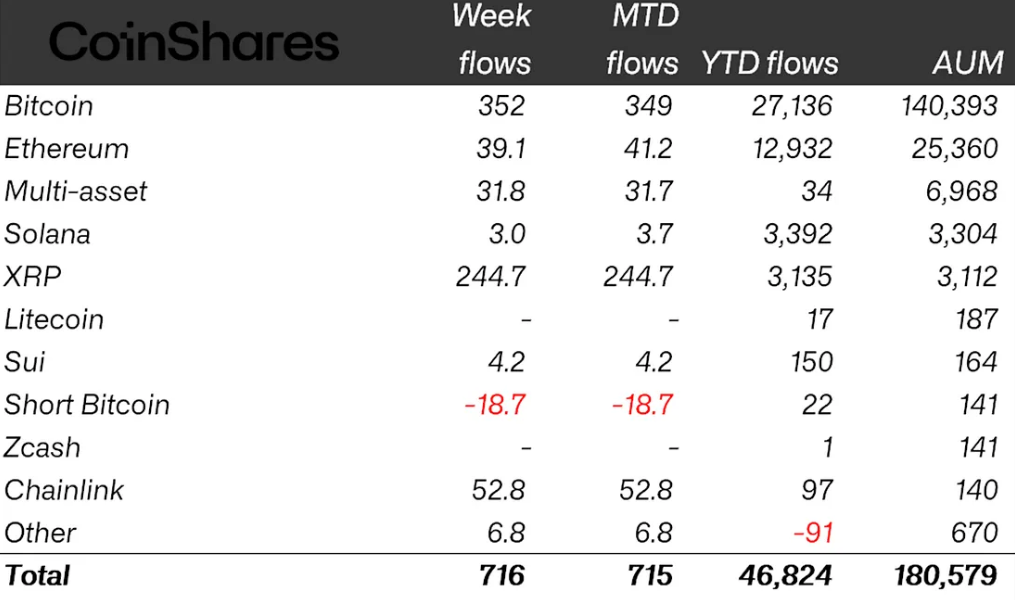
Weekly crypto ETP flows by asset as of Friday (in millions of US dollars). Source: CoinShares

On the other hand, Ether (ETH) funds saw minor inflows of $39 million, while short Bitcoin ETPs posted around $19 million in outflows, potentially indicating a lessening of negative sentiment.

ProShares tops inflows, while BlackRock’s iShares bleeds

Among issuers, ProShares led inflows with $210 million, while BlackRock — the largest issuer by AUM — experienced $105 million in outflows.

Cathie Wood’s ARK and Grayscale Investments also saw outflows, recording $78 million and $7 million, respectively, last week.
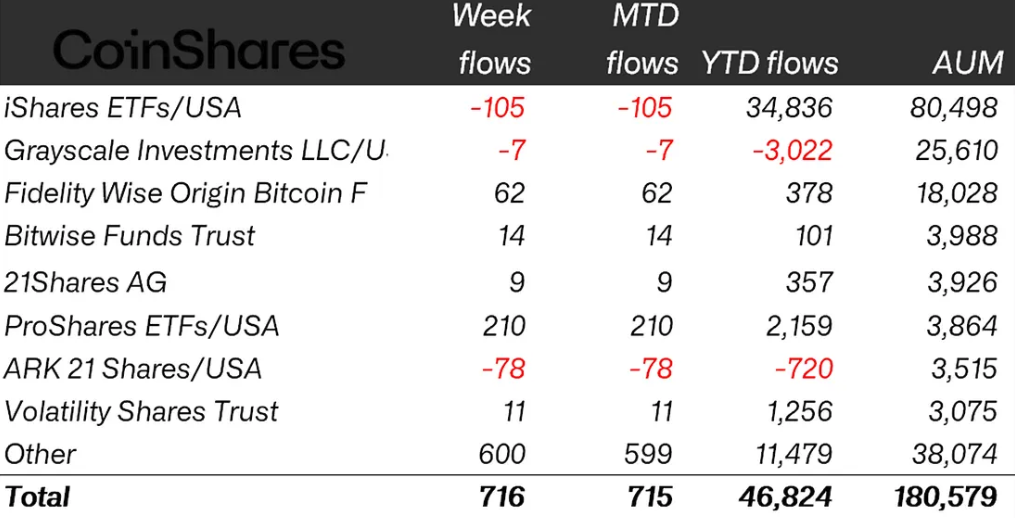
Weekly crypto ETP flows by issuer as of Friday (in millions of US dollars). Source: CoinShares

Geographically, almost all regions globally saw inflows, with the most notable being the US, Germany and Canada, with inflows of $483 million, $97 million and $80.7 million, respectively.

Related: Sweden eyes entering the Bitcoin ‘digital arms race’

On the other hand, Sweden saw $5.6 million in outflows last week, pushing its year-to-date outflows to $836 million, topping global outflows.

Magazine: Koreans ‘pump’ alts after Upbit hack, China BTC mining surge: Asia Express


Пов'язані питання

QWhat was the total amount of inflows into crypto ETPs for the week reported by CoinShares?

ACrypto ETPs attracted $716 million in inflows for the week.

QWhich cryptocurrency fund led the inflows, and how much did it attract?

ABitcoin (BTC) funds led the inflows, attracting $352 million.

QWhich asset manager experienced the largest outflows among the issuers mentioned?

ABlackRock, the largest issuer by AUM, experienced the largest outflows at $105 million.

QWhat record did Chainlink (LINK) funds set according to the report?

AChainlink (LINK) funds posted a record inflow of $52.8 million, which represented 54% of its Assets Under Management (AUM).

QWhat was the primary reason suggested for the minor outflows on Thursday and Friday?

AThe minor outflows were suggested to be a response to US macroeconomic data alluding to ongoing inflationary pressures.

Пов'язані матеріали

Analyzing the Impact of AI on Economic Growth and Productivity

**Title: Analyzing AI's Impact on Economic Growth and Productivity** This article examines three contrasting views on AI's influence on economic growth and productivity. **The Optimistic View** posits that AI, especially through automating R&D ("recursive self-improvement"), could dramatically accelerate growth, even triggering a technological "singularity" with explosive, potentially infinite, economic expansion. **The Moderate/Mainstream View** acknowledges AI's productivity benefits but emphasizes significant real-world constraints that could limit its impact. These include: limited cost savings per task, structural ceilings on which jobs and industries are "exposed" to AI, adoption bottlenecks (e.g., compute, energy, regulatory hurdles), and the "weak link" effect where non-automatable tasks cap overall gains. Consequently, the realized AI dividend may be far lower than optimistic projections, with estimates typically ranging from 0.1% to 1.3% annual productivity growth. **The Pessimistic View** stems from two strands. The first aligns with the moderate view but applies extremely conservative assumptions about task exposure and efficiency gains, yielding minimal projected impact. The second introduces a demand-side critique: if AI primarily replaces rather than augments labor, it could depress labor's share of income, weaken consumer demand, and create a "demand trap" that ultimately stifles growth, unless offset by redistribution policies. **The authors' assessment** is nuanced: * **Short-term (1-2 years):** AI will support growth primarily through investment spending, not significant productivity gains. * **Medium-term (3-5 years):** Three potential paths emerge based on AI demand and bottleneck severity: 1. **"Optimistic Path":** High demand, few bottlenecks. Rapid productivity gains but risk of major job displacement and social conflict without redistribution. 2. **"Moderate Path" (most likely):** High demand but significant, surmountable bottlenecks. Leads to moderate productivity gains, financial market volatility (K-shaped returns), and sectoral job losses. 3. **"Pessimistic Path":** Low demand or severe bottlenecks. Minimal productivity and growth impact, triggering financial market corrections but allowing a smoother societal transition with less labor disruption. * **Long-term:** AI holds potential for a major productivity revolution and prosperity. The conclusion stresses that no path is smooth. Technologically "optimistic" outcomes could be socially detrimental, while "pessimistic" technological diffusion might be more socially stable. Policymakers must monitor developments and prepare balanced responses to manage economic, financial, and social sustainability.

marsbit28 хв тому

Analyzing the Impact of AI on Economic Growth and Productivity

marsbit28 хв тому

The New Cold War is a Tech Stock War

The New Cold War is a Tech Stock War The article argues that the contemporary geopolitical and economic rivalry between the US and China represents a "New Cold War," but one fundamentally fought through technology and financial markets, not physical barriers or conventional trade. Historically, US dominance was secured through financial systems. The Soviet Union, reliant on the rigid "Transferable Ruble," was ultimately undermined by its dependency on the US dollar for oil trade. Later, Japan's semiconductor challenge was countered not just by tariffs (e.g., Plaza Accord, 301 investigations) but by binding it to US Treasury bonds. China presents a more complex, "embedded" challenger. While it holds vast dollar reserves and US debt like Japan, its industrial base is stronger and more diversified than the Soviet Union's. Surviving the initial 2018 trade war phase, the conflict has evolved into a "tech-financial war." The core battlefield is now the stock market. US tech stocks (AI, semiconductors) are treated as sovereign assets, buoyed by bipartisan national will. China is pushing to strengthen its own financial markets to convert industrial strength into financial power and fund its tech ambitions. Companies like ChangXin (semiconductors), Moonshot AI, and DJI compete not just for market share but as financial proxies for their respective systems. The new paradigm is moving from globally efficient monopolies (Apple, Google) towards companies that achieve monopolistic profits within their respective geopolitical spheres. This competition over "pricing power" and financial valuation in segmented markets defines the current era, making the stock market the primary arena for this tech-centric struggle.

marsbit37 хв тому

The New Cold War is a Tech Stock War

marsbit37 хв тому

Торгівля

Спот
活动图片