Crypto Funding Soars 50%, But Most Startups Are Getting Shut Out: Analysts

bitcoinistОпубліковано о 2026-03-10Востаннє оновлено о 2026-03-10

Анотація

Cryptocurrency fundraising surged nearly 50% year-over-year through March 2026, but the number of individual deals dropped by 46%, according to Messari data. The average deal size soared 272% to $34 million, reflecting a trend of capital concentration in fewer, larger rounds. Three major deals in February alone accounted for 44% of the month’s total funding. While early-stage activity remains fragmented, late-stage and strategic mega-rounds dominate. A significant concern is the decline in new venture fund closures, with few major crypto VCs raising fresh capital beyond Dragonfly’s recent $650 million fund. This suggests that despite headline growth, the industry faces a potential future funding shortage.

Three deals last February ate up nearly half of all the money raised in crypto that month. Just three. That single fact tells you more about where crypto funding stands right now than the headline numbers do.

A Shrinking Pool Of Big Bets

According to data from research firm Messari, total crypto fundraising climbed almost 50% in the 12 months ending March 2026 compared to the year before.

But the number of individual deals fell 46% over the same period. Fewer rounds. Bigger checks. The average deal size hit $34 million — a 272% jump from a year earlier. The number of active investors dropped by about a third, down to 3,225.

Those three February standouts were Tether’s $200 million investment into online marketplace Whop, a $75 million Series B for sports prediction platform Novig led by Pantera Capital, and a $70 million Series B for ARQ, a Latin American fintech app built around stablecoins, backed by Sequoia Capital. Together, they accounted for 44% of the close to $800 million raised across the entire month.

Messari describes the pattern as capital concentration driven by late-stage and strategic mega-rounds. A handful of well-positioned companies are pulling in enormous sums while smaller players scramble for scraps.

Early-stage fundraising, reports say, remains active but scattered. Messari pointed to Interstate’s $1.5 million round, which pulled in more than 15 backers — a mix of firms like Bloccelerate VC and individual angel investors. That kind of fragmented, small-dollar activity is happening in volume. But it exists in a different world from the mega-rounds grabbing the headlines.
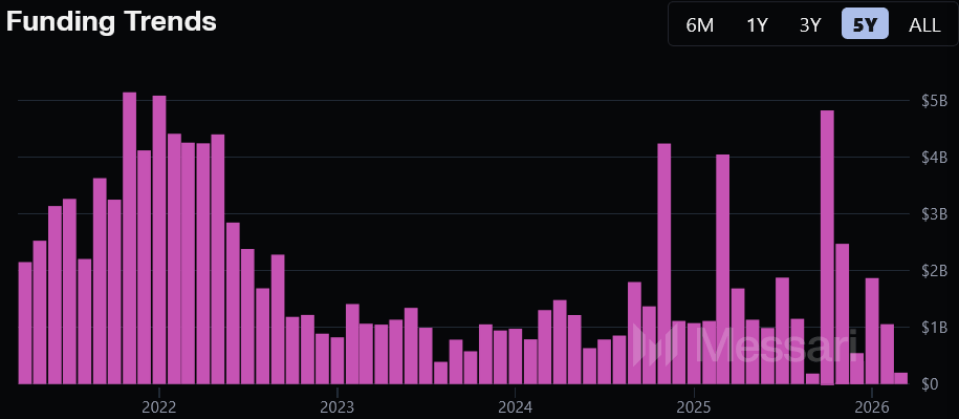
Five-year trend of monthly crypto fundraising changes. Source: Messari

The VC Drought No One Is Talking About

Here is the part the headline buries. Messari CEO Eric Turner flagged a problem that goes beyond deal counts: outside of Dragonfly Capital, no major crypto venture firm has recently closed a new fund. Dragonfly closed a $650 million fund with a focus on real-world assets, but it stands largely alone. Turner put it bluntly — the industry needs fresh capital.

BTCUSD trading at $68,749 on the 24-hour chart: TradingView

Crypto Investors Stay Active As New Funds Decline

That matters because venture funds have a shelf life. Firms raise a fund, deploy it over several years, then raise again. When new fund closes dry up, the money flowing into deals eventually does too.

The 50% year-over-year gain may look strong on paper, but it is being powered by existing pools that are not being replenished at the same rate.

Coinbase Ventures, QUBIC Labs, and Somnia ranked as the three most active crypto investors over the past three months, based on Messari data.

Featured image from KuCoin, chart from TradingView

Пов'язані питання

QWhat was the overall trend in crypto fundraising in the 12 months ending March 2026, and what was the percentage change?

ATotal crypto fundraising climbed almost 50% in the 12 months ending March 2026 compared to the year before.

QDespite the increase in total funds raised, what happened to the number of individual deals and the average deal size?

AThe number of individual deals fell 46% over the same period, while the average deal size hit $34 million, a 272% jump from a year earlier.

QAccording to Messari, what is the pattern driving the concentration of capital in the crypto fundraising market?

AMessari describes the pattern as capital concentration driven by late-stage and strategic mega-rounds, where a handful of well-positioned companies are pulling in enormous sums.

QWhich major crypto venture firm was noted as a standout for closing a new fund recently, and how much did it raise?

ADragonfly Capital was the standout, closing a $650 million fund with a focus on real-world assets.

QWhat problem did Messari CEO Eric Turner flag that goes beyond the deal counts in the crypto fundraising space?

AHe flagged that outside of Dragonfly Capital, no major crypto venture firm has recently closed a new fund, indicating a need for fresh capital in the industry.

Пов'язані матеріали

The AI Agent Era Accelerates Its Arrival: Questflow Defines a New Paradigm of Financial Intelligence with On-Chain AI Brokerage

The AI Agent era is accelerating, with the CB Insights AI 100 list highlighting global investment confidence. The focus has shifted from whether AI works to its speed of deployment and ability to manage complex workflows, with autonomous AI Agents driving this transformation. At the forefront is Questflow, a Singapore-based startup redefining financial intelligence through its on-chain AI brokerage. Unlike tools that merely provide data dashboards, Questflow deploys AI Agents that proactively scan markets, form judgments, and execute trades via a conversational interface—operating 24/7 without requiring manual confirmation for each decision. This embodies the new AI paradigm of agents capable of executing multi-step workflows autonomously. Questflow's mission is to democratize institutional-grade trading intelligence. Historically reserved for the ultra-wealthy, this capability is now accessible starting from just $1 through Questflow's "AI Clone + Copy Trade" model. The platform charges only a 1% execution fee, aligning its incentives directly with users and eliminating traditional management or performance fees. The timing is opportune, aligning with key trends identified by CB Insights: the scalable deployment of AI Agents, accelerated AI adoption in financial services, and the maturation of on-chain infrastructure. With robust liquidity on platforms like Hyperliquid and Polymarket, alongside advancements in AI reasoning and non-custodial wallet security, Questflow is positioned to merge the roles of broker, fund, and exchange into a single, accessible platform for millions.

链捕手14 хв тому

The AI Agent Era Accelerates Its Arrival: Questflow Defines a New Paradigm of Financial Intelligence with On-Chain AI Brokerage

链捕手14 хв тому

Why Pricing Social Interactions is Doomed to Fail?

Titled "Why Putting a Price on Social Interaction Is Doomed to Fail," this article critiques attempts to monetize social networks directly through SocialFi models, arguing their inevitable failure stems from a fundamental misunderstanding of media dynamics. Using Marshall McLuhan's theory of "hot" and "cold" media, the author posits that social networks are inherently "cold" media. Their value isn't contained in individual posts but is co-created through user participation, interpretation, and fragmented, ongoing interaction (e.g., replies, shares). This ambiguity and need for user involvement are core to their function. The article asserts that SocialFi projects like Friend.tech failed because introducing real-time, tradable financial pricing (a definitive "hot" signal) into this "cold" environment doesn't add a layer—it replaces the medium's essence. The unambiguous price signal overshadows and nullifies the nuanced, participatory social signal. Users become traders, not participants, and when speculative profits vanish, the underlying social ecosystem—never genuinely cultivated—collapses entirely. This principle extends beyond crypto. The author argues platforms like Twitter have gradually "heated up" through metrics (likes, retweets counts, algorithmically defined value), shifting users from participants to performers and eroding organic engagement. The solution isn't to abandon capital but to manage its entry point. Successful models like Substack, Patreon, or Bandcamp allow capital to "condense" at specific, isolated nodes (e.g., subscriptions, one-time payments) without permeating and "heating" every social interaction. They preserve the core "cold," participatory medium while enabling monetization at designated boundaries. The NFT boom and bust serves as a stark parallel: the ancient "cold" medium of collecting (valued for story, community, gradual accumulation) was rapidly destroyed by platforms that introduced real-time floor prices, rarity scores, and trading dashboards, transforming collectors into speculators and vaporizing cultural value when prices fell. The core lesson: "Liquidity equals heat." Injecting high liquidity and definitive pricing into a "cold" participatory medium doesn't optimize it; it fundamentally alters and destroys its value-creating mechanism. The future lies not in pricing every social gesture but in finding precise, non-invasive points for capital to condense without overheating the entire ecosystem.

marsbit22 хв тому

Why Pricing Social Interactions is Doomed to Fail?

marsbit22 хв тому

Jensen Huang's CMU Speech: In the AI Era, Don't Just Watch, Build

Jensen Huang, CEO of NVIDIA and a first-generation immigrant, delivered the commencement address to Carnegie Mellon University's class of 2026. He shared his personal journey from a humble background to founding NVIDIA, emphasizing resilience, learning from failure, and the responsibility that comes with leadership. Huang framed the present moment as the dawn of the AI revolution, a shift he believes is more profound than previous computing waves. He described AI as fundamentally resetting computing—moving from human-written software to machines that understand, reason, and use tools. This will create a new industry for generating intelligence and transform every sector. While acknowledging AI's potential to automate tasks and displace some jobs, Huang distinguished between the *tasks* of a job and its core *purpose*. He argued AI will augment human capability, not replace humans. The real risk, he stated, is not AI itself, but people being left behind by those who effectively use AI. He presented AI as a generational opportunity for massive infrastructure investment—in chip factories, data centers, energy grids, and advanced manufacturing—that could re-industrialize nations like the U.S. and bridge the digital divide by making computing and intelligent tools accessible to all. Huang called for a balanced approach: advancing AI safely and responsibly, establishing prudent policies, ensuring broad access, and encouraging universal participation. He urged the graduates not to fear the future but to engage with optimism and ambition, reminding them of CMU's motto, "My heart is in the work." His core message was clear: this is their moment to actively build and shape the AI-powered future, not merely observe it.

marsbit1 год тому

Jensen Huang's CMU Speech: In the AI Era, Don't Just Watch, Build

marsbit1 год тому

Торгівля

Спот
Ф'ючерси

Популярні статті

Як купити T

Ласкаво просимо до HTX.com! Ми зробили покупку Threshold Network Token (T) простою та зручною. Дотримуйтесь нашої покрокової інструкції, щоб розпочати свою криптовалютну подорож.Крок 1: Створіть обліковий запис на HTXВикористовуйте свою електронну пошту або номер телефону, щоб зареєструвати обліковий запис на HTX безплатно. Пройдіть безпроблемну реєстрацію й отримайте доступ до всіх функцій.ЗареєструватисьКрок 2: Перейдіть до розділу Купити крипту і виберіть спосіб оплатиКредитна/дебетова картка: використовуйте вашу картку Visa або Mastercard, щоб миттєво купити Threshold Network Token (T).Баланс: використовуйте кошти з балансу вашого рахунку HTX для безперешкодної торгівлі.Треті особи: ми додали популярні способи оплати, такі як Google Pay та Apple Pay, щоб підвищити зручність.P2P: Торгуйте безпосередньо з іншими користувачами на HTX.Позабіржова торгівля (OTC): ми пропонуємо індивідуальні послуги та конкурентні обмінні курси для трейдерів.Крок 3: Зберігайте свої Threshold Network Token (T)Після придбання Threshold Network Token (T) збережіть його у своєму обліковому записі на HTX. Крім того, ви можете відправити його в інше місце за допомогою блокчейн-переказу або використовувати його для торгівлі іншими криптовалютами.Крок 4: Торгівля Threshold Network Token (T)Легко торгуйте Threshold Network Token (T) на спотовому ринку HTX. Просто увійдіть до свого облікового запису, виберіть торгову пару, укладайте угоди та спостерігайте за ними в режимі реального часу. Ми пропонуємо зручний досвід як для початківців, так і для досвідчених трейдерів.

409 переглядів усьогоОпубліковано 2024.12.10Оновлено 2025.03.21

Як купити T

Обговорення

Ласкаво просимо до спільноти HTX. Тут ви можете бути в курсі останніх подій розвитку платформи та отримати доступ до професійної ринкової інформації. Нижче представлені думки користувачів щодо ціни T (T).

活动图片













