Crypto Donations Branded ‘Dangerous’? UK Security Panel Urges Immediate Ban

bitcoinistОпубліковано о 2026-03-18Востаннє оновлено о 2026-03-18

Анотація

A UK National Security Panel has called for an immediate ban on political donations made with cryptocurrency, labeling them an "unnecessary and unacceptably high risk" to the integrity of the political finance system. The cross-party committee warns that crypto donations create a "gaping hole" in national security defenses, making it difficult to verify donors due to pseudonymous wallets, mixers, and foreign payment processors. The report urges stricter donor-identity checks, wealth-source verification, and a single-agency lead for enforcement to prevent foreign interference and illicit finance. Proposed rules would require donations to go through FCA-registered platforms, prohibit mixed coins, and mandate conversion to pounds within 48 hours. This is framed as a national security measure, not a blanket attack on crypto.

UK National Security Panel has deemed donations made with crypto assets as an “unnecessary and unacceptably high risk” and it is asking the government for an immediate ban.

Too High Of A Crypto-Risk

The Joint Committee on the National Security Strategy has called today for a moratorium on crypto political donations (an official temporary ban), alongside new donor‐verification rules, to tackle illicit finance and foreign interference in UK politics. The latest report of the Joint Committee warns that crypto donations to UK political parties are a high‐risk channel for illicit and foreign money. Crypto donations pose an “unnecessary and unacceptably high risk to the integrity of the political finance system”, the report reads.

The Government must immediately ban political donations made through cryptocurrency until firm rules can be developed, in order to keep UK politics safe from illicit finance, a cross-party Committee has found.

This decision follows a letter issued on February 24 by Committee Chair of the House of Commons Matt Western to Housing Secretary Steve Reed, urging the government to act before the next general election, warning that hostile states may exploit opaque crypto flows, as reported by Bitcoinist.

Inside The Warning Report

The main concerns expressed by the parliamentary include pseudonymous wallets, mixers and foreign‐based payment processors make it hard to verify who is really bankrolling UK parties, creating a “gaping hole” in national‐security defenses. In order to tackle this, the committee is asking for stricter donor‐identity checks and wealth‐source verification, plus a clear single‐agency lead over political finance enforcement to avoid the current fragmentation across multiple bodies.

Responsibility for policing risks of foreign influence in political finance is dispersed across several services, including the Electoral Commission, Metropolitan Police, Counter Terrorism Policing, MI5, the National Crime Agency and other police services. The Committee argues that accountability and governance are “inadequate”, and notes that a clearer set up with a single national lead would help address low public trust in enforcement of the rules.

What Happens Next?

Under the specific conditions proposed for any future digital assets donations after the moratorium, parties would only be allowed to accept coins that move through fully FCA‐registered platforms, closing off the offshore exchanges and bespoke portals currently used to route funds into Westminster. Any crypto that has passed through mixers or tumblers would be flat‐out prohibited and, on top of that, parties would have to convert donated tokens into pounds within roughly 48 hours, sharply limiting the time funds remain on‐chain and making it easier for regulators and watchdogs to audit who is really paying for UK politics.

The UK is trying to position itself as a “global hub” for digital assets in trading and custody, even as its national‐security apparatus moves aggressively to regulate crypto assets.

The committee frames this as a national‐security and anti‐corruption issue, not a blanket attack on crypto markets, but the political narrative still feeds into a broader crackdown theme investors cannot ignore. While spot crypto trading in the UK remains unaffected in the short term, headlines about “illicit money” and “foreign interference” can sap risk appetite, weigh on politically exposed tokens, and add another layer of regulatory overhang for any UK‐facing exchanges or payment rails.
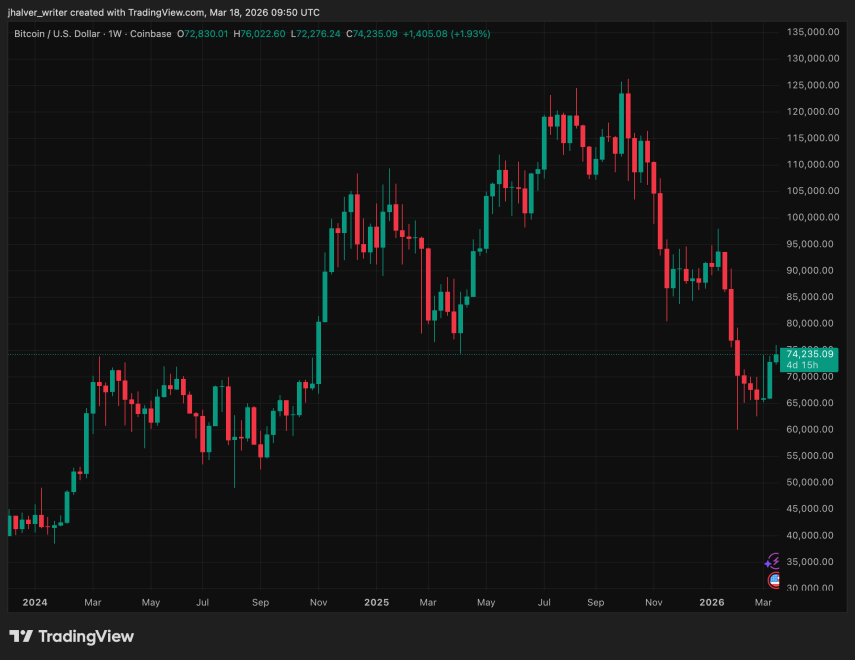
At the time of writing, BTC’s price stays on the $74k. Source: BTCUSD on Tradingview

Cover image from Perplexity, BTCUSD chart from Tradingview

Пов'язані питання

QWhat is the main recommendation of the UK National Security Panel regarding crypto political donations?

AThe UK National Security Panel has recommended an immediate ban (moratorium) on political donations made through cryptocurrency to protect the integrity of the political finance system from illicit finance and foreign interference.

QWhat specific risks did the committee identify with crypto donations?

AThe committee identified risks including pseudonymous wallets, mixers, and foreign-based payment processors that make it difficult to verify the true source of donations, creating a 'gaping hole' in national security defenses.

QWhat conditions are proposed for allowing crypto donations after the moratorium?

AAfter the moratorium, parties would only be allowed to accept crypto that moves through fully FCA-registered platforms, must convert donated tokens to pounds within 48 hours, and any crypto that has passed through mixers or tumblers would be prohibited.

QWhich UK agencies are currently responsible for policing risks of foreign influence in political finance?

AResponsibility is dispersed across several services including the Electoral Commission, Metropolitan Police, Counter Terrorism Policing, MI5, the National Crime Agency, and other police services.

QHow does the committee frame this issue in relation to the UK's broader crypto ambitions?

AThe committee frames this as a national security and anti-corruption issue, not a blanket attack on crypto markets, even as the UK tries to position itself as a 'global hub' for digital assets in trading and custody.

Пов'язані матеріали

In-Depth Report on the On-Chain Lending Market: When Off-Chain Credit Meets On-Chain Liquidation

The on-chain lending market has evolved from a peripheral DeFi niche into core financial infrastructure. As of early 2026, total value locked (TVL) in on-chain lending protocols has reached $64.3 billion, accounting for 53.54% of total DeFi TVL, making it the largest and most mature vertical within decentralized finance. Aave dominates the sector with approximately $32.9 billion in TVL, commanding nearly half of the market—a leadership position that is unlikely to be challenged in the foreseeable future. However, the path of on-chain lending forward is not without risk. Liquidation cascades, credit defaults, and cross-chain vulnerabilities remain systemic threats hanging over the industry. At the same time, a deeper structural transformation is underway: on-chain lending is shifting from a “leverage tool for crypto-native users” to a “compliant gateway for institutional capital”. The scale of RWA (Real World Asset) lending has surpassed $18.5 billion, with U.S. Treasuries and government securities increasingly serving as core collateral. Institutional capital inflows are reshaping both the user base and risk appetite of the sector. This report systematically analyzes the evolution of on-chain lending definitions, competitive dynamics, core risks, and future trends, providing a comprehensive industry outlook for investors and trade practitioners. Key findings suggest that the “one dominant player with several strong challengers” structure will persist in the short term, while fixed-rate lending, compliant collateral, and institutional credit underwriting will define the next phase of competition. For investors focused on DeFi infrastructure, three key opportunity tracks stand out, namely, the Aave ecosystem (Morpho, Spark), RWA lending protocols (Ondo, Maple) and fixed-rate innovation (Notional, Pendle).

HTX Learn1 год тому

In-Depth Report on the On-Chain Lending Market: When Off-Chain Credit Meets On-Chain Liquidation

HTX Learn1 год тому

Fu Peng's First Public Speech in 2026: What Exactly Are Crypto Assets? Why Did I Join the Crypto Asset Industry?

Fu Peng, a renowned macroeconomist and now Chief Economist at New火 Group, delivered his first public speech of 2026 at the Hong Kong Web3 Festival. He explained his perspective on crypto assets and why he joined the industry, framing it within the context of macroeconomic trends and financial evolution. Fu emphasized that crypto assets are transitioning from an early, belief-driven phase to a mature, institutionally integrated asset class. He drew parallels to the 1970s-80s, when technological advances (like computing) revolutionized traditional finance, leading to the rise of FICC (Fixed Income, Currencies, and Commodities). Similarly, current advancements in AI, data, and blockchain are reshaping finance, with crypto assets becoming part of a new "FICC + C" (C for Crypto) framework. He noted that institutional capital, including traditional hedge funds, avoided early crypto due to its speculative nature but are now engaging as regulatory clarity emerges (e.g., stablecoin laws, CFTC classifying crypto as a commodity). Fu predicted that 2025-2026 marks a turning point where crypto becomes a standardized, financially viable asset for diversified portfolios, akin to commodities or derivatives in traditional finance. Fu defined Bitcoin not as "digital gold" in a simplistic sense but as a value-preserving, financially tradable asset. He highlighted that crypto's future lies in regulated, institutional adoption, moving away from retail-dominated trading. His entry into crypto signals this maturation, where traditional finance integrates crypto into mainstream asset management.

marsbit2 год тому

Fu Peng's First Public Speech in 2026: What Exactly Are Crypto Assets? Why Did I Join the Crypto Asset Industry?

marsbit2 год тому

Justin Sun Sues Trump Family: What $75 Million Bought Was Only a Blacklist

Justin Sun, founder of Tron, has filed a lawsuit in federal court against World Liberty Financial (WLF), alleging he was made the "primary target of a fraudulent scheme" after investing $75 million. Sun claims the investment secured him an advisor title and WLFI tokens, which were later frozen by WLF, causing "hundreds of millions in losses." The dispute began in late 2024 when Sun's investment helped revive WLF's struggling token sale, which ultimately raised $550 million. Shortly after, the SEC dropped its lawsuit against Sun following Donald Trump's inauguration. However, relations soured when Sun refused WLF's demands for additional funding. In August 2025, WLF added a "blacklist" function to its smart contract, allowing it to unilaterally freeze tokens. Sun's holdings, worth approximately $107 million, were frozen, and he was threatened with token destruction. The lawsuit highlights WLF's structure, which directs 75% of token sale profits to the Trump family, who had earned $1 billion by December 2025. WLF's CEO is Zach Witkoff, son of U.S. Middle East envoy Steve Witkoff. The project faces scrutiny for opaque operations, including a controversial loan arrangement on the Dolomite platform, co-founded by a WLF advisor. Despite Sun's history with the SEC, the case underscores centralization risks within DeFi, as WLF controls governance and holds powers to freeze assets arbitrarily. Sun's tokens remain frozen as legal proceedings begin.

marsbit2 год тому

Justin Sun Sues Trump Family: What $75 Million Bought Was Only a Blacklist

marsbit2 год тому

Торгівля

Спот
Ф'ючерси

Популярні статті

Як купити BAN

Ласкаво просимо до HTX.com! Ми зробили покупку Comedian (BAN) простою та зручною. Дотримуйтесь нашої покрокової інструкції, щоб розпочати свою криптовалютну подорож.Крок 1: Створіть обліковий запис на HTXВикористовуйте свою електронну пошту або номер телефону, щоб зареєструвати обліковий запис на HTX безплатно. Пройдіть безпроблемну реєстрацію й отримайте доступ до всіх функцій.ЗареєструватисьКрок 2: Перейдіть до розділу Купити крипту і виберіть спосіб оплатиКредитна/дебетова картка: використовуйте вашу картку Visa або Mastercard, щоб миттєво купити Comedian (BAN).Баланс: використовуйте кошти з балансу вашого рахунку HTX для безперешкодної торгівлі.Треті особи: ми додали популярні способи оплати, такі як Google Pay та Apple Pay, щоб підвищити зручність.P2P: Торгуйте безпосередньо з іншими користувачами на HTX.Позабіржова торгівля (OTC): ми пропонуємо індивідуальні послуги та конкурентні обмінні курси для трейдерів.Крок 3: Зберігайте свої Comedian (BAN)Після придбання Comedian (BAN) збережіть його у своєму обліковому записі на HTX. Крім того, ви можете відправити його в інше місце за допомогою блокчейн-переказу або використовувати його для торгівлі іншими криптовалютами.Крок 4: Торгівля Comedian (BAN)Легко торгуйте Comedian (BAN) на спотовому ринку HTX. Просто увійдіть до свого облікового запису, виберіть торгову пару, укладайте угоди та спостерігайте за ними в режимі реального часу. Ми пропонуємо зручний досвід як для початківців, так і для досвідчених трейдерів.

427 переглядів усьогоОпубліковано 2024.12.11Оновлено 2025.03.21

Як купити BAN

Обговорення

Ласкаво просимо до спільноти HTX. Тут ви можете бути в курсі останніх подій розвитку платформи та отримати доступ до професійної ринкової інформації. Нижче представлені думки користувачів щодо ціни BAN (BAN).

活动图片