Crypto among sectors ‘debanked’ by 9 major banks: US regulator

cointelegraphОпубліковано о 2025-12-11Востаннє оновлено о 2025-12-11

Анотація

According to preliminary findings from the U.S. Office of the Comptroller of the Currency (OCC), nine major U.S. banks restricted financial services to politically contentious industries—including cryptocurrency—between 2020 and 2023. The OCC stated that these banks made “inappropriate distinctions” among customers based on lawful business activities, either by implementing restrictive policies or requiring escalated reviews. Sectors affected were crypto, oil and gas, firearms, private prisons, and others. Crypto businesses faced limitations often tied to financial crime concerns. The OCC is continuing its review and may refer findings to the Justice Department. Critics argue the report overlooks regulatory pressure from agencies like the FDIC that contributed to debanking.

The nine largest US banks restricted financial services to politically contentious industries, including cryptocurrency, between 2020 and 2023, according to the preliminary findings of the Office of the Comptroller of the Currency (OCC).

The banking regulator said on Wednesday that its early findings show that major banks “made inappropriate distinctions among customers in the provision of financial services on the basis of their lawful business activities” across the three-year period.

The banks either implemented policies restricting access to banking or required escalated reviews and approvals before giving financial services to certain customers, the OCC said, without giving specific details.

The OCC initiated its review after President Donald Trump signed an executive order in August, directing a review of whether banks had debanked or discriminated against individuals based on their political or religious beliefs.

Crypto issuers and exchanges caught in restrictions

The OCC’s report found that in addition to crypto, the sectors that faced banking restrictions included oil and gas exploration, coal mining, firearms, private prisons, tobacco and e-cigarette manufacturers and adult entertainment.

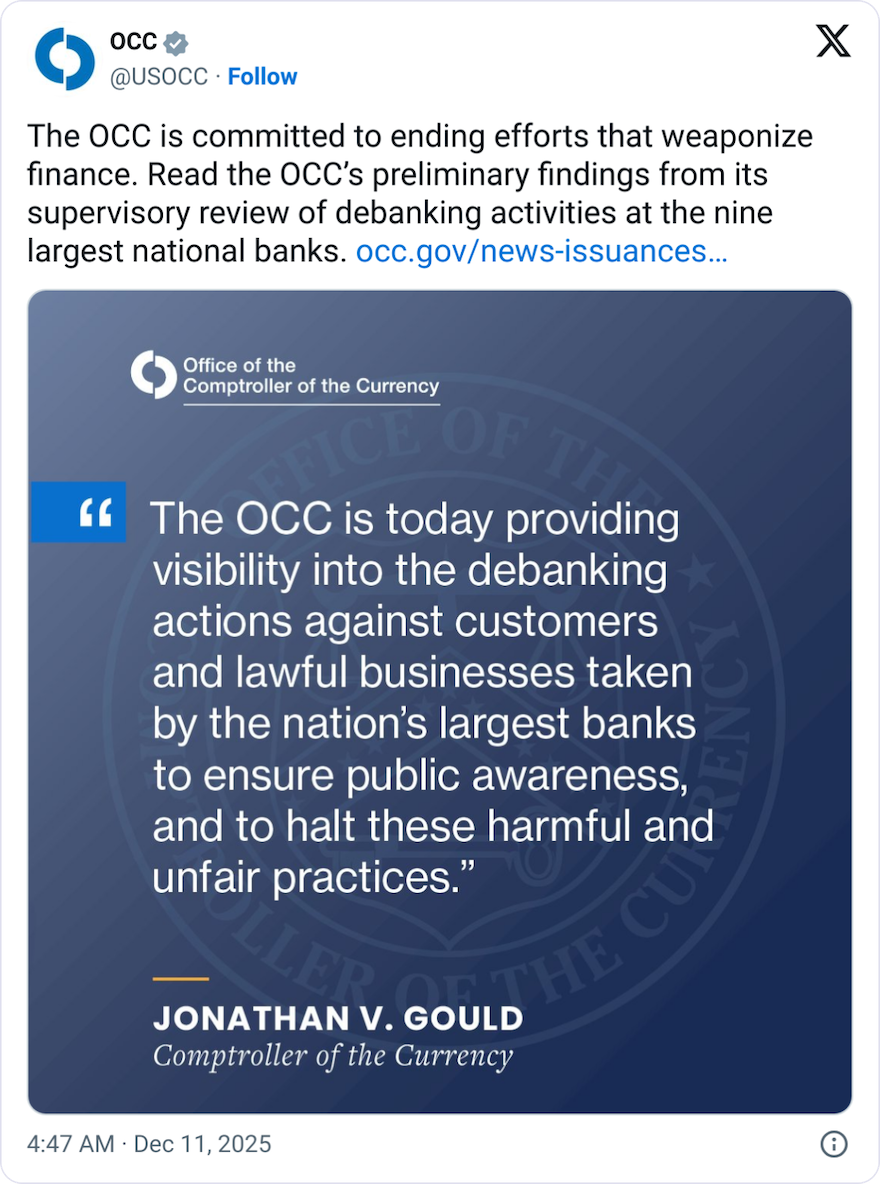
Banks’ actions toward crypto included restrictions on “issuers, exchanges, or administrators, often attributed to financial crime considerations,” the OCC said.
Source: OCC

“It is unfortunate that the nation’s largest banks thought these harmful debanking policies were an appropriate use of their government-granted charter and market power,” said Comptroller of the Currency Jonathan Gould.

“While many of these policies were undertaken in plain sight and even announced publicly, certain banks have continued to insist that they did not engage in debanking,” he added.

The OCC examined JPMorgan Chase, Bank of America, Citibank, Wells Fargo, US Bank, Capital One, PNC Bank, TD Bank, and BMO Bank, the largest national banks it regulates.

The OCC reported that it is continuing its investigation and could refer its findings to the Justice Department.

OCC debanking report leaves “much to be desired”

Nick Anthony, a policy analyst at the libertarian think tank Cato Institute, said in an emailed statement to Cointelegraph that the OCC’s report “leaves much to be desired” and didn’t mention “the most well-known causes of debanking.”

“The report criticizes banks for severing ties with controversial clients, but it fails to mention that regulators explicitly assess banks on their reputation,” he said.

Related: ‘Grow up... We debank Democrats, we debank Republicans:’ JPMorgan CEO

“Making matters worse, the report appears to blame banks for cutting ties with cryptocurrency companies, yet makes no mention of the fact that the [Federal Deposit Insurance Corporation] explicitly told banks to stay away from these companies,” Anthony added.

Republicans on the House Finance Committee reported earlier this month that the FDIC’s so-called “pause letters” it sent to banks under the Biden administration helped to spur “the debanking of the digital asset ecosystem.”

Caitlin Long, the founder and CEO of the crypto-focused Custodia Bank, said the “worst culprits” of crypto-related debanking under the Biden administration were the FDIC and Federal Reserve, “not OCC.”

“In OCC’s defense, this report covers large banks only. Crushing crypto wasn’t a supervisory priority for large banks like it was for small [and] mid-sized banks,” she added.

Magazine: Quitting Trump’s top crypto job wasn’t easy: Bo Hines

Пов'язані матеріали

Google and Amazon Simultaneously Invest Heavily in a Competitor: The Most Absurd Business Logic of the AI Era Is Becoming Reality

In a span of four days, Amazon announced an additional $25 billion investment, and Google pledged up to $40 billion—both direct competitors pouring over $65 billion into the same AI startup, Anthropic. Rather than a typical venture capital move, this signals the latest escalation in the cloud wars. The core of the deal is not equity but compute pre-orders: Anthropic must spend the majority of these funds on AWS and Google Cloud services and chips, effectively locking in massive future compute consumption. This reflects a shift in cloud market dynamics—enterprises now choose cloud providers based on which hosts the best AI models, not just price or stability. With OpenAI deeply tied to Microsoft, Anthropic’s Claude has become the only viable strategic asset for Google and Amazon to remain competitive. Anthropic’s annualized revenue has surged to $30 billion, and it is expanding into verticals like biotech, positioning itself as a cross-industry AI infrastructure layer. However, this funding comes with constraints: Anthropic’s independence is challenged as it balances two rival investors, its safety-first narrative faces pressure from regulatory scrutiny, and its path to IPO introduces new financial pressures. Globally, this accelerates a "tri-polar" closed-loop structure in AI infrastructure, with Microsoft-OpenAI, Google-Anthropic, and Amazon-Anthropic forming exclusive model-cloud alliances. In contrast, China’s landscape differs—investments like Alibaba and Tencent backing open-source model firm DeepSeek reflect a more decoupled approach, though closed-source models from major cloud providers still dominate. The $65 billion bet is ultimately about securing a seat at the table in an AI-defined future—where missing the model layer means losing the cloud war.

marsbit2 год тому

Google and Amazon Simultaneously Invest Heavily in a Competitor: The Most Absurd Business Logic of the AI Era Is Becoming Reality

marsbit2 год тому

Computing Power Constrained, Why Did DeepSeek-V4 Open Source?

DeepSeek-V4 has been released as a preview open-source model, featuring 1 million tokens of context length as a baseline capability—previously a premium feature locked behind enterprise paywalls by major overseas AI firms. The official announcement, however, openly acknowledges computational constraints, particularly limited service throughput for the high-end DeepSeek-V4-Pro version due to restricted high-end computing power. Rather than competing on pure scale, DeepSeek adopts a pragmatic approach that balances algorithmic innovation with hardware realities in China’s AI ecosystem. The V4-Pro model uses a highly sparse architecture with 1.6T total parameters but only activates 49B during inference. It performs strongly in agentic coding, knowledge-intensive tasks, and STEM reasoning, competing closely with top-tier closed models like Gemini Pro 3.1 and Claude Opus 4.6 in certain scenarios. A key strategic product is the Flash edition, with 284B total parameters but only 13B activated—making it cost-effective and accessible for mid- and low-tier hardware, including domestic AI chips from Huawei (Ascend), Cambricon, and Hygon. This design supports broader adoption across developers and SMEs while stimulating China's domestic semiconductor ecosystem. Despite facing talent outflow and intense competition in user traffic—with rivals like Doubao and Qianwen leading in monthly active users—DeepSeek has maintained technical momentum. The release also comes amid reports of a new funding round targeting a valuation exceeding $10 billion, potentially setting a new record in China’s LLM sector. Ultimately, DeepSeek-V4 represents a shift toward open yet realistic infrastructure development in the constrained compute landscape of Chinese AI, emphasizing engineering efficiency and domestic hardware compatibility over pure model scale.

marsbit3 год тому

Computing Power Constrained, Why Did DeepSeek-V4 Open Source?

marsbit3 год тому

Торгівля

Спот
Ф'ючерси

Популярні статті

Як купити US

Ласкаво просимо до HTX.com! Ми зробили покупку Talus Network (US) простою та зручною. Дотримуйтесь нашої покрокової інструкції, щоб розпочати свою криптовалютну подорож.Крок 1: Створіть обліковий запис на HTXВикористовуйте свою електронну пошту або номер телефону, щоб зареєструвати обліковий запис на HTX безплатно. Пройдіть безпроблемну реєстрацію й отримайте доступ до всіх функцій.ЗареєструватисьКрок 2: Перейдіть до розділу Купити крипту і виберіть спосіб оплатиКредитна/дебетова картка: використовуйте вашу картку Visa або Mastercard, щоб миттєво купити Talus Network (US).Баланс: використовуйте кошти з балансу вашого рахунку HTX для безперешкодної торгівлі.Треті особи: ми додали популярні способи оплати, такі як Google Pay та Apple Pay, щоб підвищити зручність.P2P: Торгуйте безпосередньо з іншими користувачами на HTX.Позабіржова торгівля (OTC): ми пропонуємо індивідуальні послуги та конкурентні обмінні курси для трейдерів.Крок 3: Зберігайте свої Talus Network (US)Після придбання Talus Network (US) збережіть його у своєму обліковому записі на HTX. Крім того, ви можете відправити його в інше місце за допомогою блокчейн-переказу або використовувати його для торгівлі іншими криптовалютами.Крок 4: Торгівля Talus Network (US)Легко торгуйте Talus Network (US) на спотовому ринку HTX. Просто увійдіть до свого облікового запису, виберіть торгову пару, укладайте угоди та спостерігайте за ними в режимі реального часу. Ми пропонуємо зручний досвід як для початківців, так і для досвідчених трейдерів.

1.2k переглядів усьогоОпубліковано 2025.12.11Оновлено 2025.12.11

Як купити US

Обговорення

Ласкаво просимо до спільноти HTX. Тут ви можете бути в курсі останніх подій розвитку платформи та отримати доступ до професійної ринкової інформації. Нижче представлені думки користувачів щодо ціни US (US).

活动图片