Coinbase to acquire The Clearing Company in prediction markets push

cointelegraphОпубліковано о 2025-12-22Востаннє оновлено о 2025-12-22

Анотація

Coinbase has agreed to acquire The Clearing Company, an on-chain prediction markets startup, as part of its strategy to become an "Everything Exchange." The acquisition, expected to close in January, will expand Coinbase’s offerings beyond digital assets to include prediction markets spanning politics, sports, and culture. The Clearing Company, founded earlier this year and backed by Coinbase Ventures, recently applied to become a Derivatives Clearing Organization with the CFTC. Coinbase views prediction markets as a major growth opportunity, citing regulatory developments and potential tax advantages over traditional gambling. The move aligns with broader industry interest in event-based markets, with players like Polymarket and Kalshi also active in the space.

Coinbase has agreed to acquire The Clearing Company, an on-chain prediction markets startup that spans digital assets, politics, sports, and culture, as it expands its push to become an “Everything Exchange” offering a broad range of investment products.

In an announcement shared with Cointelegraph, Coinbase said it has entered into a definitive agreement to acquire The Clearing Company, with the transaction expected to close in January. Financial terms of the deal were not disclosed.

The acquisition marks a rapid turnaround for The Clearing Company, which was founded earlier this year and counted Coinbase Ventures among its investors in a $15 million funding round alongside Union Square Ventures, Haun Ventures and several other venture firms and angel investors.

The Clearing Company is an on-chain prediction markets platform built by veterans of the cryptocurrency, prediction markets, and cloud infrastructure sectors. It was founded by Toni Gemayel, who previously worked with prediction market platforms Polymarket and Kalshi. Its broader team brings experience from companies including Polymarket, 0x, Dune and Coinbase.

Coinbase unveiled the acquisition less than a week after announcing its entry into prediction markets as part of its broader “Everything Exchange” strategy in partnership with Kalshi.

At the same time, Coinbase stated it will begin offering stock trading, further broadening its product lineup beyond digital assets.

Taken together, the acquisition highlights how event-based markets are moving closer to the regulated financial mainstream, with cryptocurrency infrastructure increasingly serving as the backbone for emerging market types.

“The Everything Exchange is a unified platform to trade crypto, equities, and everything else people want to trade,” Max Branzburg, Coinbase’s vice president of product management, told Cointelegraph. “Prediction markets are an important part of that platform.”

A Coinbase spokesperson added that markets tied to real-world outcomes represent “a natural extension of modern financial infrastructure.”

Source: Haun Ventures

This momentum is unfolding alongside a shifting regulatory landscape. Last month, The Clearing Company applied with the US Commodity Futures Trading Commission to become a Derivatives Clearing Organization, in a step that could further integrate prediction markets into established financial frameworks.

Related: Coinbase borrows Kalshi’s playbook, sues three states over prediction markets

Why Coinbase is betting on prediction markets

Coinbase’s push into prediction markets comes as the company increasingly views the sector as a major growth opportunity rather than a niche product.

In its latest market outlook report, which was covered by Cointelegraph, Coinbase identified prediction markets as one of the most important categories to watch through 2026, citing rising user engagement, regulatory clarity, and expanding real-world use cases.

In the report, Coinbase pointed to a tax provision in President Donald Trump’s “One Big Beautiful Bill,” which would limit the deductibility of gambling losses against winnings to 90%, down from the current 100%.

While the change may appear modest, Coinbase warned it could result in taxpayers being taxed on so-called “phantom income,” even in cases where net winnings are minimal or losses are incurred.

In this environment, Coinbase argued that prediction markets, which rely on contracts structurally similar to derivatives, could emerge as a more tax-efficient alternative to traditional sportsbooks and casinos, particularly if they are treated differently under the tax code.
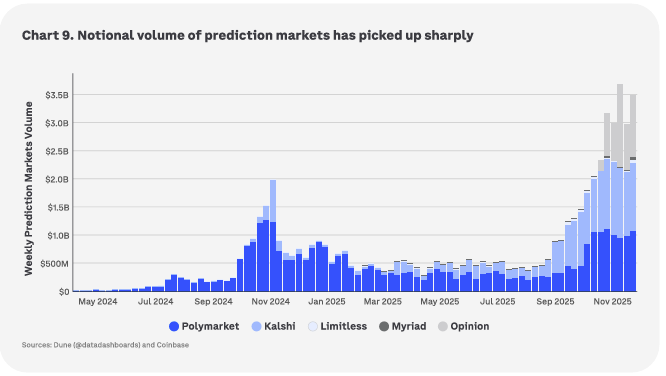
Prediction market activity has surged since the 2024 US presidential election. Source: Coinbase

While prediction markets remain a relatively nascent industry, the space is already dominated by a handful of major players. Chief among them is Polymarket, a decentralized platform built on the Polygon network that allows users to trade on political, economic, and cultural outcomes using blockchain-based contracts.

Kalshi has also emerged as a leading centralized player, operating under US regulatory oversight. Meanwhile, publicly traded sports betting company DraftKings has entered the prediction markets space, with plans to eventually offer crypto-linked contracts.

DraftKings would join a growing list of companies signaling interest in the sector, including Bitnomial Clearinghouse, a derivatives clearing organization, and crypto exchange Gemini.

Related: Polymarket shows stronger retention than most DeFi, wallets and exchanges

Пов'язані питання

QWhat is the main reason for Coinbase's acquisition of The Clearing Company?

ACoinbase is acquiring The Clearing Company to expand its push into prediction markets as part of its broader strategy to become an 'Everything Exchange' offering a wide range of investment products.

QWhen is the acquisition of The Clearing Company by Coinbase expected to be finalized?

AThe transaction is expected to close in January, though the specific financial terms of the deal were not disclosed.

QWhat regulatory step did The Clearing Company take recently to integrate prediction markets into established financial frameworks?

AThe Clearing Company applied with the US Commodity Futures Trading Commission (CFTC) to become a Derivatives Clearing Organization.

QAccording to Coinbase, why could prediction markets emerge as a more tax-efficient alternative to traditional sports betting?

ACoinbase argues that prediction markets, which use contracts similar to derivatives, could be more tax-efficient if treated differently under the tax code, especially in light of a proposed provision that would tax 'phantom income' from gambling even with minimal net winnings or losses.

QName two major existing players in the prediction markets space mentioned in the article.

ATwo major players mentioned are Polymarket, a decentralized platform on Polygon, and Kalshi, a centralized platform operating under US regulatory oversight.

Пов'язані матеріали

The Trillion-Yuan Market Cap 'Yi Zhong Tian': Who is the True Value King?

The article analyzes the three leading Chinese optical module companies, collectively nicknamed "Yi Zhong Tian": Xinyisheng, Zhongji Innolight, and TFC Optical Communication. It evaluates their "cost-performance" not by current stock price, but through three lenses: PEG ratio (growth vs. valuation), earnings quality, and premium/discount for certainty. Xinyisheng shows the most attractive PEG ratio and high profitability, but its valuation reflects discounts for risks like high customer concentration and reliance on overseas markets. Zhongji Innolight, the most expensive, commands a premium for its market leadership, dominant share in key products like 800G/1.6T modules, and higher earnings certainty, though it faces geopolitical risks. TFC Optical, as an upstream component supplier ("water seller"), has the highest gross margin and bets on the long-term CPO/NPO architecture trend, but trades at a high valuation with more stable, less explosive growth. The core argument is that while these companies dominate module assembly, the true profit pool and technological moat lie upstream in laser and switch chips, currently controlled by U.S. firms like Lumentum and Coherent. The long-term "cost-performance" for these Chinese leaders hinges on whether the domestic industry, exemplified by companies like Yuanjie Technology, can successfully move up the value chain into high-power laser chips. Otherwise, their high growth may remain confined to the lower-margin assembly segment.

marsbitЩойно

The Trillion-Yuan Market Cap 'Yi Zhong Tian': Who is the True Value King?

marsbitЩойно

Has the Crypto Market Bottomed? Here's What Institutions Think

The crypto market is in a period of significant debate, with leading institutions offering differing views on whether a bottom has been reached. Three prominent firms have published detailed analyses: * **Galaxy Digital** argues Bitcoin has **not yet bottomed**. Their analysis of 13 historical indicators across six dimensions (valuation, profit-taking, miner pressure, etc.) shows only four are fully met. They project a potential bottom range between $30k and $54k. * **NYDIG** states a bottom is **possible but not likely**. While metrics are close to historic bear market extremes, they note the absence of a classic panic-selling event. They also suggest increased institutional adoption may have structurally altered the market cycle, potentially leading to a shallower downturn. * **Standard Chartered Bank** asserts the **bottom has already occurred** at around $59k. They cite two key factors: potential US-Iran diplomatic progress and the anticipated SpaceX IPO, which they believe absorbed capital and caused ETF selling pressure that is now subsiding. They forecast a year-end price target of $100k. Despite the surface-level disagreement, the reports share critical common ground more valuable for long-term investors: 1. All three believe the market bottom will form **within this year**. 2. All agree the current price is **closer to the bottom than to previous highs**. 3. All maintain a **bullish long-term outlook** for Bitcoin and a new cycle. The core takeaway is that while the exact bottom price ($40k, $50k, or $60k) is debated, the consensus is that a bottom is imminent. For long-term holders, the primary focus should not be pinpointing the absolute low, but on the future potential for prices to reach $100k, $200k, or higher. The fundamental thesis for Bitcoin—sovereign debt accumulation, inflation, declining trust in centralized institutions, global digitization, and improved accessibility—remains intact and is arguably strengthening. The overall landscape is viewed as more favorable than in previous crypto winters.

marsbit11 хв тому

Has the Crypto Market Bottomed? Here's What Institutions Think

marsbit11 хв тому

The 'Chip' Challenge and Breakthroughs in China's Optical Industry Chain

China's Photonics Industry: Bottlenecks and Breakthroughs In the global AI race, computing chips dominate the narrative, but the underlying bottleneck increasingly defining the scale of AI clusters is light—or more specifically, optical connectivity. Optical modules, which translate electrical signals to light and vice versa, are crucial for connecting thousands of GPUs in AI data centers, preventing data congestion and ensuring efficient model training. High-speed modules (800G, 1.6T) are now standard, with performance hinging on advanced DSP (Digital Signal Processor) chips. This is where a critical dependency lies. Two US giants—Marvell and Broadcom—collectively dominate over 90% of the high-end DSP chip market. Chinese optical module leaders like Zhongji Innolight and Eoptolink rely on these chips to manufacture modules for overseas AI customers, primarily in North America. While this creates a supply chain vulnerability, complete decoupling is difficult. Marvell derives over half its revenue from Greater China, and the US firms depend on Chinese partners for chip packaging and optical components. The risk from laser chips (e.g., from Lumentum), another key component, is considered more manageable due to multiple global suppliers and faster progress in domestic alternatives from companies like YOFC and Accelink. To mitigate risks, China's industry is pursuing a multi-pronged strategy: diversifying supply chains and locking in long-term orders; fostering a domestic market ecosystem to adopt homegrown DSPs from firms like Huawei HiSilicon and CETC; accelerating R&D in high-speed DSPs and advanced packaging; and investing in next-gen technologies like silicon photonics and Co-Packaged Optics (CPO) to reduce reliance on discrete DSPs. The ultimate solution lies not in short-term博弈 but in persistent advancement of domestic high-end chip R&D and manufacturing. While challenges remain in performance, certification, and ecosystem building, China's vast domestic market and manufacturing base provide a crucial buffer, buying time for the industry to achieve greater technological independence.

marsbit24 хв тому

The 'Chip' Challenge and Breakthroughs in China's Optical Industry Chain

marsbit24 хв тому

Behind SpaceX's $2 Trillion Market Cap: Why Does Musk Always Have the Next Move Planned?

On June 12th, SpaceX debuted on the Nasdaq, reaching a valuation that briefly touched $2 trillion. This marked the culmination of a 24-year journey from its founding in 2002, driven by Elon Musk's frustration at the high cost of buying rockets. The company's path was defined by early failures, with its first three Falcon 1 launches ending in explosions before a successful 2008 flight opened the era of commercial spaceflight. Key to its model was a fixed-price NASA contract, incentivizing cost reduction. SpaceX mastered rocket reusability, first achieving a Falcon 9 landing in 2015, which drastically cut launch costs. This enabled its profitable Starlink satellite internet constellation, envisioned years before reusability was proven, to create an internal market for frequent launches. Similarly, the next-generation Starship rocket was in development long before its first flight, with its business case evolving from Mars colonization to supporting the emerging concept of in-orbit data centers for AI—a story now central to its valuation. The company's recent IPO, a reversal of its long-standing "no IPO" stance, is funding this ambitious "space-based compute" vision. While major tech players like Google, Blue Origin, and others are investing heavily, significant technical and cost hurdles remain. Ultimately, SpaceX's history is one of creating its own demand: first with Starlink and now with space-based AI compute, betting that its next rocket will enable its next giant market.

marsbit27 хв тому

Behind SpaceX's $2 Trillion Market Cap: Why Does Musk Always Have the Next Move Planned?

marsbit27 хв тому

Торгівля

Спот
Ф'ючерси

Популярні статті

Як купити PUSH

Ласкаво просимо до HTX.com! Ми зробили покупку Push Protocol (PUSH) простою та зручною. Дотримуйтесь нашої покрокової інструкції, щоб розпочати свою криптовалютну подорож.Крок 1: Створіть обліковий запис на HTXВикористовуйте свою електронну пошту або номер телефону, щоб зареєструвати обліковий запис на HTX безплатно. Пройдіть безпроблемну реєстрацію й отримайте доступ до всіх функцій.ЗареєструватисьКрок 2: Перейдіть до розділу Купити крипту і виберіть спосіб оплатиКредитна/дебетова картка: використовуйте вашу картку Visa або Mastercard, щоб миттєво купити Push Protocol (PUSH).Баланс: використовуйте кошти з балансу вашого рахунку HTX для безперешкодної торгівлі.Треті особи: ми додали популярні способи оплати, такі як Google Pay та Apple Pay, щоб підвищити зручність.P2P: Торгуйте безпосередньо з іншими користувачами на HTX.Позабіржова торгівля (OTC): ми пропонуємо індивідуальні послуги та конкурентні обмінні курси для трейдерів.Крок 3: Зберігайте свої Push Protocol (PUSH)Після придбання Push Protocol (PUSH) збережіть його у своєму обліковому записі на HTX. Крім того, ви можете відправити його в інше місце за допомогою блокчейн-переказу або використовувати його для торгівлі іншими криптовалютами.Крок 4: Торгівля Push Protocol (PUSH)Легко торгуйте Push Protocol (PUSH) на спотовому ринку HTX. Просто увійдіть до свого облікового запису, виберіть торгову пару, укладайте угоди та спостерігайте за ними в режимі реального часу. Ми пропонуємо зручний досвід як для початківців, так і для досвідчених трейдерів.

579 переглядів усьогоОпубліковано 2024.12.13Оновлено 2026.06.02

Як купити PUSH

Обговорення

Ласкаво просимо до спільноти HTX. Тут ви можете бути в курсі останніх подій розвитку платформи та отримати доступ до професійної ринкової інформації. Нижче представлені думки користувачів щодо ціни PUSH (PUSH).

活动图片