Claude Engineer Finally Unveils Fable 5's Ultimate Strategy, Teaching You How to Bridge the Information Gap with AI Models

marsbitОпубліковано о 2026-07-06Востаннє оновлено о 2026-07-06

Анотація

This article, titled "Claude Engineer Finally Releases Fable 5 'Skill-Burning' Guide, Teaching How to Bridge the Information Gap with Models," details a blog post by Claude Code engineer Thariq Shihipar. The core concept is the "information gap" or "unknowns"—the disconnect between a user's instructions (the "map") and the actual task requirements (the "territory"). The article argues that with powerful models like Claude Fable 5, work quality depends on the user's ability to identify and clarify these unknowns. Shihipar categorizes unknowns into four types: Known Knowns (explicit instructions), Known Unknowns (awareness of gaps), Unknown Knowns (implicit, unstated knowledge), and Unknown Unknowns (unforeseen issues). The blog provides a framework for addressing these gaps throughout the workflow: * **Before Implementation:** Techniques include "Blindspot Scanning" to uncover Unknown Unknowns, brainstorming/prototyping for visual or complex tasks, having Claude ask clarifying questions, using reference code/examples, and creating implementation plans. * **During Implementation:** Maintaining an "implementation notes" file for Claude to document deviations and decisions made due to encountered edge cases. * **After Implementation:** Creating summary documents for review and having Claude generate quizzes to ensure the user fully understands the completed changes. The article concludes that as models become more capable, the key to success is systematically discovering...

The fate of Fable 5 has been as mystifying as its model's name since its release.

From the highly anticipated "AI's Defining Moment" to being forced offline by a U.S. government ban, and then restricting access to non-Americans, it has captivated global attention.

Now, the storm has gradually subsided. Ultimately, models must return to productivity.

To this end, Claude Code engineer Thariq Shihipar published a detailed blog post on social media, outlining techniques for using Fable 5.

This article addresses a long-standing question. With models having evolved to such powerful capabilities, why do I still feel they perform tasks incorrectly when I use them?

Thariq's blog post is an eye-opener. In short: there is an information gap between humans and models, a disparity between the prompts, Skills, and context provided by the user and the actual task execution.

Thus, the entire blog post teaches you how to bridge this information gap. Below, Machine Heart provides the full blog post for our readers.

Blog Title: A Field Guide to Fable: Finding Your Unknowns

Blog Link: https://x.com/trq212/status/2073100352921215386

Working with Claude Fable 5 constantly reminds me of an old adage: the map is not the territory.

The "map" is the representation of the work to be done—my prompts, skills, and context—what I give to Claude. The "territory" is where the work actually needs to happen: the codebase, the real world, and the real constraints within.
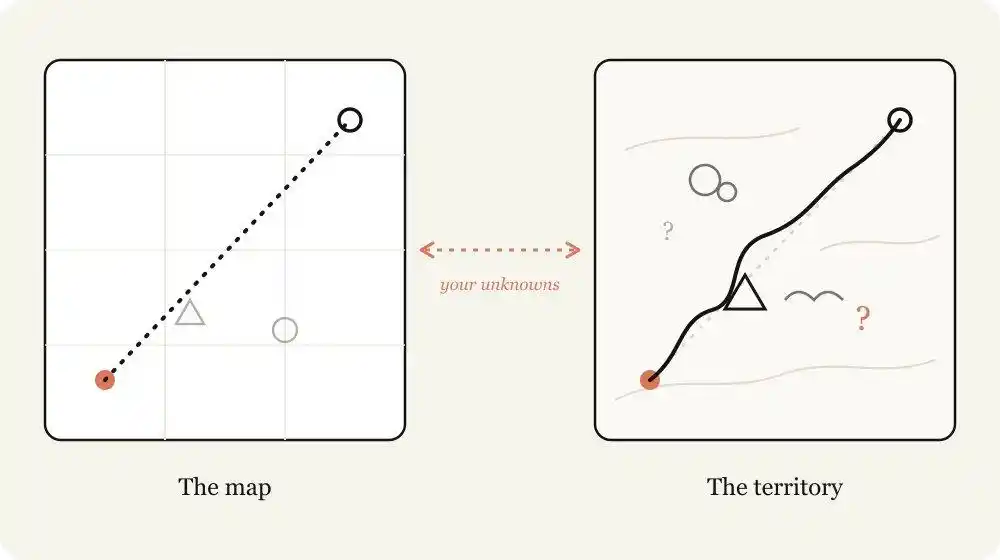
I call the gap between the map and the territory "unknowns." When Claude encounters an unknown, it must make a decision based on its best guess of my intent. The more complex the work, the more unknowns Claude might encounter.

Fable is the first model where I've strongly felt that the bottleneck of work quality depends on my ability to clarify its unknowns.

Importantly, mere upfront planning isn't always enough. You might discover unknowns deep in implementation; you might also find these unknowns point to the fact that you should be solving the problem in a completely different way.

I find that collaborating with Fable is essentially an iterative process of discovering unknowns before, during, and after implementation.

The author provides some examples of discovering "unknowns." Readers are encouraged to review them alongside the full article.
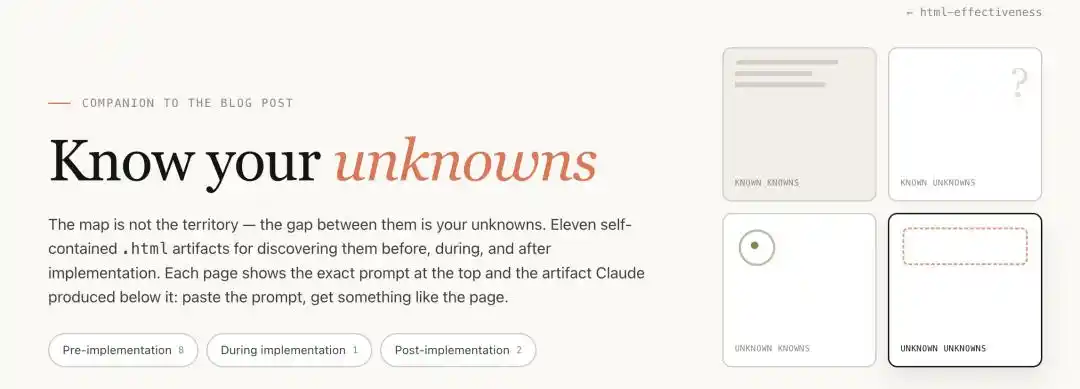
Example Link: https://thariqs.github.io/html-effectiveness/unknowns/

Know Your Unknowns

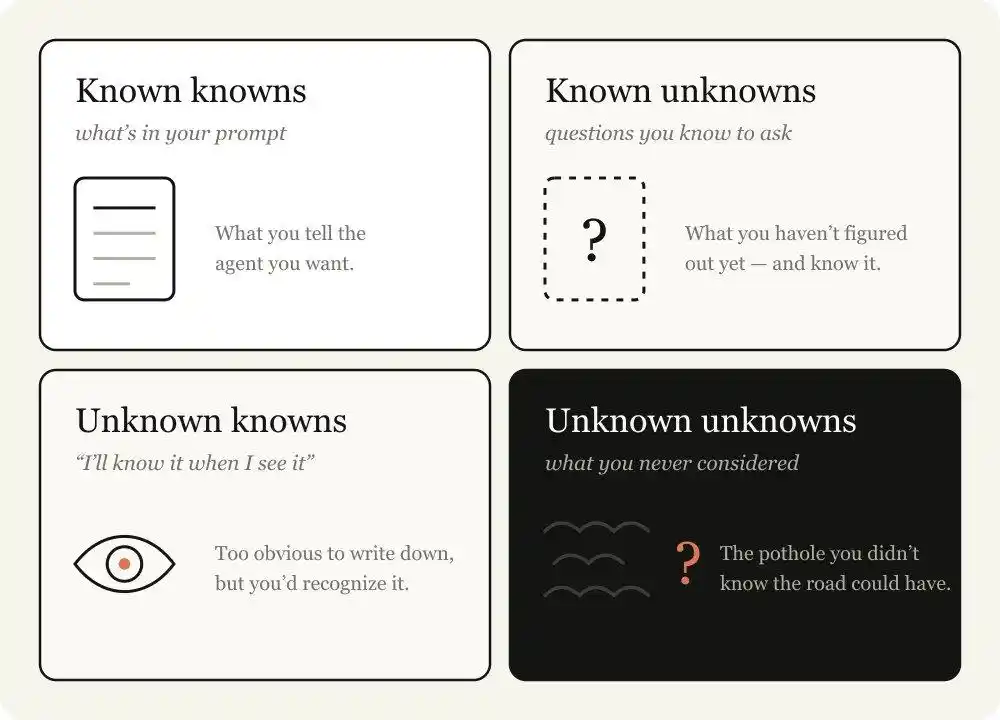
What are unknowns? When I approach Claude with a problem, I typically break it down from four perspectives:

Known knowns: This is basically what I write in the prompt. I tell the agent what I want.

Known unknowns: What things haven't I figured out yet, but I know I haven't figured them out?

Unknown knowns: What things are so obvious to me that I wouldn't even write them down, but I'd recognize them if I saw them?

Unknown unknowns: What things haven't I considered at all? What knowledge do I not yet know I don't know? Do I know how well something can be done?
The most skilled agent-style programmers tend to have relatively fewer unknowns. They know exactly what they want, in great detail. They are highly synchronized with both the codebase and model behavior.

But they also presuppose the existence of unknowns. In many ways, reducing and planning for your unknowns ahead of time is the core skill of agent-style programming. Fortunately, this is a skill that can be honed by collaborating with Claude.

Help Claude Help You
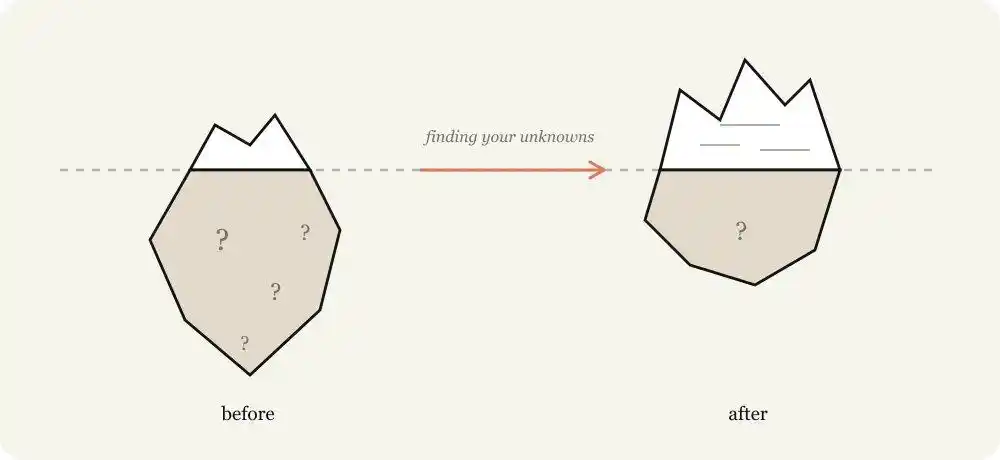
Giving instructions to Claude is a delicate balance. If you're too specific, Claude will follow your instructions strictly, even if pivoting to a different approach might be better. If you're too vague, Claude will often make choices and assumptions based on industry best practices, which may not be right for your task.

Both can fail when you haven't adequately considered your unknowns. You don't know when the road ahead is fraught with obstacles, nor do you know when it's actually smooth, but you still want Claude to make adjustments if necessary.

Claude can help you discover unknowns faster. It can search your codebase and the internet incredibly quickly, and it possesses more general knowledge on most topics than you do. It can also iterate faster from failures.

The most important part of this process is giving Claude enough starting context. For example, tell it what step you're currently thinking about; explain your level of familiarity with the problem and codebase; let it collaborate with you as a thinking partner.

I've previously written about generating HTML with Claude. In almost all those scenarios, the HTML artifact is the best way to visualize and express ideas.

In this article, I'll detail some patterns I use to discover these unknowns. I don't use all these tricks every time, but having them as a toolkit to call upon is incredibly useful.
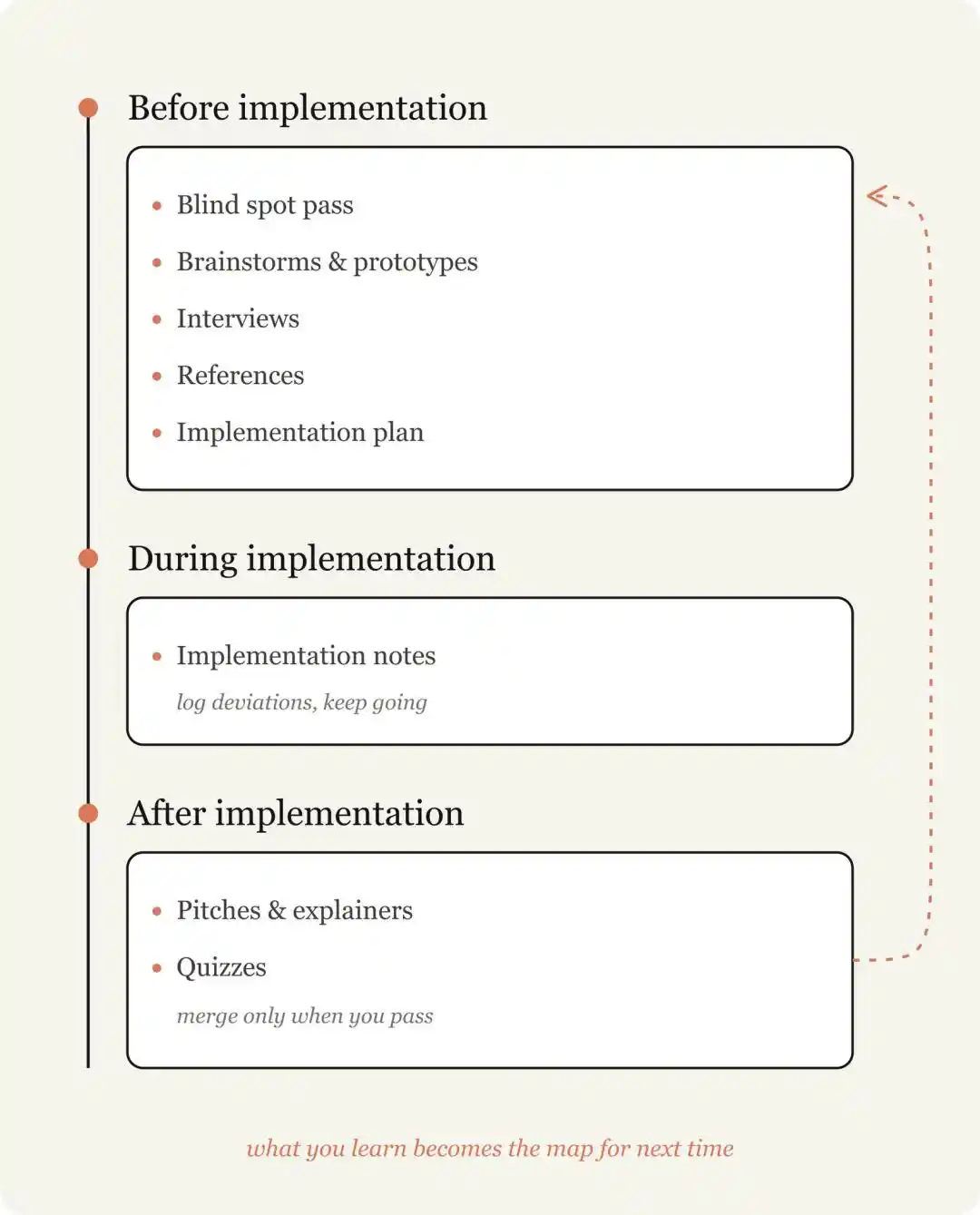
Before Implementation

Blindspot Scan

One of the most useful things when starting work is understanding your blind spots. For example, if you're writing a feature in a new module of the codebase, or having Claude handle a type of work you're unfamiliar with, like iterating on a design, you're likely to have many "unknown unknowns."

You might not know what questions to ask, what constitutes "good," what historical work has been done before, or what pitfalls to avoid.

To do this, you can ask Claude to help find your "unknown unknowns" and explain them. I like to use the terms "blindspot pass" and "unknown unknowns" directly. Usually, it's also important to tell it who you are and what you know.

Example prompts:

"I'm adding a new identity authentication provider, but I know nothing about the auth module in this codebase. Can you do a blindspot pass, help me find relevant unknown unknowns, and assist me in writing better prompts for you?"

"I don't understand color grading, but I need to grade this video. Can you teach me to understand my unknown unknowns about color grading so I can write better prompts?"

Brainstorming & Prototyping

When I'm working in a domain with many "unknown knowns"—things I only know how to define standards for once I see them—I have Claude brainstorm and prototype with me.

Identifying and expressing these "unknown knowns" early in the prototyping stage is valuable because discovering them during implementation often carries a higher relative cost. Small changes in features or specifications can lead to vastly different code implementations, and it's harder to get the agent to backtrack on previous changes.

For example, you might just want to see what adding a button looks like in a certain framework, without actually hooking up the backend routes or maintaining extra frontend state.

Visual design is something I find hard to articulate clearly, but I know what I want when I see it. In such cases, I ask Claude to provide several different design directions for an artifact.

I also start almost every coding session with exploration or brainstorming. This helps me define the project scope with clear intent. Claude often discovers high-value approaches I would have missed, but it can also miss the forest for the trees. Brainstorming prevents me from setting the scope too narrowly or too broadly from the start.

Example prompts:

"I want to make a dashboard for this dataset, but I have no visual taste and don't know what's possible. Help me create an HTML page with 4 vastly different design styles so I can provide feedback based on the results."

"Before wiring anything up, create a standalone HTML file with fake data to simulate the new editor toolbar. I want to give feedback on the layout first before you touch the real app."

"Here's my rough problem: user churn after completing onboarding. Search the codebase and brainstorm 10 places we could intervene, from lowest cost to most ambitious. I'll tell you which directions feel better."

Reverse Interview

After enough brainstorming, I usually still have unknowns.

In such cases, I have Claude interview me around anything unclear or ambiguous. When having Claude interview you, try to provide context about the problem so it can ask more targeted questions. Here are some examples.

Example prompts:

"Please ask me one question at a time, interviewing me around any points of ambiguity. Prioritize questions where my answer would change the architectural design."

Reference Materials

Sometimes, you can't describe in detail what you want. Maybe you lack the language to express it, or it's too complex to describe fully within a reasonable time.

In such cases, the best answer is reference materials. You can provide diagrams, documentation, or images, but the best reference is often source code.

If you have a library that implements a feature in a specific way, or a design component you really like, just point Fable to the corresponding folder and tell it what to look at. Even if the reference code is in another language, that's okay.

This is also how Claude Design works. You don't necessarily have to give it a file, though you can. You can point it to a module on a website you like, and it will read the underlying code, not just a screenshot. This provides richer detail—markup structure, component organization, and how the component is actually built.

Example prompts:

"This Rust crate in vendor/rate-limiter implements exactly the exponential backoff retry behavior I want. Please read it and reimplement the same semantics in our TypeScript API client."

Implementation Plan

When I feel ready to start implementation, I usually have Claude first compile an implementation plan for my review, focusing on parts most likely to change, such as data models, type interfaces, or UX flows. This lets Claude surface areas I might indeed need to adjust ahead of time.

Example prompts:

"Write an implementation plan in HTML, but start by presenting the decision points I'm most likely to change: data model changes, new type interfaces, and any user-facing content. Put mechanical refactoring at the bottom; I trust you can handle that part."

During Implementation

Implementation Notes

When satisfied with the plan, I start a new session and pass the relevant artifacts into the prompt. For example, I might pass a specification file and a prototype, then ask the agent to implement it.

But the truth is, no matter how much you plan, unknown unknowns will always lurk. The agent might discover mid-work that it must take a different approach due to an edge case in the code.

I ask Claude Code to maintain a temporary implementation-notes.md file, or an .html file, to record the decisions it makes, so we can learn from them for the next attempt.

Example prompts:

"Please maintain an implementation-notes.md file. If you encounter an edge case forcing you to deviate from the original plan, choose the conservative option, record the reason under 'Deviations,' and continue."

After Implementation

Pitch & Explanation Documentation
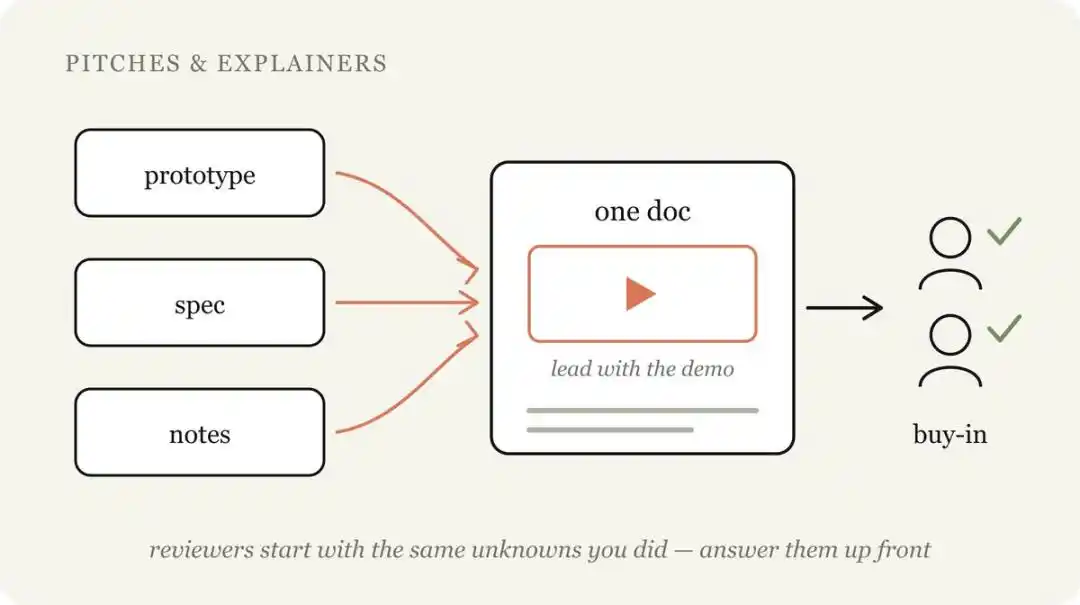
One of the most important things when shipping something is getting others' understanding, support, and approval. Building pitch and explanation artifacts into the final documentation helps:

Accelerate reviewers' understanding when they start with the same unknowns you had.

Accelerate approval from experts when they want to confirm you've considered the unknowns and common failure points they would have foreseen.

Example prompts:

"Package the prototype, spec, and implementation notes into a single document I can directly post on Slack to seek support. Start with a demo GIF."

Quizzes

After a long work session, Claude might have accomplished more than I realize. Just looking at the code diff often gives me only a shallow understanding of what happened, as much behavior depends on existing code paths.

Having Claude test me on the changes after providing substantial context helps me truly understand what occurred. I only merge the code after perfectly passing the quiz.

Example prompts:

"I want to ensure I understand everything that happened in this change. Please give me an HTML report to help me read and understand these changes, including context, intuitive explanations, what was done concretely, etc., and attach a quiz at the bottom that I must pass."

Putting It All Together: The Fable Launch Example

The launch video for Fable was entirely edited by Claude Code. This was a completely new field for me, and I am by no means an expert.

So I started with what I knew. I knew Claude could use code to edit videos and transcribe, but I wasn't sure if its accuracy was sufficient. So I had Claude explain how transcription technologies like Whisper work and whether I could use ffmpeg to accurately cut filler words like "um" or long pauses.

I wanted Claude to create a UI synchronized with my spoken words in time, but I wasn't sure if it could. So I had Claude create a video prototype using Remotion and transcript text to see if the idea was feasible.

Finally, the video itself looked somewhat dark. I knew this was a color grading issue, but I didn't truly understand what color grading was. My first attempt was to have Claude make a few versions for me to choose from, but I realized that when it comes to color grading, I didn't know what "good" was. So, instead of having it generate versions blindly, I had Claude teach me color grading to discover my unknowns.

Matching the Map to the Territory

The more powerful the model, the more you can accomplish with the right approach. When a long-cycle task returns an incorrect result, it likely means you need to spend more time defining your unknowns or creating an implementation plan that allows Claude to navigate these unknowns flexibly.

Every explanation document, brainstorming session, interview, prototype, and reference material is a low-cost way to discover things you didn't know before the cost of fixing them becomes high.

So, when starting your next project, first let Claude help you find your unknowns.

This article is from the WeChat public account "Machine Heart," edited by the Machine Heart Editorial Department.


Трендові криптовалюти

Пов'язані питання

QWhat is the core issue that prevents AI models like Claude Fable 5 from performing tasks correctly, according to the article?

AAccording to the article, the core issue is the information gap or 'unknowns' between the user (the map) and the actual task execution environment (the territory). This gap exists in the prompts, skills, and context provided versus what is truly needed in the codebase or real world.

QWhat are the four categories of 'unknowns' mentioned in Thariq Shihipar's framework for breaking down a problem?

AThe four categories are: Known Knowns (what is written in the prompt), Known Unknowns (things the user knows they haven't figured out), Unknown Knowns (things obvious to the user that aren't written down but can be recognized), and Unknown Unknowns (things the user hasn't considered or knowledge they don't know they lack).

QWhat is one specific technique recommended for the 'Before Implementation' phase to help identify blind spots?

AOne recommended technique is a 'Blindspot Scan.' The user can ask Claude to help identify 'Unknown Unknowns' by using prompts like, 'Can you do a blindspot pass for me to identify relevant unknown unknowns to help me write better prompts?'

QHow can providing references, especially source code, help when working with Claude Fable 5?

AProviding references, especially source code, helps when the user cannot fully describe what they want. It gives Claude a concrete example of the desired implementation, style, or component structure, even if the reference code is in a different language, allowing for more accurate and detailed task execution.

QWhat practice does the author recommend for the 'After Implementation' phase to ensure a reviewer's understanding and approval?

AThe author recommends creating 'Pitch and Explanation Documentation.' This involves packaging prototypes, specifications, and implementation notes into a single document (often starting with a demo GIF) to quickly bring reviewers up to speed and address potential concerns they might have.

Пов'язані матеріали

After Close Observation of Wash, Morgan Stanley's Chief Economist Insists: The Fed Will Not Raise Rates This Year

After close observation of Federal Reserve Chair Wash, Seth Carpenter, Morgan Stanley's Chief Global Economist, asserts that the Fed will not raise interest rates this year. Following Wash's speech at the ECB's Sintra forum, Carpenter notes a marginal dovish shift: Wash now more clearly balances the Fed's dual mandate of price stability and maximum employment, rather than focusing nearly exclusively on inflation. Importantly, Wash highlighted that the latest policy meeting (coinciding with falling oil prices) has already lowered market inflation expectations and term premiums, signaling no urgency for a July rate hike. Carpenter's view is supported by data. Recent non-farm payroll figures provide room for the Fed to remain patient. Morgan Stanley's inflation forecasts are below the median FOMC projection, and methodological revisions to PCE inflation could further lower readings. These factors make Carpenter "comfortable" with the call for no hikes in 2024. Carpenter also pushes back against the simplistic narrative that AI will be deflationary and lead to rate cuts. He argues AI investment is currently boosting inflation marginally. More broadly, the business cycle will dictate policy; AI's productivity gains could boost demand and, crucially, raise the equilibrium interest rate (r*), weakening the case for cuts. In contrast, the ECB's path remains more hawkish. Carpenter interprets President Lagarde's Sintra comments as leaving the door open for another 25 basis point hike in September, though softer recent data and falling oil prices provide some flexibility. A July hike or more than one additional hike this year is seen as unlikely.

marsbit1 хв тому

After Close Observation of Wash, Morgan Stanley's Chief Economist Insists: The Fed Will Not Raise Rates This Year

marsbit1 хв тому

StarDynamics Secures 2.5 Billion in Two Months, State-Owned Capital Consortium Joins In

Star Era Raises 25 Billion Yuan in Two Months with State Capital Leading the Charge. Chinese humanoid robotics leader Star Era has secured a new 10-billion-yuan funding round led by state-owned capital, including funds like Chengtong Fund under the SASAC, marking 25 billion yuan raised within two months. The company, a spin-off from Tsinghua University, has built a comprehensive capital matrix combining state guidance, top-tier financial backers, and industrial partners. Founded in 2023 by Dr. Chen Jianyu, one of Tsinghua's youngest doctoral supervisors, Star Era stands out for its early and pioneering work on "world models" for embodied AI, notably releasing its PAD world action model ahead of major global players. The company follows an AI-native, full-stack R&D strategy from data and AI brain to control, dexterous hands (XHAND series), and robot bodies (bipedal L7, wheeled Q5). A core innovation is its fully direct-drive dexterous hands, which act as high-fidelity data collectors for training its AI models like the ERA-42 and VLAW, creating a virtuous cycle of data and intelligence. Star Era claims to possess one of the world's largest real-world dexterous hand datasets. Commercially, Star Era has achieved product-market fit, most notably in logistics, with robots operating 24/7 in distribution centers for partners like SF Express and China Post, handling over 1,200 parcels per hour. It is also expanding into high-end manufacturing (Samsung, Geely) and commercial services. Its hardware components are used by nine of the global top ten tech firms and leading research institutions. The article positions 2026 as an inflection point where success shifts from model capabilities to proven, scalable commercial deployment. Star Era's rapid funding and industrial traction highlight its position in this competitive race.

marsbit5 хв тому

StarDynamics Secures 2.5 Billion in Two Months, State-Owned Capital Consortium Joins In

marsbit5 хв тому

U.S. Stock Market Trend (July 6th): Gold and Crypto Lead Rebound Ahead of Stocks, Fed Minutes Set Weekly Direction

**U.S. Market Trends (July 6): Gold & Crypto Lead, Fed Minutes to Set Tone** Markets rebounded ahead of the U.S. Independence Day holiday, with Nasdaq 100 futures rising over 1% as AI sector concerns eased. Gold posted its best week in over a month, breaking a four-week losing streak despite ongoing Russia-Ukraine tensions, as Middle East risk premiums faded. Brent crude extended its decline for a fourth week. The week ahead is packed with key events. On Tuesday, SpaceX makes a record-fast entry into the Nasdaq 100 index, forcing passive fund flows, while U.S. tariff hearings and the Sun Valley Conference—notably missing NVIDIA's Jensen Huang and Tesla's Elon Musk—add complexity. OpenAI's scheduled GPT-5.6 release intensifies the AI model rollout race. The main focus is Thursday's release of the first Fed meeting minutes under Chair Wash. With half the FOMC already leaning toward a rate hike this year per the June dot plot, the minutes' tone will be critical for market direction. Hawkish confirmation could reverse recent risk-on sentiment, likely signaled first by a pullback in high-volatility assets like Bitcoin and Ethereum, which significantly outperformed last week. Other events include SK Hynix's large U.S. ADR listing and the start of the Q2 earnings season with reports from PepsiCo and Delta Air Lines. The market's path hinges on whether the liquidity and optimism built during the holiday can withstand the combined tests of Fed policy, trade tensions, and major corporate events.

marsbit6 хв тому

U.S. Stock Market Trend (July 6th): Gold and Crypto Lead Rebound Ahead of Stocks, Fed Minutes Set Weekly Direction

marsbit6 хв тому

World's Largest Data Center Project Scrapped

Blackstone Abandons Plans for World's Largest Data Center, Signaling Wider AI Infrastructure Headwinds Blackstone has halted construction of its massive "Digital Gateway" data center campus in Virginia, which was planned to be the world's largest. The project's cancellation follows a five-year battle with local residents concerned about historical preservation, environmental impact, and strain on local resources. A procedural error in the zoning approval process ultimately led a state court to invalidate the project's permits. This move comes shortly after Blackstone sold other mature data center assets, suggesting a strategic pivot by the asset management giant. Industry analysts see this as a potential sign of "peak" investment enthusiasm, mirroring Blackstone's past exits from overheated sectors like office real estate. The cancellation highlights significant bottlenecks facing the AI-driven data center boom across the U.S. Key challenges include severe power grid constraints, with data centers' electricity demand projected to triple nationally by 2035, and mounting grassroots opposition. A report notes over $130 billion worth of U.S. data center projects were delayed in Q1 2026 alone, primarily due to power shortages and community resistance. Local and state governments are also beginning to implement stricter regulations, including new taxes and moratoriums on construction. Blackstone's exit underscores that the breakneck expansion of AI infrastructure is colliding with practical limits, from physical resource caps to social license, forcing a more realistic assessment of costs and feasibility.

marsbit33 хв тому

World's Largest Data Center Project Scrapped

marsbit33 хв тому

Торгівля

Спот

Популярні статті

Що таке $S$

Розуміння SPERO: Комплексний огляд Вступ до SPERO Оскільки ландшафт інновацій продовжує еволюціонувати, виникнення технологій web3 та криптовалютних проектів відіграє ключову роль у формуванні цифрового майбутнього. Один з проектів, який привернув увагу в цій динамічній сфері, — це SPERO, позначений як SPERO,$$s$. Ця стаття має на меті зібрати та представити детальну інформацію про SPERO, щоб допомогти ентузіастам та інвесторам зрозуміти його основи, цілі та інновації в рамках web3 та крипто-сектору. Що таке SPERO,$$s$? SPERO,$$s$ — це унікальний проект у криптопросторі, який прагне використати принципи децентралізації та технології блокчейн для створення екосистеми, що сприяє залученню, корисності та фінансовій інклюзії. Проект розроблений для полегшення взаємодії між користувачами новими способами, надаючи їм інноваційні фінансові рішення та послуги. У своїй основі SPERO,$$s$ прагне надати можливості індивідам, забезпечуючи інструменти та платформи, які покращують користувацький досвід у криптовалютному просторі. Це включає в себе можливість більш гнучких методів транзакцій, сприяння ініціативам, що підтримуються спільнотою, та створення шляхів для фінансових можливостей через децентралізовані додатки (dApps). Основна концепція SPERO,$$s$ обертається навколо інклюзивності, прагнучи зменшити розриви в традиційній фінансовій системі, використовуючи переваги технології блокчейн. Хто є творцем SPERO,$$s$? Особистість творця SPERO,$$s$ залишається дещо невідомою, оскільки є обмежені публічно доступні ресурси, що надають детальну інформацію про його засновників. Ця відсутність прозорості може бути наслідком зобов'язання проекту до децентралізації — етики, яку багато проектів web3 поділяють, ставлячи колективні внески вище за індивідуальне визнання. Зосереджуючи обговорення навколо спільноти та її колективних цілей, SPERO,$$s$ втілює суть наділення без виділення конкретних осіб. Таким чином, розуміння етики та місії SPERO є більш важливим, ніж ідентифікація єдиного творця. Хто є інвесторами SPERO,$$s$? SPERO,$$s$ підтримується різноманітними інвесторами, починаючи від венчурних капіталістів до ангельських інвесторів, які прагнуть сприяти інноваціям у крипто-секторі. Зосередження цих інвесторів зазвичай узгоджується з місією SPERO — пріоритет надається проектам, які обіцяють технологічний прогрес у суспільстві, фінансову інклюзію та децентралізоване управління. Ці інвесторські фонди зазвичай зацікавлені в проектах, які не лише пропонують інноваційні продукти, але й позитивно впливають на спільноту блокчейн та її екосистеми. Підтримка з боку цих інвесторів підкріплює SPERO,$$s$ як значного конкурента в швидко змінюваній сфері крипто-проектів. Як працює SPERO,$$s$? SPERO,$$s$ використовує багатогранну структуру, яка відрізняє його від традиційних криптовалютних проектів. Ось деякі ключові особливості, які підкреслюють його унікальність та інноваційність: Децентралізоване управління: SPERO,$$s$ інтегрує моделі децентралізованого управління, надаючи користувачам можливість активно брати участь у процесах прийняття рішень щодо майбутнього проекту. Цей підхід сприяє відчуттю власності та відповідальності серед членів спільноти. Корисність токена: SPERO,$$s$ використовує свій власний криптовалютний токен, розроблений для виконання різних функцій в екосистемі. Ці токени дозволяють здійснювати транзакції, отримувати винагороди та полегшувати послуги, що пропонуються на платформі, підвищуючи загальну залученість та корисність. Шарова архітектура: Технічна архітектура SPERO,$$s$ підтримує модульність та масштабованість, що дозволяє безперешкодно інтегрувати додаткові функції та додатки в міру розвитку проекту. Ця адаптивність є надзвичайно важливою для збереження актуальності в постійно змінюваному крипто-ландшафті. Залучення спільноти: Проект підкреслює ініціативи, що підтримуються спільнотою, використовуючи механізми, які стимулюють співпрацю та зворотний зв'язок. Підтримуючи сильну спільноту, SPERO,$$s$ може краще задовольняти потреби користувачів та адаптуватися до ринкових тенденцій. Фокус на інклюзію: Пропонуючи низькі комісії за транзакції та зручні інтерфейси, SPERO,$$s$ прагне залучити різноманітну базу користувачів, включаючи осіб, які раніше не брали участі в крипто-просторі. Це зобов'язання до інклюзії узгоджується з його загальною місією наділення через доступність. Хронологія SPERO,$$s$ Розуміння історії проекту надає важливі уявлення про його розвиток та етапи. Нижче наведено пропоновану хронологію, що відображає значні події в еволюції SPERO,$$s$: Етап концептуалізації та ідеації: Початкові ідеї, що стали основою SPERO,$$s$, були сформовані, тісно пов'язані з принципами децентралізації та фокусом на спільноті в індустрії блокчейн. Запуск білого паперу проекту: Після концептуального етапу був випущений комплексний білий папір, що детально описує бачення, цілі та технологічну інфраструктуру SPERO,$$s$, щоб залучити інтерес та зворотний зв'язок від спільноти. Створення спільноти та ранні залучення: Активні зусилля були спрямовані на створення спільноти ранніх прихильників та потенційних інвесторів, що полегшило обговорення цілей проекту та отримання підтримки. Подія генерації токенів: SPERO,$$s$ провів подію генерації токенів (TGE) для розподілу своїх рідних токенів серед ранніх прихильників та встановлення початкової ліквідності в екосистемі. Запуск початкового dApp: Перший децентралізований додаток (dApp), пов'язаний з SPERO,$$s$, став доступним, дозволяючи користувачам взаємодіяти з основними функціями платформи. Постійний розвиток та партнерства: Безперервні оновлення та вдосконалення пропозицій проекту, включаючи стратегічні партнерства з іншими учасниками блокчейн-простору, сформували SPERO,$$s$ у конкурентоспроможного та еволюціонуючого гравця на крипто-ринку. Висновок SPERO,$$s$ є свідченням потенціалу web3 та криптовалют для революціонізації фінансових систем та наділення індивідів. Завдяки зобов'язанню до децентралізованого управління, залучення спільноти та інноваційно спроектованих функцій, він прокладає шлях до більш інклюзивного фінансового ландшафту. Як і з будь-якими інвестиціями в швидко змінюваному крипто-просторі, потенційним інвесторам та користувачам рекомендується ретельно досліджувати та обдумано взаємодіяти з поточними подіями в SPERO,$$s$. Проект демонструє інноваційний дух крипто-індустрії, запрошуючи до подальшого дослідження його численних можливостей. Хоча подорож SPERO,$$s$ ще триває, його основні принципи можуть справді вплинути на майбутнє того, як ми взаємодіємо з технологією, фінансами та один з одним у взаємопов'язаних цифрових екосистемах.

120 переглядів усьогоОпубліковано 2024.12.17Оновлено 2024.12.17

Що таке $S$

Що таке AGENT S

Агент S: Майбутнє автономної взаємодії в Web3 Вступ У постійно змінюваному ландшафті Web3 та криптовалюти інновації постійно переосмислюють, як люди взаємодіють з цифровими платформами. Один з таких новаторських проектів, Агент S, обіцяє революціонізувати взаємодію людини з комп'ютером через свою відкриту агентну структуру. Прокладаючи шлях для автономних взаємодій, Агент S прагне спростити складні завдання, пропонуючи трансформаційні застосування в штучному інтелекті (ШІ). Це детальне дослідження заглиблюється в складності проекту, його унікальні особливості та наслідки для сфери криптовалюти. Що таке Агент S? Агент S є революційною відкритою агентною структурою, спеціально розробленою для вирішення трьох основних викликів в автоматизації комп'ютерних завдань: Набуття специфічних знань у галузі: Структура інтелектуально навчається з різних зовнішніх джерел знань та внутрішнього досвіду. Цей подвійний підхід дозволяє їй створити багатий репозиторій специфічних знань у галузі, покращуючи її продуктивність у виконанні завдань. Планування на довгих горизонтах завдань: Агент S використовує планування з підкріпленням досвіду, стратегічний підхід, який полегшує ефективний розподіл та виконання складних завдань. Ця функція значно підвищує її здатність ефективно та результативно управляти кількома підзавданнями. Обробка динамічних, неоднорідних інтерфейсів: Проект представляє Інтерфейс Агент-Комп'ютер (ACI), інноваційне рішення, яке покращує взаємодію між агентами та користувачами. Використовуючи багатомодальні великі мовні моделі (MLLMs), Агент S може безперешкодно орієнтуватися та маніпулювати різноманітними графічними інтерфейсами користувача. Завдяки цим новаторським функціям Агент S надає надійну структуру, яка вирішує складнощі, пов'язані з автоматизацією людської взаємодії з машинами, прокладаючи шлях для численних застосувань у ШІ та за його межами. Хто є творцем Агент S? Хоча концепція Агент S є фундаментально новаторською, конкретна інформація про його творця залишається невідомою. Творець наразі невідомий, що підкреслює або початкову стадію проекту, або стратегічний вибір зберегти засновників у таємниці. Незважаючи на анонімність, акцент залишається на можливостях та потенціалі структури. Хто є інвесторами Агент S? Оскільки Агент S є відносно новим у криптографічній екосистемі, детальна інформація про його інвесторів та фінансових спонсорів не задокументована. Відсутність публічно доступних відомостей про інвестиційні фонди або організації, що підтримують проект, викликає питання щодо його фінансової структури та дорожньої карти розвитку. Розуміння підтримки є критично важливим для оцінки стійкості проекту та потенційного впливу на ринок. Як працює Агент S? В основі Агент S лежить передова технологія, яка дозволяє йому ефективно функціонувати в різних умовах. Його операційна модель побудована навколо кількох ключових функцій: Взаємодія з комп'ютером, подібна до людської: Структура пропонує розширене планування ШІ, прагнучи зробити взаємодії з комп'ютерами більш інтуїтивними. Імітуючи людську поведінку при виконанні завдань, вона обіцяє підвищити досвід користувачів. Наративна пам'ять: Використовується для використання високорівневого досвіду, Агент S використовує наративну пам'ять для відстеження історій завдань, тим самим покращуючи свої процеси прийняття рішень. Епізодична пам'ять: Ця функція надає користувачам покрокові інструкції, дозволяючи структурі пропонувати контекстуальну підтримку в міру виконання завдань. Підтримка OpenACI: Завдяки можливості працювати локально, Агент S дозволяє користувачам зберігати контроль над своїми взаємодіями та робочими процесами, узгоджуючи з децентралізованою етикою Web3. Легка інтеграція з зовнішніми API: Його універсальність і сумісність з різними платформами ШІ забезпечують те, що Агент S може безперешкодно вписатися в існуючі технологічні екосистеми, роблячи його привабливим вибором для розробників та організацій. Ці функціональні можливості колективно сприяють унікальному положенню Агент S у крипто-просторі, оскільки він автоматизує складні, багатоступеневі завдання з мінімальним втручанням людини. У міру розвитку проекту його потенційні застосування в Web3 можуть переосмислити, як відбуваються цифрові взаємодії. Хронологія Агент S Розробка та етапи Агент S можуть бути узагальнені в хронології, яка підкреслює його значні події: 27 вересня 2024 року: Концепція Агент S була представлена в комплексній науковій статті під назвою “Відкрита агентна структура, яка використовує комп'ютери як людина”, що демонструє основи проекту. 10 жовтня 2024 року: Наукова стаття була опублікована на arXiv, пропонуючи детальне дослідження структури та її оцінки продуктивності на основі бенчмарку OSWorld. 12 жовтня 2024 року: Було випущено відеопрезентацію, що надає візуальне уявлення про можливості та особливості Агент S, ще більше залучаючи потенційних користувачів та інвесторів. Ці маркери в хронології не лише ілюструють прогрес Агент S, але й вказують на його прихильність до прозорості та залучення громади. Ключові моменти про Агент S У міру розвитку структури Агент S кілька ключових характеристик виділяються, підкреслюючи її новаторський характер та потенціал: Інноваційна структура: Розроблена для забезпечення інтуїтивного використання комп'ютерів, подібного до людської взаємодії, Агент S пропонує новий підхід до автоматизації завдань. Автономна взаємодія: Здатність автономно взаємодіяти з комп'ютерами через GUI означає стрибок до більш інтелектуальних та ефективних обчислювальних рішень. Автоматизація складних завдань: Завдяки своїй надійній методології він може автоматизувати складні, багатоступеневі завдання, роблячи процеси швидшими та менш схильними до помилок. Безперервне вдосконалення: Механізми навчання дозволяють Агенту S покращуватися на основі минулого досвіду, постійно підвищуючи свою продуктивність та ефективність. Універсальність: Його адаптивність до різних операційних середовищ, таких як OSWorld та WindowsAgentArena, забезпечує його здатність служити широкому спектру застосувань. Оскільки Агент S займає своє місце в ландшафті Web3 та криптовалюти, його потенціал покращити можливості взаємодії та автоматизувати процеси означає значний прогрес у технологіях ШІ. Завдяки своїй інноваційній структурі Агент S є прикладом майбутнього цифрових взаємодій, обіцяючи більш безперешкодний та ефективний досвід для користувачів у різних галузях. Висновок Агент S представляє собою сміливий крок вперед у поєднанні ШІ та Web3, з можливістю переосмислити, як ми взаємодіємо з технологією. Хоча проект все ще на ранніх стадіях, можливості для його застосування є величезними та переконливими. Завдяки своїй комплексній структурі, що вирішує критичні виклики, Агент S прагне вивести автономні взаємодії на передній план цифрового досвіду. У міру того, як ми заглиблюємося в сфери криптовалюти та децентралізації, проекти, подібні до Агент S, безсумнівно, відіграватимуть ключову роль у формуванні майбутнього технологій та співпраці людини з комп'ютером.

748 переглядів усьогоОпубліковано 2025.01.14Оновлено 2025.01.14

Що таке AGENT S

Як купити S

Ласкаво просимо до HTX.com! Ми зробили покупку Sonic (S) простою та зручною. Дотримуйтесь нашої покрокової інструкції, щоб розпочати свою криптовалютну подорож.Крок 1: Створіть обліковий запис на HTXВикористовуйте свою електронну пошту або номер телефону, щоб зареєструвати обліковий запис на HTX безплатно. Пройдіть безпроблемну реєстрацію й отримайте доступ до всіх функцій.ЗареєструватисьКрок 2: Перейдіть до розділу Купити крипту і виберіть спосіб оплатиКредитна/дебетова картка: використовуйте вашу картку Visa або Mastercard, щоб миттєво купити Sonic (S).Баланс: використовуйте кошти з балансу вашого рахунку HTX для безперешкодної торгівлі.Треті особи: ми додали популярні способи оплати, такі як Google Pay та Apple Pay, щоб підвищити зручність.P2P: Торгуйте безпосередньо з іншими користувачами на HTX.Позабіржова торгівля (OTC): ми пропонуємо індивідуальні послуги та конкурентні обмінні курси для трейдерів.Крок 3: Зберігайте свої Sonic (S)Після придбання Sonic (S) збережіть його у своєму обліковому записі на HTX. Крім того, ви можете відправити його в інше місце за допомогою блокчейн-переказу або використовувати його для торгівлі іншими криптовалютами.Крок 4: Торгівля Sonic (S)Легко торгуйте Sonic (S) на спотовому ринку HTX. Просто увійдіть до свого облікового запису, виберіть торгову пару, укладайте угоди та спостерігайте за ними в режимі реального часу. Ми пропонуємо зручний досвід як для початківців, так і для досвідчених трейдерів.

1.6k переглядів усьогоОпубліковано 2025.01.15Оновлено 2026.06.02

Як купити S

Обговорення

Ласкаво просимо до спільноти HTX. Тут ви можете бути в курсі останніх подій розвитку платформи та отримати доступ до професійної ринкової інформації. Нижче представлені думки користувачів щодо ціни S (S).

活动图片