Circle: From Issuance to Infrastructure

marsbitОпубліковано о 2026-05-19Востаннє оновлено о 2026-05-19

Анотація

Title: Circle: From Issuance to Infrastructure Circle, the issuer of the USDC stablecoin, is undergoing a strategic transformation to reduce its dependence on interest income from reserve holdings, which is declining due to falling interest rates. Historically, Circle's revenue came primarily from the yield on US Treasury reserves backing USDC. However, it also paid significant fees (approximately 60 cents of every dollar earned) to partners like Coinbase for distributing and settling USDC. To capture more value across the financial stack, Circle is vertically integrating into three new layers: 1. **Settlement Layer:** It is launching **Arc**, a native Layer-1 blockchain. Arc, which uses USDC as its gas token, aims to capture transaction fees currently paid to other blockchains (like Ethereum and Solana) and offers features like privacy for institutional payments. 2. **Distribution Layer:** The **Circle Payments Network (CPN)** connects financial institutions directly to Circle, reducing reliance on exchanges like Coinbase. While not yet monetized, CPN growth has improved Circle's margins. 3. **Application Layer:** Circle is building an **AI Agent Economy** infrastructure with products like Agent Wallets and Nanopayments. The goal is to capture fees from high-volume, automated transactions executed by AI agents, a market where USDC already dominates. These moves represent Circle's shift from a single-product company (USDC issuance) to a full-stack financial platform....

Article compiled by: Block unicorn

The company has earned billions in interest income by holding Treasury reserves as collateral for its stablecoin, and pays fees to other platforms for distributing and settling USDC throughout the payment system. For every dollar Circle earns, it pays out about 60 cents to its USDC partners. As long as the profit margin was large enough, it could afford this cost. But with the arrival of a low-interest-rate environment, the USDC issuer lost too much profit. For most of its existence, Circle had only one product: USDC.

In its recently released Q1 2026 earnings report, the USDC issuer announced several initiatives aimed at enhancing the value captured within its operational scope. These include: a $222 million presale for its native Layer-1 token ARC at a fully diluted valuation of $30 billion; the launch of AI agent infrastructure; and the expansion of its Circle Payments Network, enabling banks to facilitate stablecoin payments by bypassing the volatility of digital assets. However, achievements from the past few quarters will change this status quo.

In summary, these moves signal Circle's attempt to transform from a single-layer company into a full-stack financial platform capable of operating and capturing value across multiple layers of the payment stack.

Today, I will assess whether Circle can use vertical integration to offset the erosion of its yield-generating business, which shrinks with every Federal Reserve rate cut.

The Vanishing Float

In Q1 2026, Circle's total revenue was $694 million, a 20% year-over-year increase. This growth was entirely due to the expansion of stablecoin circulation, with no improvement from USDC itself. The circulating stablecoin supply grew from $235 billion in March 2025 to $315 billion in March 2026, an increase of over 30%. During the same period, USDC's market share declined by 62 basis points.

Circle faces a bigger problem. The era of low interest rates has arrived, with the Fed rate dropping from 4.5% a year ago to the current 3.75%.

Despite a 39% year-over-year increase in the average circulating supply of USDC through Q1 2026, Circle's reserve income only grew 17% year-over-year to $653 million. This is because the average reserve yield decreased by 66 basis points year-over-year, dropping from 4.16% in Q1 2025 to 3.50% in Q1 2026, significantly offsetting the aforementioned growth.

This is not a one-time phenomenon. The gap between Circle's reserve revenue growth rate and USDC supply growth rate has been narrowing for the past four quarters.
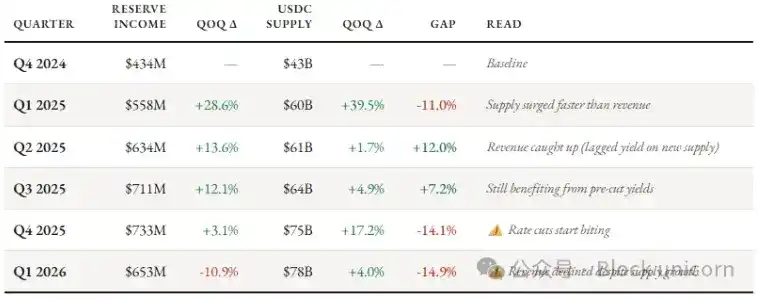
Circle's primary revenue source is not growing proportionally with its circulating stablecoin supply.

The company also faces a value leakage problem.

The 60-Cent Wake-Up Call

This means the cost of platforms holding and distributing USDC exceeds 60 cents per dollar earned. Of the $405 million in distribution and transaction costs paid by Circle in Q1 2026, approximately $330 million (about 80%) went to Coinbase. Out of the quarter's $653 million in reserve income, Circle paid $405 million to partners for distribution and transaction costs.

In an industry where new players are constantly emerging and integrating across all layers of the tech stack, this is a massive amount of money left on the table.

At this point, the signs are clear that Circle should face reality. Interest rates keep falling, dragging down its reserve income; distribution costs remain high, causing constant value leakage; and Circle's core business remains a proxy for yield, shrinking in value with each Fed rate cut. Under the leadership of U.S. President Donald Trump, market expectations for a dovish Fed are growing stronger.

What is Circle's response? The answer: capture more value across the entire business chain through vertical integration and reduce reliance on interest rate income.

To understand what Circle is building, consider what it currently possesses.

The USDC issuer started at the bottom layer of the stablecoin stack—the issuance layer—and for years watched others capture value at every layer above it.
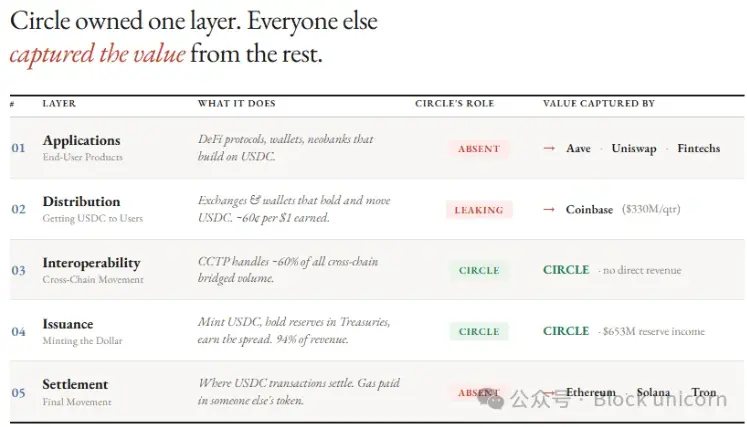
At the issuance layer, Circle issues USDC and EURC, holds U.S. Treasury reserves via the BlackRock-managed Circle Reserve Fund, manages the 1:1 peg, and handles issuance and redemption through Circle Mint. 94% of its total revenue comes from government bond reserve yields.

Subsequently, Circle expanded into the interoperability layer via its Cross-Chain Transfer Protocol (CCTP), which transfers USDC between blockchains and handles about 60% of cross-chain bridging volume. Although this mechanism routes USDC across chains, CCTP itself runs on chains owned by others. Therefore, Circle cannot derive significant direct revenue from it.

All other layers in the stack belong to others.

Settlement systems run on Ethereum, Solana, and Tron. Every USDC transaction pays gas fees in other tokens (ETH, SOL, TRX), and Circle has no control over congestion, fees, or governance on these chains.

Distribution channels rely heavily on Coinbase, exchanges, and wallets. Circle must pay revenue shares, incentive program fees, and integration costs to get USDC into users' hands.

Third parties, such as DeFi protocols, fintech companies, neo-banks, and prediction markets, build applications and products that use USDC. This means end customers, whether retail or institutional, do not need to transact directly with Circle.

This structure results in Circle capturing only about 40 cents of every dollar it generates.

Controlling the Stack

On May 11, Circle announced three investment plans aimed at vertically integrating different layers of the business it previously did not own.

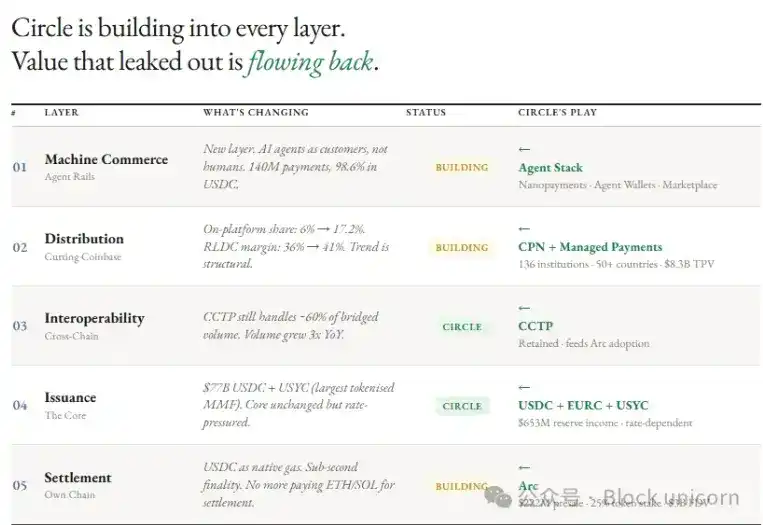
First, settlement. Circle owns the native Layer-1 blockchain, Arc, designed to capture the fees currently generated when USDC is transferred on chains like Ethereum, Solana, and Tron.

The EVM-compatible Arc offers sub-second finality and uses USDC as its native gas fee token, with each transaction costing about $0.001. To make its chain more attractive to institutional users, Circle offers configurable privacy and quantum-resistant architecture. In contrast, general-purpose public chains like Ethereum and Solana are completely transparent and cannot provide privacy for sensitive transactions like institutional payments.

Circle raised $222 million through an ARC token presale, reaching a $3 billion valuation. This funding round was led by a $75 million investment from a16z, with other investors including BlackRock, Apollo Global Management, Intercontinental Exchange (owner of the NYSE), Standard Chartered, ARK Invest, SBI Group, IDG Capital, Bullish, and Haun Ventures.

Second, distribution. The Circle Payments Network (CPN) helps the USDC issuer reduce its dependence on Coinbase.

CPN connects financial institutions directly to Circle's network, enabling them to mint, redeem, and route USDC without going through exchanges. The network has 136 registered institutions (up 36% quarter-over-quarter), an annualized transaction volume of $8.3 billion (up 17% quarter-over-quarter), and facilitates fiat payments in over 50 countries.

Consequently, the percentage of USDC based on Circle's own infrastructure nearly tripled, from about 6% a year ago to 17.2%. Even with declining reserve yields, the RLDC margin (revenue minus distribution and transaction costs as a percentage of revenue) steadily recovered from 38% in Q2 2025 to 41% in Q1 2026.

Circle has not yet commercialized CPN, prioritizing user growth over charging fees. But once commercialized, for every additional dollar of CPN usage, Circle will gain usage-based revenue, independent of interest rates.

Third is the application layer. Through products like Agent Wallets, Nanopayments (supporting gas-free USDC transfers as low as $0.000001 [one millionth of a dollar]), Agent Marketplace (where agents can discover and pay for services), and Circle CLI (accelerating agent registration and wallet configuration), Circle is building a full agent economy.

Through this third layer, Circle aims to capture ongoing value across the agent economy by charging small fees on high-volume transactions executed by AI agents.

How big is the market opportunity for agent payments? Last month, Circle's Head of Marketing, Peter Schroeder, posted that USDC accounted for 98.6% of the 140 million transactions completed by AI agents within nine months.
The Stack Race

Circle's expansion into the payment stack is not easy. The payment giant Stripe started at the top and worked its way down through a series of acquisitions and product launches. Acquiring Bridge gave Stripe control over authorization, custody, forex, and card issuance layers. Launching Tempo brought Stripe into the settlement layer. Today, Stripe controls all seven payment layers, serving 5 million merchants.

Tether uses Plasma, incubated by the USDT issuer, as its settlement chain. However, Tether's regulatory scrutiny still falls short of USDC's.

Stripe dominates human-to-human transactions, while Tether leads in dollar transactions in emerging markets and crypto trading. Therefore, Circle is positioning itself in institutional settlement and machine-to-machine transactions, where regulatory credibility and programmable infrastructure may be more critical than the checkout integrations Stripe dominates.

CRCL's Fight Back

Although Circle raised $222 million by preselling ARC tokens to institutional investors, the initial development funding for ARC actually came from CRCL shareholders. Ironically, the biggest resistance Circle may face is internal.

What does the appreciation of the Arc token mean for a public company? I pointed out this issue last November.

"The nature of the native token will cause some controversy in public markets. Why should the market recognize or value a native token that captures the value created by Arc and CPN, instead of having that value flow back to Circle's P&L? Why should Circle's surplus be used to fund a cost center not expected to return profits to shareholders? Existing shareholders would never tolerate this. Public market investors bought CRCL for its reserve yield. They are unlikely to watch a new asset absorb the appreciation from the infrastructure they invested in."

How will Circle resolve this? Is a separate listing for Arc justified? We will only know the answer after Arc's mainnet launches and its first quarter of operation.

For now, Circle's long-term goal is to capture as much value as possible by expanding its reach across these layers. Every time USDC settles on Arc, Circle earns settlement fees. When institutions transact through CPN, Circle retains the distribution profits. Finally, when agents transact via Nanopayments on Arc, Circle also hopes to capture fees at that layer.


Пов'язані питання

QWhat is the primary challenge that Circle faces with its main revenue source as described in the article?

ACircle's primary challenge is the shrinking yield from its reserve income. This is because its main revenue source comes from interest earned on US Treasury bonds held as collateral for USDC. As the Federal Reserve lowers interest rates, Circle's yield decreases. Furthermore, its revenue growth is not keeping pace with the growth in its stablecoin supply (USDC circulation), which exacerbates the problem.

QAccording to the article, what strategy is Circle implementing to capture more value and reduce its dependence on interest rate income?

ACircle is pursuing a strategy of vertical integration across the payment technology stack. This involves expanding into and controlling layers it previously did not own, specifically in settlement (with its native Arc blockchain), distribution (with the Circle Payments Network, CPN), and the application layer (with its AI agent infrastructure). This allows Circle to capture fees and value at multiple points in the transaction flow rather than just at the issuance layer.

QWhat are the three key announcements made by Circle on May 11th as part of its vertical integration efforts?

AOn May 11th, Circle announced three key initiatives: 1. The native Layer-1 blockchain 'Arc' for settlement, which uses USDC as its native gas token. 2. The expansion of the 'Circle Payments Network (CPN)' to reduce reliance on partners like Coinbase for distribution. 3. The development of its 'AI agent infrastructure' (Agent Wallets, Nanopayments, Agent Marketplace) to capture value from transactions executed by AI agents.

QHow does the article describe the potential internal conflict for Circle regarding the development of its Arc blockchain and ARC token?

AThe article points out a potential internal conflict for Circle, a publicly traded company. The conflict arises from the fact that the value created by the Arc blockchain and the CPN might be captured by the ARC token rather than flowing back to Circle's core business and its shareholders (who invested in CRCL stock). Public market investors bought CRCL primarily for its reserve income yield and may not tolerate company resources being used to fund a new asset (ARC) that does not directly return profits to them.

QHow is Circle positioning itself to compete with existing giants like Stripe and Tether in the payments space?

ACircle is positioning itself in the specific niches of 'institutional settlement' and 'machine-to-machine transactions'. It aims to leverage its regulatory credibility (compared to Tether) and programmable, privacy-focused infrastructure (like the Arc blockchain) to serve these markets. This is a different focus from Stripe, which dominates human-to-human merchant checkouts, and Tether, which leads in emerging market dollar trading and crypto trading.

Пов'язані матеріали

Will the Next Crypto Bull Run Start with On-Chain Trading of SpaceX?

This article presents a scenario-based forecast for the crypto industry from 2026 to 2029, arguing that the next major cycle will be driven not by technological narratives but by legal access to real-world assets. The author predicts that by mid-2026, pre-IPO perpetual contracts for top private companies like SpaceX, OpenAI, and Anthropic on platforms like Hyperliquid will become the primary gateway for accessing quality assets, as most crypto-native tokens fail to capture real value. The much-hyped AI x Crypto intersection largely fails except for prediction markets, which thrive on betting on AI model supremacy. By 2027, public blockchain foundations are forced to choose between catering to retail speculation or building compliant infrastructure for institutions, with many opting for the latter. Growth in stablecoins and tokenized private credit/equity hits a "triple ceiling" due to regulatory and political uncertainty rather than market demand. The pivotal shift is forecast for 2028. A major liquidation event in pre-IPO perpetuals exposes the structural flaw of synthetic markets lacking a real underlying asset anchor. In response, regulatory changes finally allow the public solicitation of private securities resales to verified accredited investors. This creates a legitimate secondary market for real company equity, which then becomes the core asset class of the new bull market, relegating synthetic perps to a niche role. By 2029, the industry becomes "boring" but foundational. Tokens without claims on real cash flows or assets cease trading. Stablecoin growth is steady but politically capped. Crypto infrastructure fades from view as it gets absorbed into traditional finance backends. The article's central thesis is that the key bottleneck for crypto's next phase is legal and regulatory channels for real asset ownership, not technology.

marsbit1 год тому

Will the Next Crypto Bull Run Start with On-Chain Trading of SpaceX?

marsbit1 год тому

The Value Distribution of Stablecoins

**Summary: The Value Distribution of Stablecoins** The article argues that stablecoins are evolving from mere trading tools into broader channels for dollar access. It divides the stablecoin ecosystem into four layers to analyze how value is distributed: 1. **Issuance Layer:** Mints stablecoins, holds reserve assets, and captures the spread between reserve yield and user costs (e.g., Tether, Circle). This layer currently earns the largest profit margin. 2. **Infrastructure Layer:** Connects stablecoins to the traditional financial system, handling fiat on/off-ramps, banking integration, compliance (KYC/AML), and asset management (e.g., Bridge, BVNK). This is the "unglamorous" but critical work, building the essential bridges between crypto and real-world finance. 3. **Acquiring/Distribution Layer:** Integrates stablecoins into merchant systems, manages payment flows, and provides enterprise financial software (e.g., Stripe, Coinbase). They act as the access point for businesses. 4. **Application Layer:** The end-users and businesses that ultimately use stablecoins for payments, settlements, or as a store of value. They benefit from convenience but have little pricing power. The core thesis is that while the issuance layer currently dominates profits, the often-overlooked **infrastructure layer holds significant long-term potential**. The real challenge and barrier to mass adoption is not the on-chain transfer of stablecoins (which is simple), but the complex "last mile" integration into existing business workflows, banking systems, and regulatory frameworks across different countries. Companies in this layer are currently in a "land grab" phase, investing heavily to build networks, secure bank partnerships, and establish compliance pathways. While their position is currently pressured by the profitable issuers above and distribution platforms below, the article suggests that if stablecoins become a default financial rail for businesses, the infrastructure providers who have done the hard work of integration will ultimately gain strong pricing power and become entrenched, essential players.

marsbit7 год тому

The Value Distribution of Stablecoins

marsbit7 год тому

The Value Distribution of Stablecoins

The Value Distribution of Stablecoins The article argues that stablecoins are evolving from a mere trading tool into a broad "dollar channel." It analyzes the industry's value chain through four layers: 1. **Issuance Layer (e.g., Tether, Circle):** The top layer that mints stablecoins, holds reserve assets, and captures the thickest interest rate spread. 2. **Infrastructure Layer (e.g., Bridge, BVNK):** Connects stablecoins to the traditional financial system, handling critical but complex "dirty work" like fiat on/off-ramps, banking integration, compliance (KYC/AML), and cross-border settlement. 3. **Acquiring/Distribution Layer (e.g., Stripe, Coinbase):** Embeds stablecoins into merchant systems, manages payment flows, and integrates with enterprise software. 4. **Application Layer:** End-users and businesses that ultimately use stablecoins for payments, settlement, or storing value. The author posits that while the issuance layer currently captures the most profit, the most overlooked and potentially critical layer is infrastructure. The core challenge for stablecoin adoption isn't the on-chain transfer (which is simple), but bridging the gap between blockchain and the real-world financial system. This involves solving practical problems for businesses: fiat conversion, reconciliation, tax handling, and user onboarding. Infrastructure companies are currently in a difficult "land-grab" phase—building networks, securing banking relationships, and achieving compliance country-by-country. They face pressure from both the profitable issuance layer above and distribution platforms below. However, the author suggests this layer is building a crucial moat. Once stablecoins become a default business rail, the infrastructure players who have done the hard work of integration may gain significant, durable value and pricing power.

链捕手7 год тому

The Value Distribution of Stablecoins

链捕手7 год тому

Торгівля

Спот
Ф'ючерси
活动图片



