Chasing Beta, Letting Go of Alpha: The Harsh Conclusion from a Century of U.S. Stock Market Data

比推Опубліковано о 2026-01-07Востаннє оновлено о 2026-01-07

Анотація

Based on an analysis of 100 years of U.S. stock market data, this article argues that investors should prioritize market returns (Beta) over the pursuit of outperforming the market (Alpha). The author illustrates that even a skilled investor generating significant Alpha can underperform a simple index fund if their investment period coincides with a weak market cycle. For example, an investor with a +5% annual Alpha from 1960-1980 would have achieved lower real returns than a poor investor with a -5% Alpha who invested during the strong 1980-2000 bull market. Historical data shows that even with a 3% annual advantage, an active investor still had a 25% probability of underperforming the index over 20-year periods. The core conclusion is that market performance (Beta) is a far more critical determinant of ultimate returns than investment skill (Alpha). Since investors cannot control market cycles, the article suggests this is actually liberating. It allows individuals to redirect their energy away from the futile pressure to "beat the market" and toward factors they can control: optimizing their career, savings rate, health, and family. The potential financial and personal gains from excelling in these areas are argued to be vastly more significant than the marginal benefits of seeking Alpha. The advice for 2026 is to "chase Beta, not Alpha."

Author: Nick Maggiulli, Finance Blogger & Author of "Just Keep Buying"

Compiled by: Felix, PANews

Original Title: A Century of U.S. Stock Market Revelations: Why We Should Chase Beta and Forget Alpha


The investment world widely believes that alpha, or the ability to outperform the market, is the goal investors should pursue. This is entirely logical. All else being equal, more alpha is always better.

However, having alpha does not always mean better investment returns. Because your alpha always depends on the market's performance. If the market performs poorly, alpha may not necessarily bring you profits.

For example, imagine two investors: Alex and Pat. Alex is very skilled at investing, outperforming the market by 5% every year. Pat, on the other hand, is a poor investor, underperforming the market by 5% each year. If Alex and Pat invest during the same period, Alex's annual return will always be 10% higher than Pat's.

But what if Pat and Alex start investing at different times? Is it possible that despite Alex's superior skills, Pat ends up with higher returns than Alex?

The answer is yes. In fact, if Alex invests in U.S. stocks from 1960 to 1980, and Pat invests from 1980 to 2000, then after 20 years, Pat's investment returns will exceed Alex's. The chart below illustrates this:
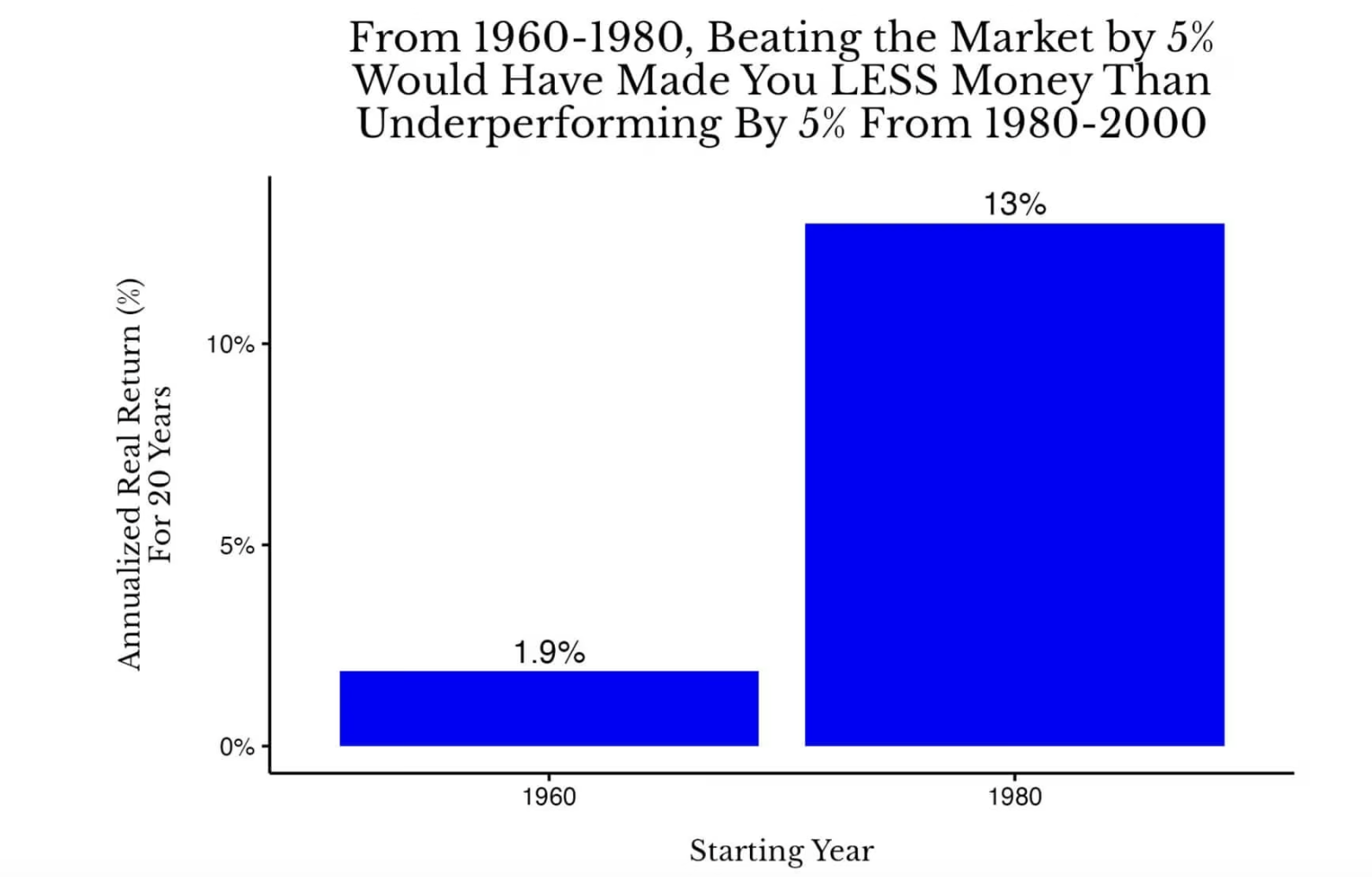
Comparison of 20-year annualized real total returns of U.S. stocks from 1960-1980 vs. 1980-2000

In this scenario, Alex's annual return from 1960 to 1980 is 6.9% (1.9% + 5%), while Pat's annual return from 1980 to 2000 is 8% (13% – 5%). Although Pat is a less skilled investor than Alex, in terms of inflation-adjusted total returns, Pat performs better.

But what if Alex's competitor is a true investor? Now assume Alex's competitor is Pat, the person who lags the market by 5% each year. But in reality, Alex's true competitor should be an index investor who earns returns equal to the market each year.

In this scenario, even if Alex outperforms the market by 10% annually from 1960-1980, he would still lag behind an index investor from 1980-2000.

Although this is an extreme example (an outlier), you might be surprised how frequently having alpha leads to underperformance relative to historical periods. As shown in the chart below:
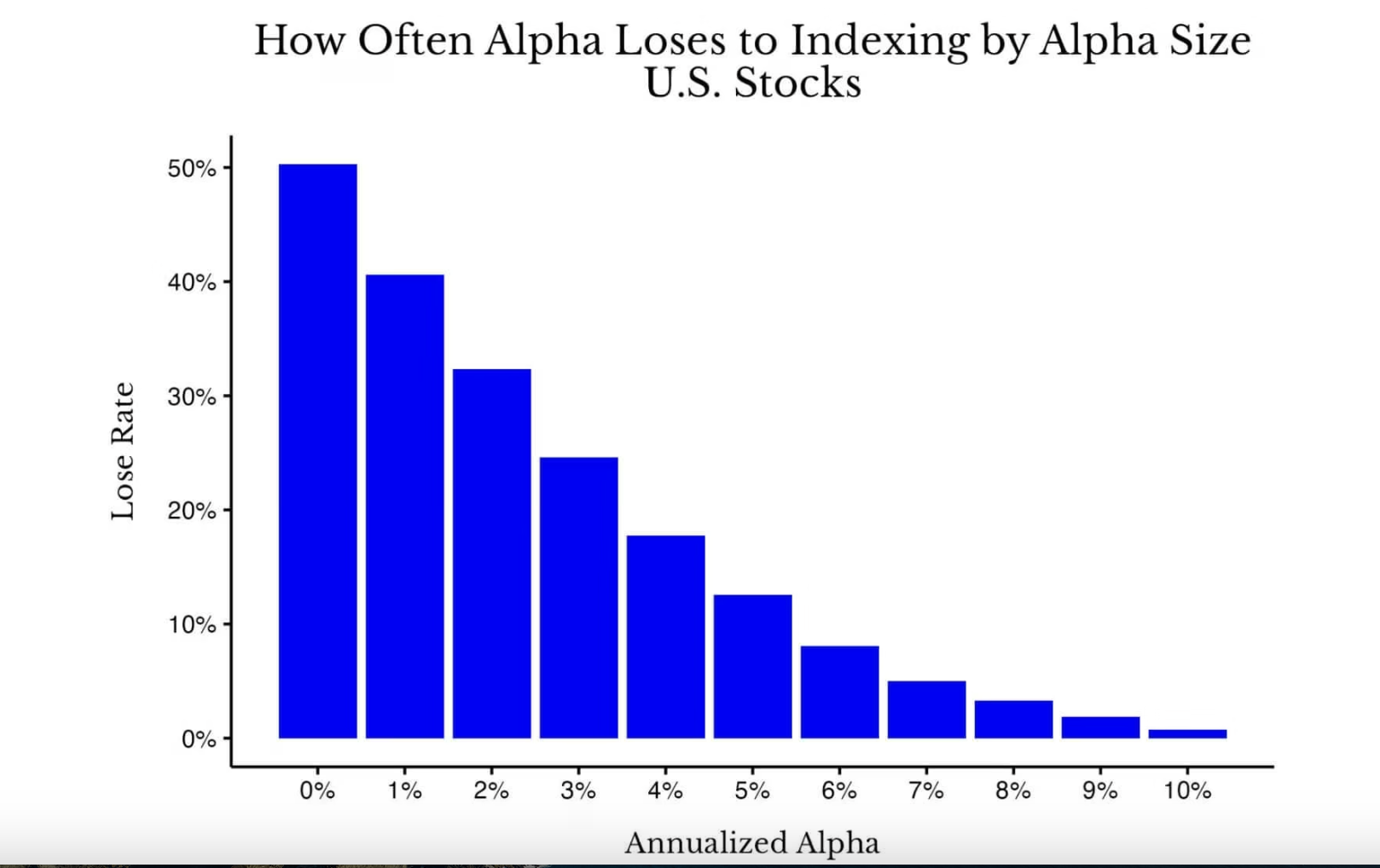
Probability of underperforming the index vs. alpha size across all 20-year periods in the U.S. stock market from 1871 to 2005

As you can see, when you have no alpha (0%), the probability of outperforming the market is essentially a coin flip (about 50%). However, as alpha increases, the compounding effect of returns does reduce the frequency of underperforming the index, but not as much as one might think. For example, even with an annual alpha of 3% over a 20-year period, there is still a 25% probability of underperforming an index fund during other periods in U.S. market history.

Of course, some might argue that relative performance is what matters, but I don't share that view. Ask yourself: would you rather have average market returns during normal times, or just "lose less money" (i.e., achieve positive alpha) during a great depression? I would certainly choose the index returns.

After all, most of the time, index returns deliver fairly good results. As shown below, the annualized real returns of U.S. stocks fluctuated by decade but were mostly positive (Note: Data for the 2020s only shows returns up to 2025):
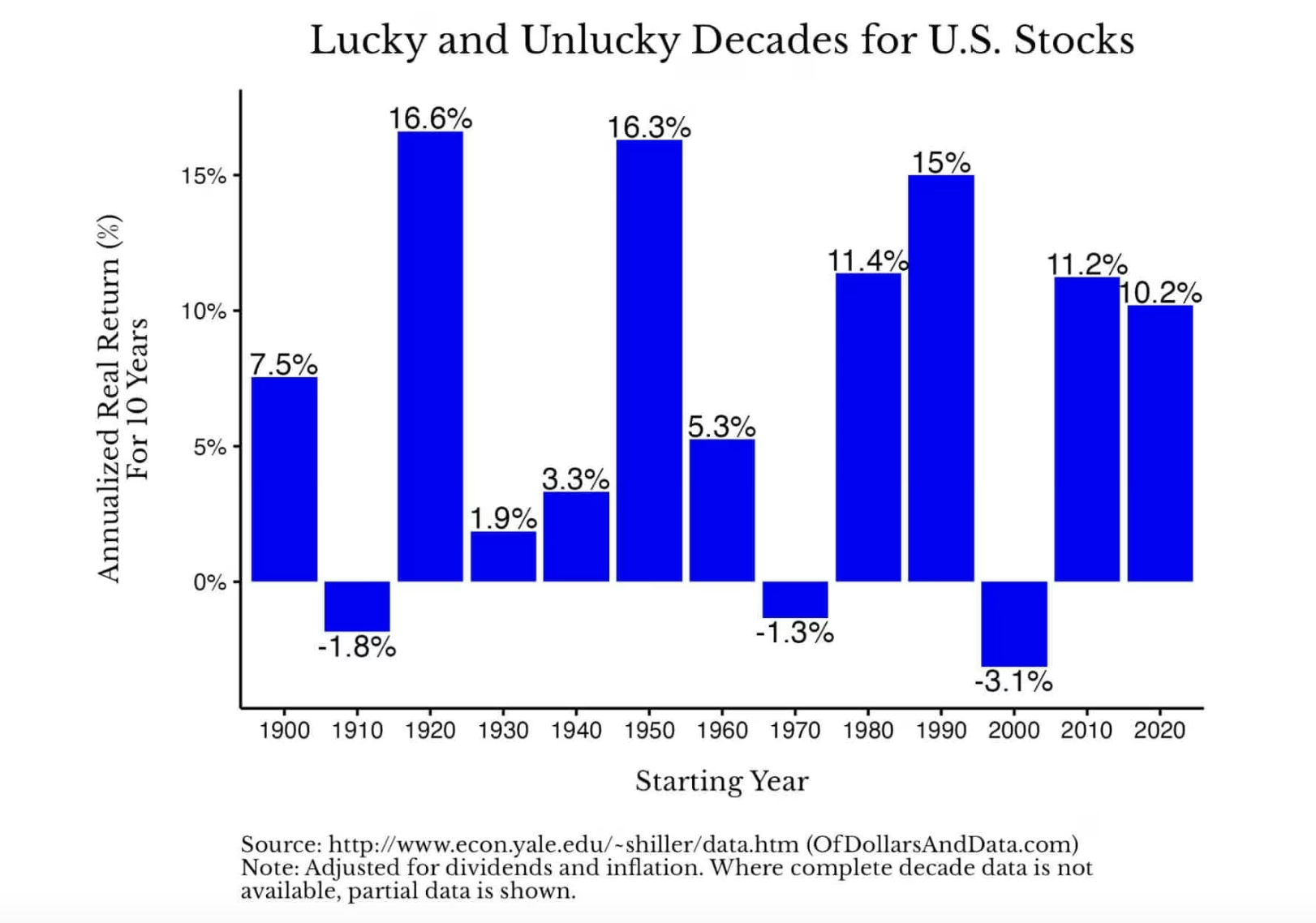
All of this shows that while investment skill is important, market performance is often more critical. In other words, pray for Beta, not Alpha.

Technically, β (Beta) measures the volatility of an asset's returns relative to the market. If a stock has a Beta of 2, it is expected to rise 2% when the market rises 1% (and vice versa). But for simplicity, market return is often referred to as Beta (i.e., a beta coefficient of 1).

The good news is that if the market doesn't provide enough "Beta" in one period, it may make up for it in the next cycle. You can see this in the chart below, which shows the 20-year rolling annualized real returns of U.S. stocks from 1871 to 2025:
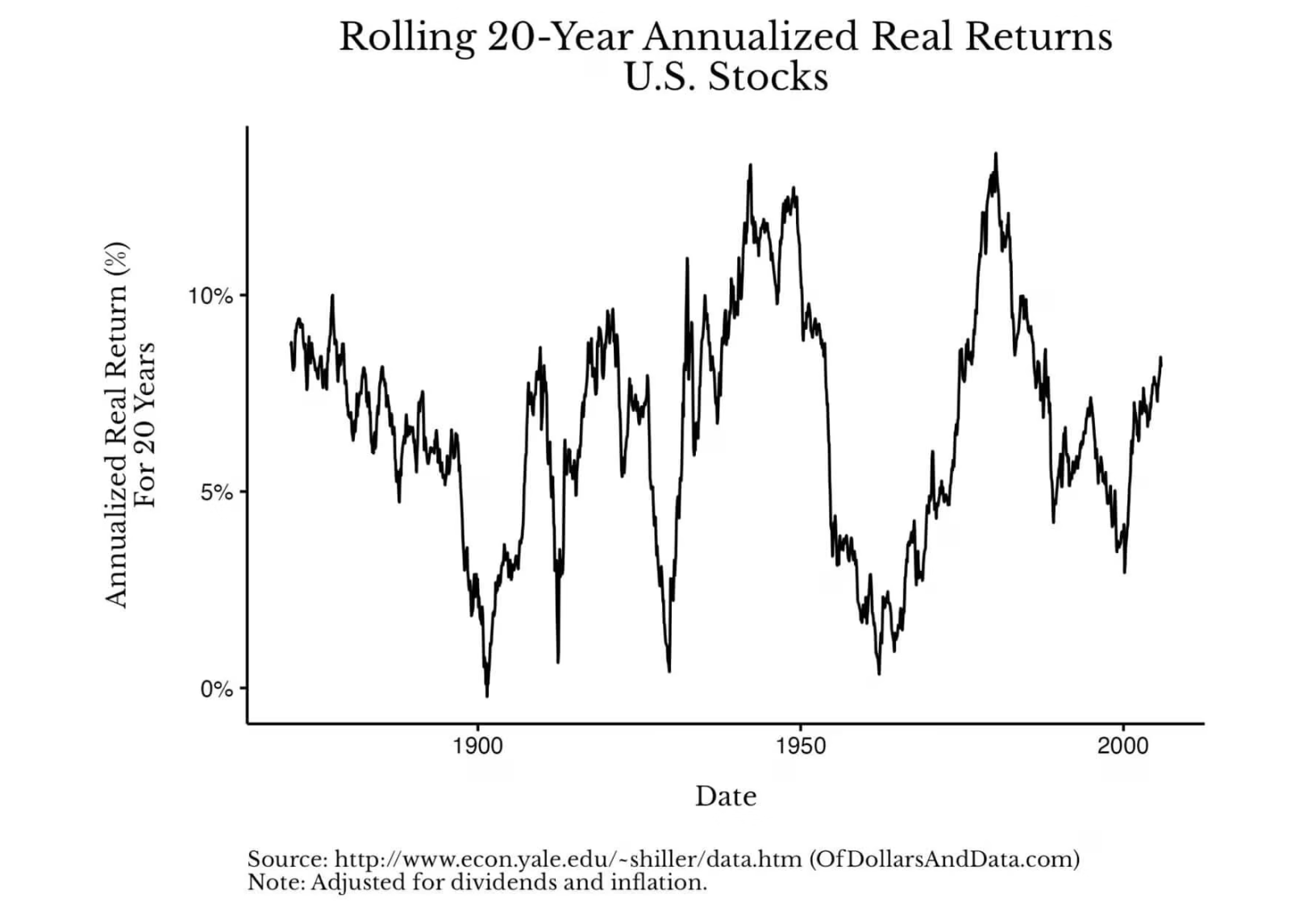
This chart visually shows how returns can rebound strongly after downturns. Taking U.S. stock history as an example, if you invested in U.S. stocks in 1900, your annualized real return over the next 20 years would be close to 0%. But if you invested in 1910, your annualized real return over the next 20 years would be about 7%. Similarly, if invested at the end of 1929, the annualized return was about 1%; whereas if invested in the summer of 1932, the annualized return was as high as 10%.

This huge difference in returns again confirms the importance of overall market performance (Beta) relative to investment skill (Alpha). You might ask, "I can't control where the market goes, so why does this matter?"

It matters because it is a relief. It frees you from the pressure of "having to beat the market" and allows you to focus on what you can truly control. Instead of feeling anxious that the market is beyond your command, see it as one less thing to worry about. See it as a variable you don't need to optimize because you simply cannot optimize it.

So what should you optimize instead? Optimize your career, savings rate, health, family, and so on. Over the long span of life, the value created in these areas is far more meaningful than苦苦追求 a few percentage points of excess returns in your investment portfolio.

Do the simple math: a 5% raise or a strategic career transition can increase your lifetime income by six figures or more. Similarly, maintaining good health is efficient risk management, significantly hedging against future medical expenses. And spending time with family sets a positive example for their future. The benefits of these decisions far exceed the gains most investors can expect from trying to outperform the market.

In 2026, focus your energy on the right things. Chase Beta, not Alpha.


Twitter:https://twitter.com/BitpushNewsCN

Bitpush TG Discussion Group:https://t.me/BitPushCommunity

Bitpush TG Subscription: https://t.me/bitpush

Original link:https://www.bitpush.news/articles/7600652

Пов'язані питання

QWhat is the main argument presented in the article regarding investment returns?

AThe article argues that market performance (Beta) is more important than investment skill (Alpha) for long-term returns. Even skilled investors with positive Alpha can underperform if they invest during a poor market period, while less skilled investors can outperform if they invest during a strong market period.

QAccording to the historical data, what is the probability of underperforming the index even with a 3% annual Alpha over 20 years?

AEven with a 3% annual Alpha over 20 years, there is still a 25% probability of underperforming the index fund, based on U.S. market data from 1871 to 2005.

QWhy does the author suggest that investors should focus on Beta rather than Alpha?

AThe author suggests focusing on Beta because market returns are largely uncontrollable, and investors should instead optimize factors they can control, such as their career, savings rate, health, and family, which can provide greater long-term value than seeking marginal investment outperformance.

QHow does the article illustrate the impact of market timing using the examples of Alex and Pat?

AAlex, who outperforms the market by 5% annually from 1960-1980, achieves a 6.9% real annual return. Pat, who underperforms the market by 5% annually from 1980-2000, achieves an 8% real annual return. This shows Pat's superior results due to better market timing, despite poorer investment skill.

QWhat does the 20-year rolling annualized real returns chart of U.S. stocks from 1871 to 2025 demonstrate?

AThe chart demonstrates that market returns tend to rebound strongly after periods of low returns, highlighting the importance of market cycles (Beta) over individual investment skill (Alpha). For example, returns were near 0% from 1900-1920 but rose to 7% from 1910-1930.

Пов'язані матеріали

Podcast Notes | Conversation with GSR Asset Management Head: To Determine if This Crypto Rally is Real, Just Watch the Lending Rates on Aave

Podcast Summary: Dialogue with GSR's Head of Asset Management: To Determine if This Crypto Rally is Real, Just Check Lending Rates on Aave Andy Baehr, Managing Director of Asset Management at GSR, discusses the current crypto market, characterizing it as stuck in a state of "ambivalence" with short-lived, unsustainable rallies. He outlines a simple framework: the market moves between "ambivalence" and "conviction" (sustained upward momentum). Currently, every rally resembles a single-stage rocket booster that quickly fizzles out. Baehr identifies three key signals to watch: 1) DeFi lending rates, 2) the potential passage of the CLARITY Act, and 3) the market forming a consensus on the "Fed hawkish peak." He emphasizes that the most immediate indicator for the sustainability of the recent CPI-triggered rally is the USDC borrowing rate on Aave, currently around 3.75%—close to U.S. Treasury yields. The absence of a credit spread indicates low leverage demand and a lack of market energy. He explains that a healthy, sustained rally requires layered buying pressure. Last year's rally progressed from an ETH short squeeze to crypto-native trader influx and finally to ETF inflows. Currently, this structure is missing. Other potential structural buyers like Digital Asset Treasury (DAT) companies are absent, and ETF flows have proven transient. Baehr notes that while small-cap crypto tokens outperformed large caps in Q2—a potential sign of capitation in major assets—capital is also flowing to more exciting opportunities like AI stocks and tech IPOs, leaving crypto sidelined. Regarding DeFi, he highlights that platforms like Aave provide a clear, real-time signal of leverage demand through their supply/demand-driven interest rates. A significant, sustained rate increase would signal genuine market conviction. He also observes the quiet emergence of fixed-income-like products and vaults in DeFi. On regulation, the probability of the CLARITY Act passing before the August 7th deadline has dropped linearly from 75% to below 40% on Polymarket. Baehr suggests its passage would be treated as a bullish surprise, a potent driver for price movement. However, political hurdles, including ethical clause debates and disclosures about the First Family's crypto profits, remain significant obstacles. Ultimately, the market awaits clarity on the Fed's terminal rate under Chair Warsh. Until the "Fed Solstice"—the point where the market collectively understands the peak of hawkish policy—sustained conviction will be difficult to achieve.

marsbit16 хв тому

Podcast Notes | Conversation with GSR Asset Management Head: To Determine if This Crypto Rally is Real, Just Watch the Lending Rates on Aave

marsbit16 хв тому

7 Months After the Collapse of Huiwang, Southeast Asia's Escrow Platforms Undergo a Major Reshuffle

Following the collapse of Huione Pay—dubbed the "Alipay of Southeast Asia"—seven months ago, the region's underground financial guarantee platform sector is undergoing a significant reshuffle. This power vacuum has been swiftly filled by emerging platforms such as XinBi, Tiger/Navigator, JinBei (renamed JinBo), Dali/Tiancheng, and FullyLight. These platforms, operating largely via Telegram and offering services like escrow for illicit transactions, have absorbed the vast user base and markets left behind by Huione. While positioning themselves as "trust intermediaries," their primary clientele consists of networks involved in online scams, money laundering, illegal gambling, and even human trafficking. For instance, the Tiger/Navigator platform explicitly provides "escrow" services for kidnapping-for-ransom operations ("强押车交易"). Data underscores the immense scale: Huione alone processed over $103 billion in cryptocurrency payments and facilitated over $31 billion through its escrow market before its downfall, linking it to Cambodia's notorious Prince Group. Since its collapse, competitors have seen explosive growth. For example, the XinBi platform has accumulated over $1.6 billion in total USDT revenue, while platforms like NewPay, OkPay (under Dali), and FullyLight Wallet collectively processed over $4.8 billion in USDT in a single year. This ecosystem thrives in regions like Cambodia and Myanmar, where regulatory gaps allow these platforms to act as critical financial infrastructure for sprawling cybercrime industries, from scam compounds to online casinos. The article concludes that the moniker "Southeast Asian Alipay" is a misnomer, obscuring the platforms' fundamental role in enabling serious criminal enterprises rather than representing legitimate financial innovation.

Odaily星球日报1 год тому

7 Months After the Collapse of Huiwang, Southeast Asia's Escrow Platforms Undergo a Major Reshuffle

Odaily星球日报1 год тому

Торгівля

Спот
活动图片





