Chaos Labs Exits, Who Will Take Over Aave's Risk?

marsbitОпубліковано о 2026-04-07Востаннє оновлено о 2026-04-07

Анотація

Chaos Labs, the core risk management provider for Aave V2 and V3 markets, has announced its decision to terminate its partnership with Aave. Despite Aave Labs increasing the budget to $5 million to retain them, Chaos Labs chose to leave due to fundamental disagreements on how risk should be managed. Key reasons for the departure include: the loss of core Aave contributors increasing operational risk, the expanded scope and complexity introduced by Aave V4 (which requires rebuilding risk infrastructure from scratch), and the fact that Chaos Labs operated at a financial loss even with increased budgets. They estimate that proper risk management for both V3 and V4 should cost at least $8 million annually (≈5.6% of protocol revenue), closer to traditional banking standards, rather than the previous 2%. Chaos Labs emphasized that Aave’s reputation and institutional adoption rely heavily on its risk management track record. They also highlighted unquantified costs like legal liability and operational security risks. The exit occurs as Aave plans its V4 upgrade and expands into institutional markets. Chaos Labs warns that migrating to V4 while maintaining V3 will double, not halve, the workload, and that accumulated operational experience cannot be easily transferred. The decision reflects a principled stance: Chaos Labs only attaches its name to work that meets its high-risk standards, even at significant financial sacrifice.

Editor's Note: Chaos Labs has announced its decision to proactively end its risk management collaboration with Aave and is seeking early termination of this authorized relationship. As the core team that has provided risk pricing and management for all of Aave's V2 and V3 markets over the past three years, its departure comes at a critical juncture as Aave is advancing its V4 architectural restructuring and institutional expansion.

In the statement, Chaos Labs emphasized that this decision was not due to short-term budget disagreements but rather a fundamental divergence in the perception of "how risk should be managed." With the loss of core contributors, increasing system complexity, and the architectural rewrite brought by V4, the responsibilities and costs of risk management have significantly expanded, but resource allocation and priority setting have not been adjusted accordingly.

The article further points out that as DeFi gradually attracts institutional funds, the risk record itself has become the most critical "admission asset." When a protocol needs to simultaneously handle more complex system structures and higher compliance standards, risk is no longer just a technical issue but a foundational capability that determines its sustainable operation.

As DeFi enters its next phase, where should risk management be positioned, and is the industry willing to bear the corresponding costs?

Below is the original text:

Since November 2022, Chaos Labs has priced every loan initiated on Aave and managed the risks for all Aave V2 and V3 markets across various networks, during which no materially impactful bad debts occurred.

During this period, Aave's Total Value Locked (TVL) grew from $5.2 billion to over $26 billion, with cumulative deposits exceeding $2.5 trillion and over $2 billion in completed liquidations.
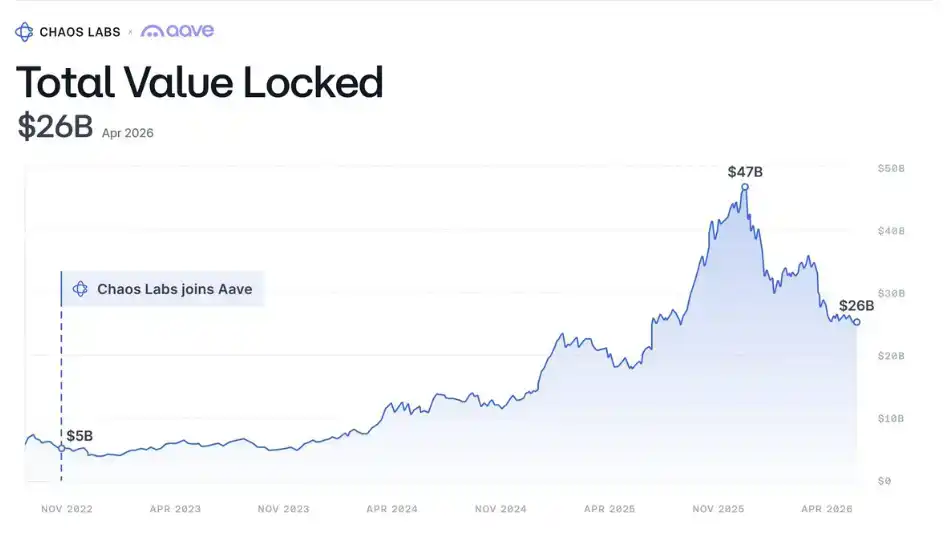
Today, we have decided to proactively end this authorized relationship and seek early termination of the collaboration.

This decision was not made hastily. We have always collaborated in good faith with DAO contributors, and Aave Labs has remained professional, even increasing the budget to $5 million to retain us. However, we chose to leave because this collaboration no longer aligns with our fundamental understanding of "how risk should be managed."

Although there are differences in future paths, I still believe Aave Labs is acting in what it perceives as the best interest of Aave.

Why We Chose to Leave

Over the past three years, we have stood with Aave through multiple market crises—moments that tested nearly every parameter we set and every machine learning model we built.

When we joined, the DAO's annualized net expenditure was negative $35 million; a few months ago, it peaked at $150 million. As one of the core contributors, we take pride in this journey.

People do not easily walk away from such an experience. Therefore, for the sake of transparency and as a reference for the DAO's future, we explain our reasons here.

Funding can solve many problems, but not all. The deeper issue lies in the structural divergence between the two parties on the fundamental question of "how to manage risk." As discussions about the future path continued, this divergence became increasingly clear.

Ultimately, the issue boils down to three points:

The departure of core Aave contributors has significantly increased the workload and operational risks;

The launch of V4 has expanded the scope of risk management functions, increasing operational and legal responsibilities, and its architecture was not designed by us, nor is it a design approach we would adopt;

Over the past three years, we have consistently operated Aave's risk management at a loss. Even with a $1 million budget increase, overall operations would still be in negative profit.

This leaves only two choices, neither of which we can accept:

Doing our best with insufficient resources but failing to meet the risk management standards expected of the "world's largest DeFi application";

Continuing to subsidize Aave's risk operations with our own funds, sustaining losses.

Even if the economic issues were resolved, the divergence in risk priorities and management approaches remains, and this cannot be solved simply by increasing the budget.

However, none of this changes our perspective on this work.

For Chaos Labs, contributing to Aave has always been an honor and a heavy responsibility. Our reputation is built on our track record. Every collaboration must be done to the standard it deserves, or not at all.

People, Technology, and Operational Experience

Aave is an excellent brand. Its leading position does not stem from the flashiest features or the most aggressive growth strategies.

What has long given Aave its advantage is its "reliability." Brand and market sentiment are essentially lagging reflections of its performance, security, and risk management capabilities—especially in extreme market conditions that have destroyed other participants. It is on this foundation that the consensus of "Just Use Aave" has gradually formed.

Competitors have launched more aggressive mechanisms and growth strategies, but they have collapsed one after another due to risk management failures or security vulnerabilities. In a market composed of the world's most volatile assets, "survivability" is the product itself. Those who can manage risk better and longer will prevail.

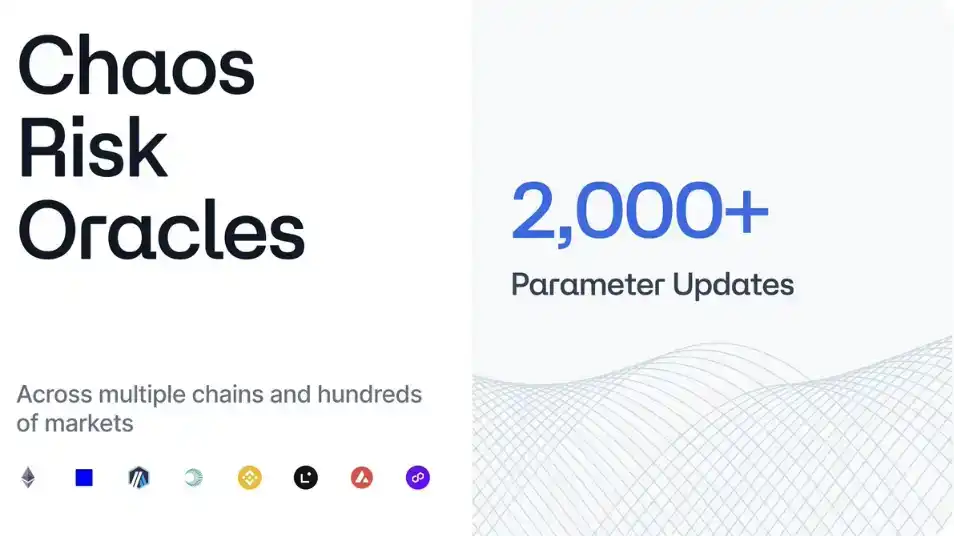
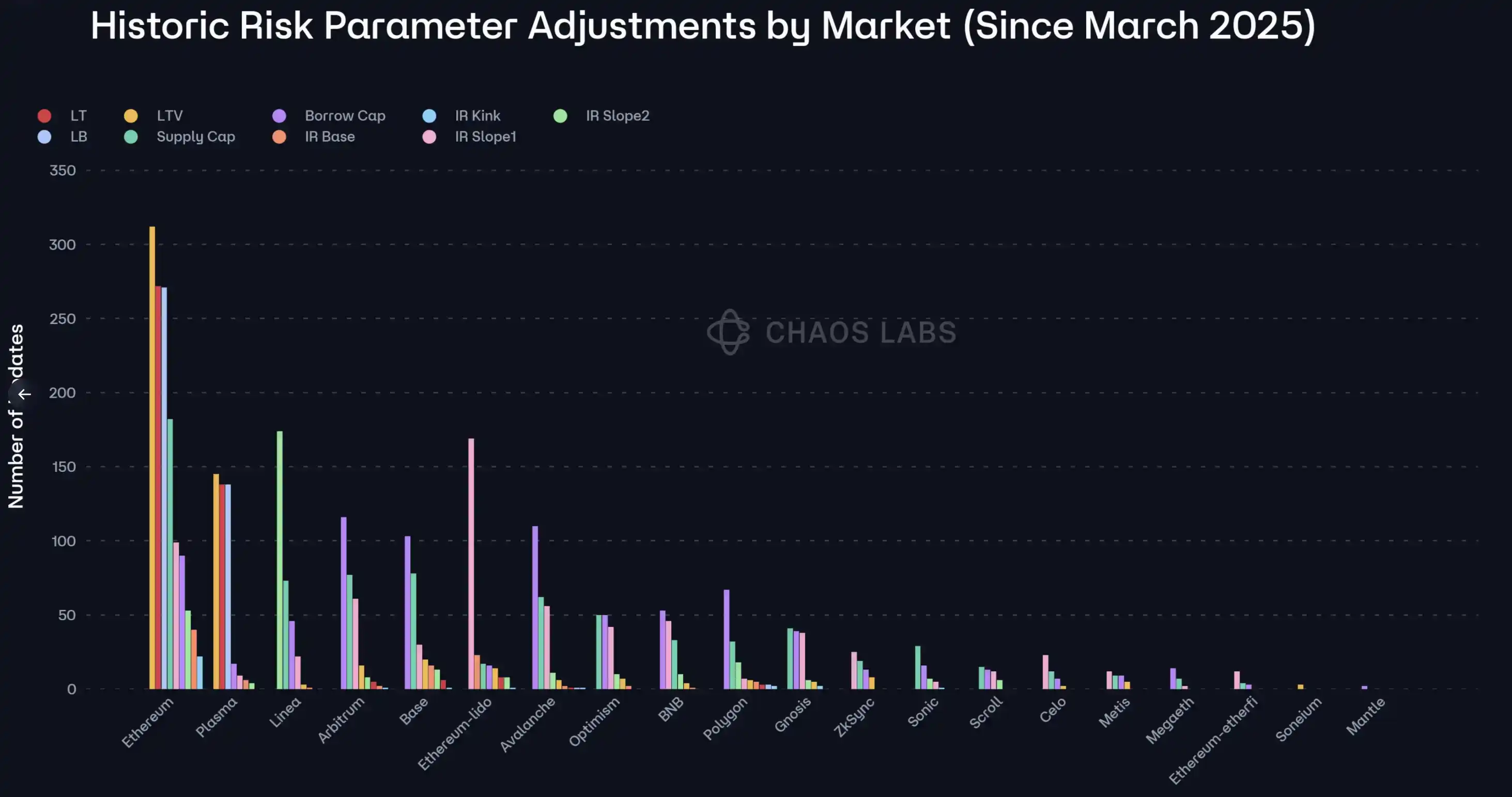
Aave's true innovation, however, lies in areas many protocols overlook: processes and infrastructure. The Risk Oracles we built and first launched on Aave enable the protocol to self-heal and update parameters in real-time based on dynamic and highly volatile market conditions. This infrastructure supports Aave's expansion to over 250 markets across 19 blockchains, handling hundreds of parameter updates monthly while maintaining rigorous operational standards, thus earning the trust it holds today.
This rigor stems from a specific collaboration system and execution stack: ACI handles growth and governance (@Marczeller), TokenLogic handles treasury management and growth (@Token_Logic), BGD handles protocol engineering (@bgdlabs), and Chaos Labs handles risk management.

The brand is what the outside world sees; what truly makes it worth seeing are the people, technology, and operational experience behind it.

GTM and Institutional Expansion

Our contributions extend far beyond risk management.

Over the past few years, the crypto industry has rapidly institutionalized. The world's largest financial institutions have begun accessing DeFi, but no matter how real the on-chain yields are, they are outweighed by one prerequisite: if institutions fear client funds could be at risk, none of this matters. For any regulated entity, all discussions begin and end with risk. A few extra basis points of yield are never worth risking principal. Institutions seek risk-adjusted returns, and they will not allocate funds to a protocol they cannot "clearly explain" to their compliance teams.

Precisely because of this, Aave's risk record has become its most important GTM asset. And we, as the builders of this record, have thus been able to directly engage with these institutions. At the request of Aave Labs, we took on this role, meeting with partners globally, producing research and due diligence materials, and personally participating in Aave's institutional expansion. We also hope the DAO will continue to benefit from these accumulated efforts in the coming months.

Ship of Theseus

If every plank of a ship is replaced, is it still the same ship? The name remains, the flag remains, but the foundation is already different.

Aave is now in such a state. The core contributors who built and operated V3 have left, and the operational experience that supported Aave through market cycles over the past three years has been lost with them.

We are the last remaining technical contributor from this group.

V3 remains the largest application in DeFi, requiring 7×24×365 risk management. Although Aave Labs is optimistic about a rapid migration to V4, history shows that such migrations often take months or even years. Until V4 fully assumes V3's markets and liquidity, both systems must run in parallel. The workload does not halve; it doubles.

More critical is operational experience. Even assuming different teams have equal capability, the experience accumulated over three years of continuous operation cannot be directly handed over.

How long will it take to bridge this gap? The answer is clearly not "zero." And until the gap is closed, someone must bear this cost—a responsibility that falls almost entirely on us, while the budget is already insufficient for the expanded scope.

The continuity of the brand is not equivalent to the continuity of the system.

Why V4 Is Different

V4 is a completely new lending protocol with entirely new smart contract code, system architecture, and design paradigms. Aside from the name, it bears little resemblance to Aave V3.

Architectural changes directly impact risk: more cross-market, cross-module interdependencies,全新的信用结构, and adjusted liquidation logic. And the "second-order risks" of any new protocol only gradually apparent after real funds enter the system.

Responsibly taking over this system means rebuilding infrastructure, toolchains, and simulation systems from the ground up and redoing the entire operational process on a codebase that has not yet been market-tested. This scope is far greater than V3, and this is at the core of our decision.

Risk is downstream of architecture. When the architecture undergoes fundamental changes, risk management itself must be重构. Unlike standardized services like price oracles or reserve proofs, the Risk Oracle and its supporting systems must be customized for the specific protocol architecture. Once the architecture is rewritten, the risk infrastructure must be rebuilt.

The problem is: the scope has significantly expanded, but resources have not increased accordingly. Aave Labs may be able to accept such a trade-off, but we cannot.

The Real Cost of This

We are walking away from a historically well-functioning, $5 million collaboration. For a startup, this is by no means a decision made lightly, and thus deserves fuller context.

Remuneration is only part of it; more importantly, it's a signal: how many resources an organization dedicates to risk reflects its priority on risk.

Simultaneously, I also believe that few truly understand the actual costs, real expenditures, and risks borne by such systems. Therefore, I hope to clarify this here.

It must be clear: the DAO has every right to decide what it values and how much it is willing to pay for it. I have no objection to that. My duty is merely to judge whether these conditions are suitable for us—and this time, they are not.

Comparing Aave to a Bank

Aave often compares itself to a bank, and we use this standard for perspective. Banks typically allocate 6%–10% of their revenue to compliance and risk infrastructure. In 2025, Aave's revenue was $142 million, and our budget was $3 million, accounting for about 2%.

We estimate that the minimum risk budget for V3 + V4 should be $8 million to cover the broader risk scope, additional infrastructure, and the GTM work we have already undertaken, accounting for about 5.6% of revenue, still below the lower bound for banks.

And this comparison might even be "generous." The openness of blockchain makes it more complex and asymmetric in terms of market risk and cybersecurity risk. The protocol's open-source transparency means the attack surface is equally visible to everyone. Recent series of attacks have proven this is not a theoretical risk. We believe DeFi should invest more in risk than traditional finance, not less.

Of course, Aave's scale has almost no comparable counterpart in DeFi; banks are just a reference point to understand how much institutions that "take risk seriously" typically invest. Whether a protocol "has the ability" to invest in risk and whether it "chooses to invest" are two different things.

For Aave, capability is not the issue: the DAO holds approximately $140 million in reserves, and Aave Labs just passed a $50 million self-funding proposal. But even if resources were scarce, the cost of risk management would not change. Budgets cannot reshape the threat structure—cost is cost.

Costs That Don't Appear in the Budget

Manpower and infrastructure are only explicit costs; there are also隐性成本 that are harder to quantify but must be borne.

First, legal and institutional risk. Engaging in risk management in DeFi (whether as a risk manager or treasury manager) faces undefined liability boundaries. There is no mature regulatory framework, no "safe harbor," and no clear legal definition of what responsibility risk managers should bear when a protocol fails. When the system functions normally, this work is "invisible"; once problems arise, the responsibility does not disappear.

Second, network and operational security. Providing risk services for a protocol managing tens of billions of dollars in assets itself becomes a target for attacks. The costs of audits, monitoring, infrastructure, and internal control systems rise in tandem with user deposit规模.

These costs are not unique to us. Any team taking on this role at this scale would face the same exposure. The question is whether the collaboration structure reflects this reality.

If the upside is limited and the downside risk is unlimited, then choosing to continue is not "having faith"; it is poor risk management.

Our Principles

At Chaos, we always adhere to a simple principle: we only put our name to work we fully stand behind.

When things go well, this principle is easy to uphold; what truly matters is when it comes at a cost. Today, that cost is $5 million.

I once wrote in "The Market Crypto Never Built" what institutional-grade risk management should look like. This decision is the embodiment of that belief in reality. If we advocate for higher standards in the industry, we must first hold ourselves to those standards.

I hope V4 will succeed. If it turns out our concerns were overestimated, that would be good for the entire industry.

To the Aave community: Thank you for the trust during this time; it has been our honor.

Пов'язані питання

QWhy did Chaos Labs decide to end its risk management partnership with Aave?

AChaos Labs ended the partnership due to a fundamental disagreement with Aave on how risk should be managed, not because of short-term budget issues. The departure of core Aave contributors, increased operational risks, the expanded scope and legal responsibilities from V4's architecture (which they did not design), and operating at a financial loss for three years were key factors.

QWhat was Chaos Labs' role and contribution to Aave during their partnership?

AChaos Labs was responsible for pricing every loan and managing risk for all Aave V2 and V3 markets across multiple networks. They built risk infrastructure like Risk Oracles, handled parameter updates, and contributed to Aave's growth from $5.2B to over $26B TVL. They also supported Aave's institutional expansion by engaging with regulated entities and providing research and due diligence materials.

QHow does Chaos Labs view the importance of risk management in DeFi, especially for protocols like Aave?

AChaos Labs believes risk management is a foundational capability, not just a technical issue. In DeFi, where protocols handle volatile assets, survival and reliability are the product. A strong risk record is a critical GTM asset for attracting institutional funds, as institutions prioritize risk-adjusted returns and require clear risk explanations for compliance.

QWhat are the challenges and increased costs associated with managing risk for Aave V4 according to Chaos Labs?

AV4 is a completely new protocol with different architecture, credit structures, and liquidation logic, requiring rebuilding risk infrastructure, tools, and simulations from scratch. Managing both V3 and V4 in parallel would double the workload. Chaos Labs estimated a minimum risk budget of $8M (5.6% of revenue) for V3+V4, higher than the 2% they received, to cover expanded scope, infrastructure, and hidden costs like legal and operational security.

QWhat principle did Chaos Labs cite as the reason for their decision to leave, despite the financial impact?

AChaos Labs operates on the principle of only putting their name on work they fully stand behind. They believe that advocating for higher standards in DeFi risk management requires adhering to those standards themselves, even at a cost—in this case, foregoing a $5M partnership that no longer aligned with their risk management philosophy.

Пов'язані матеріали

In-Depth Report on the On-Chain Lending Market: When Off-Chain Credit Meets On-Chain Liquidation

The on-chain lending market has evolved from a peripheral DeFi niche into core financial infrastructure. As of early 2026, total value locked (TVL) in on-chain lending protocols has reached $64.3 billion, accounting for 53.54% of total DeFi TVL, making it the largest and most mature vertical within decentralized finance. Aave dominates the sector with approximately $32.9 billion in TVL, commanding nearly half of the market—a leadership position that is unlikely to be challenged in the foreseeable future. However, the path of on-chain lending forward is not without risk. Liquidation cascades, credit defaults, and cross-chain vulnerabilities remain systemic threats hanging over the industry. At the same time, a deeper structural transformation is underway: on-chain lending is shifting from a “leverage tool for crypto-native users” to a “compliant gateway for institutional capital”. The scale of RWA (Real World Asset) lending has surpassed $18.5 billion, with U.S. Treasuries and government securities increasingly serving as core collateral. Institutional capital inflows are reshaping both the user base and risk appetite of the sector. This report systematically analyzes the evolution of on-chain lending definitions, competitive dynamics, core risks, and future trends, providing a comprehensive industry outlook for investors and trade practitioners. Key findings suggest that the “one dominant player with several strong challengers” structure will persist in the short term, while fixed-rate lending, compliant collateral, and institutional credit underwriting will define the next phase of competition. For investors focused on DeFi infrastructure, three key opportunity tracks stand out, namely, the Aave ecosystem (Morpho, Spark), RWA lending protocols (Ondo, Maple) and fixed-rate innovation (Notional, Pendle).

HTX Learn35 хв тому

In-Depth Report on the On-Chain Lending Market: When Off-Chain Credit Meets On-Chain Liquidation

HTX Learn35 хв тому

Fu Peng's First Public Speech in 2026: What Exactly Are Crypto Assets? Why Did I Join the Crypto Asset Industry?

Fu Peng, a renowned macroeconomist and now Chief Economist at New火 Group, delivered his first public speech of 2026 at the Hong Kong Web3 Festival. He explained his perspective on crypto assets and why he joined the industry, framing it within the context of macroeconomic trends and financial evolution. Fu emphasized that crypto assets are transitioning from an early, belief-driven phase to a mature, institutionally integrated asset class. He drew parallels to the 1970s-80s, when technological advances (like computing) revolutionized traditional finance, leading to the rise of FICC (Fixed Income, Currencies, and Commodities). Similarly, current advancements in AI, data, and blockchain are reshaping finance, with crypto assets becoming part of a new "FICC + C" (C for Crypto) framework. He noted that institutional capital, including traditional hedge funds, avoided early crypto due to its speculative nature but are now engaging as regulatory clarity emerges (e.g., stablecoin laws, CFTC classifying crypto as a commodity). Fu predicted that 2025-2026 marks a turning point where crypto becomes a standardized, financially viable asset for diversified portfolios, akin to commodities or derivatives in traditional finance. Fu defined Bitcoin not as "digital gold" in a simplistic sense but as a value-preserving, financially tradable asset. He highlighted that crypto's future lies in regulated, institutional adoption, moving away from retail-dominated trading. His entry into crypto signals this maturation, where traditional finance integrates crypto into mainstream asset management.

marsbit1 год тому

Fu Peng's First Public Speech in 2026: What Exactly Are Crypto Assets? Why Did I Join the Crypto Asset Industry?

marsbit1 год тому

Justin Sun Sues Trump Family: What $75 Million Bought Was Only a Blacklist

Justin Sun, founder of Tron, has filed a lawsuit in federal court against World Liberty Financial (WLF), alleging he was made the "primary target of a fraudulent scheme" after investing $75 million. Sun claims the investment secured him an advisor title and WLFI tokens, which were later frozen by WLF, causing "hundreds of millions in losses." The dispute began in late 2024 when Sun's investment helped revive WLF's struggling token sale, which ultimately raised $550 million. Shortly after, the SEC dropped its lawsuit against Sun following Donald Trump's inauguration. However, relations soured when Sun refused WLF's demands for additional funding. In August 2025, WLF added a "blacklist" function to its smart contract, allowing it to unilaterally freeze tokens. Sun's holdings, worth approximately $107 million, were frozen, and he was threatened with token destruction. The lawsuit highlights WLF's structure, which directs 75% of token sale profits to the Trump family, who had earned $1 billion by December 2025. WLF's CEO is Zach Witkoff, son of U.S. Middle East envoy Steve Witkoff. The project faces scrutiny for opaque operations, including a controversial loan arrangement on the Dolomite platform, co-founded by a WLF advisor. Despite Sun's history with the SEC, the case underscores centralization risks within DeFi, as WLF controls governance and holds powers to freeze assets arbitrarily. Sun's tokens remain frozen as legal proceedings begin.

marsbit1 год тому

Justin Sun Sues Trump Family: What $75 Million Bought Was Only a Blacklist

marsbit1 год тому

Торгівля

Спот
Ф'ючерси

Популярні статті

Що таке $S$

Розуміння SPERO: Комплексний огляд Вступ до SPERO Оскільки ландшафт інновацій продовжує еволюціонувати, виникнення технологій web3 та криптовалютних проектів відіграє ключову роль у формуванні цифрового майбутнього. Один з проектів, який привернув увагу в цій динамічній сфері, — це SPERO, позначений як SPERO,$$s$. Ця стаття має на меті зібрати та представити детальну інформацію про SPERO, щоб допомогти ентузіастам та інвесторам зрозуміти його основи, цілі та інновації в рамках web3 та крипто-сектору. Що таке SPERO,$$s$? SPERO,$$s$ — це унікальний проект у криптопросторі, який прагне використати принципи децентралізації та технології блокчейн для створення екосистеми, що сприяє залученню, корисності та фінансовій інклюзії. Проект розроблений для полегшення взаємодії між користувачами новими способами, надаючи їм інноваційні фінансові рішення та послуги. У своїй основі SPERO,$$s$ прагне надати можливості індивідам, забезпечуючи інструменти та платформи, які покращують користувацький досвід у криптовалютному просторі. Це включає в себе можливість більш гнучких методів транзакцій, сприяння ініціативам, що підтримуються спільнотою, та створення шляхів для фінансових можливостей через децентралізовані додатки (dApps). Основна концепція SPERO,$$s$ обертається навколо інклюзивності, прагнучи зменшити розриви в традиційній фінансовій системі, використовуючи переваги технології блокчейн. Хто є творцем SPERO,$$s$? Особистість творця SPERO,$$s$ залишається дещо невідомою, оскільки є обмежені публічно доступні ресурси, що надають детальну інформацію про його засновників. Ця відсутність прозорості може бути наслідком зобов'язання проекту до децентралізації — етики, яку багато проектів web3 поділяють, ставлячи колективні внески вище за індивідуальне визнання. Зосереджуючи обговорення навколо спільноти та її колективних цілей, SPERO,$$s$ втілює суть наділення без виділення конкретних осіб. Таким чином, розуміння етики та місії SPERO є більш важливим, ніж ідентифікація єдиного творця. Хто є інвесторами SPERO,$$s$? SPERO,$$s$ підтримується різноманітними інвесторами, починаючи від венчурних капіталістів до ангельських інвесторів, які прагнуть сприяти інноваціям у крипто-секторі. Зосередження цих інвесторів зазвичай узгоджується з місією SPERO — пріоритет надається проектам, які обіцяють технологічний прогрес у суспільстві, фінансову інклюзію та децентралізоване управління. Ці інвесторські фонди зазвичай зацікавлені в проектах, які не лише пропонують інноваційні продукти, але й позитивно впливають на спільноту блокчейн та її екосистеми. Підтримка з боку цих інвесторів підкріплює SPERO,$$s$ як значного конкурента в швидко змінюваній сфері крипто-проектів. Як працює SPERO,$$s$? SPERO,$$s$ використовує багатогранну структуру, яка відрізняє його від традиційних криптовалютних проектів. Ось деякі ключові особливості, які підкреслюють його унікальність та інноваційність: Децентралізоване управління: SPERO,$$s$ інтегрує моделі децентралізованого управління, надаючи користувачам можливість активно брати участь у процесах прийняття рішень щодо майбутнього проекту. Цей підхід сприяє відчуттю власності та відповідальності серед членів спільноти. Корисність токена: SPERO,$$s$ використовує свій власний криптовалютний токен, розроблений для виконання різних функцій в екосистемі. Ці токени дозволяють здійснювати транзакції, отримувати винагороди та полегшувати послуги, що пропонуються на платформі, підвищуючи загальну залученість та корисність. Шарова архітектура: Технічна архітектура SPERO,$$s$ підтримує модульність та масштабованість, що дозволяє безперешкодно інтегрувати додаткові функції та додатки в міру розвитку проекту. Ця адаптивність є надзвичайно важливою для збереження актуальності в постійно змінюваному крипто-ландшафті. Залучення спільноти: Проект підкреслює ініціативи, що підтримуються спільнотою, використовуючи механізми, які стимулюють співпрацю та зворотний зв'язок. Підтримуючи сильну спільноту, SPERO,$$s$ може краще задовольняти потреби користувачів та адаптуватися до ринкових тенденцій. Фокус на інклюзію: Пропонуючи низькі комісії за транзакції та зручні інтерфейси, SPERO,$$s$ прагне залучити різноманітну базу користувачів, включаючи осіб, які раніше не брали участі в крипто-просторі. Це зобов'язання до інклюзії узгоджується з його загальною місією наділення через доступність. Хронологія SPERO,$$s$ Розуміння історії проекту надає важливі уявлення про його розвиток та етапи. Нижче наведено пропоновану хронологію, що відображає значні події в еволюції SPERO,$$s$: Етап концептуалізації та ідеації: Початкові ідеї, що стали основою SPERO,$$s$, були сформовані, тісно пов'язані з принципами децентралізації та фокусом на спільноті в індустрії блокчейн. Запуск білого паперу проекту: Після концептуального етапу був випущений комплексний білий папір, що детально описує бачення, цілі та технологічну інфраструктуру SPERO,$$s$, щоб залучити інтерес та зворотний зв'язок від спільноти. Створення спільноти та ранні залучення: Активні зусилля були спрямовані на створення спільноти ранніх прихильників та потенційних інвесторів, що полегшило обговорення цілей проекту та отримання підтримки. Подія генерації токенів: SPERO,$$s$ провів подію генерації токенів (TGE) для розподілу своїх рідних токенів серед ранніх прихильників та встановлення початкової ліквідності в екосистемі. Запуск початкового dApp: Перший децентралізований додаток (dApp), пов'язаний з SPERO,$$s$, став доступним, дозволяючи користувачам взаємодіяти з основними функціями платформи. Постійний розвиток та партнерства: Безперервні оновлення та вдосконалення пропозицій проекту, включаючи стратегічні партнерства з іншими учасниками блокчейн-простору, сформували SPERO,$$s$ у конкурентоспроможного та еволюціонуючого гравця на крипто-ринку. Висновок SPERO,$$s$ є свідченням потенціалу web3 та криптовалют для революціонізації фінансових систем та наділення індивідів. Завдяки зобов'язанню до децентралізованого управління, залучення спільноти та інноваційно спроектованих функцій, він прокладає шлях до більш інклюзивного фінансового ландшафту. Як і з будь-якими інвестиціями в швидко змінюваному крипто-просторі, потенційним інвесторам та користувачам рекомендується ретельно досліджувати та обдумано взаємодіяти з поточними подіями в SPERO,$$s$. Проект демонструє інноваційний дух крипто-індустрії, запрошуючи до подальшого дослідження його численних можливостей. Хоча подорож SPERO,$$s$ ще триває, його основні принципи можуть справді вплинути на майбутнє того, як ми взаємодіємо з технологією, фінансами та один з одним у взаємопов'язаних цифрових екосистемах.

73 переглядів усьогоОпубліковано 2024.12.17Оновлено 2024.12.17

Що таке $S$

Що таке AGENT S

Агент S: Майбутнє автономної взаємодії в Web3 Вступ У постійно змінюваному ландшафті Web3 та криптовалюти інновації постійно переосмислюють, як люди взаємодіють з цифровими платформами. Один з таких новаторських проектів, Агент S, обіцяє революціонізувати взаємодію людини з комп'ютером через свою відкриту агентну структуру. Прокладаючи шлях для автономних взаємодій, Агент S прагне спростити складні завдання, пропонуючи трансформаційні застосування в штучному інтелекті (ШІ). Це детальне дослідження заглиблюється в складності проекту, його унікальні особливості та наслідки для сфери криптовалюти. Що таке Агент S? Агент S є революційною відкритою агентною структурою, спеціально розробленою для вирішення трьох основних викликів в автоматизації комп'ютерних завдань: Набуття специфічних знань у галузі: Структура інтелектуально навчається з різних зовнішніх джерел знань та внутрішнього досвіду. Цей подвійний підхід дозволяє їй створити багатий репозиторій специфічних знань у галузі, покращуючи її продуктивність у виконанні завдань. Планування на довгих горизонтах завдань: Агент S використовує планування з підкріпленням досвіду, стратегічний підхід, який полегшує ефективний розподіл та виконання складних завдань. Ця функція значно підвищує її здатність ефективно та результативно управляти кількома підзавданнями. Обробка динамічних, неоднорідних інтерфейсів: Проект представляє Інтерфейс Агент-Комп'ютер (ACI), інноваційне рішення, яке покращує взаємодію між агентами та користувачами. Використовуючи багатомодальні великі мовні моделі (MLLMs), Агент S може безперешкодно орієнтуватися та маніпулювати різноманітними графічними інтерфейсами користувача. Завдяки цим новаторським функціям Агент S надає надійну структуру, яка вирішує складнощі, пов'язані з автоматизацією людської взаємодії з машинами, прокладаючи шлях для численних застосувань у ШІ та за його межами. Хто є творцем Агент S? Хоча концепція Агент S є фундаментально новаторською, конкретна інформація про його творця залишається невідомою. Творець наразі невідомий, що підкреслює або початкову стадію проекту, або стратегічний вибір зберегти засновників у таємниці. Незважаючи на анонімність, акцент залишається на можливостях та потенціалі структури. Хто є інвесторами Агент S? Оскільки Агент S є відносно новим у криптографічній екосистемі, детальна інформація про його інвесторів та фінансових спонсорів не задокументована. Відсутність публічно доступних відомостей про інвестиційні фонди або організації, що підтримують проект, викликає питання щодо його фінансової структури та дорожньої карти розвитку. Розуміння підтримки є критично важливим для оцінки стійкості проекту та потенційного впливу на ринок. Як працює Агент S? В основі Агент S лежить передова технологія, яка дозволяє йому ефективно функціонувати в різних умовах. Його операційна модель побудована навколо кількох ключових функцій: Взаємодія з комп'ютером, подібна до людської: Структура пропонує розширене планування ШІ, прагнучи зробити взаємодії з комп'ютерами більш інтуїтивними. Імітуючи людську поведінку при виконанні завдань, вона обіцяє підвищити досвід користувачів. Наративна пам'ять: Використовується для використання високорівневого досвіду, Агент S використовує наративну пам'ять для відстеження історій завдань, тим самим покращуючи свої процеси прийняття рішень. Епізодична пам'ять: Ця функція надає користувачам покрокові інструкції, дозволяючи структурі пропонувати контекстуальну підтримку в міру виконання завдань. Підтримка OpenACI: Завдяки можливості працювати локально, Агент S дозволяє користувачам зберігати контроль над своїми взаємодіями та робочими процесами, узгоджуючи з децентралізованою етикою Web3. Легка інтеграція з зовнішніми API: Його універсальність і сумісність з різними платформами ШІ забезпечують те, що Агент S може безперешкодно вписатися в існуючі технологічні екосистеми, роблячи його привабливим вибором для розробників та організацій. Ці функціональні можливості колективно сприяють унікальному положенню Агент S у крипто-просторі, оскільки він автоматизує складні, багатоступеневі завдання з мінімальним втручанням людини. У міру розвитку проекту його потенційні застосування в Web3 можуть переосмислити, як відбуваються цифрові взаємодії. Хронологія Агент S Розробка та етапи Агент S можуть бути узагальнені в хронології, яка підкреслює його значні події: 27 вересня 2024 року: Концепція Агент S була представлена в комплексній науковій статті під назвою “Відкрита агентна структура, яка використовує комп'ютери як людина”, що демонструє основи проекту. 10 жовтня 2024 року: Наукова стаття була опублікована на arXiv, пропонуючи детальне дослідження структури та її оцінки продуктивності на основі бенчмарку OSWorld. 12 жовтня 2024 року: Було випущено відеопрезентацію, що надає візуальне уявлення про можливості та особливості Агент S, ще більше залучаючи потенційних користувачів та інвесторів. Ці маркери в хронології не лише ілюструють прогрес Агент S, але й вказують на його прихильність до прозорості та залучення громади. Ключові моменти про Агент S У міру розвитку структури Агент S кілька ключових характеристик виділяються, підкреслюючи її новаторський характер та потенціал: Інноваційна структура: Розроблена для забезпечення інтуїтивного використання комп'ютерів, подібного до людської взаємодії, Агент S пропонує новий підхід до автоматизації завдань. Автономна взаємодія: Здатність автономно взаємодіяти з комп'ютерами через GUI означає стрибок до більш інтелектуальних та ефективних обчислювальних рішень. Автоматизація складних завдань: Завдяки своїй надійній методології він може автоматизувати складні, багатоступеневі завдання, роблячи процеси швидшими та менш схильними до помилок. Безперервне вдосконалення: Механізми навчання дозволяють Агенту S покращуватися на основі минулого досвіду, постійно підвищуючи свою продуктивність та ефективність. Універсальність: Його адаптивність до різних операційних середовищ, таких як OSWorld та WindowsAgentArena, забезпечує його здатність служити широкому спектру застосувань. Оскільки Агент S займає своє місце в ландшафті Web3 та криптовалюти, його потенціал покращити можливості взаємодії та автоматизувати процеси означає значний прогрес у технологіях ШІ. Завдяки своїй інноваційній структурі Агент S є прикладом майбутнього цифрових взаємодій, обіцяючи більш безперешкодний та ефективний досвід для користувачів у різних галузях. Висновок Агент S представляє собою сміливий крок вперед у поєднанні ШІ та Web3, з можливістю переосмислити, як ми взаємодіємо з технологією. Хоча проект все ще на ранніх стадіях, можливості для його застосування є величезними та переконливими. Завдяки своїй комплексній структурі, що вирішує критичні виклики, Агент S прагне вивести автономні взаємодії на передній план цифрового досвіду. У міру того, як ми заглиблюємося в сфери криптовалюти та децентралізації, проекти, подібні до Агент S, безсумнівно, відіграватимуть ключову роль у формуванні майбутнього технологій та співпраці людини з комп'ютером.

535 переглядів усьогоОпубліковано 2025.01.14Оновлено 2025.01.14

Що таке AGENT S

Як купити S

Ласкаво просимо до HTX.com! Ми зробили покупку Sonic (S) простою та зручною. Дотримуйтесь нашої покрокової інструкції, щоб розпочати свою криптовалютну подорож.Крок 1: Створіть обліковий запис на HTXВикористовуйте свою електронну пошту або номер телефону, щоб зареєструвати обліковий запис на HTX безплатно. Пройдіть безпроблемну реєстрацію й отримайте доступ до всіх функцій.ЗареєструватисьКрок 2: Перейдіть до розділу Купити крипту і виберіть спосіб оплатиКредитна/дебетова картка: використовуйте вашу картку Visa або Mastercard, щоб миттєво купити Sonic (S).Баланс: використовуйте кошти з балансу вашого рахунку HTX для безперешкодної торгівлі.Треті особи: ми додали популярні способи оплати, такі як Google Pay та Apple Pay, щоб підвищити зручність.P2P: Торгуйте безпосередньо з іншими користувачами на HTX.Позабіржова торгівля (OTC): ми пропонуємо індивідуальні послуги та конкурентні обмінні курси для трейдерів.Крок 3: Зберігайте свої Sonic (S)Після придбання Sonic (S) збережіть його у своєму обліковому записі на HTX. Крім того, ви можете відправити його в інше місце за допомогою блокчейн-переказу або використовувати його для торгівлі іншими криптовалютами.Крок 4: Торгівля Sonic (S)Легко торгуйте Sonic (S) на спотовому ринку HTX. Просто увійдіть до свого облікового запису, виберіть торгову пару, укладайте угоди та спостерігайте за ними в режимі реального часу. Ми пропонуємо зручний досвід як для початківців, так і для досвідчених трейдерів.

1.3k переглядів усьогоОпубліковано 2025.01.15Оновлено 2025.03.21

Як купити S

Обговорення

Ласкаво просимо до спільноти HTX. Тут ви можете бути в курсі останніх подій розвитку платформи та отримати доступ до професійної ринкової інформації. Нижче представлені думки користувачів щодо ціни S (S).

活动图片














