Chainlink and Mastercard Join Swapper Finance To Bring Direct Deposits To 3.5B Users

bitcoinistОпубліковано о 2025-12-10Востаннє оновлено о 2025-12-10

Анотація

Swapper Finance has launched Direct Deposits in collaboration with Chainlink and Mastercard, aiming to bring global payments directly into the on-chain economy for over 3.5 billion users. This new feature, powered by Chainlink Runtime Environment (CRE) and Mastercard’s global network, allows users to deposit into DeFi protocols using payment cards, crypto transfers, or Web3 wallets through a single, secure, and compliant on-chain workflow. The solution eliminates traditional bottlenecks like multi-step onboarding, KYC, compliance, and settlement by unifying these processes into one verifiable orchestration layer. Chainlink and Mastercard’s involvement highlights the integration of traditional payment infrastructure with blockchain, simplifying user onboarding and expanding access to DeFi. Several leading Web3 platforms have already integrated the technology, signaling strong demand for a unified card-to-onchain standard. Swapper’s CTO described it as a "turning point" for Web3 adoption, making the process intuitive and accessible for billions.

Swapper Finance has launched Direct Deposits in collaboration with Chainlink and Mastercard, aiming to bring global payments directly into the on-chain economy to more than 3.5 billion users worldwide.

Swapper Finance Launches Direct Deposits With Chainlink, Mastercard

On Tuesday, Swapper Finance, a next-generation payments infrastructure layer that connects global users to on-chain applications, announced the launch of Direct Deposits in collaboration with Chainlink, Mastercard, and multiple key partners.

Direct Deposits, which are live now, are set to bring “the global payments world directly into the on-chain economy through a unified, secure, and compliant flow,” powered by Chainlink Runtime Environment (CRE) and Mastercard’s recognized global network.

According to the announcement, users will be able to deposit into Decentralized Finance (DeFi) protocols using payment cards, crypto transfers, or Web3 wallets inside a single, end-to-end on-chain workflow for the first time.

Swapper’s Direct Deposits aim to unlock instant access to DeFi for billions of people worldwide by eliminating traditional bottlenecks, exchanges, and multi-step onboarding. This has historically required stitching together isolated systems, including Know Your Client (KYC) requirements, compliance, card payments, fiat conversion, settlement, and liquidity routing, which has created friction, high drop-off rates, and inconsistent security across the process.

Direct Deposits are set to replace this old-fashioned flow through one “unified, verifiable, on-chain orchestration layer,” with every component of the process executed inside a secure on-chain environment.

Roman Tirone, Senior Manager, Chainlink Build at Chainlink Labs, affirmed that “by unifying identity, compliance, token swaps, settlement, and more in a single orchestration layer, CRE is enabling the onboarding of billions of cardholders into the onchain economy.”

This creates a simple and familiar checkout experience that quickly moves a user from traditional finance to on-chain, supported by institutional-grade security and global reach. Meanwhile, the launch represents another step in Mastercard’s efforts to integrate traditional payment infrastructure with blockchain-based applications, helping it expand its digital asset strategy.

‘The Onboarding Layer For Web3’

Swapper’s launch will see multiple leading Web3 platforms integrate the Direct Deposits technology directly into their user flows, including Pi Squared, Stake.link, KyberSwap, AITECH, NPC, Teneo, BigWater, Rhuna, TrebleSwap, MyStandard, Landwolf, Dolomite, HyperSwap, Turbo, APU, and Radiant Capital, among others.

This signals strong demand for a unified card-to-on-chain standard, the announcement added, which suggests that Direct Deposits “are quickly becoming a foundational component for user acquisition across Web3.”

The launch also represents “deep technical collaboration across Mastercard, Chainlink, Swapper Finance, and key partners” to bring together payment authorization, compliance, execution, and liquidity routing in a single verifiable workflow powered by CRE and Swapper Finance.

Arthur, CTO of Swapper Finance, affirmed that “this is the onboarding layer we always believed the industry needed,” adding that Direct Deposits represent a “turning point” for how people enter the space as “the first truly unified onboarding layer for Web3.”

“Our goal has always been to remove the barriers that keep billions of people from accessing DeFi, and with this launch, that future becomes real,” Arthur stated, concluding that “Direct Deposits represent a turning point for how people enter Web3. For the first time, the process feels intuitive rather than intimidating. We expect this launch to dramatically expand the number of users who can participate in onchain markets.”
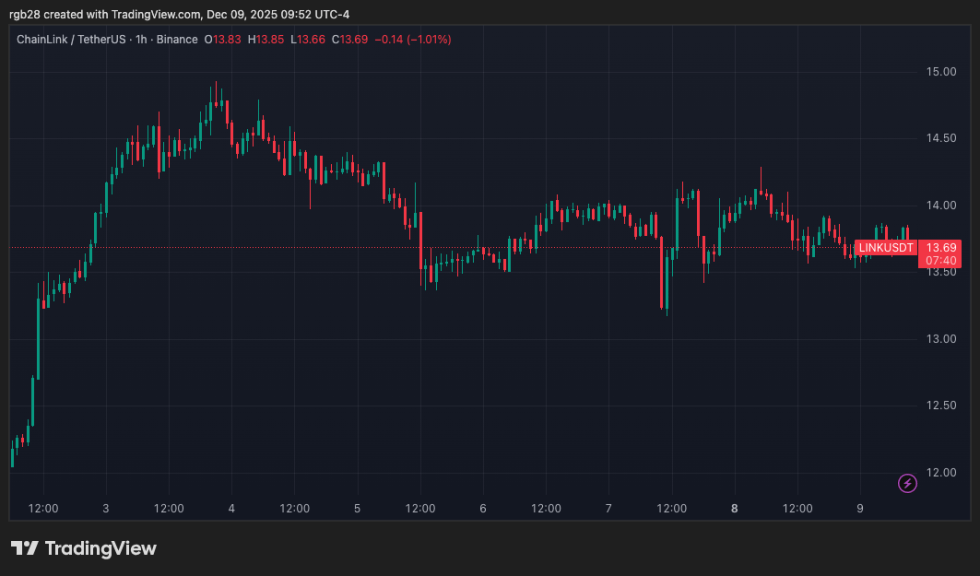
LINK trades at $13.69 in the one-week chart. Source: LINKUSDT on TradingView

Пов'язані матеріали

Five Core Forms of AI Agent in YC's Eyes

The article outlines five core architectural patterns for effective AI Agents, emerging from tools like Codex and Claude, that move beyond simple prompts towards reusable, process-based capabilities. 1. **Skills**: Reusable, parameterized workflows that function like method calls, allowing a single process (e.g., "/investigate") to handle various tasks based on input parameters. 2. **Thin Harness**: A lightweight execution framework (~200 lines) that manages the AI model's "hands and feet"—handling loops, file I/O, and context—without becoming bloated. 3. **Resolvers**: Routing tables that map tasks to specific Skills, preventing "context corruption" when managing dozens of Skills and ensuring outputs go to the correct locations. 4. **Latent vs. Deterministic Layer**: A critical separation where LLMs handle judgment, synthesis, and pattern recognition, while deterministic code handles tasks requiring precision, consistency, and low cost (like calculations). 5. **Memory**: A persistent, accumulating knowledge base (e.g., a markdown folder) with a "current trusted conclusion" section and an append-only timeline, enabling the system to learn and retain context over time. Together, these patterns create a "process power"—a durable competitive advantage. Unlike one-off prompt-based applications whose value quickly commoditizes, a well-designed AI Agent system encodes experience into reusable, parameterized workflows, offloads stable rules to code, and continuously learns through memory. This creates a structured, hard-to-replicate capability that can provide sustained value for individuals or businesses, such as an accountant automating client reviews while preserving privacy and accumulating expertise.

marsbit1 год тому

Five Core Forms of AI Agent in YC's Eyes

marsbit1 год тому

Tiger Research: On-Chain Risk Operators, The Market Cap Gap Between 147 Trillion and 70 Billion

This report by Tiger Research examines the evolution of risk management in decentralized finance (DeFi) lending. It highlights a power shift from protocol developers to specialized professional risk operators who manage on-chain capital. The era of protocols and community governance solely dictating DeFi lending is ending. A new professional asset management layer has emerged. While the sector is nascent, capital and distribution channels are rapidly consolidating around top risk operator teams, whose past performance is now a key criterion for institutional entry. The industry's development, accelerated by modular infrastructures like Morpho, has led to a clear division of labor mirroring traditional finance: distribution channels (e.g., exchanges), strategy/risk management (the risk operators), and product infrastructure/asset custody (smart contract protocols). This structure lowers the entry barrier for traditional institutions. Currently, the total value managed by risk operators is approximately $70 billion, dominated by a few leading teams like Steakhouse (RWA focus), Sentora (AI models), and Gauntlet (crisis management). Competition now centers on collateral standards, distribution access, and crisis response capabilities. The report outlines three primary entry paths for institutions: 1) **Distribution Model**: Leveraging external risk operators as backend service providers (common for exchanges). 2) **Asset Supply Model**: Onboarding real-world assets to DeFi as collateral. 3) **Independent Operator Model**: Building an in-house team to become a risk operator (e.g., Bitwise). The core opportunity lies in the strategy/risk management layer, where traditional financial institutions can leverage their existing expertise in due diligence and risk assessment without deep technical development. A vast opportunity gap exists: the global traditional asset management industry manages ~$147 trillion, while the entire DeFi sector is only ~$800 billion, with the risk operator niche at ~$70 billion. This disparity signifies immense growth potential. Once robust risk frameworks and clearer regulations are established, even a minor allocation from traditional markets could trigger exponential DeFi growth. Early movers who help build these foundational systems will gain significant rule-setting influence and first-mover advantages.

marsbit1 год тому

Tiger Research: On-Chain Risk Operators, The Market Cap Gap Between 147 Trillion and 70 Billion

marsbit1 год тому

Торгівля

Спот
Ф'ючерси

Популярні статті

Як купити LINK

Ласкаво просимо до HTX.com! Ми зробили покупку ChainLink (LINK) простою та зручною. Дотримуйтесь нашої покрокової інструкції, щоб розпочати свою криптовалютну подорож.Крок 1: Створіть обліковий запис на HTXВикористовуйте свою електронну пошту або номер телефону, щоб зареєструвати обліковий запис на HTX безплатно. Пройдіть безпроблемну реєстрацію й отримайте доступ до всіх функцій.ЗареєструватисьКрок 2: Перейдіть до розділу Купити крипту і виберіть спосіб оплатиКредитна/дебетова картка: використовуйте вашу картку Visa або Mastercard, щоб миттєво купити ChainLink (LINK).Баланс: використовуйте кошти з балансу вашого рахунку HTX для безперешкодної торгівлі.Треті особи: ми додали популярні способи оплати, такі як Google Pay та Apple Pay, щоб підвищити зручність.P2P: Торгуйте безпосередньо з іншими користувачами на HTX.Позабіржова торгівля (OTC): ми пропонуємо індивідуальні послуги та конкурентні обмінні курси для трейдерів.Крок 3: Зберігайте свої ChainLink (LINK)Після придбання ChainLink (LINK) збережіть його у своєму обліковому записі на HTX. Крім того, ви можете відправити його в інше місце за допомогою блокчейн-переказу або використовувати його для торгівлі іншими криптовалютами.Крок 4: Торгівля ChainLink (LINK)Легко торгуйте ChainLink (LINK) на спотовому ринку HTX. Просто увійдіть до свого облікового запису, виберіть торгову пару, укладайте угоди та спостерігайте за ними в режимі реального часу. Ми пропонуємо зручний досвід як для початківців, так і для досвідчених трейдерів.

1.1k переглядів усьогоОпубліковано 2024.12.13Оновлено 2025.03.21

Як купити LINK

Обговорення

Ласкаво просимо до спільноти HTX. Тут ви можете бути в курсі останніх подій розвитку платформи та отримати доступ до професійної ринкової інформації. Нижче представлені думки користувачів щодо ціни LINK (LINK).

活动图片