CFTC Partners With SEC On ‘Project Crypto’ For Unified Regulatory Approach

bitcoinistОпубліковано о 2026-01-31Востаннє оновлено о 2026-01-31

Анотація

The U.S. SEC and CFTC are relaunched "Project Crypto" as a joint initiative to create a unified regulatory framework for crypto assets. The effort aims to harmonize oversight, clarify jurisdictional boundaries, eliminate redundant compliance requirements, and enhance interagency coordination. Both agencies emphasized the need for precise, innovation-friendly regulation that supports economic growth while protecting investors. Additionally, the SEC delayed its anticipated innovation exemption for crypto firms, originally expected by early 2026, citing the need for careful implementation and potential disruptions from government shutdowns. The exemption would allow crypto products to launch under principles-based conditions rather than prescriptive rules. Both chairs reaffirmed their commitment to ensuring that the U.S. remains a leader in the evolving digital asset landscape.

The Securities and Exchange Commission (SEC) and Commodity Futures Trading Commission (CFTC) have announced they are relaunching the Project Crypto initiative as a joint policy effort to prepare US markets for the digital era.

SEC-CFTC Joint Efforts For Project Crypto

On Thursday, CFTC Chairman Michael Selig revealed that the regulatory agency is partnering with the SEC on its Project Crypto initiative to bring “coordination, coherence, and a unified approach to the federal oversight of crypto asset markets.”

At a joint event on regulatory harmonization, Selig and SEC Chairman Paul Atkins outlined their plan to advance a clear crypto asset taxonomy, clarify jurisdictional lines, remove duplicative compliance requirements, and reduce regulatory fragmentation through their partnership.

The SEC-CFTC harmonization agenda will focus on the fundamentals, as the chairmen detailed, including aligned definitions, coordinated oversight, and seamless, secure data sharing between agencies. “Harmonization strengthens standards through coherence, predictability, and economic rationality.”

The agencies aim to ensure that “innovation takes root on American soil, under American law, and in service of American investors, customers, and businesses,” Selig affirmed during his opening remarks.

He added that he had directed the CFTC staff to work with the SEC to study “joint codification” of the common-sense crypto asset taxonomy recently laid by Atkins, “as an interim measure while Congress finalizes legislation.”

In a joint statement shared by the CFTC, the pro-industry chairmen explained that Project Crypto was designed to ensure that the US is ready to reinforce its global financial leadership when Congress acts:

At its core, Project Crypto and our broader harmonization efforts reflect a shared philosophy: financial regulation must be precise, not punitive. Rules must be narrowly tailored to address material risks, nimble enough to adapt to technological change and remain anchored in our agencies’ statutory authorities.

Innovation Exemption Timeline Pushed Back

During the panel, Chair Atkins discussed the timeline for the Commission’s long-awaited innovation exemption for the crypto industry, which was initially expected to come before the end of January.

As reported by Bitcoinist, the SEC chair said in December that the regulatory agency could issue innovation exemption rules for crypto firms in early 2026. Notably, the Commission has been studying a rule exemption since July 2025.

The measure would allow crypto firms to quickly launch products by complying with “certain principles-based conditions designed to achieve the core policy aims of the federal securities laws” instead of “burdensome prescriptive regulatory requirements that hinder productive economic activity.”

Atkins affirmed that the agency is still working on the innovation exemption, arguing that they “need to measure twice and cut once.” As he outlined, the agency wants to deliver a rule change that is “fit for purpose that will allow enough people to be able to develop their products, you know, within a predictable ambit of maneuver and then with an end date, an off-ramp, that sort of thing.”

In addition, he noted that last year’s government shutdown delayed progress on crypto regulation, adding that the potential new shutdown could further delay the highly anticipated measure.

Atkins denied that the SEC is waiting on the market structure bill to put out the innovation exemption, arguing that it is within the agency’s authority. However, he emphasized that they are taking the upcoming regulation into account because “there are a lot of moving parts to the situation.”

“I just want to make sure that we keep the train going forward at full speed and for all parties’ sake,” he asserted, but did not offer a new potential timeline for the innovation exemption rollout.

Meanwhile, Chair Selig also shared his plan to explore “ways in which the agency can encourage innovation in software development and support builders as they work toward product market fit.” This includes assessing whether an innovation exemption “may be appropriate in certain circumstances.”
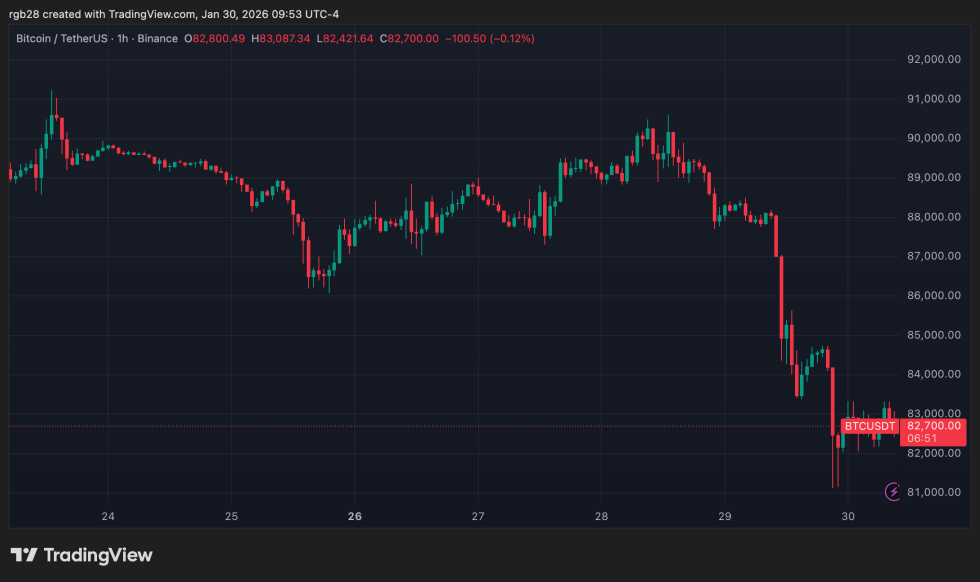
Bitcoin (BTC) trades at $82,700 in the one-week chart. Source: BTCUSDT on TradingView


Пов'язані питання

QWhat is the main purpose of the relaunched 'Project Crypto' initiative announced by the SEC and CFTC?

AThe main purpose is to bring coordination, coherence, and a unified approach to the federal oversight of crypto asset markets, preparing US markets for the digital era.

QWhat are the key focus areas of the SEC-CFTC harmonization agenda as detailed by the chairmen?

AThe key focus areas include advancing a clear crypto asset taxonomy, clarifying jurisdictional lines, removing duplicative compliance requirements, reducing regulatory fragmentation, and ensuring aligned definitions, coordinated oversight, and secure data sharing.

QWhat did CFTC Chairman Michael Selig direct his staff to study in collaboration with the SEC?

AHe directed CFTC staff to work with the SEC to study 'joint codification' of the common-sense crypto asset taxonomy recently laid out by SEC Chairman Atkins, as an interim measure while Congress finalizes legislation.

QWhat is the initial expected timeline for the SEC's innovation exemption for crypto firms, and what was the reason for the delay mentioned?

AThe innovation exemption was initially expected by the end of January but is now anticipated in early 2026. The delay was attributed to the need for careful development ('measure twice and cut once') and was further impacted by last year's government shutdown.

QAccording to the chairmen's joint statement, what is the core philosophy behind Project Crypto and their broader harmonization efforts?

AThe core philosophy is that financial regulation must be precise, not punitive, with rules narrowly tailored to address material risks, nimble enough to adapt to technological change, and anchored in the agencies' statutory authorities.

Пов'язані матеріали

OpenAI Goes Left, DeepSeek Goes Right

On April 24, 2026, DeepSeek released V4, a Chinese large language model offering a free "million-token context window," enabling it to process vast amounts of data like entire books or years of corporate documents in one go. In contrast, OpenAI’s GPT-5.5, released around the same time, is more powerful but significantly more expensive, charging up to $180 per million output tokens. DeepSeek’s strategy represents a shift from a pure AI research firm to a heavy-infrastructure player, building data centers in Inner Mongolia’s Ulanqab to bypass U.S. chip export restrictions. This move, supported by Huawei’s Ascend chips and China’s cheap green electricity, highlights a fundamental divergence in AI development models: U.S. firms focus on high-cost, high-margin services, while Chinese players like DeepSeek prioritize accessibility and affordability. Facing intense talent poaching from tech giants, DeepSeek is seeking a $44 billion valuation funding round to retain researchers and scale infrastructure. Meanwhile, Chinese manufacturers are compressing AI models to run on smartphones, making AI accessible offline and across the Global South. Through open-source models and localized solutions, Chinese AI is empowering non-English speakers and low-income users, driving a form of "digital equality." While Silicon Valley builds walled gardens, DeepSeek and others are turning AI into a public utility—like tap water—flowing freely to those previously left behind.

marsbit19 хв тому

OpenAI Goes Left, DeepSeek Goes Right

marsbit19 хв тому

$292 Million KelpDAO Cross-Chain Bridge Hack: Who Should Foot the Bill?

On April 18, 2026, an attacker stole 116,500 rsETH (worth ~$292M) from KelpDAO’s cross-chain bridge in 46 minutes—the largest DeFi exploit of 2026. The stolen assets were deposited into Aave V3 as collateral, causing $177–200M in bad debt and triggering a cascade of losses across nine DeFi protocols. Aave’s TVL dropped by ~$6B overnight. This legal analysis argues that KelpDAO and LayerZero Labs share concurrent liability, with fault apportioned 60%/40%. KelpDAO negligently configured its bridge with a 1-of-1 decentralized verifier network (DVN)—a single point of failure—despite LayerZero’s explicit recommendation of a 2-of-3 setup. LayerZero, which operated the compromised DVN, failed to secure its RPC infrastructure against a known poisoning attack vector. Both protocols’ terms of service cap liability at $200 (KelpDAO) or $50 (LayerZero), but these limits are likely unenforceable due to unconscionability, gross negligence exceptions, and potential securities law invalidation (if rsETH is deemed a security under the Howey test). Aave’s governance also faces fiduciary duty claims for raising rsETH’s loan-to-value ratio to 93%—far above competitors’ 72–75%—without adequately assessing bridge risks, amplifying the systemic fallout. Practical recovery targets include LayerZero Labs (a registered Canadian entity), KelpDAO’s founders, auditors, and identifiable Aave governance delegates. The incident underscores escalating legal risks for DeFi protocols, infrastructure providers, and governance participants.

marsbit1 год тому

$292 Million KelpDAO Cross-Chain Bridge Hack: Who Should Foot the Bill?

marsbit1 год тому

Insider Trading in War: 5 People Involved, the Highest Earner Was Arrested

On April 24, the U.S. Department of Justice arrested U.S. Army Special Forces Staff Sergeant Gannon Ken Van Dyke for insider trading related to the capture of Venezuelan President Nicolás Maduro on January 3. Van Dyke allegedly profited over $400,000 by placing bets on a prediction market, Polymarket, using insider knowledge of the covert operation. According to the indictment, Van Dyke registered an account (0x31a5) on December 26 and made a series of bets predicting Maduro’s capture and U.S. military involvement in Venezuela. He withdrew most of his funds on the day of the operation and attempted to obscure his tracks by transferring assets through crypto and brokerage accounts. This case marks the first time the DOJ has prosecuted insider trading on Polymarket. PolyBeats had previously identified five suspicious accounts, including Van Dyke’s—the highest earner—in January. The other accounts, with profits ranging from $34,000 to $145,000, remain under unofficial scrutiny but have not been charged. Their lower profits, indirect access to information, and unclear legal boundaries may complicate prosecution. Polymarket has since strengthened its market integrity rules, explicitly prohibiting trading based on confidential or insider information. Van Dyke’s arrest, nearly four months after his trades, signals increased regulatory attention and the persistent traceability of blockchain-based transactions.

marsbit1 год тому

Insider Trading in War: 5 People Involved, the Highest Earner Was Arrested

marsbit1 год тому

Торгівля

Спот
Ф'ючерси
活动图片