Sam Bankman-Fried Backs Off New Trial Request, Keeps Pressure On Judge Removal

bitcoinistОпубліковано о 2026-04-24Востаннє оновлено о 2026-04-24

Анотація

Sam Bankman-Fried has withdrawn his request for a new trial, stating he does not expect a fair hearing from Judge Lewis Kaplan, who oversees his criminal case. He withdrew the motion without prejudice, meaning he can refile it after his appeal and a separate request to remove Kaplan from the case are resolved. Bankman-Fried is serving a 25-year sentence for fraud related to the collapse of FTX. The withdrawal followed a court-ordered inquiry into whether he had legal help drafting an earlier filing, which he denied. His efforts to replace the judge and appeal his conviction continue. Outside court, he has sought a pardon, but former President Trump has indicated he will not grant one.

Sam Bankman-Fried has told a federal court he does not expect a fair hearing from the judge overseeing his criminal case — and because of that, he is pulling his request for a new trial.

A Calculated Move In Federal Court

The former FTX chief executive filed a letter Wednesday in the US District Court for the Southern District of New York, withdrawing a Rule 33 motion he had been pursuing to overturn his conviction.

The withdrawal, he made clear, is not final. He dropped the motion without prejudice, meaning he can bring it back after his appeal and his separate request to have a different judge assigned to the case are resolved.

Bankman-Fried, 32, is currently held at the Federal Correctional Institution in Lompoc, California, where he is serving a 25-year sentence handed down after his 2023 conviction on fraud and related charges tied to the collapse of FTX.

At its peak, the crypto exchange was one of the largest in the world.
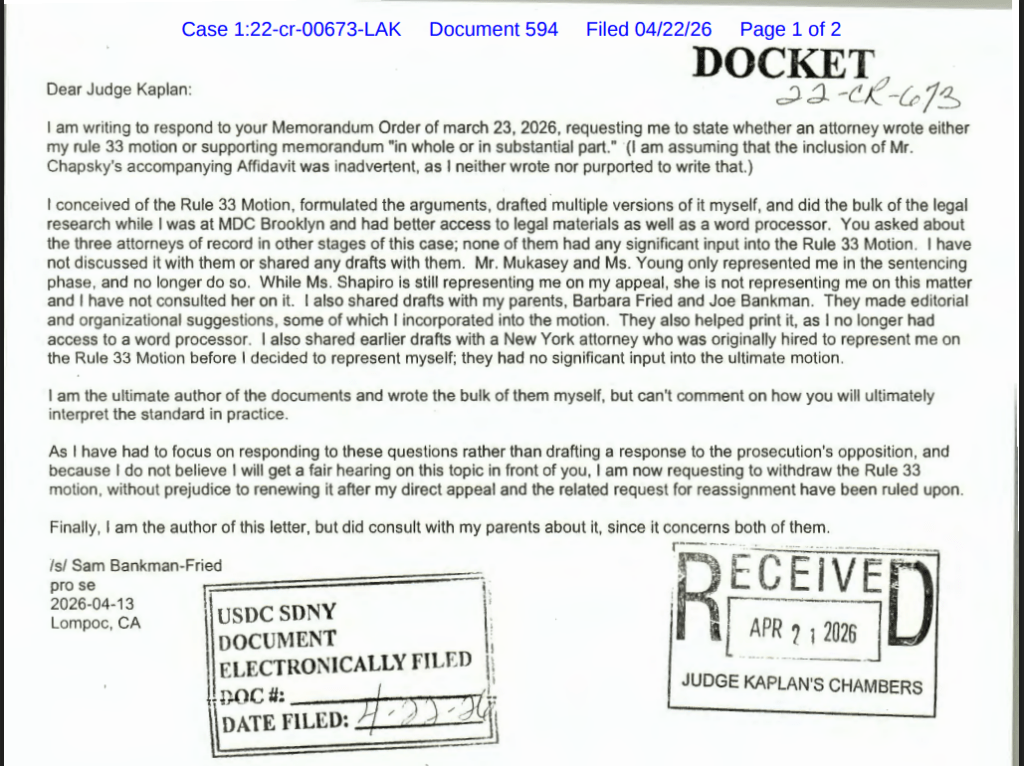
Sam Bankman-Fried's letter to Judge Kaplan released publicly Wednesday. Source: CourtListener.

His decision to pull the motion came after Judge Lewis Kaplan ordered him to explain whether lawyers had helped him draft an earlier filing — a pro se document, meaning one submitted without formal legal representation.

Federal prosecutors had raised doubts about whether Bankman-Fried had written the filing on his own, particularly after his mother, Barbara Fried, sent her own letter to the court. She had no legal standing to do so.

Questions About Who Wrote What

In his Wednesday response, Sam Bankman-Fried said he consulted with his parents while writing the letter but described himself as the “ultimate author of the documents.”

He said the need to respond to the court’s questions had taken time away from preparing a fuller response to prosecutors opposing his new trial request. That, combined with his stated belief that Judge Kaplan would not treat the matter fairly, led him to withdraw the motion.

BTCUSD currently trading at $77,600. Chart: TradingView

His bid to have Kaplan removed from the case predates Wednesday’s filing. Back in February, Bankman-Fried asked a court to assign a different judge to rule on his new trial request, accusing Kaplan of showing “extreme prejudice.”

That request remains active. So does his appeal of both his conviction and his sentence, which is pending before the US Court of Appeals for the Second Circuit.

Sam Bankman-Fried: Pardon Talk Has Done Little To Help His Cause

Outside the courtroom, Bankman-Fried has made no secret of his interest in a presidential pardon. According to reports, he has posted publicly praising US President Donald Trump’s crypto-related policies and his administration’s military moves in Iran.

But Trump has shown no sign of extending any relief. Based on reports from a January interview with The New York Times, Trump said flatly that he had no plans to pardon the convicted founder of FTX.

Featured image from Getty Images, chart from TradingView

Пов'язані питання

QWhy did Sam Bankman-Fried withdraw his request for a new trial?

AHe withdrew the request because he stated he does not expect a fair hearing from Judge Kaplan and the need to respond to the court's questions about who drafted an earlier filing took time away from preparing a fuller response.

QWhat is the status of Sam Bankman-Fried's request to have Judge Kaplan removed from his case?

AHis request to have a different judge assigned to the case remains active and is separate from his withdrawn motion for a new trial.

QWhat specific legal motion did Sam Bankman-Fried file and then withdraw?

AHe withdrew a Rule 33 motion, which is a request for a new trial based on newly discovered evidence.

QWhat was the reason federal prosecutors raised doubts about an earlier court filing from Sam Bankman-Fried?

AProsecutors raised doubts about whether he had written the pro se filing on his own, particularly after his mother, who has no legal standing, sent her own letter to the court.

QHas former President Donald Trump indicated he would pardon Sam Bankman-Fried?

ANo, based on a January interview with The New York Times, Trump said flatly that he had no plans to pardon the convicted founder of FTX.

Пов'язані матеріали

Solana Price Forecast for August 2026: Can $19 Million from Morgan Stanley and 330,000 Korean Merchants Break SOL's Triangle?

**Solana Price Forecast for August 2026: Key Catalysts and Technical Setup** As of July 31, Solana (SOL) trades at $73.59, consolidating within a triangle pattern formed between its May peak (~$98) and June low (~$60.29). A decisive breakout from this pattern is anticipated. Key resistance levels are clustered around $74.79 (0.382 Fib), $75.33 (20-day EMA), $76.01 (50-day EMA), and a critical zone near $79 (0.5 Fib & 100-day EMA). Support lies at $73.42, $69.25 (0.236 Fib), and the June low of $60.29. Two major institutional catalysts emerged recently: 1. **Morgan Stanley's MSOL ETF:** Launched July 28, it saw $19.06 million in inflows on its second day—the largest single-day inflow for any US SOL ETF since mid-May. 2. **KSNET Partnership:** The Solana Foundation signed an MoU with South Korean payment processor KSNET (serving 330,000 merchants) to explore integrating Solana Pay for domestic and AI-powered transactions. Historically, August has been volatile for SOL, marked by extreme gains in 2020 and 2021 but otherwise weak performance. The forecast for August 2026 is bifurcated: * **Bullish Case:** An upside triangle breakout, sustained MSOL inflows, and positive momentum from the KSNET news could propel SOL toward the $79 resistance cluster, especially if the CLARITY Act is passed by August 8. * **Bearish Case:** A downside break below $73.42, fading excitement around the new ETF, and stalled regulatory progress could see SOL retest support near $69.25, exacerbated by macro risks.

cryptonews.ru11 хв тому

Solana Price Forecast for August 2026: Can $19 Million from Morgan Stanley and 330,000 Korean Merchants Break SOL's Triangle?

cryptonews.ru11 хв тому

AFX Trade Promises to Present "Goodwill Plan" on August 3 Following $24 Million Loss Incident

AFX Trade, a cryptocurrency platform, announced it will present a "goodwill plan" on August 3rd, following a security incident on July 22nd that resulted in a loss of $24.15 million. The company's brief update offered no specific details on compensation for affected users, investors, and employees, only urging calm while the team formulates next steps. The theft occurred from a USDC custody account on Arbitrum, with the stolen funds converted to Ethereum. Blockchain analysts traced the funds to a single wallet. AFX Trade and Arbitrum clarified the exploit targeted a third-party bridge, not Arbitrum's native bridge. An investigation revealed the attack began on July 9th with a social engineering scheme targeting a developer. The attacker then deployed malicious code within AFX's internal JFrog repository and infrastructure, eventually compromising bridge validators to authorize the fraudulent withdrawal. The company stated the exploit leveraged a "trust vulnerability," not a smart contract bug. AFX Trade's head of business development made an offer to the attacker, proposing they keep 30% of the funds as a white hat bounty if 70% is returned. The incident fits a 2026 trend identified by TRM Labs: while the number of crypto hacks hit a record, total losses decreased. However, infrastructure and operational breaches, though fewer, accounted for the majority of financial losses. The AFX breach is classified as an infrastructure incident involving private key compromise.

cryptonews.ru21 хв тому

AFX Trade Promises to Present "Goodwill Plan" on August 3 Following $24 Million Loss Incident

cryptonews.ru21 хв тому

Торгівля

Спот
活动图片