CertiK Founder Ronghui Gu Appears at Davos: Anchoring IPO Goals, Advancing into the Institutional Market

marsbitОпубліковано о 2026-01-23Востаннє оновлено о 2026-01-23

Анотація

CertiK founder Ronghui Gu announced at the 2026 World Economic Forum in Davos that the company is advancing its IPO plans, aiming to become the "first Web3 infrastructure stock." This signals both CertiK's corporate maturity and the Web3 industry's shift toward institutional adoption and standardization. Gu emphasized that a successful public listing would help mainstream markets better understand and adopt Web3 technology, reflecting recognition from traditional industries. CertiK has received significant strategic investment, including from YZi Labs (formerly Binance Labs), supporting its expansion into institutional markets. To meet growing institutional demand, CertiK launched Skynet Enterprise, a security platform offering real-time on-chain monitoring, risk visualization, and compliance-ready tools. The company is also integrating AI into its formal verification engine, Spoq, to enhance security scalability and efficiency—a approach validated at top academic conferences. Gu concluded that CertiK’s public market entry is a critical step for Web3's integration into the global financial system, marking the industry’s transition toward regulated, institution-friendly maturity.

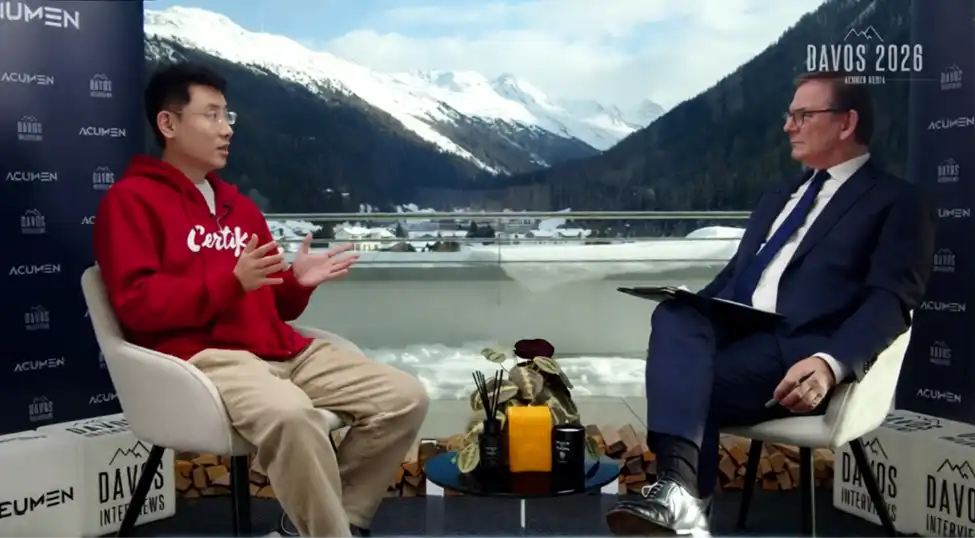
During the 2026 World Economic Forum (WEF) Annual Meeting, CertiK Founder Ronghui Gu was interviewed by CBS in Davos. He revealed that as the world's largest Web3 security company, CertiK is actively advancing its IPO plans, striving to become the "first stock in Web3 infrastructure." This signal not only marks CertiK's own development entering a mature stage but is also seen by the industry as a significant indicator of the Web3 sector moving towards institutionalization and standardization.

"The market is still anticipating the listing of native Web3 enterprises, especially infrastructure companies like CertiK," Gu stated in the interview. "This will help the mainstream market better understand and adopt Web3 technology, and it also represents recognition from traditional enterprises and mainstream industries."

It is reported that CertiK's IPO plan has received support from strategic capital. Among them, YZi Labs (formerly Binance Labs) recently completed a milestone investment, establishing its position as CertiK's largest investor to date. The continuous injection of capital from such top-tier investors not only provides CertiK with ample momentum for expansion but also paves the way for its comprehensive penetration into the institutional market.

Web3 Infrastructure for Institutions

As more traditional financial institutions and large enterprises explore Web3, security, transparency, and risk visibility have become prerequisites for entering this field. Gu pointed out that Web3 is entering a new phase that requires "institutional-grade standards."

In this context, CertiK has focused on institutional needs and launched the enterprise-grade security platform Skynet Enterprise. This platform is designed to meet the demands of institutions and regulators for transparency, risk visibility, and data quality. Through real-time on-chain monitoring, alert systems, and analytical dashboards, it transforms complex on-chain activities into intuitive insights, helping to build a more resilient digital asset ecosystem. Currently, CertiK is working closely with multiple regulatory bodies to promote the platform's implementation, paving the way for Web3 industry compliance.

AI-Enhanced Formal Verification Security Framework

In the interview, Gu also emphasized the application of AI in Web3 security. Unlike basic automation tools, CertiK deeply integrates AI into its self-developed Spoq engine, significantly enhancing the scalability and execution efficiency of its core formal verification system through empowerment. This cutting-edge research has been validated at top academic conferences such as OSDI 2023 and ASPLOS 2026.

Relying on this system, CertiK can provide mathematical-grade security guarantees for institutional clients. This practice of translating academic rigor into production-ready tools highlights CertiK's core philosophy: security should be a matter of genuine technical depth, not just superficial "trust labels."

The Inevitable Path for Web3's Integration into the Global Financial System

Gu noted in the interview: "Many people hope to see CertiK's successful IPO because it is not only crucial for CertiK but also for the entire Web3 industry." In his view, moving towards the public market is not only a natural progression for corporate development but also an essential path for Web3 to integrate into the global financial system and win the trust of users worldwide.

In the global context of Davos, the signal sent by CertiK is increasingly clear: Web3 is moving away from fringe innovation and transitioning into a mature stage that can be regulated, adopted by institutions, and supervised by public markets.


Пов'язані питання

QWhat is the main goal of CertiK as announced by its founder at the World Economic Forum?

ACertiK is actively advancing its listing plan, aiming to become the 'first Web3 infrastructure stock' and targeting the institutional market.

QWhich investment firm is now the largest investor in CertiK?

AYZi Labs (formerly Binance Labs) is the largest investor in CertiK following a milestone investment.

QWhat enterprise-level security platform did CertiK launch to meet institutional needs?

ACertiK launched Skynet Enterprise, an enterprise-level security platform designed for institutional transparency, risk visibility, and data quality needs.

QHow does CertiK integrate AI into its Web3 security solutions?

ACertiK integrates AI into its self-developed Spoq engine to enhance the scalability and efficiency of its formal verification system, providing mathematical-level security for institutional clients.

QWhy is CertiK's potential IPO significant for the broader Web3 industry?

ACertiK's IPO is seen as a critical step for Web3 to integrate into the global financial system, gain trust, and be adopted by mainstream institutions and traditional enterprises.

Пов'язані матеріали

Uncovering the Truth About Agent Commerce, Payments, and Infrastructure

Decoding Agent Commerce, Payments, and Infrastructure: The Reality Over the past year, I've been building infrastructure for the Agent economy, engaging with major players like Stripe, Visa, Coinbase, Google, and dozens of startups. A clear conclusion emerges: true, large-scale demand does not yet exist. Startups face structural challenges. Data points illustrate this gap. Stripe's Agent commerce platform has over 1,000 merchants but only single-digit transacting agents. Visa's Agent payment token requires 9-month KYC and a $250M revenue threshold, accessible only to giants like Amazon. On-chain analysis reveals actual daily Agent transaction volume is around $17k, half of which are test transactions. The article analyzes four potential markets: **1. Agent-to-Merchant (A2M):** Current AI shopping UX is often inferior to traditional e-commerce for visual, comparison-heavy purchases (clothing, electronics). Chat interfaces are a step back. Real merchant interest is defensive "Agent Engine Optimization," fearing future obsolescence, not current demand. Potential exists in high-frequency, low-decision purchases (e.g., food delivery) or simplifying terrible UX (complex checkouts, non-native shoppers), but these require massive consumer distribution channels dominated by giants like DoorDash and Amazon. **2. Agent-to-API (A2A):** Developers already have subscriptions and billing for core APIs (compute, data). The argument for micro-payments via crypto for sub-dollar API calls is addressed by pre-paid balances today. The deeper issue is supplier resistance; major SaaS firms rely on enterprise contracts, not fractional cent pricing. Opportunity lies in the long tail of niche services, but this is a smaller market catering to developers, a historically low-paying group. **3. Agent-to-Agent (A2A):** This remains a theoretical long-term vision with near-zero current transaction volume. It involves unique challenges: discovery, trust, negotiation, dispute resolution. When it materializes, it will require a fundamentally new settlement infrastructure for high-speed, variable-value, multi-party transactions. It's a real long-term bet, but not the current market. **4. Agent-to-Finance (A2F):** This is the only category with existing, paying demand. Integrating AI into financial workflows (trading, portfolio management) is a natural evolution and enables new capabilities like autonomous rebalancing. However, competition favors incumbents with regulatory licenses, compliance infrastructure, and existing client relationships. **The Real Issue:** Why is infrastructure still being built? Incumbents can afford long-term bets, and payment companies see every problem as a nail for their payment hammer. However, payment is just one piece. The core challenge is *coordination*—orchestrating work between Agents and humans, verifying outcomes, and settling results. Payment is part of settlement, which is part of coordination. Companies that solve the coordination problem will subsume payments, not the other way around. Startups lack the infinite runway of giants and must find today's real market, which, after a year of exploration, lies outside these four categories—in an area with real, growing, and underserved activity.

marsbit2 год тому

Uncovering the Truth About Agent Commerce, Payments, and Infrastructure

marsbit2 год тому

Торгівля

Спот
Ф'ючерси
活动图片