Celestia breaks down: Sell pressure builds ahead of TIA’s $85K token unlock

ambcryptoОпубліковано о 2026-03-29Востаннє оновлено о 2026-03-29

Анотація

Celestia (TIA) is facing increasing bearish pressure due to deteriorating market structure and sentiment. An upcoming token unlock on March 29th, valued at approximately $85,000, is adding to the selling pressure. Although the unlock is relatively small, it is negatively impacting short-term market sentiment. Spot market activity shows a clear shift, with investors selling over $500,000 worth of TIA after a period of accumulation. Derivatives data further confirms the bearish trend, with a negative funding rate indicating concentrated short positions and significant liquidations for long traders. Technically, TIA has broken below a key consolidation range and critical support level, signaling a potential further decline toward the $0.233 region. Both fundamental and technical factors suggest continued downside risk unless buyers can reclaim key levels.

Celestia [TIA] is increasingly exposed to bearish pressure as both market structure and sentiment deteriorate.

Although the asset has recorded only a modest 1.3% decline over the past 24 hours, underlying conditions point to a broader shift that could accelerate losses. Rising circulating supply and weakening demand continue to tilt the balance in favor of sellers.

Token unlock adds to supply overhang

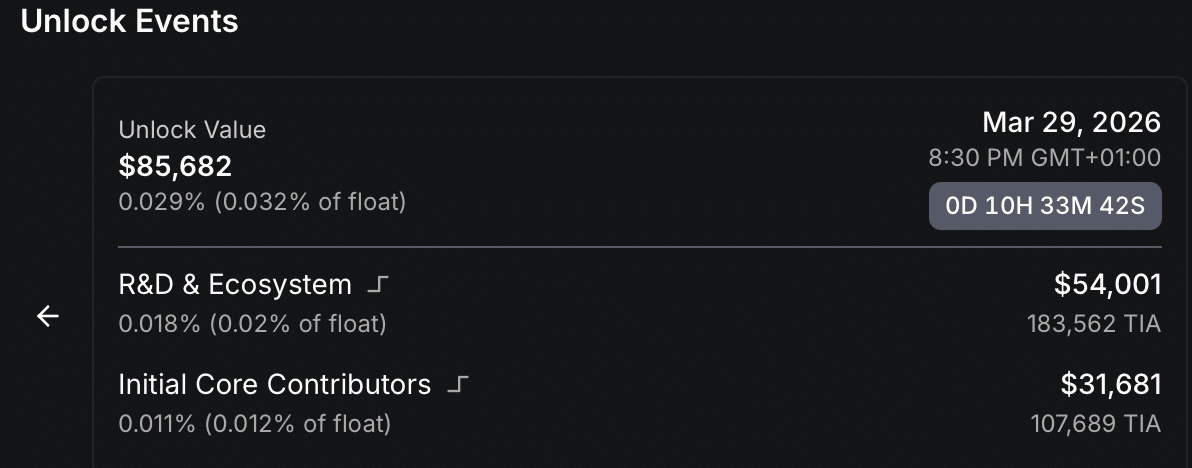
An upcoming token unlock is set to hit the market, with new TIA supply expected to enter circulation on the 29th of March.

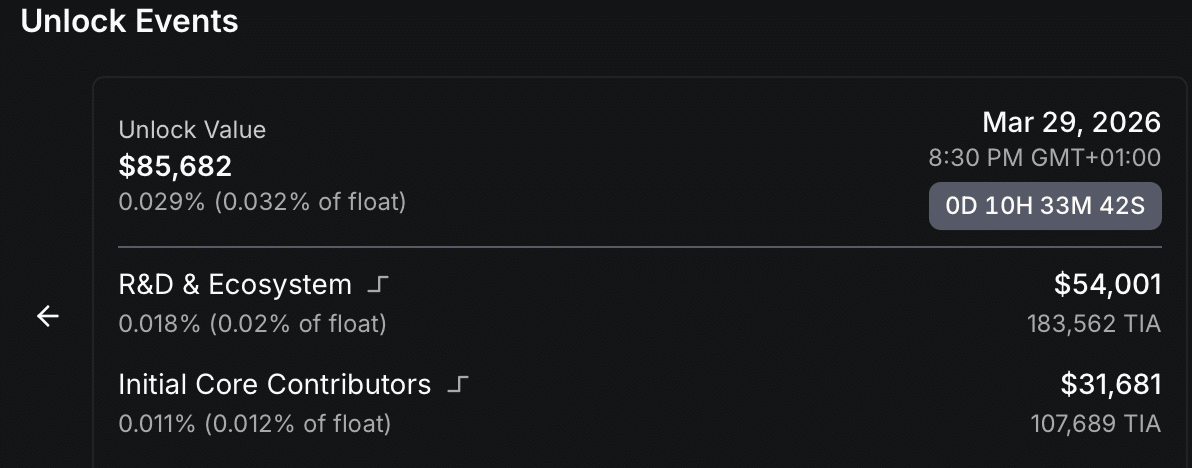
According to DeFiLlama, the unlock represents just 0.032% of the current circulating supply, valued at roughly $85,000 at the time of writing. While relatively small, such events often influence short-term sentiment disproportionately.
Source: CoinGlass

The allocation is expected to go toward research and development and core contributors within the ecosystem, indicating a utility-driven distribution.

However, market reactions to unlocks tend to reflect sentiment rather than fundamentals. With broader conditions already leaning bearish, the additional supply could reinforce downside pressure.

Spot market flips bearish

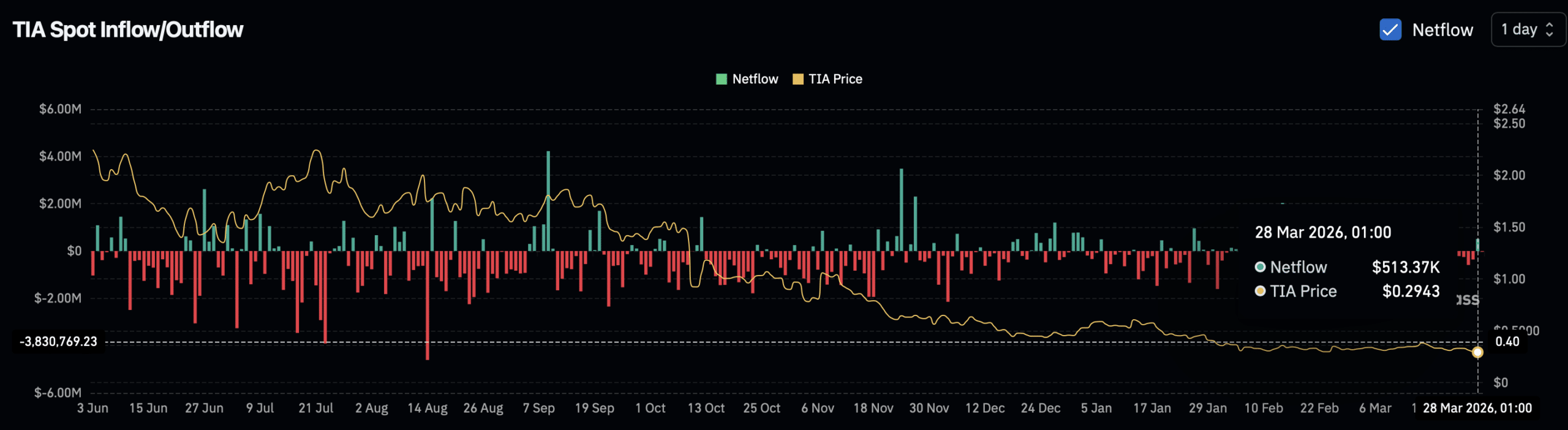
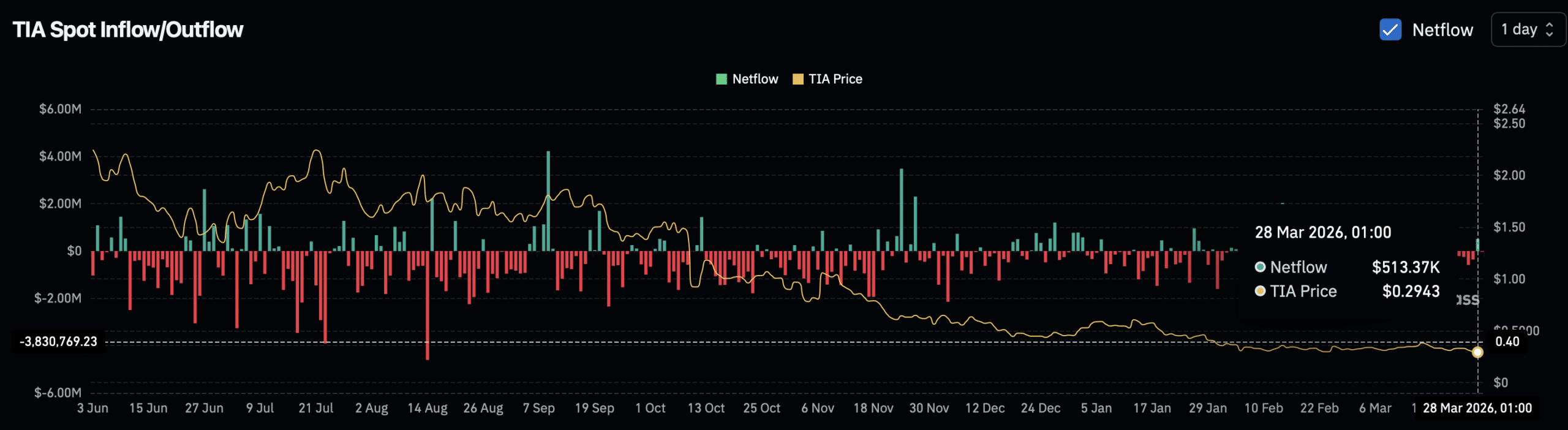
Selling activity in the Spot market has intensified. On the 28th of March, Spot investors offloaded approximately $513,000 worth of TIA, marking a clear shift in positioning.

This move follows four consecutive days of gradual accumulation, making the reversal more significant. A transition from steady buying to aggressive selling typically reflects declining conviction and a more cautious market outlook.

The bearish tilt extends beyond the spot market. Derivatives data shows a similar pattern, reinforcing the broader weakness in TIA’s positioning.
Source: CoinGlass

The Open Interest-Weighted Funding Rate has turned negative, indicating that traders have concentrated leveraged positions on the short side.

At -0.0057%, the metric reflects a growing bias toward downside bets. This positioning has already translated into losses for long traders, who have recorded nearly $99,990 in liquidations over the period, compared to about $16,690 for short traders.

Breakdown shifts focus to lower levels

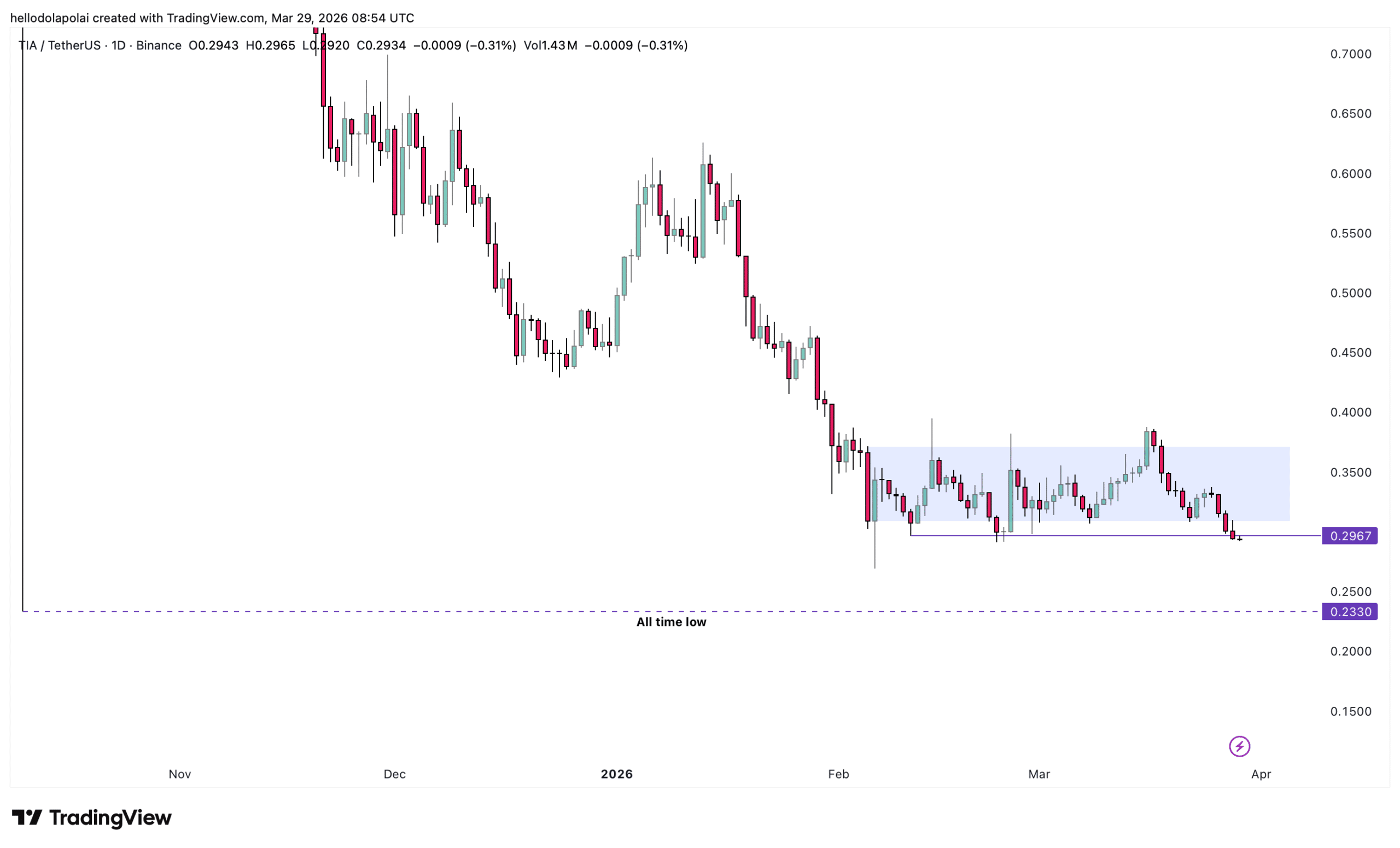
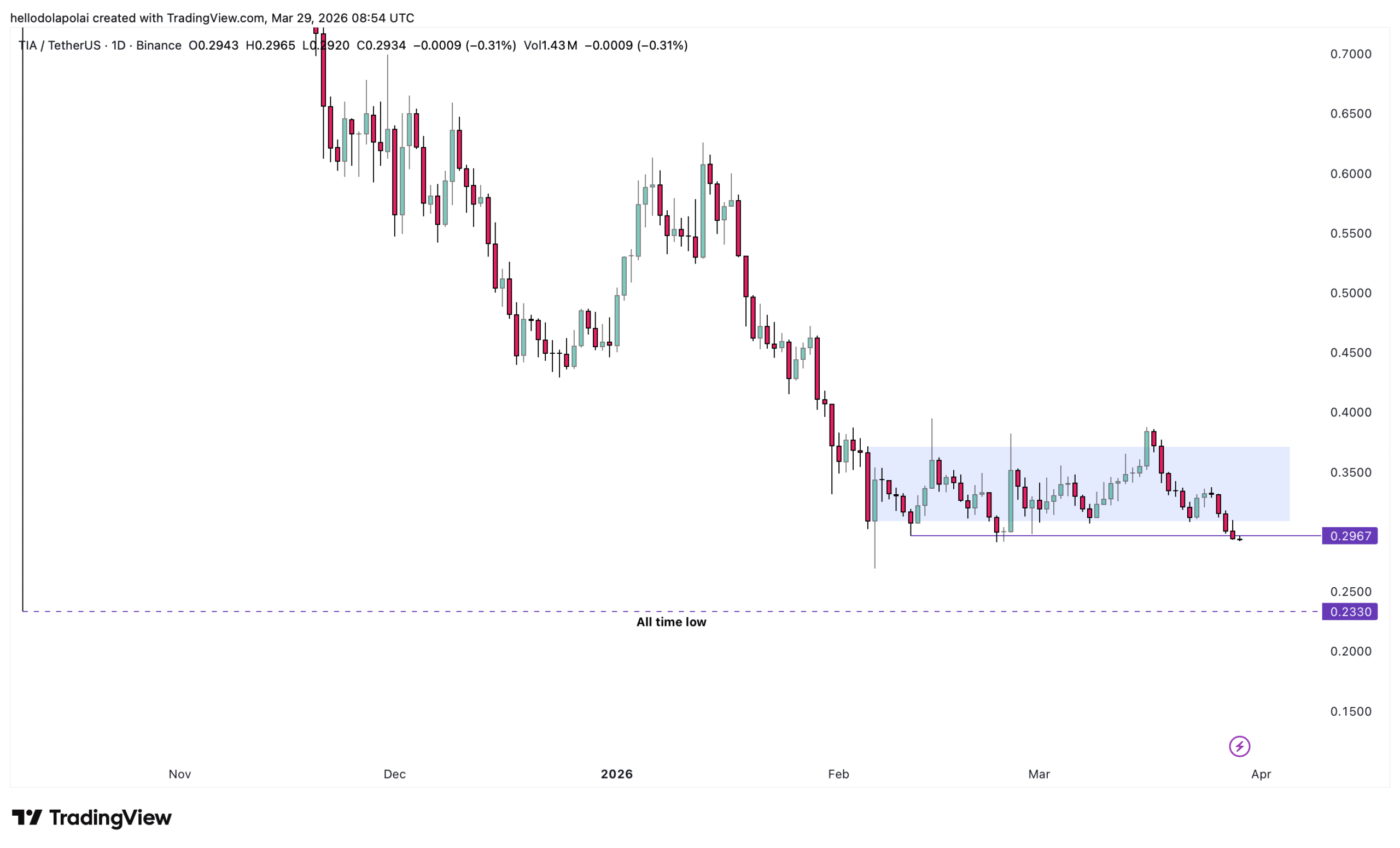
From a technical standpoint, TIA has broken below a prolonged consolidation range that had held since the 5th of February, ending months of sideways movement. The breakdown signals a loss of structural support and reinforces bearish momentum.

The asset now trades below the $0.2967 support level. A sustained close beneath this threshold would confirm a continuation of the downtrend and increase the likelihood of a move toward the $0.233 region.
Source: TradingView

With both fundamentals and technical indicators aligning to the downside, TIA remains vulnerable to further declines unless buyers reclaim key levels and restore momentum.


Final Summary

  • Anticipated token unlocks have begun to weigh on Celestia’s sentiment, with Spot traders reversing course after days of steady accumulation.
  • Key support levels will determine whether TIA stabilizes or extends its downside move.

Трендові криптовалюти

Пов'язані питання

QWhat is the main reason for the increasing bearish pressure on Celestia (TIA)?

AThe main reason is a combination of an upcoming token unlock adding to selling pressure, deteriorating market structure, weakening demand, and a shift in spot market activity from accumulation to selling.

QWhen is the upcoming TIA token unlock scheduled, and what is its value?

AThe token unlock is scheduled for the 29th of March, and it is valued at roughly $85,000, representing 0.032% of the current circulating supply.

QHow did the spot market activity change for TIA on March 28th?

AOn March 28th, spot investors offloaded approximately $513,000 worth of TIA, marking a clear shift from four consecutive days of gradual accumulation to aggressive selling.

QWhat does the negative Open Interest-Weighted Funding Rate indicate for TIA?

AA negative Open Interest-Weighted Funding Rate of -0.0057% indicates that traders have concentrated their leveraged positions on the short side, reflecting a growing bias toward betting on the price going down.

QWhat key technical level did TIA break below, and what is the next potential target if the downtrend continues?

ATIA broke below the $0.2967 support level. A sustained close below this level could lead to a move toward the $0.233 region.

Пов'язані матеріали

He Just Raised 2.7 Billion, and Li Fei-Fei Also Invested

Pete Florence, a former senior research scientist at Google DeepMind and a key contributor to the Vision-Language-Action (VLA) model architecture, is deliberately distancing his startup, Generalist AI, from the trendy "world model" label. He argues that the industry should prioritize concrete goals over buzzwords. His goal is to create robots that can perform a vast range of unseen tasks with high speed and success rates, without needing task-specific training data. Recently, his company raised $400 million (¥2.7 billion) at a $2 billion valuation. Notable investors include NVIDIA's NVentures, Bezos Expeditions, NFDG, as well as Xiaomi co-founder Lin Bin, Zoom founder Eric Yuan, and renowned AI scientist Fei-Fei Li. Florence's approach stems from his academic background at MIT under Professor Russ Tedrake, focusing on understanding the physical world. After joining DeepMind, he developed models like Transporter Network and co-created the VLA framework. He left in 2025 to found Generalist AI. The company has launched two models: GEN-0, which demonstrated that scaling laws apply to physical motion, and GEN-1. GEN-1 was trained on over 500,000 hours of physical interaction data collected via a specialized wearable device. It achieves a 99% success rate on precise mechanical tasks like folding boxes and maintains performance three times faster than its predecessor. Florence believes GEN-1 is reaching a commercial utility threshold similar to the GPT-3 inflection point. The substantial funding round, following GEN-1's release, signifies strong investor confidence in Generalist AI's practical, goal-driven path to creating versatile, useful robots, regardless of the "world model" terminology.

marsbit3 хв тому

He Just Raised 2.7 Billion, and Li Fei-Fei Also Invested

marsbit3 хв тому

Two Legends Lost in Three Days: Is Google's AI Talent Dam Cracking?

In three days, Google lost two AI legends. On June 18, Noam Shazeer, co-author of the seminal "Attention is All You Need" paper and Gemini co-lead, left for OpenAI. Just 48 hours later, John Jumper, 2024 Nobel laureate and AlphaFold lead, departed DeepMind for Anthropic. This follows Andrej Karpathy joining Anthropic in May. These moves highlight a structural trend: top AI talent is concentrating at mission-driven, pre-IPO firms like OpenAI and Anthropic, while Google becomes a primary source. The exodus stems from a core mission mismatch. Google's ad-centric model often subordinates AI research to product and revenue goals, creating friction for pioneers like Shazeer, who returned in 2024 only to leave again. In contrast, OpenAI and Anthropic offer singular focus on pushing AI boundaries, whether towards AGI or safety-aligned models, which deeply appeals to top researchers like Jumper. Financial incentives amplify the pull. With both OpenAI and Anthropic nearing IPO, employees stand to gain immensely from equity, an upside Google's mature stock cannot match. Furthermore, the 2023 merger of Google Brain and DeepMind, intended to consolidate strength, has instead created cultural tension and slowed the path from research to product, as evidenced by Gemini's pace. This talent redistribution is reshaping the AI landscape. While Google retains vast data and compute resources, its true crisis is the quiet, continuous loss of the people who define the field's future. The real moat in AI is not infrastructure, but the concentration of brilliant minds—a battle Google is currently losing.

marsbit2 год тому

Two Legends Lost in Three Days: Is Google's AI Talent Dam Cracking?

marsbit2 год тому

Behind the AI Report Card, Lies a Chinese 'Exam Setter'

Beyond the familiar performance charts like MMLU-Pro and MMMU, which major AI models strive to ace, stands a key "examiner": Chinese-Canadian researcher Wenhu Chen. An assistant professor at the University of Waterloo and founder of TIGERLab, Chen addresses the crucial need for more rigorous AI evaluation. As models like GPT-4 began scoring near-perfect results on older benchmarks like MMLU, it became difficult to distinguish their true capabilities. In response, Chen introduced MMLU-Pro in 2024, featuring harder, more reasoning-focused questions with more answer choices, successfully reintroducing meaningful performance gaps. His work extends to multi-modal evaluation with MMMU and its enhanced version, MMMU-Pro. These benchmarks test a model's ability to understand and reason with complex information from images, charts, and text across diverse academic subjects, exposing the significant challenges even top models face in genuine comprehension. Chen's background in complex QA, table reasoning, and his experience at Google DeepMind on projects like Gemini inform his approach. He understands that effective benchmarks must anticipate how models might "cheat" by memorizing data or avoiding visual analysis. His lab also actively researches video understanding and generation models (e.g., UniVideo, Vamba), ensuring his evaluation work is grounded in practical model-building challenges. Now at Meta's Super Intelligence Lab, Chen continues his focus on multi-modal data and evaluation, representing the deep yet often unseen contributions of Chinese talent in shaping the fundamental tools of the AI industry.

marsbit2 год тому

Behind the AI Report Card, Lies a Chinese 'Exam Setter'

marsbit2 год тому

Alliance Co-founder's Letter to Entrepreneurs: Written at the Moment Cursor Sold for $600 Billion

Alliance Co-founder's Letter to Entrepreneurs: On Cursor's $60 Billion Sale Many aspiring founders see massive exits like Cursor's $60B sale and wonder why they can't achieve the same, often concluding opportunities are exhausted. But great companies aren't built in obvious, crowded spaces. Cursor, like Stripe, Figma, and Shopify before it, started with a non-consensus belief about the future. Before ChatGPT, they believed AI would transform knowledge work. They focused on a genuinely exciting domain, became their own customer, and obsessed over power users. Their journey involved years of "glass-chewing" effort before the market was ready. The pattern is consistent: identify a long-term technological shift, find a missed entry point, and execute for years before the trend becomes obvious. First-generation products (PayPal, Adobe, Amazon) prove a market exists. Second-generation winners (Stripe, Figma, Shopify) rebuild that market around new insights, technology, or changing customer behaviors. Founders must identify their phase in the cycle. Early entrants like Coinbase or Cursor focus on making new technology usable for power users. Later entrants find the "yin" to the established "yang"—the blind spots incumbents miss as they grow distant from individual users. The key is deep market immersion. Use every product in your space. Talk to users. Build an audience. Stop looking for ideas and start *seeing* them everywhere. Then, choose one. The idea must offer a 10x improvement or solve a "hair-on-fire" pain point—something severe enough that users are already crafting workarounds. When building, avoid feature bloat. Ask: why would someone switch? Great startups rarely force new behaviors; they improve familiar workflows with drastically lower friction (e.g., Cursor forked VS Code instead of creating a new editor). Distribution is the underestimated moat. Before product-market fit, achieve distribution-market fit. How do customers discover new tools? Founders like those at Airbnb, Stripe, and Cursor did unscalable, manual work to recruit early users. The final, unteachable ingredient is resilience. Cursor built for years pre-market, faced rejection, and persisted. So did Airbnb, Nvidia, and Rain (which launched post-FTX collapse). The lesson isn't that these founders were smarter, but that they stayed in the game long enough for their insights to compound. Framework: Spot technological cycles. Cultivate unique insight. Obsess over your market. Talk to customers. Find a hair-on-fire problem. Build the simplest wedge. Win your distribution channel. Above all, don't quit when it gets hard. Most people won't do these things consistently. The few who do build the next generation of great companies. Go build.

marsbit2 год тому

Alliance Co-founder's Letter to Entrepreneurs: Written at the Moment Cursor Sold for $600 Billion

marsbit2 год тому

Торгівля

Спот
Ф'ючерси

Популярні статті

Як купити TIA

Ласкаво просимо до HTX.com! Ми зробили покупку Celestia (TIA) простою та зручною. Дотримуйтесь нашої покрокової інструкції, щоб розпочати свою криптовалютну подорож.Крок 1: Створіть обліковий запис на HTXВикористовуйте свою електронну пошту або номер телефону, щоб зареєструвати обліковий запис на HTX безплатно. Пройдіть безпроблемну реєстрацію й отримайте доступ до всіх функцій.ЗареєструватисьКрок 2: Перейдіть до розділу Купити крипту і виберіть спосіб оплатиКредитна/дебетова картка: використовуйте вашу картку Visa або Mastercard, щоб миттєво купити Celestia (TIA).Баланс: використовуйте кошти з балансу вашого рахунку HTX для безперешкодної торгівлі.Треті особи: ми додали популярні способи оплати, такі як Google Pay та Apple Pay, щоб підвищити зручність.P2P: Торгуйте безпосередньо з іншими користувачами на HTX.Позабіржова торгівля (OTC): ми пропонуємо індивідуальні послуги та конкурентні обмінні курси для трейдерів.Крок 3: Зберігайте свої Celestia (TIA)Після придбання Celestia (TIA) збережіть його у своєму обліковому записі на HTX. Крім того, ви можете відправити його в інше місце за допомогою блокчейн-переказу або використовувати його для торгівлі іншими криптовалютами.Крок 4: Торгівля Celestia (TIA)Легко торгуйте Celestia (TIA) на спотовому ринку HTX. Просто увійдіть до свого облікового запису, виберіть торгову пару, укладайте угоди та спостерігайте за ними в режимі реального часу. Ми пропонуємо зручний досвід як для початківців, так і для досвідчених трейдерів.

157 переглядів усьогоОпубліковано 2024.12.10Оновлено 2026.06.02

Як купити TIA

Обговорення

Ласкаво просимо до спільноти HTX. Тут ви можете бути в курсі останніх подій розвитку платформи та отримати доступ до професійної ринкової інформації. Нижче представлені думки користувачів щодо ціни TIA (TIA).

活动图片